 Add to Chrome
 Add to Firefox
 Add to Edge
Mega-ASR: Towards In-the-wild^2 Speech Recognition via Scaling up Real-world Acoustic Simulation
May 19, 2026
Despite rapid advances in automatic speech recognition (ASR) and large audio-language models, robust recognition in real-world environments remains limited by an "acoustic robustness bottleneck": models often lose acoustic grounding and produce omissions or hallucinations under severe, compositional distortions. We propose Mega-ASR, a unified ASR-in-the-wild framework that combines scalable compound-data construction with progressive acoustic-to-semantic optimization. We introduce Voices-in-the-Wild-2M, covering 7 classic acoustic phenomena and 54 physically plausible compound scenarios, and train Mega-ASR with Acoustic-to-Semantic Progressive Supervised Fine-Tuning and Dual-Granularity WER-Gated Policy Optimization. Extensive experiments demonstrate that Mega-ASR achieves significant advantages over prior state-of-the-art systems on adverse-condition ASR benchmarks (45.69% vs. 54.01% on VOiCES R4-B-F, and 21.49% vs. 29.34% on NOIZEUS Sta-0). On complex compositional acoustic scenarios, Mega-ASR further delivers over 30% relative WER reduction against strong open- and closed-source baselines, establishing a scalable paradigm for robust ASR in-the-wild.

Deep-Reporter: Deep Research for Grounded Multimodal Long-Form Generation
Apr 12, 2026Recent agentic search frameworks enable deep research via iterative planning and retrieval, reducing hallucinations and enhancing factual grounding. However, they remain text-centric, overlooking the multimodal evidence that characterizes real-world expert reports. We introduce a pressing task: multimodal long-form generation. Accordingly, we propose Deep-Reporter, a unified agentic framework for grounded multimodal long-form generation. It orchestrates: (i) Agentic Multimodal Search and Filtering to retrieve and filter textual passages and information-dense visuals; (ii) Checklist-Guided Incremental Synthesis to ensure coherent image-text integration and optimal citation placement; and (iii) Recurrent Context Management to balance long-range coherence with local fluency. We develop a rigorous curation pipeline producing 8K high-quality agentic traces for model optimization. We further introduce M2LongBench, a comprehensive testbed comprising 247 research tasks across 9 domains and a stable multimodal sandbox. Extensive experiments demonstrate that long-form multimodal generation is a challenging task, especially in multimodal selection and integration, and effective post-training can bridge the gap.
PASK: Toward Intent-Aware Proactive Agents with Long-Term Memory
Apr 09, 2026Proactivity is a core expectation for AGI. Prior work remains largely confined to laboratory settings, leaving a clear gap in real-world proactive agent: depth, complexity, ambiguity, precision and real-time constraints. We study this setting, where useful intervention requires inferring latent needs from ongoing context and grounding actions in evolving user memory under latency and long-horizon constraints. We first propose DD-MM-PAS (Demand Detection, Memory Modeling, Proactive Agent System) as a general paradigm for streaming proactive AI agent. We instantiate this paradigm in Pask, with streaming IntentFlow model for DD, a hybrid memory (workspace, user, global) for long-term MM, PAS infra framework and introduce how these components form a closed loop. We also introduce LatentNeeds-Bench, a real-world benchmark built from user-consented data and refined through thousands of rounds of human editing. Experiments show that IntentFlow matches leading Gemini3-Flash models under latency constraints, while identifying deeper user intent.
Audio-Reasoner: Improving Reasoning Capability in Large Audio Language Models
Mar 04, 2025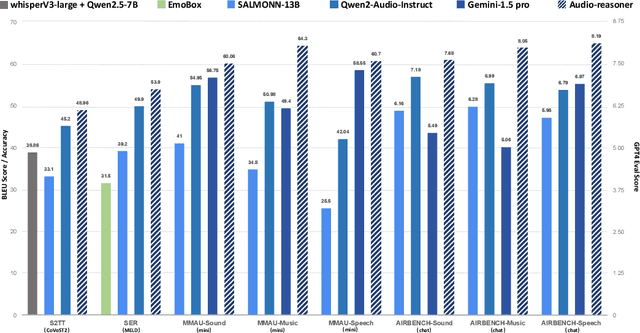
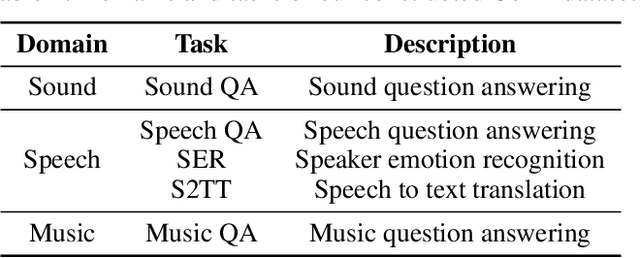
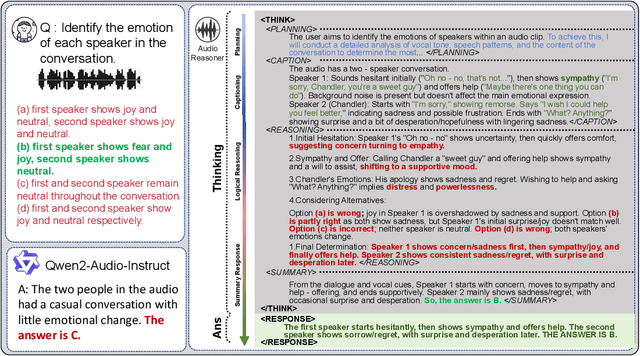
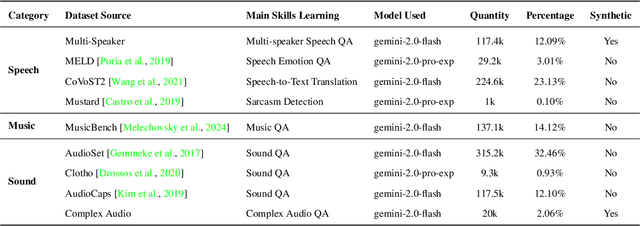
Recent advancements in multimodal reasoning have largely overlooked the audio modality. We introduce Audio-Reasoner, a large-scale audio language model for deep reasoning in audio tasks. We meticulously curated a large-scale and diverse multi-task audio dataset with simple annotations. Then, we leverage closed-source models to conduct secondary labeling, QA generation, along with structured COT process. These datasets together form a high-quality reasoning dataset with 1.2 million reasoning-rich samples, which we name CoTA. Following inference scaling principles, we train Audio-Reasoner on CoTA, enabling it to achieve great logical capabilities in audio reasoning. Experiments show state-of-the-art performance across key benchmarks, including MMAU-mini (+25.42%), AIR-Bench chat/foundation(+14.57%/+10.13%), and MELD (+8.01%). Our findings stress the core of structured CoT training in advancing audio reasoning.
Mini-Omni2: Towards Open-source GPT-4o with Vision, Speech and Duplex Capabilities
Oct 16, 2024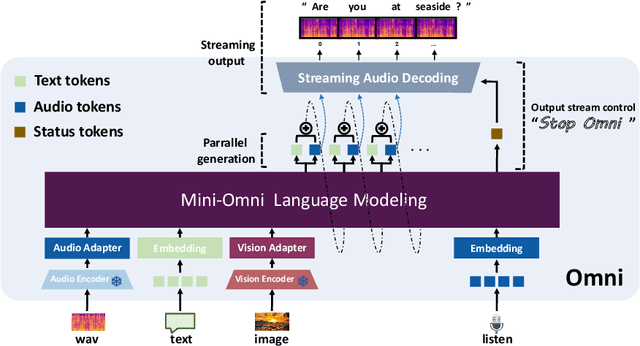
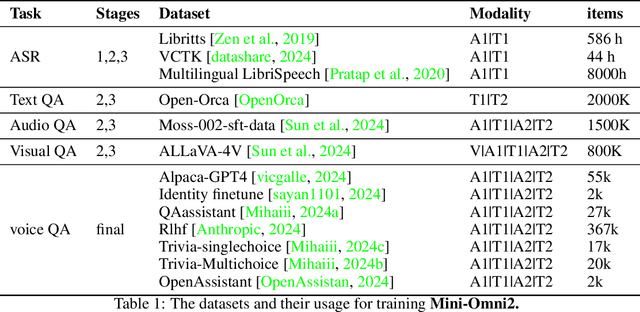
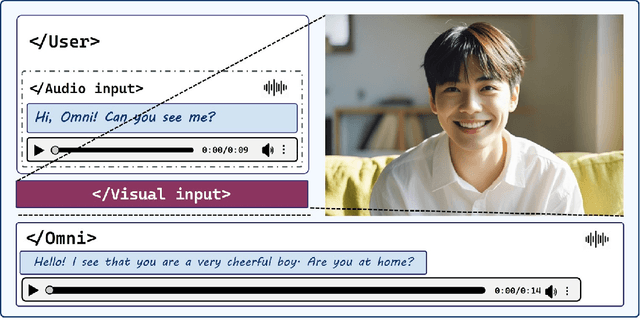
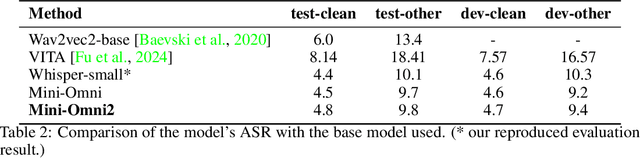
GPT-4o, an all-encompassing model, represents a milestone in the development of large multi-modal language models. It can understand visual, auditory, and textual modalities, directly output audio, and support flexible duplex interaction. Models from the open-source community often achieve some functionalities of GPT-4o, such as visual understanding and voice chat. Nevertheless, training a unified model that incorporates all modalities is challenging due to the complexities of multi-modal data, intricate model architectures, and training processes. In this paper, we introduce Mini-Omni2, a visual-audio assistant capable of providing real-time, end-to-end voice responses to visoin and audio queries. By integrating pretrained visual and auditory encoders, Mini-Omni2 maintains performance in individual modalities. We propose a three-stage training process to align modalities, allowing the language model to handle multi-modal inputs and outputs after training on a limited dataset. For interaction, we introduce a command-based interruption mechanism, enabling more flexible interaction with users. To the best of our knowledge, Mini-Omni2 is one of the closest reproductions of GPT-4o, which have similar form of functionality, and we hope it can offer valuable insights for subsequent research.
Mini-Omni2: Towards Open-source GPT-4o Model with Vision, Speech and Duplex
Oct 15, 2024GPT4o, an all-encompassing model, represents a milestone in the development of multi-modal large models. It can understand visual, auditory, and textual modalities, directly output audio, and support flexible duplex interaction. However, its technical framework is not open-sourced. Models from the open-source community often achieve some functionalities of GPT4o, such as visual understanding and voice dialogue. Nevertheless, training a unified model that incorporates all modalities is challenging due to the complexities of multi-modal data, intricate model architectures, and training processes. In this paper, we introduce Mini-Omni2, a visual-audio assistant capable of providing real-time, end-to-end voice responses to user video and voice queries, while also incorporating auditory capabilities. By integrating pretrained visual and auditory encoders, Mini-Omni2 maintains strong performance in individual modalities. We propose a three-stage training process to align modalities, allowing the language model to handle multi-modal inputs and outputs after training on a limited dataset. For interaction, we introduce a semantic-based interruption mechanism, enabling more flexible dialogues with users. All modeling approaches and data construction methods will be open-sourced. To the best of our knowledge, Mini-Omni2 is one of the models closest to GPT4o in functionality, and we hope it can offer valuable insights for subsequent research.
Mini-Omni: Language Models Can Hear, Talk While Thinking in Streaming
Aug 30, 2024Recent advances in language models have achieved significant progress. GPT-4o, as a new milestone, has enabled real-time conversations with humans, demonstrating near-human natural fluency. Such human-computer interaction necessitates models with the capability to perform reasoning directly with the audio modality and generate output in streaming. However, this remains beyond the reach of current academic models, as they typically depend on extra TTS systems for speech synthesis, resulting in undesirable latency. This paper introduces the Mini-Omni, an audio-based end-to-end conversational model, capable of real-time speech interaction. To achieve this capability, we propose a text-instructed speech generation method, along with batch-parallel strategies during inference to further boost the performance. Our method also helps to retain the original model's language capabilities with minimal degradation, enabling other works to establish real-time interaction capabilities. We call this training method "Any Model Can Talk". We also introduce the VoiceAssistant-400K dataset to fine-tune models optimized for speech output. To our best knowledge, Mini-Omni is the first fully end-to-end, open-source model for real-time speech interaction, offering valuable potential for future research.
DreamFactory: Pioneering Multi-Scene Long Video Generation with a Multi-Agent Framework
Aug 21, 2024Current video generation models excel at creating short, realistic clips, but struggle with longer, multi-scene videos. We introduce \texttt{DreamFactory}, an LLM-based framework that tackles this challenge. \texttt{DreamFactory} leverages multi-agent collaboration principles and a Key Frames Iteration Design Method to ensure consistency and style across long videos. It utilizes Chain of Thought (COT) to address uncertainties inherent in large language models. \texttt{DreamFactory} generates long, stylistically coherent, and complex videos. Evaluating these long-form videos presents a challenge. We propose novel metrics such as Cross-Scene Face Distance Score and Cross-Scene Style Consistency Score. To further research in this area, we contribute the Multi-Scene Videos Dataset containing over 150 human-rated videos.