 Add to Chrome
 Add to Firefox
 Add to Edge
Reversible Diffusion Decoding for Diffusion Language Models
Jan 29, 2026
Diffusion language models enable parallel token generation through block-wise decoding, but their irreversible commitments can lead to stagnation, where the reverse diffusion process fails to make further progress under a suboptimal context.We propose Reversible Diffusion Decoding (RDD), a decoding framework that introduces reversibility into block-wise diffusion generation. RDD detects stagnation as a state-dependent failure of the reverse process and enables efficient backtracking to earlier blocks without recomputation via cached model states. To avoid repeated failure trajectories, RDD applies confidence-guided re-masking to selectively reinitialize uncertain tokens while preserving reliable context.This reversible formulation allows decoding to recover from early commitment errors while maintaining the parallel efficiency of diffusion-based generation. Experiments show that RDD improves generation robustness and quality over baselines with minimal computational overhead.

From Generative Engines to Actionable Simulators: The Imperative of Physical Grounding in World Models
Jan 21, 2026A world model is an AI system that simulates how an environment evolves under actions, enabling planning through imagined futures rather than reactive perception. Current world models, however, suffer from visual conflation: the mistaken assumption that high-fidelity video generation implies an understanding of physical and causal dynamics. We show that while modern models excel at predicting pixels, they frequently violate invariant constraints, fail under intervention, and break down in safety-critical decision-making. This survey argues that visual realism is an unreliable proxy for world understanding. Instead, effective world models must encode causal structure, respect domain-specific constraints, and remain stable over long horizons. We propose a reframing of world models as actionable simulators rather than visual engines, emphasizing structured 4D interfaces, constraint-aware dynamics, and closed-loop evaluation. Using medical decision-making as an epistemic stress test, where trial-and-error is impossible and errors are irreversible, we demonstrate that a world model's value is determined not by how realistic its rollouts appear, but by its ability to support counterfactual reasoning, intervention planning, and robust long-horizon foresight.
Think Consistently, Reason Efficiently: Energy-Based Calibration for Implicit Chain-of-Thought
Nov 10, 2025Large Language Models (LLMs) have demonstrated strong reasoning capabilities through \emph{Chain-of-Thought} (CoT) prompting, which enables step-by-step intermediate reasoning. However, explicit CoT methods rely on discrete token-level reasoning processes that are prone to error propagation and limited by vocabulary expressiveness, often resulting in rigid and inconsistent reasoning trajectories. Recent research has explored implicit or continuous reasoning in latent spaces, allowing models to perform internal reasoning before generating explicit output. Although such approaches alleviate some limitations of discrete CoT, they generally lack explicit mechanisms to enforce consistency among reasoning steps, leading to divergent reasoning paths and unstable outcomes. To address this issue, we propose EBM-CoT, an Energy-Based Chain-of-Thought Calibration framework that refines latent thought representations through an energy-based model (EBM). Our method dynamically adjusts latent reasoning trajectories toward lower-energy, high-consistency regions in the embedding space, improving both reasoning accuracy and consistency without modifying the base language model. Extensive experiments across mathematical, commonsense, and symbolic reasoning benchmarks demonstrate that the proposed framework significantly enhances the consistency and efficiency of multi-step reasoning in LLMs.
Learning without Isolation: Pathway Protection for Continual Learning
May 24, 2025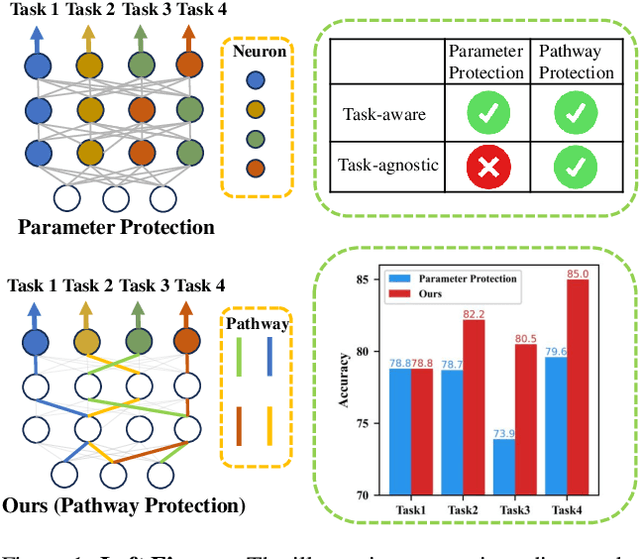
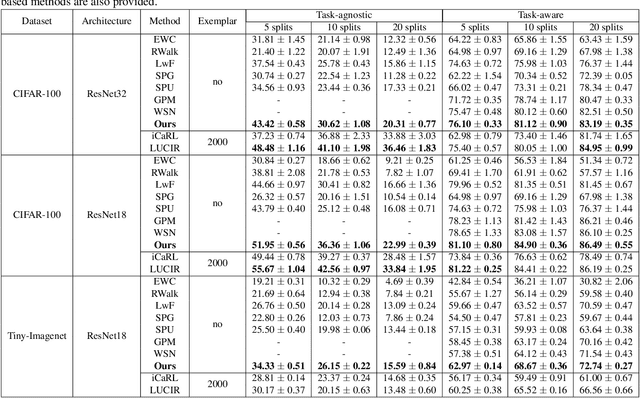
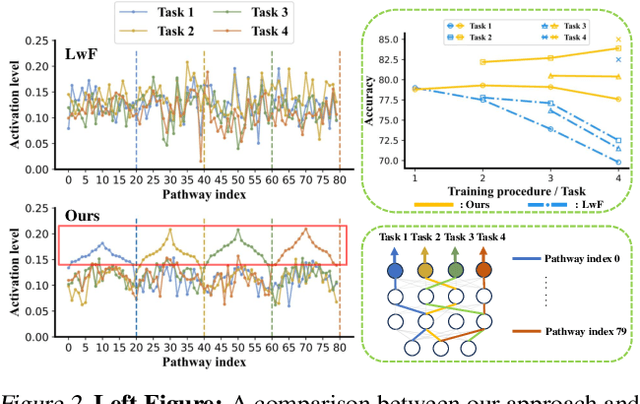
Deep networks are prone to catastrophic forgetting during sequential task learning, i.e., losing the knowledge about old tasks upon learning new tasks. To this end, continual learning(CL) has emerged, whose existing methods focus mostly on regulating or protecting the parameters associated with the previous tasks. However, parameter protection is often impractical, since the size of parameters for storing the old-task knowledge increases linearly with the number of tasks, otherwise it is hard to preserve the parameters related to the old-task knowledge. In this work, we bring a dual opinion from neuroscience and physics to CL: in the whole networks, the pathways matter more than the parameters when concerning the knowledge acquired from the old tasks. Following this opinion, we propose a novel CL framework, learning without isolation(LwI), where model fusion is formulated as graph matching and the pathways occupied by the old tasks are protected without being isolated. Thanks to the sparsity of activation channels in a deep network, LwI can adaptively allocate available pathways for a new task, realizing pathway protection and addressing catastrophic forgetting in a parameter-efficient manner. Experiments on popular benchmark datasets demonstrate the superiority of the proposed LwI.