 Add to Chrome
 Add to Firefox
 Add to Edge
VGGT-Edit: Feed-forward Native 3D Scene Editing with Residual Field Prediction
May 14, 2026
High-quality 3D scene reconstruction has recently advanced toward generalizable feed-forward architectures, enabling the generation of complex environments in a single forward pass. However, despite their strong performance in static scene perception, these models remain limited in responding to dynamic human instructions, which restricts their use in interactive applications. Existing editing methods typically rely on a 2D-lifting strategy, where individual views are edited independently and then lifted back into 3D space. This indirect pipeline often leads to blurry textures and inconsistent geometry, as 2D editors lack the spatial awareness required to preserve structure across viewpoints. To address these limitations, we propose VGGT-Edit, a feed-forward framework for text-conditioned native 3D scene editing. VGGT-Edit introduces depth-synchronized text injection to align semantic guidance with the backbone's spatial poses, ensuring stable instruction grounding. This semantic signal is then processed by a residual transformation head, which directly predicts 3D geometric displacements to deform the scene while preserving background stability. To ensure high-fidelity results, we supervise the framework with a multi-term objective function that enforces geometric accuracy and cross-view consistency. We also construct the DeltaScene Dataset, a large-scale dataset generated through an automated pipeline with 3D agreement filtering to ensure ground-truth quality. Experiments show that VGGT-Edit substantially outperforms 2D-lifting baselines, producing sharper object details, stronger multi-view consistency, and near-instant inference speed.

OpenWorldLib: A Unified Codebase and Definition of Advanced World Models
Apr 06, 2026World models have garnered significant attention as a promising research direction in artificial intelligence, yet a clear and unified definition remains lacking. In this paper, we introduce OpenWorldLib, a comprehensive and standardized inference framework for Advanced World Models. Drawing on the evolution of world models, we propose a clear definition: a world model is a model or framework centered on perception, equipped with interaction and long-term memory capabilities, for understanding and predicting the complex world. We further systematically categorize the essential capabilities of world models. Based on this definition, OpenWorldLib integrates models across different tasks within a unified framework, enabling efficient reuse and collaborative inference. Finally, we present additional reflections and analyses on potential future directions for world model research. Code link: https://github.com/OpenDCAI/OpenWorldLib
Research on World Models Is Not Merely Injecting World Knowledge into Specific Tasks
Feb 02, 2026World models have emerged as a critical frontier in AI research, aiming to enhance large models by infusing them with physical dynamics and world knowledge. The core objective is to enable agents to understand, predict, and interact with complex environments. However, current research landscape remains fragmented, with approaches predominantly focused on injecting world knowledge into isolated tasks, such as visual prediction, 3D estimation, or symbol grounding, rather than establishing a unified definition or framework. While these task-specific integrations yield performance gains, they often lack the systematic coherence required for holistic world understanding. In this paper, we analyze the limitations of such fragmented approaches and propose a unified design specification for world models. We suggest that a robust world model should not be a loose collection of capabilities but a normative framework that integrally incorporates interaction, perception, symbolic reasoning, and spatial representation. This work aims to provide a structured perspective to guide future research toward more general, robust, and principled models of the world.
Are We Ready for RL in Text-to-3D Generation? A Progressive Investigation
Dec 11, 2025Reinforcement learning (RL), earlier proven to be effective in large language and multi-modal models, has been successfully extended to enhance 2D image generation recently. However, applying RL to 3D generation remains largely unexplored due to the higher spatial complexity of 3D objects, which require globally consistent geometry and fine-grained local textures. This makes 3D generation significantly sensitive to reward designs and RL algorithms. To address these challenges, we conduct the first systematic study of RL for text-to-3D autoregressive generation across several dimensions. (1) Reward designs: We evaluate reward dimensions and model choices, showing that alignment with human preference is crucial, and that general multi-modal models provide robust signal for 3D attributes. (2) RL algorithms: We study GRPO variants, highlighting the effectiveness of token-level optimization, and further investigate the scaling of training data and iterations. (3) Text-to-3D Benchmarks: Since existing benchmarks fail to measure implicit reasoning abilities in 3D generation models, we introduce MME-3DR. (4) Advanced RL paradigms: Motivated by the natural hierarchy of 3D generation, we propose Hi-GRPO, which optimizes the global-to-local hierarchical 3D generation through dedicated reward ensembles. Based on these insights, we develop AR3D-R1, the first RL-enhanced text-to-3D model, expert from coarse shape to texture refinement. We hope this study provides insights into RL-driven reasoning for 3D generation. Code is released at https://github.com/Ivan-Tang-3D/3DGen-R1.
WideRange4D: Enabling High-Quality 4D Reconstruction with Wide-Range Movements and Scenes
Mar 17, 2025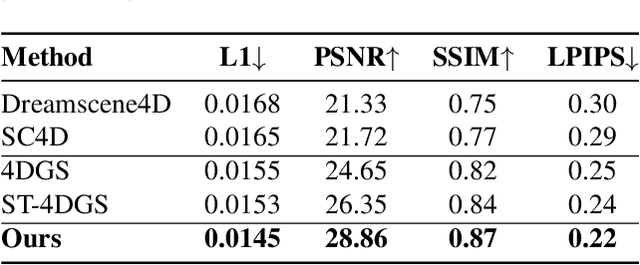
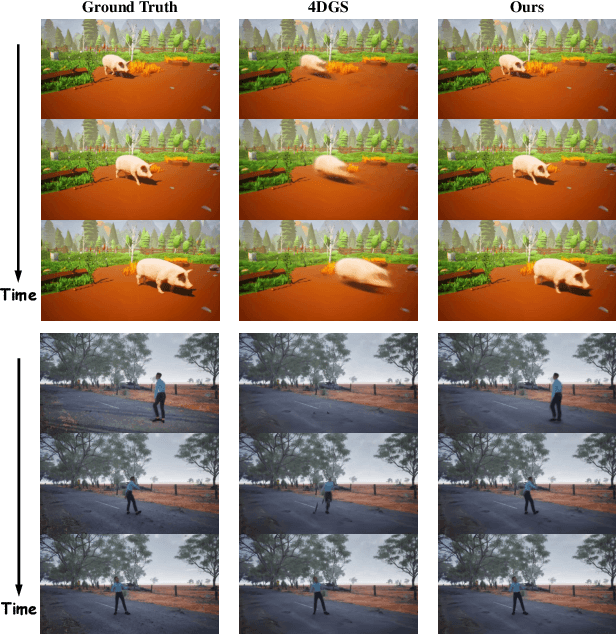
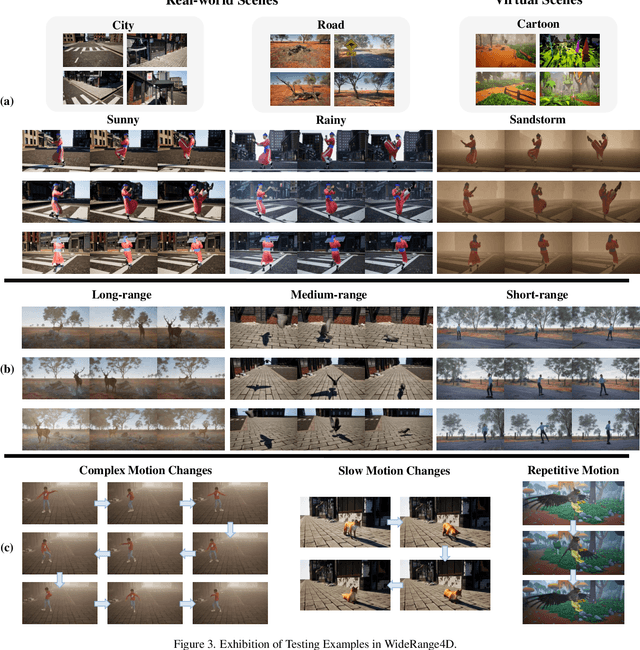
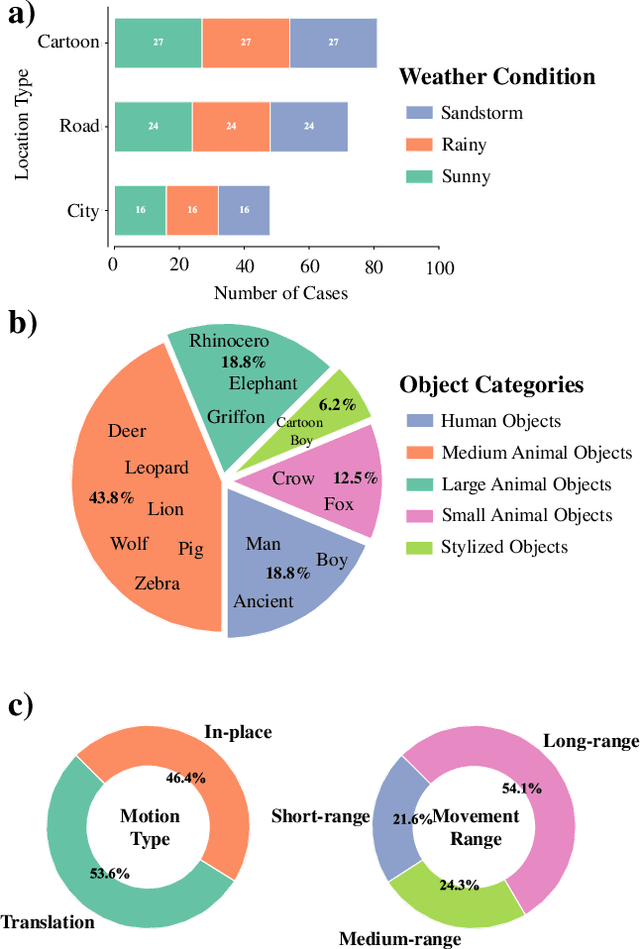
With the rapid development of 3D reconstruction technology, research in 4D reconstruction is also advancing, existing 4D reconstruction methods can generate high-quality 4D scenes. However, due to the challenges in acquiring multi-view video data, the current 4D reconstruction benchmarks mainly display actions performed in place, such as dancing, within limited scenarios. In practical scenarios, many scenes involve wide-range spatial movements, highlighting the limitations of existing 4D reconstruction datasets. Additionally, existing 4D reconstruction methods rely on deformation fields to estimate the dynamics of 3D objects, but deformation fields struggle with wide-range spatial movements, which limits the ability to achieve high-quality 4D scene reconstruction with wide-range spatial movements. In this paper, we focus on 4D scene reconstruction with significant object spatial movements and propose a novel 4D reconstruction benchmark, WideRange4D. This benchmark includes rich 4D scene data with large spatial variations, allowing for a more comprehensive evaluation of the generation capabilities of 4D generation methods. Furthermore, we introduce a new 4D reconstruction method, Progress4D, which generates stable and high-quality 4D results across various complex 4D scene reconstruction tasks. We conduct both quantitative and qualitative comparison experiments on WideRange4D, showing that our Progress4D outperforms existing state-of-the-art 4D reconstruction methods. Project: https://github.com/Gen-Verse/WideRange4D
Trans4D: Realistic Geometry-Aware Transition for Compositional Text-to-4D Synthesis
Oct 09, 2024Recent advances in diffusion models have demonstrated exceptional capabilities in image and video generation, further improving the effectiveness of 4D synthesis. Existing 4D generation methods can generate high-quality 4D objects or scenes based on user-friendly conditions, benefiting the gaming and video industries. However, these methods struggle to synthesize significant object deformation of complex 4D transitions and interactions within scenes. To address this challenge, we propose Trans4D, a novel text-to-4D synthesis framework that enables realistic complex scene transitions. Specifically, we first use multi-modal large language models (MLLMs) to produce a physic-aware scene description for 4D scene initialization and effective transition timing planning. Then we propose a geometry-aware 4D transition network to realize a complex scene-level 4D transition based on the plan, which involves expressive geometrical object deformation. Extensive experiments demonstrate that Trans4D consistently outperforms existing state-of-the-art methods in generating 4D scenes with accurate and high-quality transitions, validating its effectiveness. Code: https://github.com/YangLing0818/Trans4D