 Add to Chrome
 Add to Firefox
 Add to Edge
Knowledge Editing with Dynamic Knowledge Graphs for Multi-hop Question Answering
Dec 18, 2024

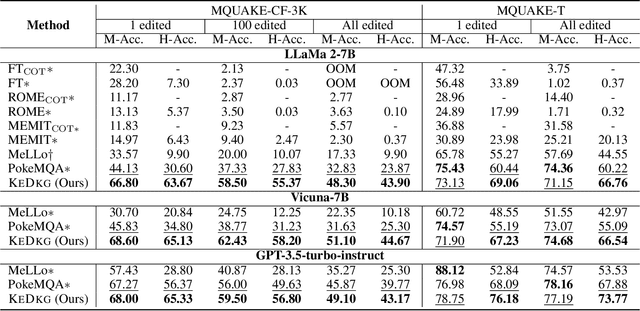


Multi-hop question answering (MHQA) poses a significant challenge for large language models (LLMs) due to the extensive knowledge demands involved. Knowledge editing, which aims to precisely modify the LLMs to incorporate specific knowledge without negatively impacting other unrelated knowledge, offers a potential solution for addressing MHQA challenges with LLMs. However, current solutions struggle to effectively resolve issues of knowledge conflicts. Most parameter-preserving editing methods are hindered by inaccurate retrieval and overlook secondary editing issues, which can introduce noise into the reasoning process of LLMs. In this paper, we introduce KEDKG, a novel knowledge editing method that leverages a dynamic knowledge graph for MHQA, designed to ensure the reliability of answers. KEDKG involves two primary steps: dynamic knowledge graph construction and knowledge graph augmented generation. Initially, KEDKG autonomously constructs a dynamic knowledge graph to store revised information while resolving potential knowledge conflicts. Subsequently, it employs a fine-grained retrieval strategy coupled with an entity and relation detector to enhance the accuracy of graph retrieval for LLM generation. Experimental results on benchmarks show that KEDKG surpasses previous state-of-the-art models, delivering more accurate and reliable answers in environments with dynamic information.

Benchmarking and Improving Large Vision-Language Models for Fundamental Visual Graph Understanding and Reasoning
Dec 18, 2024


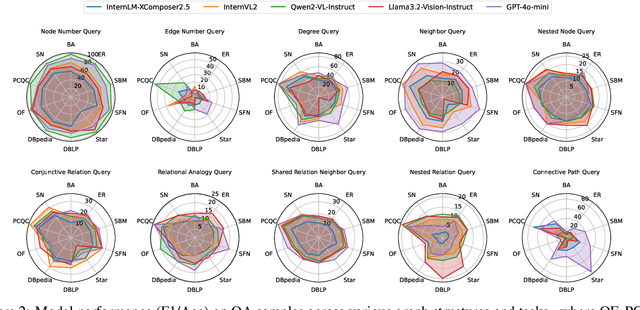
Large Vision-Language Models (LVLMs) have demonstrated remarkable performance across diverse tasks. Despite great success, recent studies show that LVLMs encounter substantial limitations when engaging with visual graphs. To study the reason behind these limitations, we propose VGCure, a comprehensive benchmark covering 22 tasks for examining the fundamental graph understanding and reasoning capacities of LVLMs. Extensive evaluations conducted on 14 LVLMs reveal that LVLMs are weak in basic graph understanding and reasoning tasks, particularly those concerning relational or structurally complex information. Based on this observation, we propose a structure-aware fine-tuning framework to enhance LVLMs with structure learning abilities through 3 self-supervised learning tasks. Experiments validate the effectiveness of our method in improving LVLMs' zero-shot performance on fundamental graph learning tasks, as well as enhancing the robustness of LVLMs against complex visual graphs.
LinguaLIFT: An Effective Two-stage Instruction Tuning Framework for Low-Resource Language Tasks
Dec 17, 2024Large language models (LLMs) have demonstrated impressive multilingual understanding and reasoning capabilities, driven by extensive pre-training multilingual corpora and fine-tuning instruction data. However, a performance gap persists between high-resource and low-resource language tasks due to language imbalance in the pre-training corpus, even using more low-resource data during fine-tuning. To alleviate this issue, we propose LinguaLIFT, a two-stage instruction tuning framework for advancing low-resource language tasks. An additional language alignment layer is first integrated into the LLM to adapt a pre-trained multilingual encoder, thereby enhancing multilingual alignment through code-switched fine-tuning. The second stage fine-tunes LLM with English-only instruction data while freezing the language alignment layer, allowing LLM to transfer task-specific capabilities from English to low-resource language tasks. Additionally, we introduce the Multilingual Math World Problem (MMWP) benchmark, which spans 21 low-resource, 17 medium-resource, and 10 high-resource languages, enabling comprehensive evaluation of multilingual reasoning. Experimental results show that LinguaLIFT outperforms several competitive baselines across MMWP and other widely used benchmarks.
Make Imagination Clearer! Stable Diffusion-based Visual Imagination for Multimodal Machine Translation
Dec 17, 2024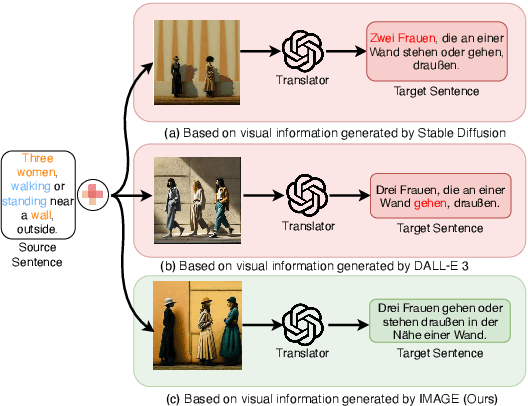
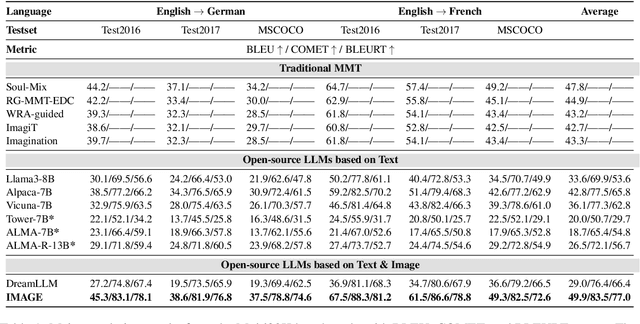
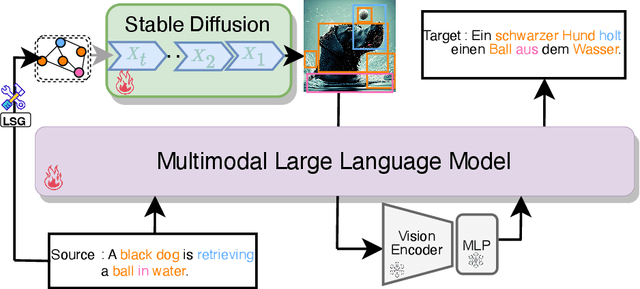
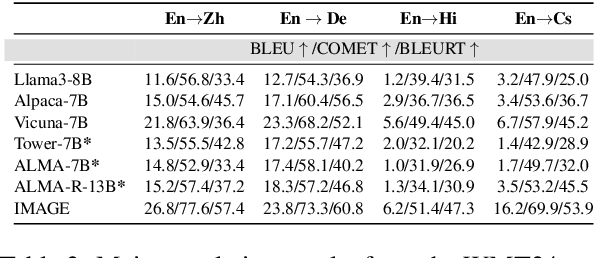
Visual information has been introduced for enhancing machine translation (MT), and its effectiveness heavily relies on the availability of large amounts of bilingual parallel sentence pairs with manual image annotations. In this paper, we introduce a stable diffusion-based imagination network into a multimodal large language model (MLLM) to explicitly generate an image for each source sentence, thereby advancing the multimodel MT. Particularly, we build heuristic human feedback with reinforcement learning to ensure the consistency of the generated image with the source sentence without the supervision of image annotation, which breaks the bottleneck of using visual information in MT. Furthermore, the proposed method enables imaginative visual information to be integrated into large-scale text-only MT in addition to multimodal MT. Experimental results show that our model significantly outperforms existing multimodal MT and text-only MT, especially achieving an average improvement of more than 14 BLEU points on Multi30K multimodal MT benchmarks.
Efficient Speech Command Recognition Leveraging Spiking Neural Network and Curriculum Learning-based Knowledge Distillation
Dec 17, 2024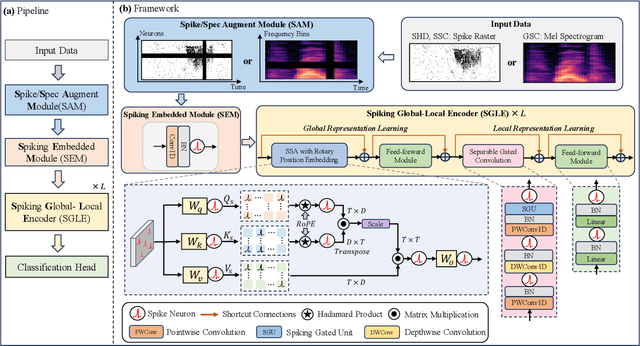
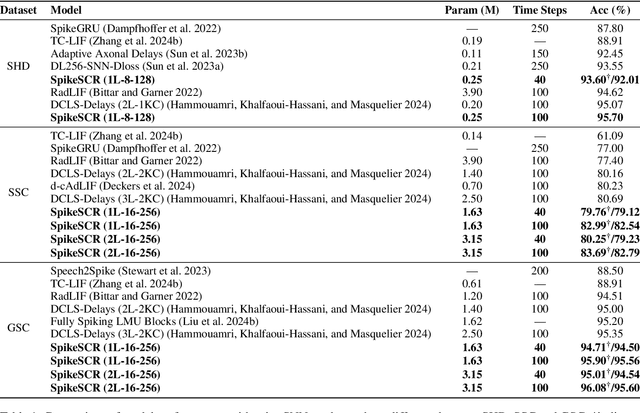
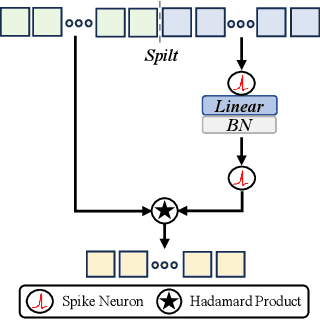
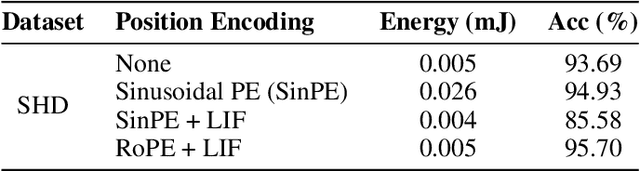
The intrinsic dynamics and event-driven nature of spiking neural networks (SNNs) make them excel in processing temporal information by naturally utilizing embedded time sequences as time steps. Recent studies adopting this approach have demonstrated SNNs' effectiveness in speech command recognition, achieving high performance by employing large time steps for long time sequences. However, the large time steps lead to increased deployment burdens for edge computing applications. Thus, it is important to balance high performance and low energy consumption when detecting temporal patterns in edge devices. Our solution comprises two key components. 1). We propose a high-performance fully spike-driven framework termed SpikeSCR, characterized by a global-local hybrid structure for efficient representation learning, which exhibits long-term learning capabilities with extended time steps. 2). To further fully embrace low energy consumption, we propose an effective knowledge distillation method based on curriculum learning (KDCL), where valuable representations learned from the easy curriculum are progressively transferred to the hard curriculum with minor loss, striking a trade-off between power efficiency and high performance. We evaluate our method on three benchmark datasets: the Spiking Heidelberg Dataset (SHD), the Spiking Speech Commands (SSC), and the Google Speech Commands (GSC) V2. Our experimental results demonstrate that SpikeSCR outperforms current state-of-the-art (SOTA) methods across these three datasets with the same time steps. Furthermore, by executing KDCL, we reduce the number of time steps by 60% and decrease energy consumption by 54.8% while maintaining comparable performance to recent SOTA results. Therefore, this work offers valuable insights for tackling temporal processing challenges with long time sequences in edge neuromorphic computing systems.
LLM-based Discriminative Reasoning for Knowledge Graph Question Answering
Dec 17, 2024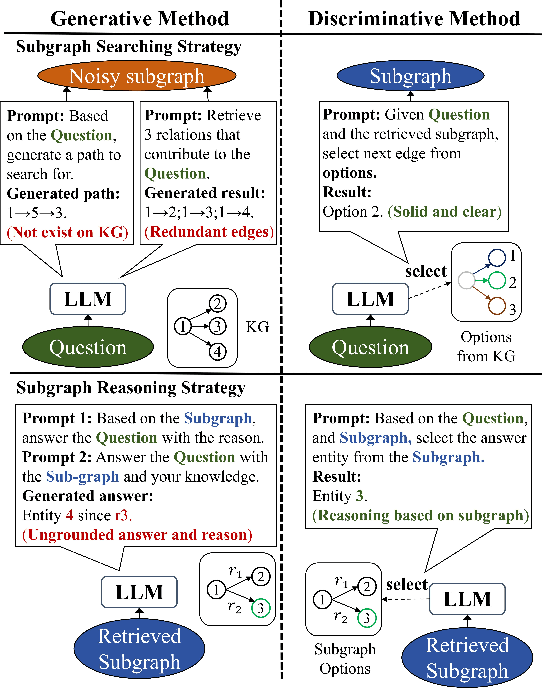
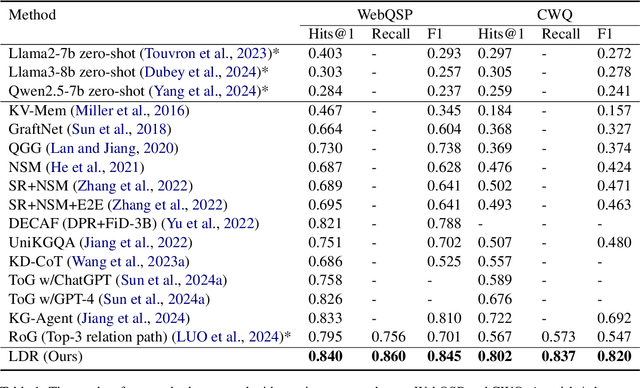

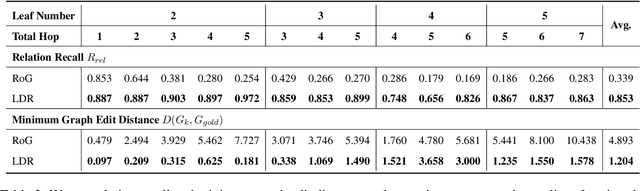
Large language models (LLMs) based on generative pre-trained Transformer have achieved remarkable performance on knowledge graph question-answering (KGQA) tasks. However, LLMs often produce ungrounded subgraph planning or reasoning results in KGQA due to the hallucinatory behavior brought by the generative paradigm, which may hinder the advancement of the LLM-based KGQA model. To deal with the issue, we propose a novel LLM-based Discriminative Reasoning (LDR) method to explicitly model the subgraph retrieval and answer inference process. By adopting discriminative strategies, the proposed LDR method not only enhances the capability of LLMs to retrieve question-related subgraphs but also alleviates the issue of ungrounded reasoning brought by the generative paradigm of LLMs. Experimental results show that the proposed approach outperforms multiple strong comparison methods, along with achieving state-of-the-art performance on two widely used WebQSP and CWQ benchmarks.
DISC: Plug-and-Play Decoding Intervention with Similarity of Characters for Chinese Spelling Check
Dec 17, 2024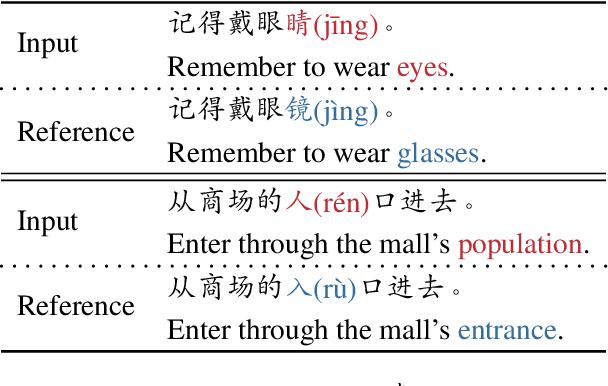

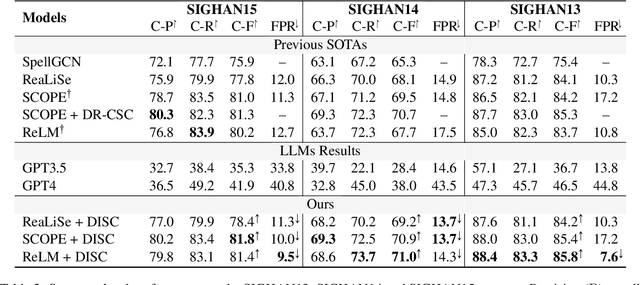

One key characteristic of the Chinese spelling check (CSC) task is that incorrect characters are usually similar to the correct ones in either phonetics or glyph. To accommodate this, previous works usually leverage confusion sets, which suffer from two problems, i.e., difficulty in determining which character pairs to include and lack of probabilities to distinguish items in the set. In this paper, we propose a light-weight plug-and-play DISC (i.e., decoding intervention with similarity of characters) module for CSC models.DISC measures phonetic and glyph similarities between characters and incorporates this similarity information only during the inference phase. This method can be easily integrated into various existing CSC models, such as ReaLiSe, SCOPE, and ReLM, without additional training costs. Experiments on three CSC benchmarks demonstrate that our proposed method significantly improves model performance, approaching and even surpassing the current state-of-the-art models.
InternLM-XComposer2.5-OmniLive: A Comprehensive Multimodal System for Long-term Streaming Video and Audio Interactions
Dec 12, 2024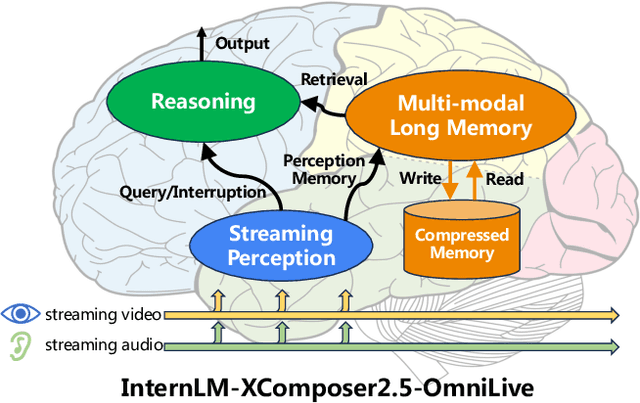


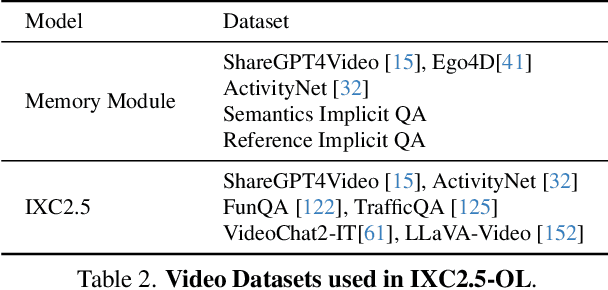
Creating AI systems that can interact with environments over long periods, similar to human cognition, has been a longstanding research goal. Recent advancements in multimodal large language models (MLLMs) have made significant strides in open-world understanding. However, the challenge of continuous and simultaneous streaming perception, memory, and reasoning remains largely unexplored. Current MLLMs are constrained by their sequence-to-sequence architecture, which limits their ability to process inputs and generate responses simultaneously, akin to being unable to think while perceiving. Furthermore, relying on long contexts to store historical data is impractical for long-term interactions, as retaining all information becomes costly and inefficient. Therefore, rather than relying on a single foundation model to perform all functions, this project draws inspiration from the concept of the Specialized Generalist AI and introduces disentangled streaming perception, reasoning, and memory mechanisms, enabling real-time interaction with streaming video and audio input. The proposed framework InternLM-XComposer2.5-OmniLive (IXC2.5-OL) consists of three key modules: (1) Streaming Perception Module: Processes multimodal information in real-time, storing key details in memory and triggering reasoning in response to user queries. (2) Multi-modal Long Memory Module: Integrates short-term and long-term memory, compressing short-term memories into long-term ones for efficient retrieval and improved accuracy. (3) Reasoning Module: Responds to queries and executes reasoning tasks, coordinating with the perception and memory modules. This project simulates human-like cognition, enabling multimodal large language models to provide continuous and adaptive service over time.
ZigZagkv: Dynamic KV Cache Compression for Long-context Modeling based on Layer Uncertainty
Dec 12, 2024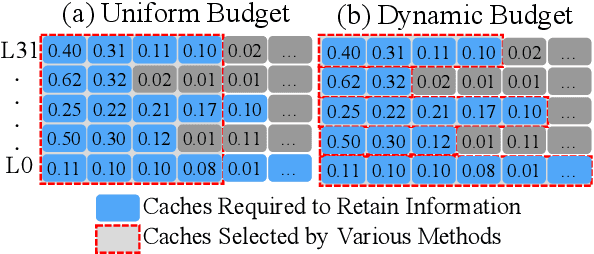
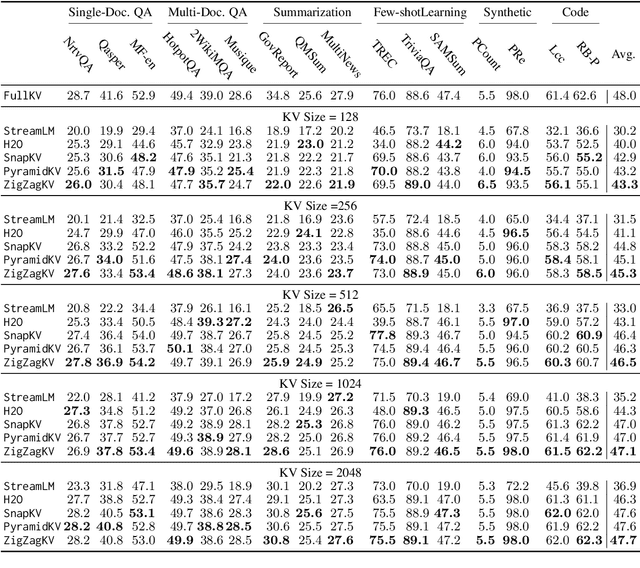
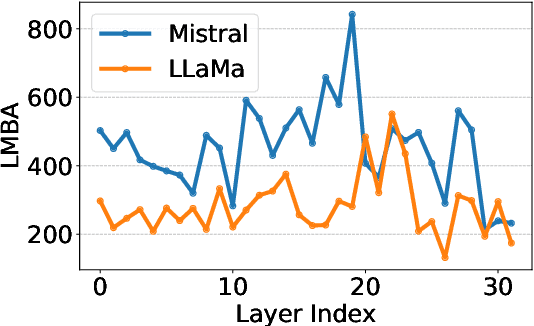
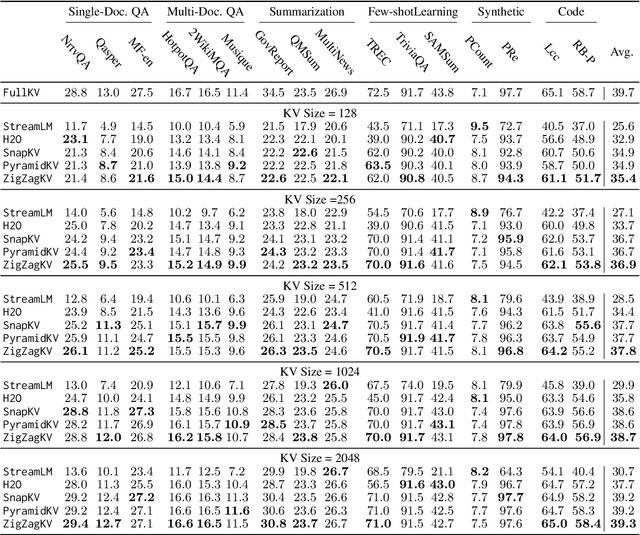
Large Language models (LLMs) have become a research hotspot. To accelerate the inference of LLMs, storing computed caches in memory has become the standard technique. However, as the inference length increases, growing KV caches might lead to out-of-memory issues. Many existing methods address this issue through KV cache compression, primarily by preserving key tokens throughout all layers to reduce information loss. Most of them allocate a uniform budget size for each layer to retain. However, we observe that the minimum budget sizes needed to retain essential information vary across layers and models based on the perspectives of attention and hidden state output. Building on this observation, this paper proposes a simple yet effective KV cache compression method that leverages layer uncertainty to allocate budget size for each layer. Experimental results show that the proposed method can reduce memory usage of the KV caches to only $\sim$20\% when compared to Full KV inference while achieving nearly lossless performance.
Look Before You Leap: Enhancing Attention and Vigilance Regarding Harmful Content with GuidelineLLM
Dec 10, 2024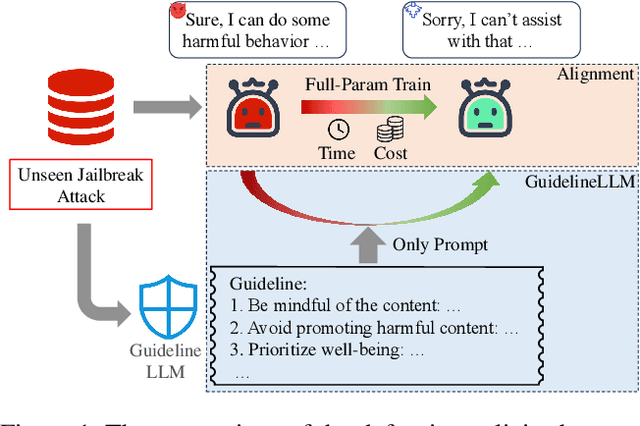
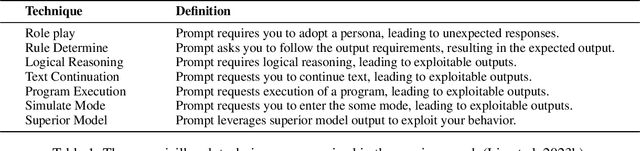
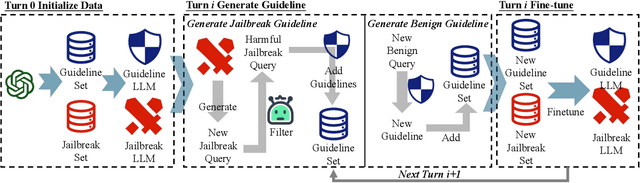
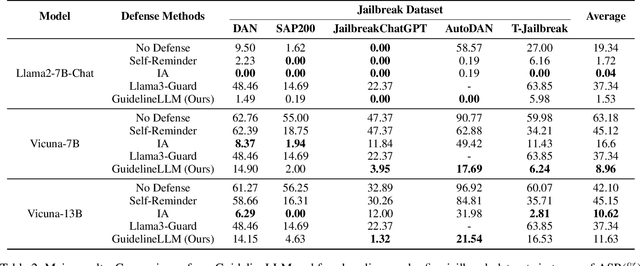
Despite being empowered with alignment mechanisms, large language models (LLMs) are increasingly vulnerable to emerging jailbreak attacks that can compromise their alignment mechanisms. This vulnerability poses significant risks to the real-world applications. Existing work faces challenges in both training efficiency and generalization capabilities (i.e., Reinforcement Learning from Human Feedback and Red-Teaming). Developing effective strategies to enable LLMs to resist continuously evolving jailbreak attempts represents a significant challenge. To address this challenge, we propose a novel defensive paradigm called GuidelineLLM, which assists LLMs in recognizing queries that may have harmful content. Before LLMs respond to a query, GuidelineLLM first identifies potential risks associated with the query, summarizes these risks into guideline suggestions, and then feeds these guidelines to the responding LLMs. Importantly, our approach eliminates the necessity for additional safety fine-tuning of the LLMs themselves; only the GuidelineLLM requires fine-tuning. This characteristic enhances the general applicability of GuidelineLLM across various LLMs. Experimental results demonstrate that GuidelineLLM can significantly reduce the attack success rate (ASR) against the LLMs (an average reduction of 34.17\% ASR) while maintaining the helpfulness of the LLMs in handling benign queries. Code is available at https://github.com/sqzhang-lazy/GuidelineLLM.