 Add to Chrome
 Add to Firefox
 Add to Edge
Brain-Atlas-Guided Generative Counterfactual Attention for Explainable Cognitive Decline Diagnosis Using Multimodal Connectomes
May 31, 2026
Mild cognitive impairment (MCI) and subjective cognitive decline (SCD) are closely associated with the early Alzheimer's disease continuum, where accurate and explainable diagnosis is important for early risk assessment and intervention. Existing connectome-based deep learning models can improve classification performance but often provide limited insight into disease-related functional and structural connectivity changes. This paper proposes an atlas-knowledge-guided Generative Counterfactual Attention-guided Network (GCAN) for explainable cognitive decline diagnosis using multimodal brain connectomes. GCAN formulates diagnosis as a source-to-target counterfactual generation problem, where target-label connectomes are generated from source-label inputs and their differences are used to construct counterfactual attention maps. To preserve connectome topology, an Atlas-aware Bidirectional Transformer (AABT) performs network-level token encoding and decoding under brain-atlas constraints. The framework is further extended from functional connectivity (FC) to joint functional and structural connectivity (SC) modeling, enabling counterfactual analysis of complementary functional reorganization and structural topology changes. Experiments on hospital-collected and ADNI datasets show that GCAN achieves competitive performance across HC vs. SCD, HC vs. MCI, and SCD vs. MCI classification tasks. Visualization, circular connectome analysis, CAM-based comparison, ablation studies, and confidence interval analysis further support the interpretability and reliability of the proposed framework. Modality-specific FC and SC pre-trained classifiers are used to provide target-state priors for counterfactual generation while being separated from the downstream diagnostic classifier to prevent data leakage.

MASPO: Joint Prompt Optimization for LLM-based Multi-Agent Systems
May 07, 2026Large language model (LLM)-based Multi-agent systems (MAS) have shown promise in tackling complex collaborative tasks, where agents are typically orchestrated via role-specific prompts. While the quality of these prompts is pivotal, jointly optimizing them across interacting agents remains a non-trivial challenge, primarily due to the misalignment between local agent objectives and holistic system goals. To address this, we introduce MASPO, a novel framework designed to automatically and iteratively refine prompts across the entire system. A core innovation of MASPO is its joint evaluation mechanism, which assesses prompts not merely by their local validity, but by their capacity to facilitate downstream success for successor agents. This effectively bridges the gap between local interactions and global outcomes without relying on ground-truth labels. Furthermore, MASPO employs a data-driven evolutionary beam search to efficiently navigate the high-dimensional prompt space. Extensive empirical evaluations across 6 diverse tasks demonstrate that MASPO consistently outperforms state-of-the-art prompt optimization methods, achieving an average accuracy improvement of 2.9. We release our code at https://github.com/wangzx1219/MASPO.
RSHallu: Dual-Mode Hallucination Evaluation for Remote-Sensing Multimodal Large Language Models with Domain-Tailored Mitigation
Feb 11, 2026Multimodal large language models (MLLMs) are increasingly adopted in remote sensing (RS) and have shown strong performance on tasks such as RS visual grounding (RSVG), RS visual question answering (RSVQA), and multimodal dialogue. However, hallucinations, which are responses inconsistent with the input RS images, severely hinder their deployment in high-stakes scenarios (e.g., emergency management and agricultural monitoring) and remain under-explored in RS. In this work, we present RSHallu, a systematic study with three deliverables: (1) we formalize RS hallucinations with an RS-oriented taxonomy and introduce image-level hallucination to capture RS-specific inconsistencies beyond object-centric errors (e.g., modality, resolution, and scene-level semantics); (2) we build a hallucination benchmark RSHalluEval (2,023 QA pairs) and enable dual-mode checking, supporting high-precision cloud auditing and low-cost reproducible local checking via a compact checker fine-tuned on RSHalluCheck dataset (15,396 QA pairs); and (3) we introduce a domain-tailored dataset RSHalluShield (30k QA pairs) for training-friendly mitigation and further propose training-free plug-and-play strategies, including decoding-time logit correction and RS-aware prompting. Across representative RS-MLLMs, our mitigation improves the hallucination-free rate by up to 21.63 percentage points under a unified protocol, while maintaining competitive performance on downstream RS tasks (RSVQA/RSVG). Code and datasets will be released.
BrainCSD: A Hierarchical Consistency-Driven MoE Foundation Model for Unified Connectome Synthesis and Multitask Brain Trait Prediction
Nov 07, 2025Functional and structural connectivity (FC/SC) are key multimodal biomarkers for brain analysis, yet their clinical utility is hindered by costly acquisition, complex preprocessing, and frequent missing modalities. Existing foundation models either process single modalities or lack explicit mechanisms for cross-modal and cross-scale consistency. We propose BrainCSD, a hierarchical mixture-of-experts (MoE) foundation model that jointly synthesizes FC/SC biomarkers and supports downstream decoding tasks (diagnosis and prediction). BrainCSD features three neuroanatomically grounded components: (1) a ROI-specific MoE that aligns regional activations from canonical networks (e.g., DMN, FPN) with a global atlas via contrastive consistency; (2) a Encoding-Activation MOE that models dynamic cross-time/gradient dependencies in fMRI/dMRI; and (3) a network-aware refinement MoE that enforces structural priors and symmetry at individual and population levels. Evaluated on the datasets under complete and missing-modality settings, BrainCSD achieves SOTA results: 95.6\% accuracy for MCI vs. CN classification without FC, low synthesis error (FC RMSE: 0.038; SC RMSE: 0.006), brain age prediction (MAE: 4.04 years), and MMSE score estimation (MAE: 1.72 points). Code is available in \href{https://github.com/SXR3015/BrainCSD}{BrainCSD}
Pattern-Aware Diffusion Synthesis of fMRI/dMRI with Tissue and Microstructural Refinement
Nov 07, 2025Magnetic resonance imaging (MRI), especially functional MRI (fMRI) and diffusion MRI (dMRI), is essential for studying neurodegenerative diseases. However, missing modalities pose a major barrier to their clinical use. Although GAN- and diffusion model-based approaches have shown some promise in modality completion, they remain limited in fMRI-dMRI synthesis due to (1) significant BOLD vs. diffusion-weighted signal differences between fMRI and dMRI in time/gradient axis, and (2) inadequate integration of disease-related neuroanatomical patterns during generation. To address these challenges, we propose PDS, introducing two key innovations: (1) a pattern-aware dual-modal 3D diffusion framework for cross-modality learning, and (2) a tissue refinement network integrated with a efficient microstructure refinement to maintain structural fidelity and fine details. Evaluated on OASIS-3, ADNI, and in-house datasets, our method achieves state-of-the-art results, with PSNR/SSIM scores of 29.83 dB/90.84\% for fMRI synthesis (+1.54 dB/+4.12\% over baselines) and 30.00 dB/77.55\% for dMRI synthesis (+1.02 dB/+2.2\%). In clinical validation, the synthesized data show strong diagnostic performance, achieving 67.92\%/66.02\%/64.15\% accuracy (NC vs. MCI vs. AD) in hybrid real-synthetic experiments. Code is available in \href{https://github.com/SXR3015/PDS}{PDS GitHub Repository}
S$^2$M-Former: Spiking Symmetric Mixing Branchformer for Brain Auditory Attention Detection
Aug 07, 2025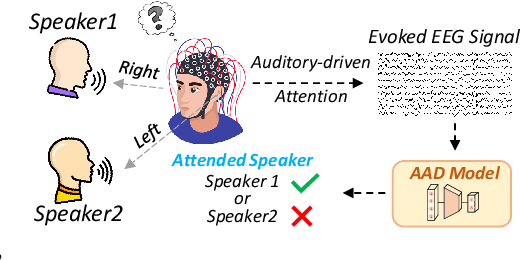

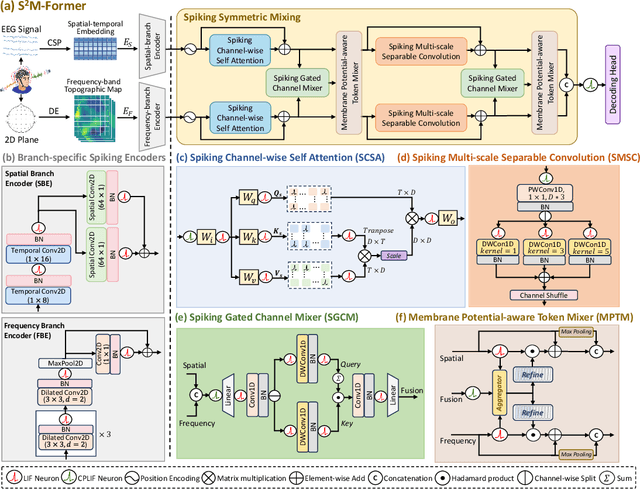
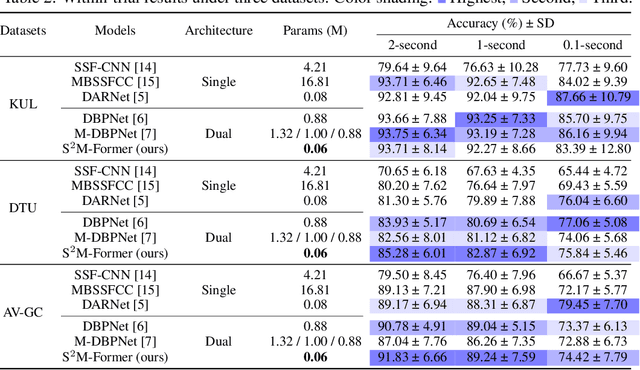
Auditory attention detection (AAD) aims to decode listeners' focus in complex auditory environments from electroencephalography (EEG) recordings, which is crucial for developing neuro-steered hearing devices. Despite recent advancements, EEG-based AAD remains hindered by the absence of synergistic frameworks that can fully leverage complementary EEG features under energy-efficiency constraints. We propose S$^2$M-Former, a novel spiking symmetric mixing framework to address this limitation through two key innovations: i) Presenting a spike-driven symmetric architecture composed of parallel spatial and frequency branches with mirrored modular design, leveraging biologically plausible token-channel mixers to enhance complementary learning across branches; ii) Introducing lightweight 1D token sequences to replace conventional 3D operations, reducing parameters by 14.7$\times$. The brain-inspired spiking architecture further reduces power consumption, achieving a 5.8$\times$ energy reduction compared to recent ANN methods, while also surpassing existing SNN baselines in terms of parameter efficiency and performance. Comprehensive experiments on three AAD benchmarks (KUL, DTU and AV-GC-AAD) across three settings (within-trial, cross-trial and cross-subject) demonstrate that S$^2$M-Former achieves comparable state-of-the-art (SOTA) decoding accuracy, making it a promising low-power, high-performance solution for AAD tasks.
AQuilt: Weaving Logic and Self-Inspection into Low-Cost, High-Relevance Data Synthesis for Specialist LLMs
Jul 24, 2025Despite the impressive performance of large language models (LLMs) in general domains, they often underperform in specialized domains. Existing approaches typically rely on data synthesis methods and yield promising results by using unlabeled data to capture domain-specific features. However, these methods either incur high computational costs or suffer from performance limitations, while also demonstrating insufficient generalization across different tasks. To address these challenges, we propose AQuilt, a framework for constructing instruction-tuning data for any specialized domains from corresponding unlabeled data, including Answer, Question, Unlabeled data, Inspection, Logic, and Task type. By incorporating logic and inspection, we encourage reasoning processes and self-inspection to enhance model performance. Moreover, customizable task instructions enable high-quality data generation for any task. As a result, we construct a dataset of 703k examples to train a powerful data synthesis model. Experiments show that AQuilt is comparable to DeepSeek-V3 while utilizing just 17% of the production cost. Further analysis demonstrates that our generated data exhibits higher relevance to downstream tasks. Source code, models, and scripts are available at https://github.com/Krueske/AQuilt.
EEG-ReMinD: Enhancing Neurodegenerative EEG Decoding through Self-Supervised State Reconstruction-Primed Riemannian Dynamics
Jan 14, 2025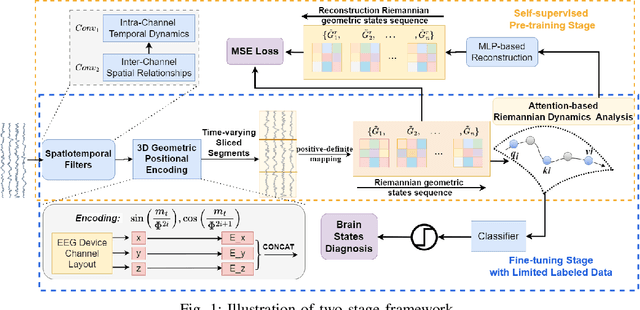


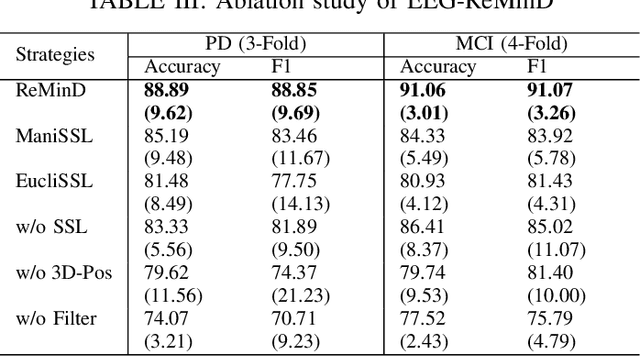
The development of EEG decoding algorithms confronts challenges such as data sparsity, subject variability, and the need for precise annotations, all of which are vital for advancing brain-computer interfaces and enhancing the diagnosis of diseases. To address these issues, we propose a novel two-stage approach named Self-Supervised State Reconstruction-Primed Riemannian Dynamics (EEG-ReMinD) , which mitigates reliance on supervised learning and integrates inherent geometric features. This approach efficiently handles EEG data corruptions and reduces the dependency on labels. EEG-ReMinD utilizes self-supervised and geometric learning techniques, along with an attention mechanism, to analyze the temporal dynamics of EEG features within the framework of Riemannian geometry, referred to as Riemannian dynamics. Comparative analyses on both intact and corrupted datasets from two different neurodegenerative disorders underscore the enhanced performance of EEG-ReMinD.
Efficient Speech Command Recognition Leveraging Spiking Neural Network and Curriculum Learning-based Knowledge Distillation
Dec 17, 2024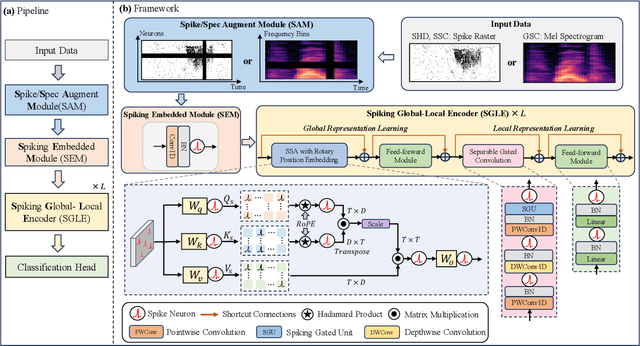
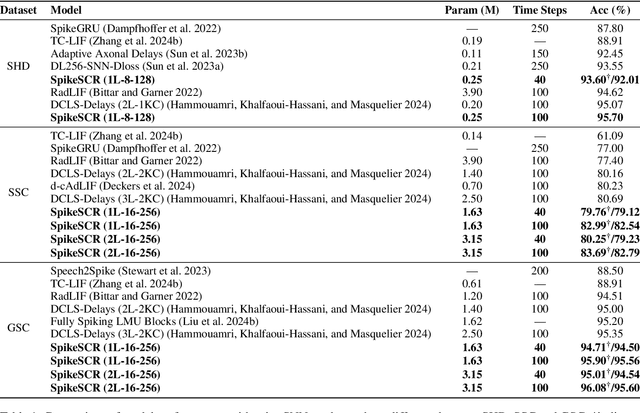
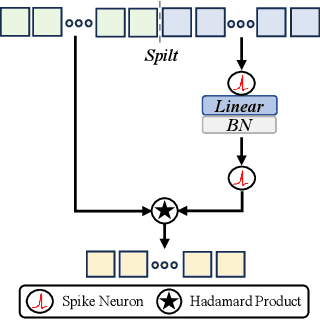
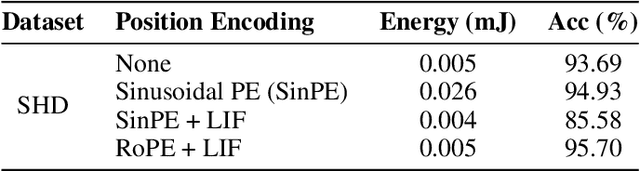
The intrinsic dynamics and event-driven nature of spiking neural networks (SNNs) make them excel in processing temporal information by naturally utilizing embedded time sequences as time steps. Recent studies adopting this approach have demonstrated SNNs' effectiveness in speech command recognition, achieving high performance by employing large time steps for long time sequences. However, the large time steps lead to increased deployment burdens for edge computing applications. Thus, it is important to balance high performance and low energy consumption when detecting temporal patterns in edge devices. Our solution comprises two key components. 1). We propose a high-performance fully spike-driven framework termed SpikeSCR, characterized by a global-local hybrid structure for efficient representation learning, which exhibits long-term learning capabilities with extended time steps. 2). To further fully embrace low energy consumption, we propose an effective knowledge distillation method based on curriculum learning (KDCL), where valuable representations learned from the easy curriculum are progressively transferred to the hard curriculum with minor loss, striking a trade-off between power efficiency and high performance. We evaluate our method on three benchmark datasets: the Spiking Heidelberg Dataset (SHD), the Spiking Speech Commands (SSC), and the Google Speech Commands (GSC) V2. Our experimental results demonstrate that SpikeSCR outperforms current state-of-the-art (SOTA) methods across these three datasets with the same time steps. Furthermore, by executing KDCL, we reduce the number of time steps by 60% and decrease energy consumption by 54.8% while maintaining comparable performance to recent SOTA results. Therefore, this work offers valuable insights for tackling temporal processing challenges with long time sequences in edge neuromorphic computing systems.
BrainECHO: Semantic Brain Signal Decoding through Vector-Quantized Spectrogram Reconstruction for Whisper-Enhanced Text Generation
Oct 19, 2024Recent advances in decoding language from brain signals (EEG and MEG) have been significantly driven by pre-trained language models, leading to remarkable progress on publicly available non-invasive EEG/MEG datasets. However, previous works predominantly utilize teacher forcing during text generation, leading to significant performance drops without its use. A fundamental issue is the inability to establish a unified feature space correlating textual data with the corresponding evoked brain signals. Although some recent studies attempt to mitigate this gap using an audio-text pre-trained model, Whisper, which is favored for its signal input modality, they still largely overlook the inherent differences between audio signals and brain signals in directly applying Whisper to decode brain signals. To address these limitations, we propose a new multi-stage strategy for semantic brain signal decoding via vEctor-quantized speCtrogram reconstruction for WHisper-enhanced text generatiOn, termed BrainECHO. Specifically, BrainECHO successively conducts: 1) Discrete autoencoding of the audio spectrogram; 2) Brain-audio latent space alignment; and 3) Semantic text generation via Whisper finetuning. Through this autoencoding--alignment--finetuning process, BrainECHO outperforms state-of-the-art methods under the same data split settings on two widely accepted resources: the EEG dataset (Brennan) and the MEG dataset (GWilliams). The innovation of BrainECHO, coupled with its robustness and superiority at the sentence, session, and subject-independent levels across public datasets, underscores its significance for language-based brain-computer interfaces.