 Add to Chrome
 Add to Firefox
 Add to Edge
DeVA: Decoupled Video-Action Model with physical guidance for robot policy learning
Jul 27, 2026
Generalizable robot manipulation requires policies that can anticipate how visual scenes evolve while executing language instructions. While recent Vision-Language-Action models benefit from large-scale pretraining, their predominantly static pretraining objectives provide limited supervision for physical dynamics and temporal causality, leaving control-relevant knowledge to be learned from downstream robot demonstrations. Video generative models offer a promising foundation by encoding rich spatiotemporal priors through future predictions. However, existing Video-Action Models either couple video and action prediction in a shared backbone, making policy adaptation harder to optimize, or under-utilize video information when guiding the action branch. In this work, we introduce DeVA, a Decoupled Video-Action model with specialized video and action experts, multi-level feature transfer, and physically salient guidance. DeVA transfers representations from multiple video layers to the action expert, enabling rich information exchange while making policy learning more tractable. It further supervises intermediate video features and the action stream with physically salient guidance (affordance/depth). Experiments on both simulation benchmarks and real-world deployment demonstrate strong performance with limited data, faster convergence than a unified architecture, and clear performance gains from physical guidance.

Evaluating and Preserving Lexical Stress in English-to-Chinese Speech-to-Speech Translation
Jun 13, 2026Speech-to-speech translation (S2ST) systems have achieved impressive progress in semantic accuracy and speech naturalness. However, the cross-lingual transfer of lexical stress, a vital cue for emphasis and speaker intent, remains heavily underexplored, compounded by a lack of reliable automatic evaluation metrics for tonal languages like Chinese. We investigate English-to-Chinese S2ST stress transfer by constructing a stress-annotated Chinese dataset and an XLS-R-based Mandarin stress detector. Integrating this with the English EmphAssess system, we propose a novel objective metric for cross-lingual stress evaluation. Furthermore, we fine-tune CosyVoice3 to build a stress-aware S2ST system. Experiments demonstrate that our proposed S2ST architecture significantly outperforms existing systems in stress translation capability while maintaining competitive translation quality. Furthermore, our evaluation metric exhibits a strong correlation with human subjective judgments.
The MiniMax-M2 Series: Mini Activations Unleashing Max Real-World Intelligence
May 26, 2026We introduce the MiniMax-M2 series, a family of Mixture-of-Experts language models built around the principle that mini activations can unleash maximum real-world intelligence. The flagship M2 contains 229.9B total parameters with only 9.8B activated per token. Designed end-to-end for agentic deployment, the M2 series rests on three components: (i) agent-driven data pipelines producing large-scale, verifiable trajectories across agentic coding and agentic cowork, each grounded in an executable workspace and an artifact-aligned reward; (ii) Forge, a scalable agent-native RL system that adapts to long-horizon agent trajectories, paired with windowed-FIFO scheduling, prefix-tree merging, inference optimization, and a clean training-inference-agent decoupling that supports both white-box and black-box agents; (iii) the latest M2.7 checkpoint takes an early step toward self-evolution -- autonomously debugging training runs and modifying its own scaffold. Across M2 through M2.7, this combination translates a mini-activation footprint into frontier-tier performance on agentic coding, deep search, office-task, and reasoning benchmarks.
Thinking with Comics: Enhancing Multimodal Reasoning through Structured Visual Storytelling
Feb 03, 2026Chain-of-Thought reasoning has driven large language models to extend from thinking with text to thinking with images and videos. However, different modalities still have clear limitations: static images struggle to represent temporal structure, while videos introduce substantial redundancy and computational cost. In this work, we propose Thinking with Comics, a visual reasoning paradigm that uses comics as a high information-density medium positioned between images and videos. Comics preserve temporal structure, embedded text, and narrative coherence while requiring significantly lower reasoning cost. We systematically study two reasoning paths based on comics and evaluate them on a range of reasoning tasks and long-context understanding tasks. Experimental results show that Thinking with Comics outperforms Thinking with Images on multi-step temporal and causal reasoning tasks, while remaining substantially more efficient than Thinking with Video. Further analysis indicates that different comic narrative structures and styles consistently affect performance across tasks, suggesting that comics serve as an effective intermediate visual representation for improving multimodal reasoning.
From Perception to Reasoning: Deep Thinking Empowers Multimodal Large Language Models
Nov 18, 2025With the remarkable success of Multimodal Large Language Models (MLLMs) in perception tasks, enhancing their complex reasoning capabilities has emerged as a critical research focus. Existing models still suffer from challenges such as opaque reasoning paths and insufficient generalization ability. Chain-of-Thought (CoT) reasoning, which has demonstrated significant efficacy in language models by enhancing reasoning transparency and output interpretability, holds promise for improving model reasoning capabilities when extended to the multimodal domain. This paper provides a systematic review centered on "Multimodal Chain-of-Thought" (MCoT). First, it analyzes the background and theoretical motivations for its inception from the perspectives of technical evolution and task demands. Then, it introduces mainstream MCoT methods from three aspects: CoT paradigms, the post-training stage, and the inference stage, while also analyzing their underlying mechanisms. Furthermore, the paper summarizes existing evaluation benchmarks and metrics, and discusses the application scenarios of MCoT. Finally, it analyzes the challenges currently facing MCoT and provides an outlook on its future research directions.
M3: 3D-Spatial MultiModal Memory
Mar 20, 2025We present 3D Spatial MultiModal Memory (M3), a multimodal memory system designed to retain information about medium-sized static scenes through video sources for visual perception. By integrating 3D Gaussian Splatting techniques with foundation models, M3 builds a multimodal memory capable of rendering feature representations across granularities, encompassing a wide range of knowledge. In our exploration, we identify two key challenges in previous works on feature splatting: (1) computational constraints in storing high-dimensional features for each Gaussian primitive, and (2) misalignment or information loss between distilled features and foundation model features. To address these challenges, we propose M3 with key components of principal scene components and Gaussian memory attention, enabling efficient training and inference. To validate M3, we conduct comprehensive quantitative evaluations of feature similarity and downstream tasks, as well as qualitative visualizations to highlight the pixel trace of Gaussian memory attention. Our approach encompasses a diverse range of foundation models, including vision-language models (VLMs), perception models, and large multimodal and language models (LMMs/LLMs). Furthermore, to demonstrate real-world applicability, we deploy M3's feature field in indoor scenes on a quadruped robot. Notably, we claim that M3 is the first work to address the core compression challenges in 3D feature distillation.
Evaluating o1-Like LLMs: Unlocking Reasoning for Translation through Comprehensive Analysis
Feb 17, 2025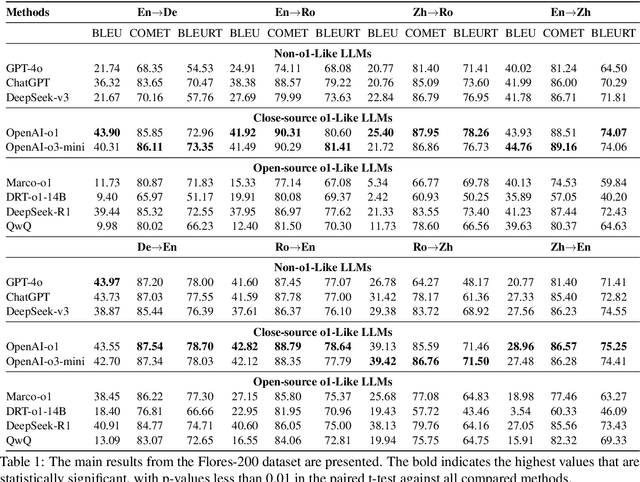
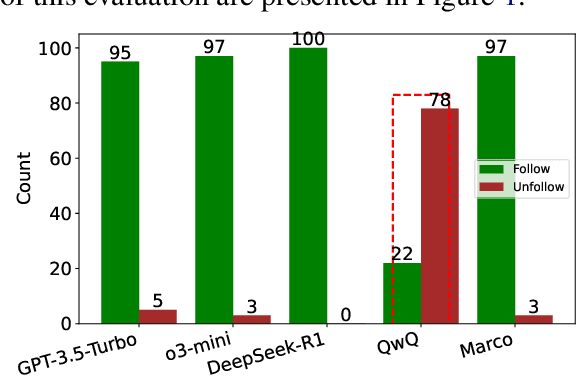
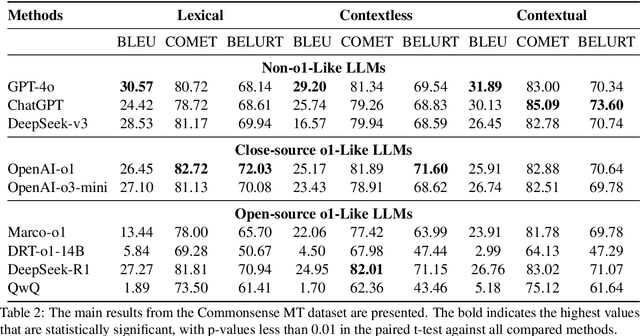
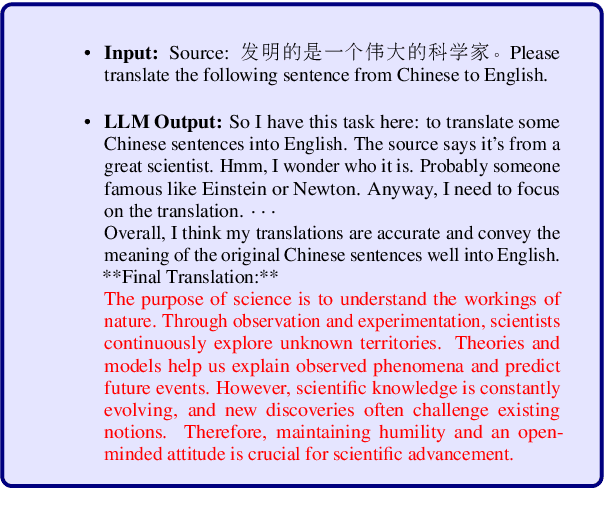
The o1-Like LLMs are transforming AI by simulating human cognitive processes, but their performance in multilingual machine translation (MMT) remains underexplored. This study examines: (1) how o1-Like LLMs perform in MMT tasks and (2) what factors influence their translation quality. We evaluate multiple o1-Like LLMs and compare them with traditional models like ChatGPT and GPT-4o. Results show that o1-Like LLMs establish new multilingual translation benchmarks, with DeepSeek-R1 surpassing GPT-4o in contextless tasks. They demonstrate strengths in historical and cultural translation but exhibit a tendency for rambling issues in Chinese-centric outputs. Further analysis reveals three key insights: (1) High inference costs and slower processing speeds make complex translation tasks more resource-intensive. (2) Translation quality improves with model size, enhancing commonsense reasoning and cultural translation. (3) The temperature parameter significantly impacts output quality-lower temperatures yield more stable and accurate translations, while higher temperatures reduce coherence and precision.
Make Imagination Clearer! Stable Diffusion-based Visual Imagination for Multimodal Machine Translation
Dec 17, 2024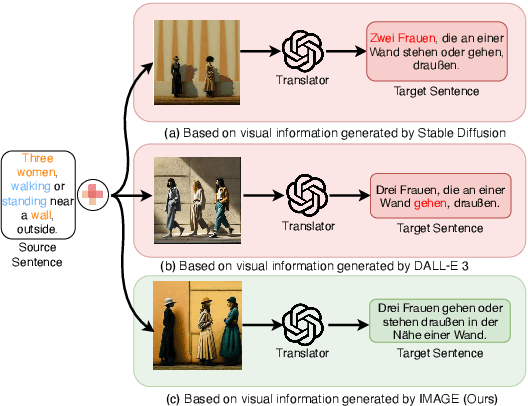
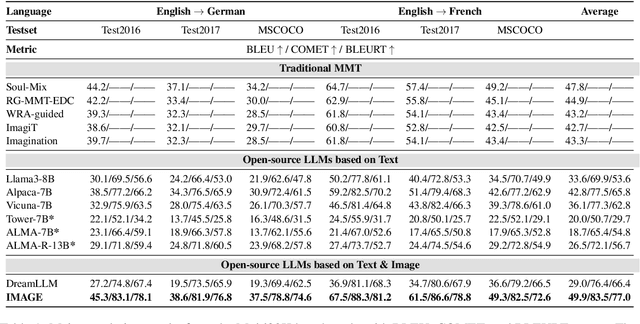
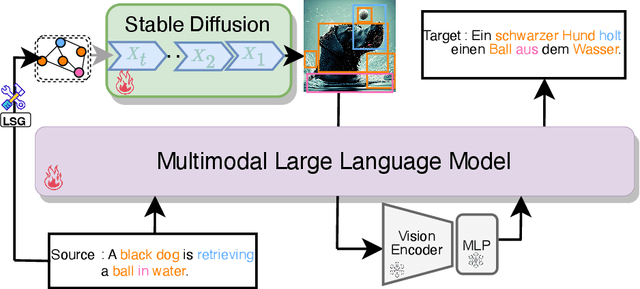
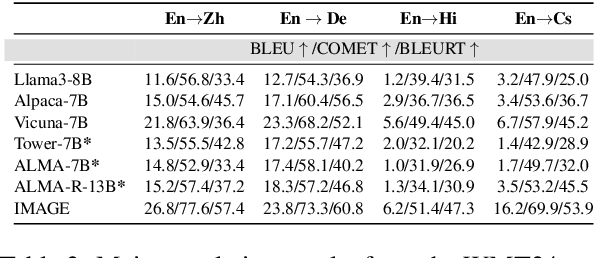
Visual information has been introduced for enhancing machine translation (MT), and its effectiveness heavily relies on the availability of large amounts of bilingual parallel sentence pairs with manual image annotations. In this paper, we introduce a stable diffusion-based imagination network into a multimodal large language model (MLLM) to explicitly generate an image for each source sentence, thereby advancing the multimodel MT. Particularly, we build heuristic human feedback with reinforcement learning to ensure the consistency of the generated image with the source sentence without the supervision of image annotation, which breaks the bottleneck of using visual information in MT. Furthermore, the proposed method enables imaginative visual information to be integrated into large-scale text-only MT in addition to multimodal MT. Experimental results show that our model significantly outperforms existing multimodal MT and text-only MT, especially achieving an average improvement of more than 14 BLEU points on Multi30K multimodal MT benchmarks.
Noro: A Noise-Robust One-shot Voice Conversion System with Hidden Speaker Representation Capabilities
Nov 29, 2024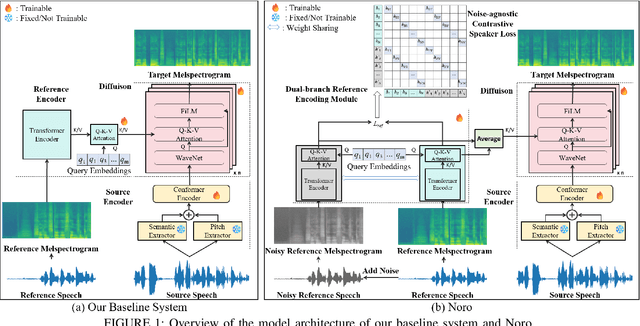

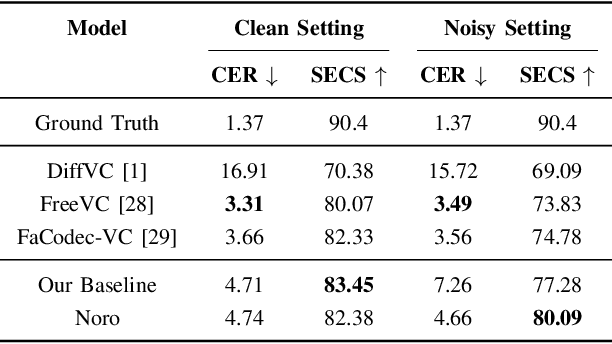
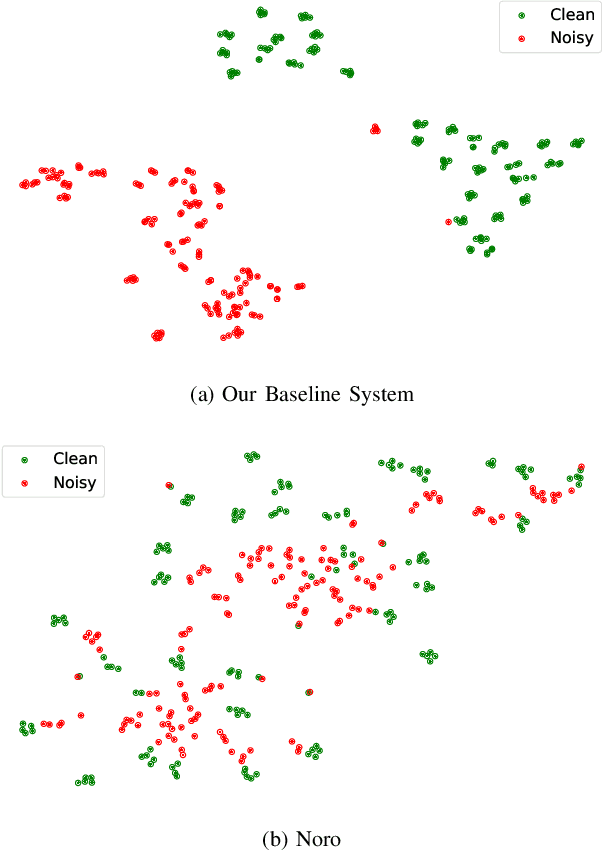
One-shot voice conversion (VC) aims to alter the timbre of speech from a source speaker to match that of a target speaker using just a single reference speech from the target, while preserving the semantic content of the original source speech. Despite advancements in one-shot VC, its effectiveness decreases in real-world scenarios where reference speeches, often sourced from the internet, contain various disturbances like background noise. To address this issue, we introduce Noro, a Noise Robust One-shot VC system. Noro features innovative components tailored for VC using noisy reference speeches, including a dual-branch reference encoding module and a noise-agnostic contrastive speaker loss. Experimental results demonstrate that Noro outperforms our baseline system in both clean and noisy scenarios, highlighting its efficacy for real-world applications. Additionally, we investigate the hidden speaker representation capabilities of our baseline system by repurposing its reference encoder as a speaker encoder. The results shows that it is competitive with several advanced self-supervised learning models for speaker representation under the SUPERB settings, highlighting the potential for advancing speaker representation learning through one-shot VC task.
WildLMa: Long Horizon Loco-Manipulation in the Wild
Nov 22, 2024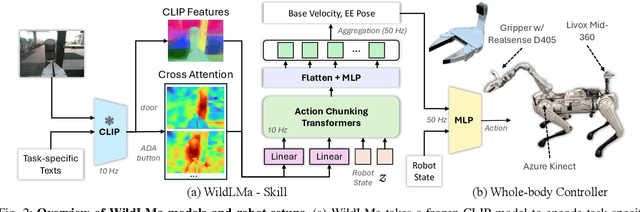
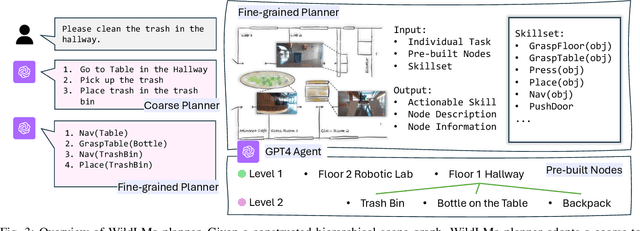
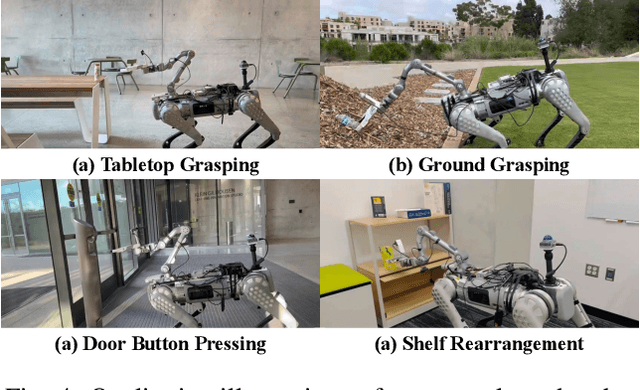
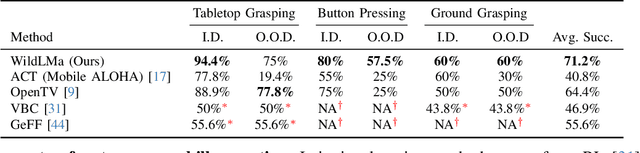
`In-the-wild' mobile manipulation aims to deploy robots in diverse real-world environments, which requires the robot to (1) have skills that generalize across object configurations; (2) be capable of long-horizon task execution in diverse environments; and (3) perform complex manipulation beyond pick-and-place. Quadruped robots with manipulators hold promise for extending the workspace and enabling robust locomotion, but existing results do not investigate such a capability. This paper proposes WildLMa with three components to address these issues: (1) adaptation of learned low-level controller for VR-enabled whole-body teleoperation and traversability; (2) WildLMa-Skill -- a library of generalizable visuomotor skills acquired via imitation learning or heuristics and (3) WildLMa-Planner -- an interface of learned skills that allow LLM planners to coordinate skills for long-horizon tasks. We demonstrate the importance of high-quality training data by achieving higher grasping success rate over existing RL baselines using only tens of demonstrations. WildLMa exploits CLIP for language-conditioned imitation learning that empirically generalizes to objects unseen in training demonstrations. Besides extensive quantitative evaluation, we qualitatively demonstrate practical robot applications, such as cleaning up trash in university hallways or outdoor terrains, operating articulated objects, and rearranging items on a bookshelf.