 Add to Chrome
 Add to Firefox
 Add to Edge
WhisperRec: Latent Reasoning for Efficient Foundation Recommendation Models
Jul 29, 2026
Large language models (LLMs) have demonstrated strong reasoning capabilities, motivating their adoption as backbones for foundation recommendation models (FRMs). Existing approaches typically enhance recommendation with explicit Chain-of-Thought (CoT) under the Think-then-Answer paradigm. However, generating lengthy rationales introduces substantial inference overhead, while fixed CoT templates struggle to model diverse, dynamic, and context-dependent user interests. We propose WhisperRec, an efficient latent reasoning framework for FRMs. WhisperRec compresses teacher-generated CoT into learnable latent reasoning tokens, enabling a Latent-Reason-then-Answer paradigm that performs reasoning in latent space without producing verbose rationales. This design retains decision-relevant reasoning information while avoiding the latency bottleneck of autoregressive rationale generation. Specifically, it first introduces Multi-View Adaptive CoT (MV-ACoT) to construct diverse, high-quality supervision from complementary perspectives on user interests. MV-ACoT also adapts reasoning complexity to each instance, applying lightweight analysis to clear cases and targeted multi-factor reasoning to challenging ones. Building on a pre-trained FRM, WhisperRec then employs a three-stage Latent Reasoning Alignment procedure to progressively internalize teacher CoT into latent representations. Finally, curriculum-based post-training activates latent-token reasoning for downstream recommendation while preserving standard recommendation capability. Experiments on an industrial-scale Kuaishou dataset and the public Kuaishou LLM-Rec benchmark show that WhisperRec consistently outperforms explicit-CoT methods and conventional baselines. Compared with explicit CoT Think and No-Think variants, WhisperRec improves SID@64 by 17.44% and 9.33%, respectively, and achieves over 10x higher online inference throughput.

On-Site Beam Calibration for RIS-Aided Positioning Systems
Jul 27, 2026High precision positioning is a key enabler for next-generation communication applications such as smart transportation and augmented reality. Reconfigurable intelligent surface (RIS) technology can enhance positioning by providing additional angular information and improving coverage under obstructed propagation conditions. However, true RIS beams can differ significantly from the simplified or ideal beam response models commonly used in RIS-aided positioning, leading to beam model mismatch and an elevated positioning error floor. This paper proposes an on-site RIS beam calibration framework that reduces this error floor by estimating a realistic 3D RIS beam response model from on-site measurements. The proposed calibration algorithm first extracts the RIS-reflected channel response from signals received by a calibration agent sampling the angular range of interest, using delay-domain sparse recovery, and then estimates the beam model parameters with a gradient-based estimator. To validate the proposed framework, 3D beam patterns under 66 phase modulations were measured and incorporated into simulations. With an angular sampling step of 1 deg, the calibrated model achieves an average beam response similarity of 88.5% with respect to the ground truth, compared with 43.7% for the ideal model. The probability that the absolute lower bound of the positioning error is below 0.5m increases from 0.52 without calibration to 0.74 after calibration, showing that on-site RIS beam calibration effectively reduces the positioning error floor caused by true beam model mismatch.
From Solvers to Research: Large Language Model-Driven Formal Mathematics at the Research Frontier
Jul 08, 2026Recent developments in AI for Mathematics (AI4Math), especially Large Language Model (LLM)-driven theorem provers, has achieved remarkable success in formal proof generation for well-defined mathematical problems through Interactive Theorem Proving (ITP) languages. However, current systems remain fundamentally limited in tackling frontier research mathematics, such as discovering new theorems or resolving open conjectures, which are often open-ended, under-specified, and involve multiple layers of abstraction. We argue that the next leap in AI4Math systems requires a decisive shift from predefined problem-solvers to research agents that can address frontier mathematical challenges with rigorous formal mathematical reasoning. In this position paper, we provide a systematic review of the field, covering datasets, auto-formalization, and proof synthesis. More importantly, we identify core limitations of existing systems in serving as mathematical research agents, examining issues across datasets, relational structure, mathematical exploration, tool ecosystem, and human-AI collaboration, outlining a strategic road-map for the future of AI4Math.
Mismatch Analysis and Cooperative Calibration of Array Beam Patterns for ISAC Systems
Feb 01, 2026Integrated sensing and communication (ISAC) is a key technology for enabling a wide range of applications in future wireless systems. However, the sensing performance is often degraded by model mismatches caused by geometric errors (e.g., position and orientation) and hardware impairments (e.g., mutual coupling and amplifier non-linearity). This paper focuses on the angle estimation performance with antenna arrays and tackles the critical challenge of array beam pattern calibration for ISAC systems. To assess calibration quality from a sensing perspective, a novel performance metric that accounts for angle estimation error, rather than beam pattern similarity, is proposed and incorporated into a differentiable loss function. Additionally, a cooperative calibration framework is introduced, allowing multiple user equipments to iteratively optimize the beam pattern based on the proposed loss functions and local data, and collaboratively update global calibration parameters. The proposed models and algorithms are validated using real-world beam pattern measurements collected in an anechoic chamber. Experimental results show that the angle estimation error can be reduced from {$\textbf{1.01}^\circ$} to $\textbf{0.11}^\circ$ in 2D calibration scenarios, and from $\textbf{5.19}^\circ$ to $\textbf{0.86}^\circ$ in 3D calibration ones.
Dynamic Generation of Multi-LLM Agents Communication Topologies with Graph Diffusion Models
Oct 09, 2025The efficiency of multi-agent systems driven by large language models (LLMs) largely hinges on their communication topology. However, designing an optimal topology is a non-trivial challenge, as it requires balancing competing objectives such as task performance, communication cost, and robustness. Existing frameworks often rely on static or hand-crafted topologies, which inherently fail to adapt to diverse task requirements, leading to either excessive token consumption for simple problems or performance bottlenecks for complex ones. To address this challenge, we introduce a novel generative framework called \textit{Guided Topology Diffusion (GTD)}. Inspired by conditional discrete graph diffusion models, GTD formulates topology synthesis as an iterative construction process. At each step, the generation is steered by a lightweight proxy model that predicts multi-objective rewards (e.g., accuracy, utility, cost), enabling real-time, gradient-free optimization towards task-adaptive topologies. This iterative, guided synthesis process distinguishes GTD from single-step generative frameworks, enabling it to better navigate complex design trade-offs. We validated GTD across multiple benchmarks, and experiments show that this framework can generate highly task-adaptive, sparse, and efficient communication topologies, significantly outperforming existing methods in LLM agent collaboration.
RIS Beam Calibration for ISAC Systems: Modeling and Performance Analysis
May 21, 2025High-accuracy localization is a key enabler for integrated sensing and communication (ISAC), playing an essential role in various applications such as autonomous driving. Antenna arrays and reconfigurable intelligent surface (RIS) are incorporated into these systems to achieve high angular resolution, assisting in the localization process. However, array and RIS beam patterns in practice often deviate from the idealized models used for algorithm design, leading to significant degradation in positioning accuracy. This mismatch highlights the need for beam calibration to bridge the gap between theoretical models and real-world hardware behavior. In this paper, we present and analyze three beam models considering several key non-idealities such as mutual coupling, non-ideal codebook, and measurement uncertainties. Based on the models, we then develop calibration algorithms to estimate the model parameters that can be used for future localization tasks. This work evaluates the effectiveness of the beam models and the calibration algorithms using both theoretical bounds and real-world beam pattern data from an RIS prototype. The simulation results show that the model incorporating combined impacts can accurately reconstruct measured beam patterns. This highlights the necessity of realistic beam modeling and calibration to achieve high-accuracy localization.
Pilot-Based End-to-End Radio Positioning and Mapping for ISAC: Beyond Point-Based Landmarks
May 12, 2025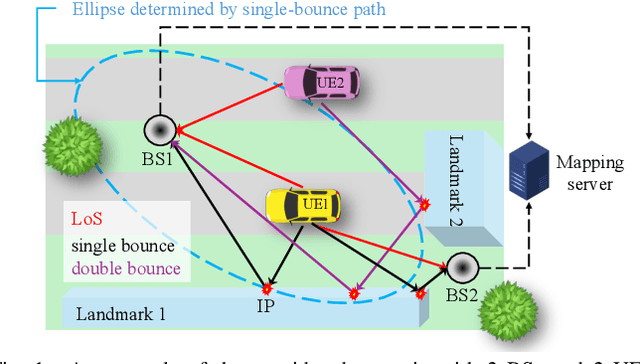
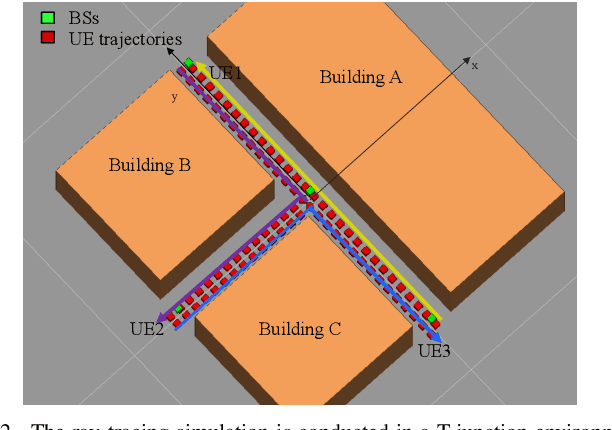
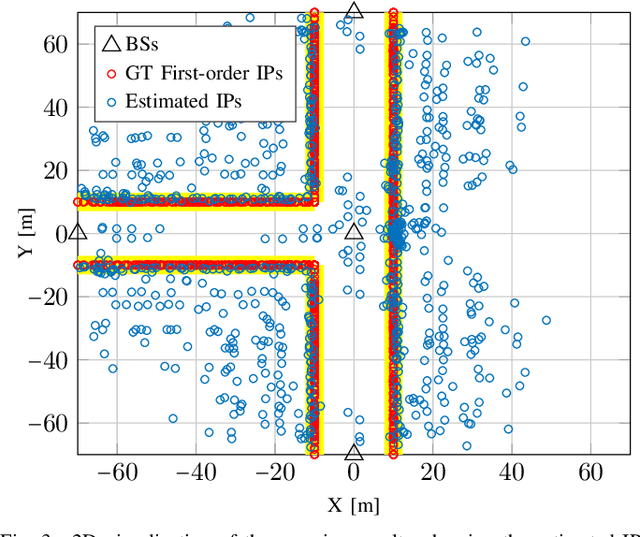
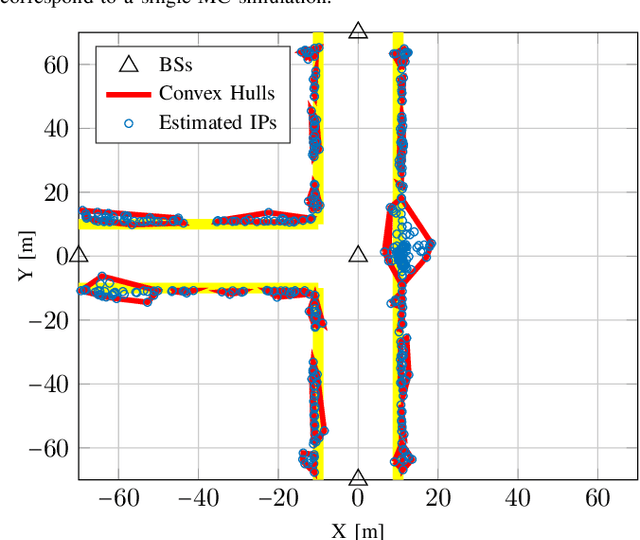
Integrated sensing and communication enables simultaneous communication and sensing tasks, including precise radio positioning and mapping, essential for future 6G networks. Current methods typically model environmental landmarks as isolated incidence points or small reflection areas, lacking detailed attributes essential for advanced environmental interpretation. This paper addresses these limitations by developing an end-to-end cooperative uplink framework involving multiple base stations and users. Our method uniquely estimates extended landmark objects and incorporates obstruction-based outlier removal to mitigate multi-bounce signal effects. Validation using realistic ray-tracing data demonstrates substantial improvements in the richness of the estimated environmental map.
Joint Near-Field Sensing and Visibility Region Detection with Extremely Large Aperture Arrays
Feb 28, 2025
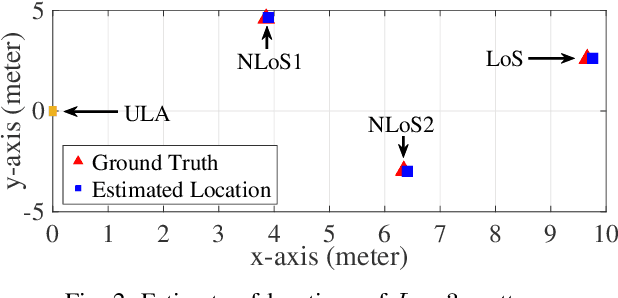


In this paper, we consider near-field localization and sensing with an extremely large aperture array under partial blockage of array antennas, where spherical wavefront and spatial non-stationarity are accounted for. We propose an Ising model to characterize the clustered sparsity feature of the blockage pattern, develop an algorithm based on alternating optimization for joint channel parameter estimation and visibility region detection, and further estimate the locations of the user and environmental scatterers. The simulation results confirm the effectiveness of the proposed algorithm compared to conventional methods.
RIS-Aided Positioning Under Adverse Conditions: Interference from Unauthorized RIS
Feb 27, 2025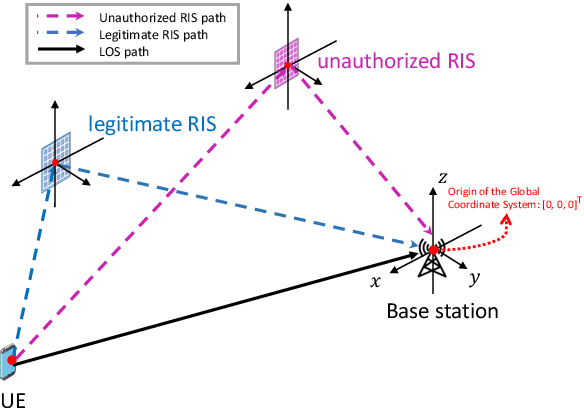
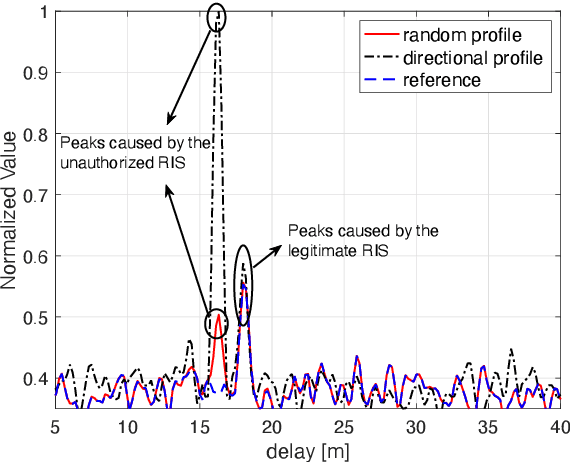
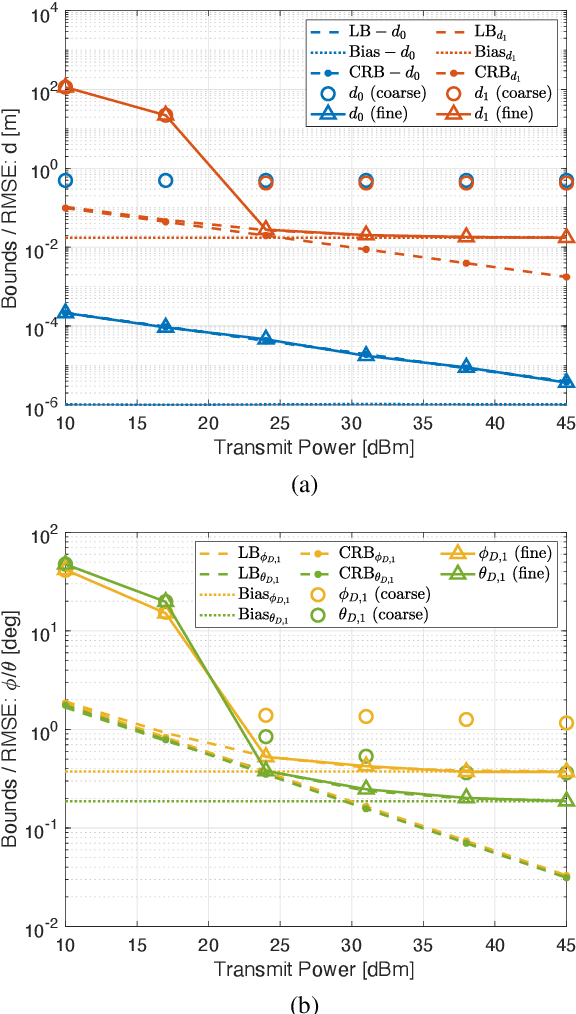
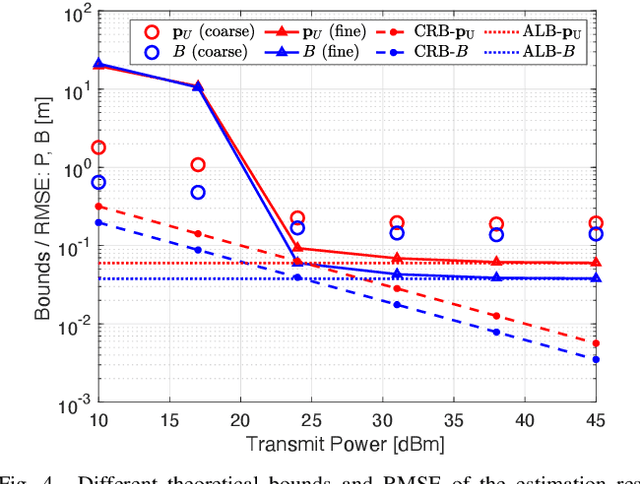
Positioning technology, which aims to determine the geometric information of a device in a global coordinate, is a key component in integrated sensing and communication systems. In addition to traditional active anchor-based positioning systems, reconfigurable intelligent surfaces (RIS) have shown great potential for enhancing system performance. However, their ability to manipulate electromagnetic waves and ease of deployment pose potential risks, as unauthorized RIS may be intentionally introduced to jeopardize the positioning service. Such an unauthorized RIS can cause unexpected interference in the original localization system, distorting the transmitted signals, and leading to degraded positioning accuracy. In this work, we investigate the scenario of RIS-aided positioning in the presence of interference from an unauthorized RIS. Theoretical lower bounds are employed to analyze the impact of unauthorized RIS on channel parameter estimation and positioning accuracy. Several codebook design strategies for unauthorized RIS are evaluated, and various system arrangements are discussed. The simulation results show that an unauthorized RIS path with a high channel gain or a delay similar to that of legitimate RIS paths leads to poor positioning performance. Furthermore, unauthorized RIS generates more effective interference when using directional beamforming codebooks compared to random codebooks.
Multiple-Frequency-Bands Channel Characterization for In-vehicle Wireless Networks
Oct 03, 2024


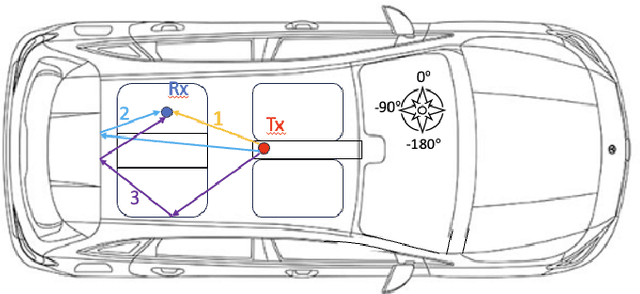
In-vehicle wireless networks are crucial for advancing smart transportation systems and enhancing interaction among vehicles and their occupants. However, there are limited studies in the current state of the art that investigate the in-vehicle channel characteristics in multiple frequency bands. In this paper, we present measurement campaigns conducted in a van and a car across below 7 GHz, millimeter-wave (mmWave), and sub-Terahertz (Sub-THz) bands. These campaigns aim to compare the channel characteristics for in-vehicle scenarios across various frequency bands. Channel impulse responses (CIRs) were measured at various locations distributed across the engine compartment of both the van and car. The CIR results reveal a high similarity in the delay properties between frequency bands below 7GHz and mmWave bands for the measurements in the engine bay. Sparse channels can be observed at Sub-THz bands in the engine bay scenarios. Channel spatial profiles in the passenger cabin of both the van and car are obtained by the directional scan sounding scheme for three bands. We compare the power angle delay profiles (PADPs) measured at different frequency bands in two line of sight (LOS) scenarios and one non-LOS (NLOS) scenario. Some major \added{multipath components (MPCs)} can be identified in all frequency bands and their trajectories are traced based on the geometry of the vehicles. The angular spread of arrival is also calculated for three scenarios. The analysis of channel characteristics in this paper can enhance our understanding of in-vehicle channels and foster the evolution of in-vehicle wireless networks.