 Add to Chrome
 Add to Firefox
 Add to Edge
On the Feasibility of Human Presence Detection Using Ceiling-Mounted Sub-THz Channel Sounding: Conference Room Measurement
Jun 13, 2026
This paper presents a measurement-based investigation on the feasibility of human presence detection using a ceiling-mounted sub-THz channel sounder operating from 134 to 146~GHz. Wideband channel measurements were conducted in an indoor conference room under empty-room, human-present, and water-filled mannequin scenarios across five spatial positions. The measurements were performed using a vector network analyzer combined with sub-THz frequency extenders. Two antenna beamwidth configurations were used, one with a highly directive horn antenna on the transmitter side and one with a less directive, open-waveguide transmitter. The measured channel responses were transformed into calibrated power delay profiles and analyzed using normalized channel variation metrics in the delay domain. The results show that human detection is strongly dependent on target position relative to the ceiling-mounted transmitter and receiver as well as on antenna beamwidth. Furthermore, repeated empty-room measurements reveal that small environmental changes, such as slight furniture displacement, introduce non-negligible channel variations that must be considered when evaluating detection performance. In the wide-beam open-waveguide configuration, the human-present measurements produced lower values of the delay-domain variation metric than the repeated empty-room baseline, whereas the water-filled mannequin produced values at or above this baseline across all positions. With the directive transmitter, the human response exceeded the baseline significantly but only at favorable positions, especially P1 and P2, showing that the sensing response remains spatially selective. These findings provide experimental insight into the capabilities and limitations of ceiling-mounted sub-THz sensing for future integrated sensing and communication systems.

Vertical Sub-THz Channel Characterization: Sounder Implementation and Initial Measurements
Jun 13, 2026We present a measurement-based characterization of indoor vertical ceiling-to-ground sub-THz channels in the 136-144 GHz band, motivated by ceiling-mounted radio-unit deployments for future distributed indoor networks. The measurements are performed using a vector network analyzer (VNA)-based channel sounder with a mechanically scanned planar virtual antenna array (VAA) at the receiver, enabling single-input single-output (SISO), small-array single-input multiple-output (SIMO), and large-array SIMO measurements in three indoor environments: an office, a laboratory, and a ventilation room. The small-array and large-array SIMO measurements synthesize 2 X 2 cm and 30 X 1 cm uniform rectangular arrays (URAs), respectively. The results show that the vertical links are generally dominated by a strong Line-of-Sight (LOS) component close to the ceiling-to-ground direction, but with clear environmental differences. The office and laboratory exhibit relatively limited delay dispersion, whereas the ventilation room shows stronger delayed multipath due to its corrugated metallic ceiling and surrounding metallic structures. The measured root mean square (RMS) delay spreads are 0.55-1.74 ns for the small-array measurements and 0.44-2.57 ns for the large-array measurements, smaller than those reported in several horizontal indoor sub-THz measurement campaigns at similar frequencies. However, the channel is not purely free-space. Repeatable second-order reflections involving the receiver table, ceiling, transmitter structure, and ceiling-mounted objects are observed in all environments. The large-array measurements further reveal spatial non-stationarity along the 30 cm aperture, with several multipath components visible only over limited parts of the array. These results show that ceiling materials, obstructions, and aperture-dependent variations matter in vertical sub-THz channel modeling.
Large Wireless Foundation Models: Stronger over Bigger
Jan 16, 2026AI-communication integration is widely regarded as a core enabling technology for 6G. Most existing AI-based physical-layer designs rely on task-specific models that are separately tailored to individual modules, resulting in poor generalization. In contrast, communication systems are inherently general-purpose and should support broad applicability and robustness across diverse scenarios. Foundation models offer a promising solution through strong reasoning and generalization, yet wireless-system constraints hinder a direct transfer of large language model (LLM)-style success to the wireless domain. Therefore, we introduce the concept of large wireless foundation models (LWFMs) and present a novel framework for empowering the physical layer with foundation models under wireless constraints. Specifically, we propose two paradigms for realizing LWFMs, including leveraging existing general-purpose foundation models and building novel wireless foundation models. Based on recent progress, we distill two roadmaps for each paradigm and formulate design principles under wireless constraints. We further provide case studies of LWFM-empowered wireless systems to intuitively validate their advantages. Finally, we characterize the notion of "large" in LWFMs through a multidimensional analysis of existing work and outline promising directions for future research.
WiFo-MUD: Wireless Foundation Model for Heterogeneous Multi-User Demodulator
Jan 02, 2026Multi-user signal demodulation is critical to wireless communications, directly impacting transmission reliability and efficiency. However, existing demodulators underperform in generic multi-user environments: classical demodulators struggle to balance accuracy and complexity, while deep learning-based methods lack adaptability under heterogeneous configurations. Although diffusion models have been introduced for demodulation, their flexibility remains limited for practical use. To address these issues, this work proposes WiFo-MUD, a universal diffusion-based foundation model for multi-user demodulation. The model aligns inter-user signal-to-noise ratio imbalance and performs conditional denoising via a customized backbone. Furthermore, a communication-aware consistency distillation method and a dynamic user-grouping strategy are devised to enhance inference. WiFo-MUD achieves state-of-the-art results on large-scale heterogeneous datasets, demonstrating efficient inference and strong generalization across varying system configurations.
WiCo-MG: Wireless Channel Foundation Model for Multipath Generation via Synesthesia of Machines
Nov 19, 2025Precise modeling of channel multipath is essential for understanding wireless propagation environments and optimizing communication systems. In particular, sixth-generation (6G) artificial intelligence (AI)-native communication systems demand massive and high-quality multipath channel data to enable intelligent model training and performance optimization. In this paper, we propose a wireless channel foundation model (WiCo) for multipath generation (WiCo-MG) via Synesthesia of Machines (SoM). To provide a solid training foundation for WiCo-MG, a new synthetic intelligent sensing-communication dataset for uncrewed aerial vehicle (UAV)-to-ground (U2G) communications is constructed. To overcome the challenges of cross-modal alignment and mapping, a two-stage training framework is proposed. In the first stage, sensing images are embedded into discrete-continuous SoM feature spaces, and multipath maps are embedded into a sensing-initialized discrete SoM space to align the representations. In the second stage, a mixture of shared and routed experts (S-R MoE) Transformer with frequency-aware expert routing learns the mapping from sensing to channel SoM feature spaces, enabling decoupled and adaptive multipath generation. Experimental results demonstrate that WiCo-MG achieves state-of-the-art in-distribution generation performance and superior out-of-distribution generalization, reducing NMSE by more than 2.59 dB over baselines, while exhibiting strong scalability in model and dataset growth and extensibility to new multipath parameters and tasks. Owing to higher accuracy, stronger generalization, and better scalability, WiCo-MG is expected to enable massive and high-fidelity channel data generation for the development of 6G AI-native communication systems.
WiCo-PG: Wireless Channel Foundation Model for Pathloss Map Generation via Synesthesia of Machines
Nov 19, 2025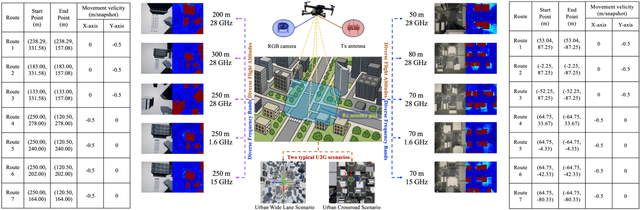
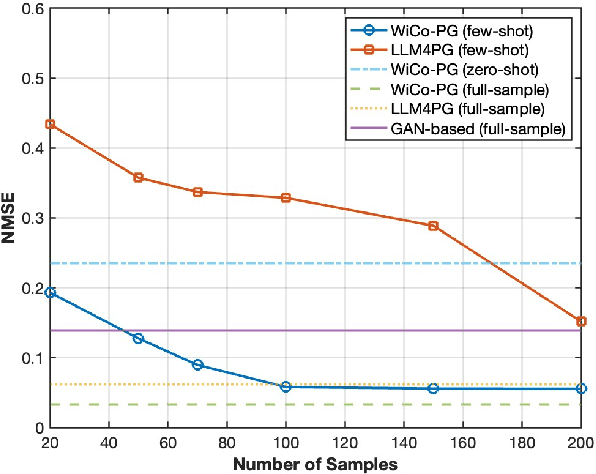
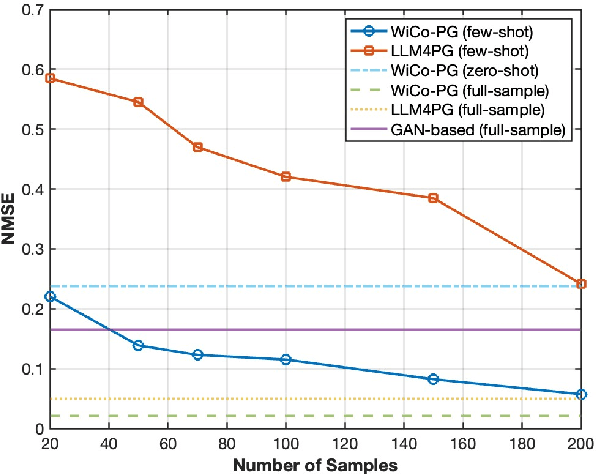
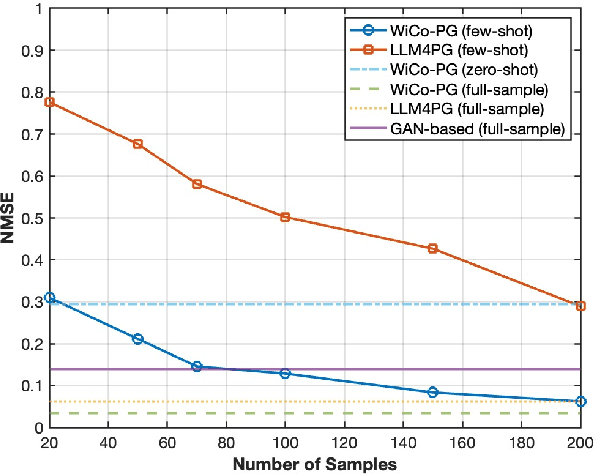
A wireless channel foundation model for pathloss map generation (WiCo-PG) via Synesthesia of Machines (SoM) is developed for the first time. Considering sixth-generation (6G) uncrewed aerial vehicle (UAV)-to-ground (U2G) scenarios, a new multi-modal sensing-communication dataset is constructed for WiCo-PG pre-training, including multiple U2G scenarios, diverse flight altitudes, and diverse frequency bands. Based on the constructed dataset, the proposed WiCo-PG enables cross-modal pathloss map generation by leveraging RGB images from different scenarios and flight altitudes. In WiCo-PG, a novel network architecture designed for cross-modal pathloss map generation based on dual vector quantized generative adversarial networks (VQGANs) and Transformer is proposed. Furthermore, a novel frequency-guided shared-routed mixture of experts (S-R MoE) architecture is designed for cross-modal pathloss map generation. Simulation results demonstrate that the proposed WiCo-PG achieves improved pathloss map generation accuracy through pre-training with a normalized mean squared error (NMSE) of 0.012, outperforming the large language model (LLM)-based scheme, i.e., LLM4PG, and the conventional deep learning-based scheme by more than 6.98 dB. The enhanced generality of the proposed WiCo-PG can further outperform the LLM4PG by at least 1.37 dB using 2.7% samples in few-shot generalization.
Distributed MIMO Positioning: Fundamental Limit Analysis and User Tracking Framework Design
Nov 17, 2025This paper presents a comprehensive study on the 3D positioning capabilities in distributed multiple-input multiple-output (MIMO) systems. Unlike previous studies that mainly rely on idealized isotropic antenna models, we adopt a polarimetric model that takes advantage of effective aperture distribution functions to characterize realistic antenna patterns, placements, and polarization effects. Based on this model, we analyze the fundamental limits of UE positioning using the Fisher information matrix (FIM) and the position error bound (PEB). The FIM is shown to be expressed as a weighted sum of the information contributions from individual access point (AP)-UE pairs, with each contribution interpreted geometrically across distance, azimuth, and elevation dimensions. The impact of the UE tilt and the spatial distribution of APs on the PEBs is further analyzed. As a further advancement, we propose a complete positioning framework from a UE tracking perspective. By integrating a global probability hypothesis density filter and a PEB-aware AP management strategy, the framework enables accurate tracking while optimizing AP scheduling. Finally, we present a distributed MIMO channel measurement campaign to validate the proposed framework. The results demonstrate a centimeter-level tracking accuracy. In addition, the PEB-aware AP management strategy is shown to maintain robust tracking performance while significantly reducing the number of concurrently active APs, thus lowering the overall system overhead.
SynthSoM-Twin: A Multi-Modal Sensing-Communication Digital-Twin Dataset for Sim2Real Transfer via Synesthesia of Machines
Nov 14, 2025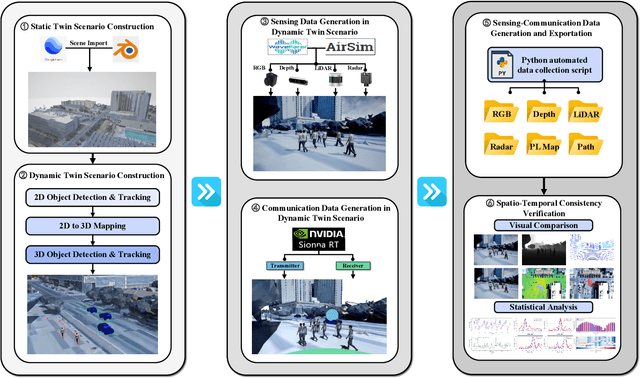
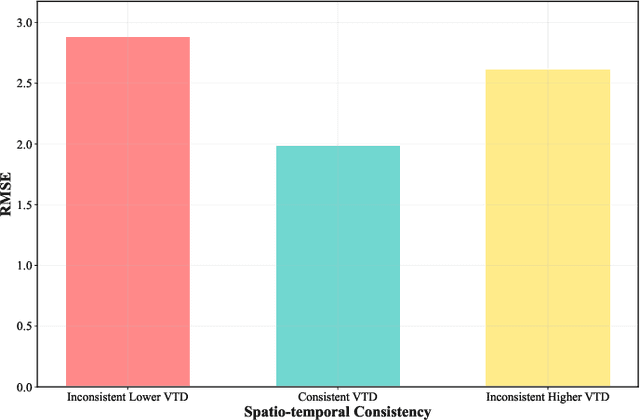
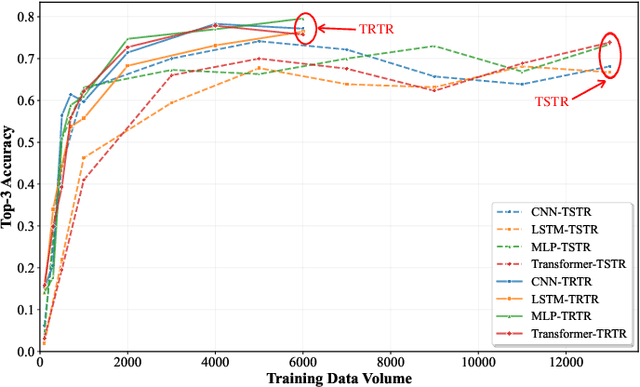
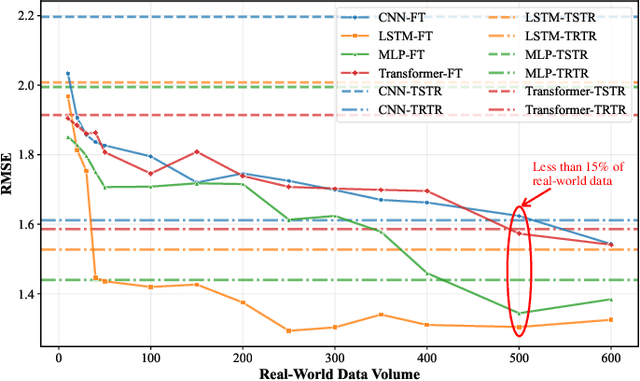
This paper constructs a novel multi-modal sensing-communication digital-twin dataset, named SynthSoM-Twin, which is spatio-temporally consistent with the real world, for Sim2Real transfer via Synesthesia of Machines (SoM). To construct the SynthSoM-Twin dataset, we propose a new framework that can extend the quantity and missing modality of existing real-world multi-modal sensing-communication dataset. Specifically, we exploit multi-modal sensing-assisted object detection and tracking algorithms to ensure spatio-temporal consistency of static objects and dynamic objects across real world and simulation environments. The constructed scenario is imported into three high-fidelity simulators, i.e., AirSim, WaveFarer, and Sionna RT. The SynthSoM-Twin dataset contains spatio-temporally consistent data with the real world, including 66,868 snapshots of synthetic RGB images, depth maps, light detection and ranging (LiDAR) point clouds, millimeter wave (mmWave) radar point clouds, and large-scale and small-scale channel fading data. To validate the utility of SynthSoM-Twin dataset, we conduct Sim2Real transfer investigation by implementing two cross-modal downstream tasks via cross-modal generative models (CMGMs), i.e., cross-modal channel generation model and multi-modal sensing-assisted beam generation model. Based on the downstream tasks, we explore the threshold of real-world data injection that can achieve a decent trade-off between real-world data usage and models' practical performance. Experimental results show that the model training on the SynthSoM-Twin dataset achieves a decent practical performance, and the injection of real-world data further facilitates Sim2Real transferability. Based on the SynthSoM-Twin dataset, injecting less than 15% of real-world data can achieve similar and even better performance compared to that trained with all the real-world data only.
3D Cooperative User Tracking for Distributed Integrated Sensing and Communication
Nov 05, 2025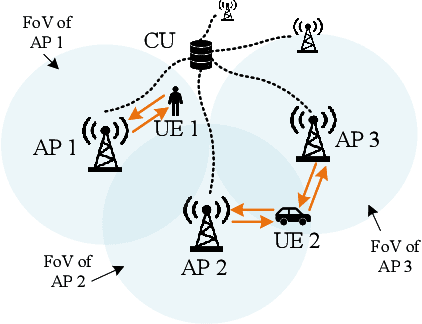
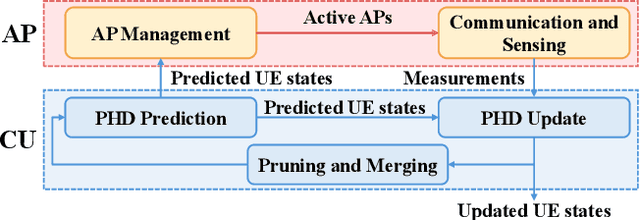
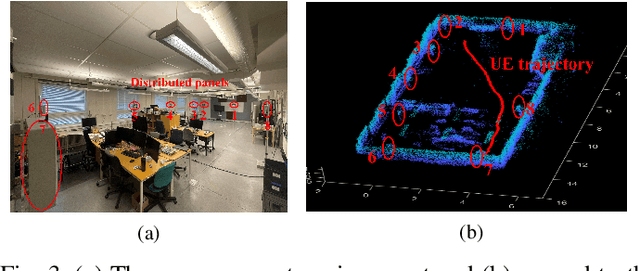
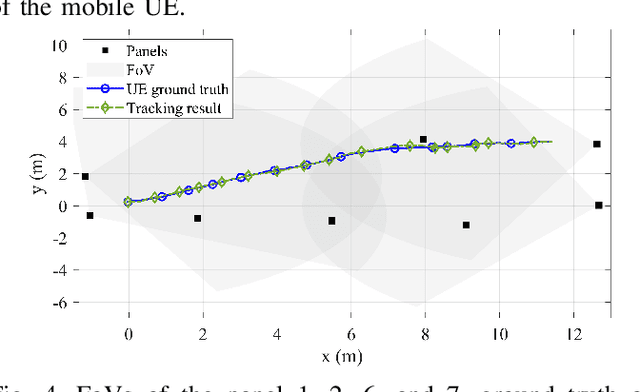
As integrated sensing and communication (ISAC) becomes an integral part of 6G networks, distributed ISAC (DISAC) is expected to enhance both sensing and communication performance through its decentralized architecture. This paper presents a complete framework to address the challenge of cooperative user tracking in DISAC systems. By incorporating a global probability hypothesis density (PHD) filter and a field-of-view-aware access point (AP) management strategy, the framework enables accurate user tracking using radio signals while optimizing AP scheduling. In addition, a real-world distributed MIMO channel measurement campaign is performed to evaluate the effectiveness of the framework. The results demonstrate that a centimeter-level root mean-square trajectory error can be achieved. Furthermore, the results show that it is not necessary to keep APs active at all times to maintain high tracking accuracy, indicating the need for robust and efficient AP management. These findings provide valuable insight into practical deployments and further development of cooperative user tracking techniques in DISAC systems.
LLM4MG: Adapting Large Language Model for Multipath Generation via Synesthesia of Machines
Sep 18, 2025Based on Synesthesia of Machines (SoM), a large language model (LLM) is adapted for multipath generation (LLM4MG) for the first time. Considering a typical sixth-generation (6G) vehicle-to-infrastructure (V2I) scenario, a new multi-modal sensing-communication dataset is constructed, named SynthSoM-V2I, including channel multipath information, millimeter wave (mmWave) radar sensory data, RGB-D images, and light detection and ranging (LiDAR) point clouds. Based on the SynthSoM-V2I dataset, the proposed LLM4MG leverages Large Language Model Meta AI (LLaMA) 3.2 for multipath generation via multi-modal sensory data. The proposed LLM4MG aligns the multi-modal feature space with the LLaMA semantic space through feature extraction and fusion networks. To further achieve general knowledge transfer from the pre-trained LLaMA for multipath generation via multi-modal sensory data, the low-rank adaptation (LoRA) parameter-efficient fine-tuning and propagation-aware prompt engineering are exploited. Simulation results demonstrate that the proposed LLM4MG outperforms conventional deep learning-based methods in terms of line-of-sight (LoS)/non-LoS (NLoS) classification with accuracy of 92.76%, multipath power/delay generation precision with normalized mean square error (NMSE) of 0.099/0.032, and cross-vehicular traffic density (VTD), cross-band, and cross-scenario generalization. The utility of the proposed LLM4MG is validated by real-world generalization. The necessity of high-precision multipath generation for system design is also demonstrated by channel capacity comparison.