 Add to Chrome
 Add to Firefox
 Add to Edge
On-Site Beam Calibration for RIS-Aided Positioning Systems
Jul 27, 2026
High precision positioning is a key enabler for next-generation communication applications such as smart transportation and augmented reality. Reconfigurable intelligent surface (RIS) technology can enhance positioning by providing additional angular information and improving coverage under obstructed propagation conditions. However, true RIS beams can differ significantly from the simplified or ideal beam response models commonly used in RIS-aided positioning, leading to beam model mismatch and an elevated positioning error floor. This paper proposes an on-site RIS beam calibration framework that reduces this error floor by estimating a realistic 3D RIS beam response model from on-site measurements. The proposed calibration algorithm first extracts the RIS-reflected channel response from signals received by a calibration agent sampling the angular range of interest, using delay-domain sparse recovery, and then estimates the beam model parameters with a gradient-based estimator. To validate the proposed framework, 3D beam patterns under 66 phase modulations were measured and incorporated into simulations. With an angular sampling step of 1 deg, the calibrated model achieves an average beam response similarity of 88.5% with respect to the ground truth, compared with 43.7% for the ideal model. The probability that the absolute lower bound of the positioning error is below 0.5m increases from 0.52 without calibration to 0.74 after calibration, showing that on-site RIS beam calibration effectively reduces the positioning error floor caused by true beam model mismatch.

Mismatch Analysis and Cooperative Calibration of Array Beam Patterns for ISAC Systems
Feb 01, 2026Integrated sensing and communication (ISAC) is a key technology for enabling a wide range of applications in future wireless systems. However, the sensing performance is often degraded by model mismatches caused by geometric errors (e.g., position and orientation) and hardware impairments (e.g., mutual coupling and amplifier non-linearity). This paper focuses on the angle estimation performance with antenna arrays and tackles the critical challenge of array beam pattern calibration for ISAC systems. To assess calibration quality from a sensing perspective, a novel performance metric that accounts for angle estimation error, rather than beam pattern similarity, is proposed and incorporated into a differentiable loss function. Additionally, a cooperative calibration framework is introduced, allowing multiple user equipments to iteratively optimize the beam pattern based on the proposed loss functions and local data, and collaboratively update global calibration parameters. The proposed models and algorithms are validated using real-world beam pattern measurements collected in an anechoic chamber. Experimental results show that the angle estimation error can be reduced from {$\textbf{1.01}^\circ$} to $\textbf{0.11}^\circ$ in 2D calibration scenarios, and from $\textbf{5.19}^\circ$ to $\textbf{0.86}^\circ$ in 3D calibration ones.
RIS Beam Calibration for ISAC Systems: Modeling and Performance Analysis
May 21, 2025High-accuracy localization is a key enabler for integrated sensing and communication (ISAC), playing an essential role in various applications such as autonomous driving. Antenna arrays and reconfigurable intelligent surface (RIS) are incorporated into these systems to achieve high angular resolution, assisting in the localization process. However, array and RIS beam patterns in practice often deviate from the idealized models used for algorithm design, leading to significant degradation in positioning accuracy. This mismatch highlights the need for beam calibration to bridge the gap between theoretical models and real-world hardware behavior. In this paper, we present and analyze three beam models considering several key non-idealities such as mutual coupling, non-ideal codebook, and measurement uncertainties. Based on the models, we then develop calibration algorithms to estimate the model parameters that can be used for future localization tasks. This work evaluates the effectiveness of the beam models and the calibration algorithms using both theoretical bounds and real-world beam pattern data from an RIS prototype. The simulation results show that the model incorporating combined impacts can accurately reconstruct measured beam patterns. This highlights the necessity of realistic beam modeling and calibration to achieve high-accuracy localization.
Joint Near-Field Sensing and Visibility Region Detection with Extremely Large Aperture Arrays
Feb 28, 2025
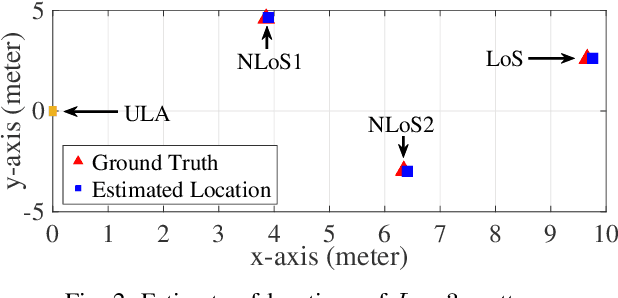


In this paper, we consider near-field localization and sensing with an extremely large aperture array under partial blockage of array antennas, where spherical wavefront and spatial non-stationarity are accounted for. We propose an Ising model to characterize the clustered sparsity feature of the blockage pattern, develop an algorithm based on alternating optimization for joint channel parameter estimation and visibility region detection, and further estimate the locations of the user and environmental scatterers. The simulation results confirm the effectiveness of the proposed algorithm compared to conventional methods.
RIS-Aided Positioning Under Adverse Conditions: Interference from Unauthorized RIS
Feb 27, 2025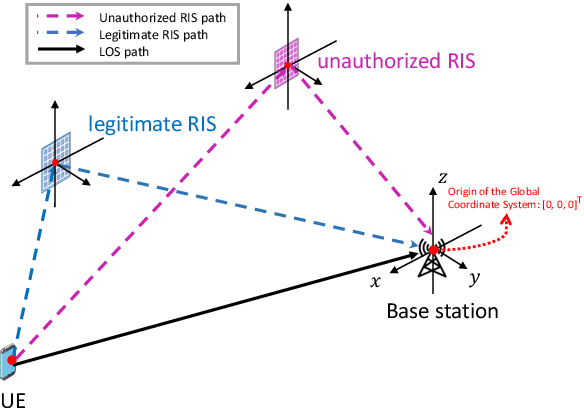
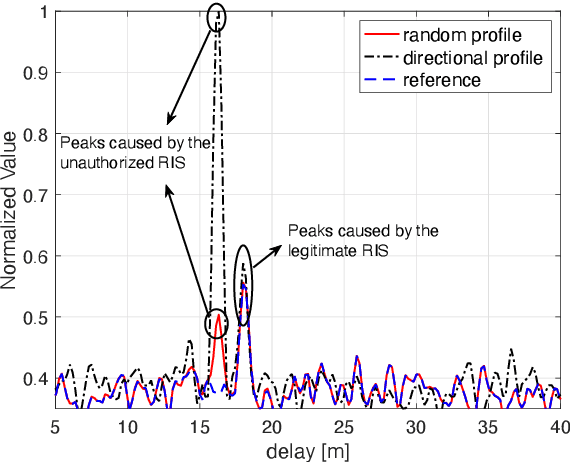
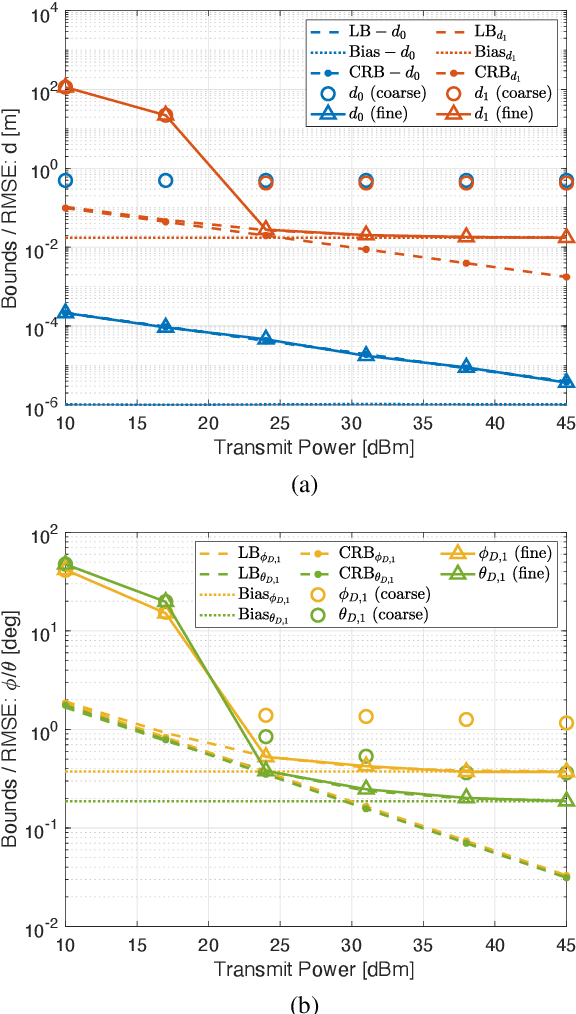
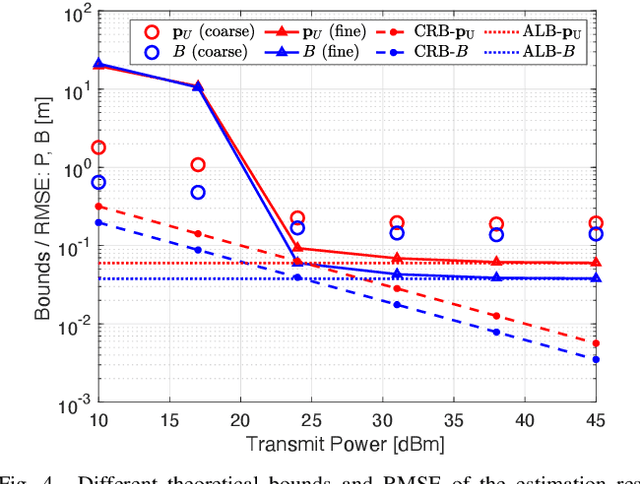
Positioning technology, which aims to determine the geometric information of a device in a global coordinate, is a key component in integrated sensing and communication systems. In addition to traditional active anchor-based positioning systems, reconfigurable intelligent surfaces (RIS) have shown great potential for enhancing system performance. However, their ability to manipulate electromagnetic waves and ease of deployment pose potential risks, as unauthorized RIS may be intentionally introduced to jeopardize the positioning service. Such an unauthorized RIS can cause unexpected interference in the original localization system, distorting the transmitted signals, and leading to degraded positioning accuracy. In this work, we investigate the scenario of RIS-aided positioning in the presence of interference from an unauthorized RIS. Theoretical lower bounds are employed to analyze the impact of unauthorized RIS on channel parameter estimation and positioning accuracy. Several codebook design strategies for unauthorized RIS are evaluated, and various system arrangements are discussed. The simulation results show that an unauthorized RIS path with a high channel gain or a delay similar to that of legitimate RIS paths leads to poor positioning performance. Furthermore, unauthorized RIS generates more effective interference when using directional beamforming codebooks compared to random codebooks.
Privacy Preservation in MIMO-OFDM Localization Systems: A Beamforming Approach
Jan 02, 2025We investigate an uplink MIMO-OFDM localization scenario where a legitimate base station (BS) aims to localize a user equipment (UE) using pilot signals transmitted by the UE, while an unauthorized BS attempts to localize the UE by eavesdropping on these pilots, posing a risk to the UE's location privacy. To enhance legitimate localization performance while protecting the UE's privacy, we formulate an optimization problem regarding the beamformers at the UE, aiming to minimize the Cram\'er-Rao bound (CRB) for legitimate localization while constraining the CRB for unauthorized localization above a threshold. A penalty dual decomposition optimization framework is employed to solve the problem, leading to a novel beamforming approach for location privacy preservation. Numerical results confirm the effectiveness of the proposed approach and demonstrate its superiority over existing benchmarks.