 Add to Chrome
 Add to Firefox
 Add to Edge
WhisperRec: Latent Reasoning for Efficient Foundation Recommendation Models
Jul 29, 2026
Large language models (LLMs) have demonstrated strong reasoning capabilities, motivating their adoption as backbones for foundation recommendation models (FRMs). Existing approaches typically enhance recommendation with explicit Chain-of-Thought (CoT) under the Think-then-Answer paradigm. However, generating lengthy rationales introduces substantial inference overhead, while fixed CoT templates struggle to model diverse, dynamic, and context-dependent user interests. We propose WhisperRec, an efficient latent reasoning framework for FRMs. WhisperRec compresses teacher-generated CoT into learnable latent reasoning tokens, enabling a Latent-Reason-then-Answer paradigm that performs reasoning in latent space without producing verbose rationales. This design retains decision-relevant reasoning information while avoiding the latency bottleneck of autoregressive rationale generation. Specifically, it first introduces Multi-View Adaptive CoT (MV-ACoT) to construct diverse, high-quality supervision from complementary perspectives on user interests. MV-ACoT also adapts reasoning complexity to each instance, applying lightweight analysis to clear cases and targeted multi-factor reasoning to challenging ones. Building on a pre-trained FRM, WhisperRec then employs a three-stage Latent Reasoning Alignment procedure to progressively internalize teacher CoT into latent representations. Finally, curriculum-based post-training activates latent-token reasoning for downstream recommendation while preserving standard recommendation capability. Experiments on an industrial-scale Kuaishou dataset and the public Kuaishou LLM-Rec benchmark show that WhisperRec consistently outperforms explicit-CoT methods and conventional baselines. Compared with explicit CoT Think and No-Think variants, WhisperRec improves SID@64 by 17.44% and 9.33%, respectively, and achieves over 10x higher online inference throughput.

POEM: Partial-Order Enhanced Real-Time Sequential Modeling for Recommendation
Jun 29, 2026Real-time recommendation systems suffer from the dynamic drift of user interests and varying contextual conditions. Conventional sequential recommendation models only exploit static historical click sequences, which fail to capture instant preference changes and overlook structured signals hidden within the multi-stage ranking pipeline of industrial recommendation systems. To tackle these limitations, we propose POEM (Partial-Order Enhanced Modeling), a new real-time sequential modeling framework built upon intrinsic partial-order relations from the recommendation cascade. POEM takes real-time multi-task ranking scores (including predicted CTR and predicted watch duration) generated by upstream ranking modules as supervision to construct dynamic partial-order sequences, supporting fine-grained real-time interest modeling and consistent optimization between system ranking targets and user behavioral patterns. We summarize our core contributions as three aspects: (1) a partial-order guided sequence construction paradigm, which enriches vanilla chronological sequences via dynamic grouping and sampling conditioned on real-time ranking scores to reassess user interests per request; (2) a multi-objective score fusion module that unifies heterogeneous ranking signals into a compact quintuple representation with normalized rank-aware weighting; (3) a hierarchical sample learning strategy, which adopts system-favored high-ranked items and user positive feedback (e.g., long-duration watched videos) as positive instances, paired with graph-mined hard negatives and a margin-based pairwise loss for robust training. Fully deployed on Kuaishou online traffic, POEM achieves significant online gains: average per-user watch time lifts by 0.249% on the KS Single Page and 0.213% on the KS Lite Page.
OneReason Technical Report
Jun 04, 2026Generative recommendation models in the OneRec family have been widely deployed in many real-world services, such as short-video, live-streaming, advertising, and e-commerce. However, these generative models can only benefit from the scaling advantage, while their reasoning ability is hard to activate, since we cannot construct meaningful Chain-of-Thought (CoT) sequences consisting of itemic tokens only. Inspired by the success of the reasoning-style ``think before answer'' paradigm in the LLM field, we conduct preliminary studies (i.e., OneRec-Think, OpenOneRec) to explore reasoning capability in generative recommendation. Nevertheless, we notice an unexpected phenomenon: the thinking mode does not show advantages over the non-thinking mode. Drawing insights from recent findings on CoT robustness in multi-modal language models, we argue that effective reasoning in recommendation rests on two factors: perception, the ability to ground itemic tokens in their underlying language semantics, and cognition, the ability to reorganize a user's behavior sequence into coherent latent interest points. We therefore propose OneReason, which includes: (1) strong itemic token perception in pre-training, (2) a three-level cognition-enhanced CoT format for recommendation tasks in SFT, and (3) a specialize-then-unify training recipe in RL to enhance the thinking ability.
COPR: Consistency-Oriented Pre-Ranking for Online Advertising
Jun 06, 2023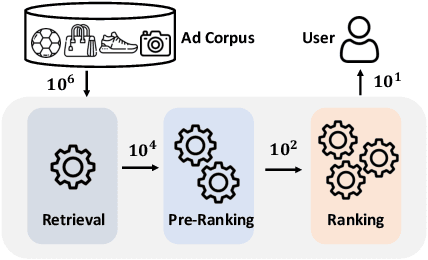

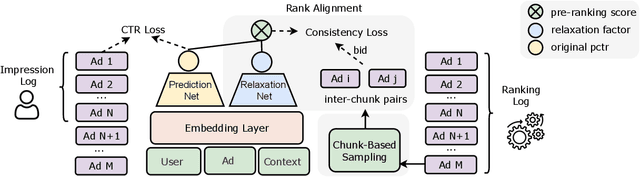

Cascading architecture has been widely adopted in large-scale advertising systems to balance efficiency and effectiveness. In this architecture, the pre-ranking model is expected to be a lightweight approximation of the ranking model, which handles more candidates with strict latency requirements. Due to the gap in model capacity, the pre-ranking and ranking models usually generate inconsistent ranked results, thus hurting the overall system effectiveness. The paradigm of score alignment is proposed to regularize their raw scores to be consistent. However, it suffers from inevitable alignment errors and error amplification by bids when applied in online advertising. To this end, we introduce a consistency-oriented pre-ranking framework for online advertising, which employs a chunk-based sampling module and a plug-and-play rank alignment module to explicitly optimize consistency of ECPM-ranked results. A $\Delta NDCG$-based weighting mechanism is adopted to better distinguish the importance of inter-chunk samples in optimization. Both online and offline experiments have validated the superiority of our framework. When deployed in Taobao display advertising system, it achieves an improvement of up to +12.3\% CTR and +5.6\% RPM.
Capturing Conversion Rate Fluctuation during Sales Promotions: A Novel Historical Data Reuse Approach
May 22, 2023
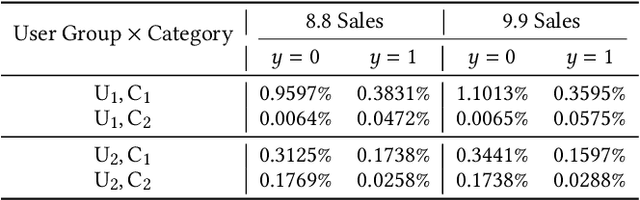
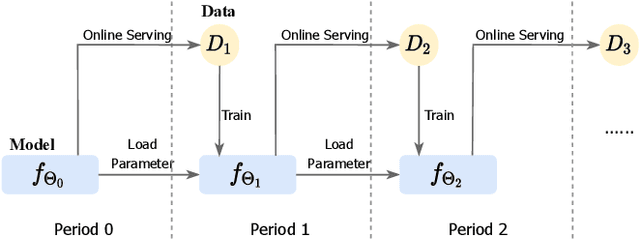
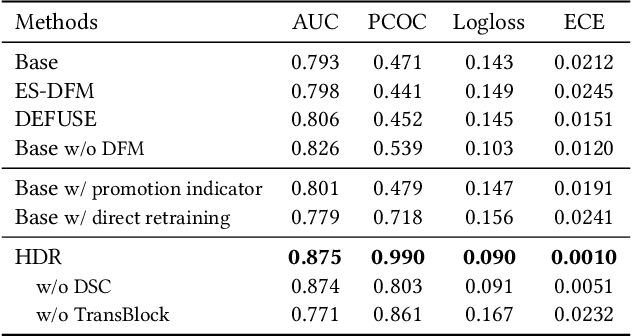
Conversion rate (CVR) prediction is one of the core components in online recommender systems, and various approaches have been proposed to obtain accurate and well-calibrated CVR estimation. However, we observe that a well-trained CVR prediction model often performs sub-optimally during sales promotions. This can be largely ascribed to the problem of the data distribution shift, in which the conventional methods no longer work. To this end, we seek to develop alternative modeling techniques for CVR prediction. Observing similar purchase patterns across different promotions, we propose reusing the historical promotion data to capture the promotional conversion patterns. Herein, we propose a novel \textbf{H}istorical \textbf{D}ata \textbf{R}euse (\textbf{HDR}) approach that first retrieves historically similar promotion data and then fine-tunes the CVR prediction model with the acquired data for better adaptation to the promotion mode. HDR consists of three components: an automated data retrieval module that seeks similar data from historical promotions, a distribution shift correction module that re-weights the retrieved data for better aligning with the target promotion, and a TransBlock module that quickly fine-tunes the original model for better adaptation to the promotion mode. Experiments conducted with real-world data demonstrate the effectiveness of HDR, as it improves both ranking and calibration metrics to a large extent. HDR has also been deployed on the display advertising system in Alibaba, bringing a lift of $9\%$ RPM and $16\%$ CVR during Double 11 Sales in 2022.