 Add to Chrome
 Add to Firefox
 Add to Edge
Latent-Frequency Validity: Fast Spectral Editing with Screened Video-VAE Transfer Operators
Aug 04, 2026
Direct spectral editing in video-VAE latents can control noise, flicker, smoothness, and frequency content without a decode--filter--reencode pass. However, video VAEs may redistribute pixel-space frequency bands across latent channels, and latent edits can disrupt VAE round-trip dynamics. We introduce \emph{latent-frequency validity} (LFV), which learns a compact VAE-specific spectral response and deploys it only when it improves decoded-target fidelity without worsening round-trip drift. LFV follows a validation-selected path from a diagonal per-frequency calibrator (C1) to full channel mixing (CM), making cross-channel capacity a controllable per-edit resource. Across 544 VAE--edit cells spanning six spectral families, LFV emits 423 cheap operators: 277 are handled by C1, while 146 (34.5\% of emitted operators) require channel mixing. On the primary 120-cell radial sweep, 99/100 emitted operators pass source-video-grouped held-out evaluation. Across five additional filter families, all 323 emitted operators pass held-out evaluation. Fully frozen OpenVid-fitted operators, including the validation-selected path coefficient, pass all 20 tested CogVideoX and HunyuanVideo generated-domain cells without adaptation. The selected response matches direct latent-filter latency and is about $3\times$ faster than pixel filter--reencode. The resulting maps reveal distinct VAE regimes, including strongly channel-coupled CogVideoX responses and a sharp Open-Sora high-band stability frontier.

FourTune: Towards Fully 4-Bit Efficient Post-Training for Diffusion Models
Jul 07, 2026Diffusion models have become a dominant paradigm for high-quality generative modeling, while post-training is essential for adapting them to diverse downstream applications. However, post-training of large diffusion models is still challenging due to the prohibitive memory footprints and slow training speed, which existing parameter-efficient fine-tuning methods only partially address. To overcome these limitations, we propose FourTune, an efficient post-training framework for diffusion models based on an end-to-end W4A4G4 paradigm. FourTune introduces a triple-branch hybrid pipeline that augments the standard LoRA architecture with a frozen numerical stabilizer to isolate quantization-sensitive outliers, enabling stable training under native 4-bit computation. In addition, FourTune employs hardware-efficient block-wise quantization and customized fused kernels to support efficient quantized backpropagation and reduce memory bandwidth overhead. Across customization, reinforcement learning, and distillation tasks, FourTune matches the quality of full-precision fine-tuning. On FLUX.1-dev (12B), FourTune reduces memory overhead by 2.25$\times$ and increases end-to-end training throughput by 2.27$\times$ compared to BF16 LoRA.
VideoNeuMat: Neural Material Extraction from Generative Video Models
Feb 06, 2026Creating photorealistic materials for 3D rendering requires exceptional artistic skill. Generative models for materials could help, but are currently limited by the lack of high-quality training data. While recent video generative models effortlessly produce realistic material appearances, this knowledge remains entangled with geometry and lighting. We present VideoNeuMat, a two-stage pipeline that extracts reusable neural material assets from video diffusion models. First, we finetune a large video model (Wan 2.1 14B) to generate material sample videos under controlled camera and lighting trajectories, effectively creating a "virtual gonioreflectometer" that preserves the model's material realism while learning a structured measurement pattern. Second, we reconstruct compact neural materials from these videos through a Large Reconstruction Model (LRM) finetuned from a smaller Wan 1.3B video backbone. From 17 generated video frames, our LRM performs single-pass inference to predict neural material parameters that generalize to novel viewing and lighting conditions. The resulting materials exhibit realism and diversity far exceeding the limited synthetic training data, demonstrating that material knowledge can be successfully transferred from internet-scale video models into standalone, reusable neural 3D assets.
Stand-In: A Lightweight and Plug-and-Play Identity Control for Video Generation
Aug 12, 2025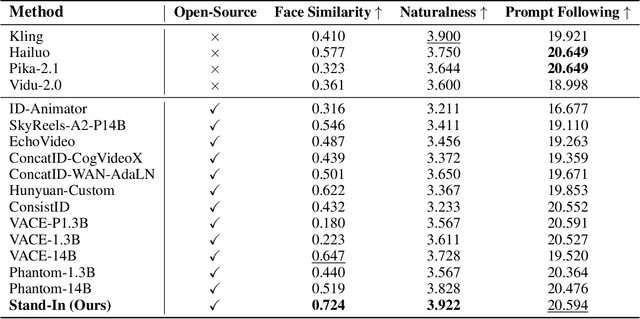
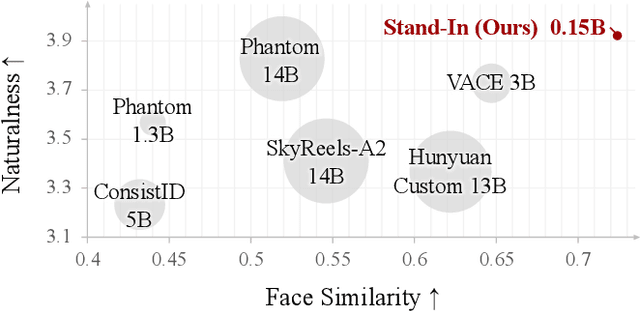
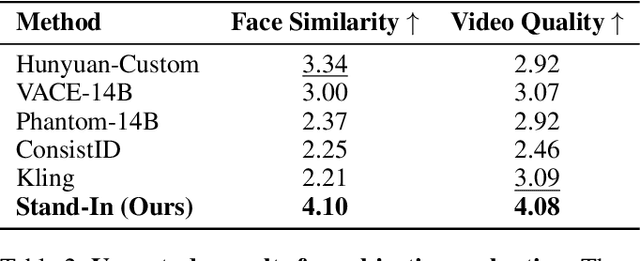
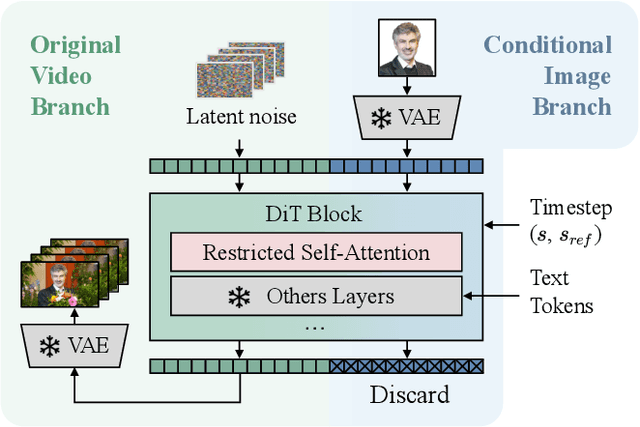
Generating high-fidelity human videos that match user-specified identities is important yet challenging in the field of generative AI. Existing methods often rely on an excessive number of training parameters and lack compatibility with other AIGC tools. In this paper, we propose Stand-In, a lightweight and plug-and-play framework for identity preservation in video generation. Specifically, we introduce a conditional image branch into the pre-trained video generation model. Identity control is achieved through restricted self-attentions with conditional position mapping, and can be learned quickly with only 2000 pairs. Despite incorporating and training just $\sim$1% additional parameters, our framework achieves excellent results in video quality and identity preservation, outperforming other full-parameter training methods. Moreover, our framework can be seamlessly integrated for other tasks, such as subject-driven video generation, pose-referenced video generation, stylization, and face swapping.
An Improved NeuMIP with Better Accuracy
Jul 19, 2023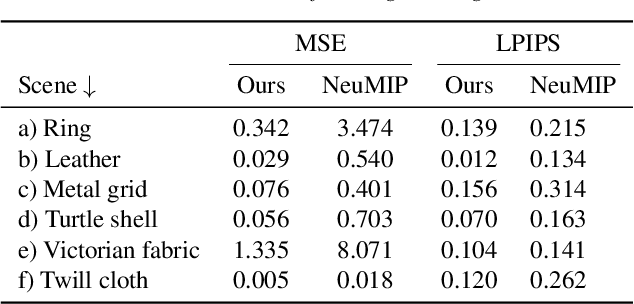
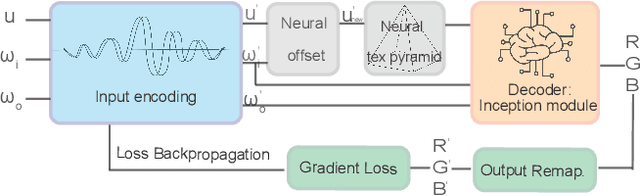


Neural reflectance models are capable of accurately reproducing the spatially-varying appearance of many real-world materials at different scales. However, existing methods have difficulties handling highly glossy materials. To address this problem, we introduce a new neural reflectance model which, compared with existing methods, better preserves not only specular highlights but also fine-grained details. To this end, we enhance the neural network performance by encoding input data to frequency space, inspired by NeRF, to better preserve the details. Furthermore, we introduce a gradient-based loss and employ it in multiple stages, adaptive to the progress of the learning phase. Lastly, we utilize an optional extension to the decoder network using the Inception module for more accurate yet costly performance. We demonstrate the effectiveness of our method using a variety of synthetic and real examples.