 Add to Chrome
 Add to Firefox
 Add to Edge
Point-SLAM: Dense Neural Point Cloud-based SLAM
Apr 09, 2023
We propose a dense neural simultaneous localization and mapping (SLAM) approach for monocular RGBD input which anchors the features of a neural scene representation in a point cloud that is iteratively generated in an input-dependent data-driven manner. We demonstrate that both tracking and mapping can be performed with the same point-based neural scene representation by minimizing an RGBD-based re-rendering loss. In contrast to recent dense neural SLAM methods which anchor the scene features in a sparse grid, our point-based approach allows dynamically adapting the anchor point density to the information density of the input. This strategy reduces runtime and memory usage in regions with fewer details and dedicates higher point density to resolve fine details. Our approach performs either better or competitive to existing dense neural RGBD SLAM methods in tracking, mapping and rendering accuracy on the Replica, TUM-RGBD and ScanNet datasets. The source code is available at https://github.com/tfy14esa/Point-SLAM.

Online Lane Graph Extraction from Onboard Video
Apr 03, 2023Autonomous driving requires a structured understanding of the surrounding road network to navigate. One of the most common and useful representation of such an understanding is done in the form of BEV lane graphs. In this work, we use the video stream from an onboard camera for online extraction of the surrounding's lane graph. Using video, instead of a single image, as input poses both benefits and challenges in terms of combining the information from different timesteps. We study the emerged challenges using three different approaches. The first approach is a post-processing step that is capable of merging single frame lane graph estimates into a unified lane graph. The second approach uses the spatialtemporal embeddings in the transformer to enable the network to discover the best temporal aggregation strategy. Finally, the third, and the proposed method, is an early temporal aggregation through explicit BEV projection and alignment of framewise features. A single model of this proposed simple, yet effective, method can process any number of images, including one, to produce accurate lane graphs. The experiments on the Nuscenes and Argoverse datasets show the validity of all the approaches while highlighting the superiority of the proposed method. The code will be made public.
Enhanced Stable View Synthesis
Mar 30, 2023We introduce an approach to enhance the novel view synthesis from images taken from a freely moving camera. The introduced approach focuses on outdoor scenes where recovering accurate geometric scaffold and camera pose is challenging, leading to inferior results using the state-of-the-art stable view synthesis (SVS) method. SVS and related methods fail for outdoor scenes primarily due to (i) over-relying on the multiview stereo (MVS) for geometric scaffold recovery and (ii) assuming COLMAP computed camera poses as the best possible estimates, despite it being well-studied that MVS 3D reconstruction accuracy is limited to scene disparity and camera-pose accuracy is sensitive to key-point correspondence selection. This work proposes a principled way to enhance novel view synthesis solutions drawing inspiration from the basics of multiple view geometry. By leveraging the complementary behavior of MVS and monocular depth, we arrive at a better scene depth per view for nearby and far points, respectively. Moreover, our approach jointly refines camera poses with image-based rendering via multiple rotation averaging graph optimization. The recovered scene depth and the camera-pose help better view-dependent on-surface feature aggregation of the entire scene. Extensive evaluation of our approach on the popular benchmark dataset, such as Tanks and Temples, shows substantial improvement in view synthesis results compared to the prior art. For instance, our method shows 1.5 dB of PSNR improvement on the Tank and Temples. Similar statistics are observed when tested on other benchmark datasets such as FVS, Mip-NeRF 360, and DTU.
Unsupervised Deep Probabilistic Approach for Partial Point Cloud Registration
Mar 23, 2023Deep point cloud registration methods face challenges to partial overlaps and rely on labeled data. To address these issues, we propose UDPReg, an unsupervised deep probabilistic registration framework for point clouds with partial overlaps. Specifically, we first adopt a network to learn posterior probability distributions of Gaussian mixture models (GMMs) from point clouds. To handle partial point cloud registration, we apply the Sinkhorn algorithm to predict the distribution-level correspondences under the constraint of the mixing weights of GMMs. To enable unsupervised learning, we design three distribution consistency-based losses: self-consistency, cross-consistency, and local contrastive. The self-consistency loss is formulated by encouraging GMMs in Euclidean and feature spaces to share identical posterior distributions. The cross-consistency loss derives from the fact that the points of two partially overlapping point clouds belonging to the same clusters share the cluster centroids. The cross-consistency loss allows the network to flexibly learn a transformation-invariant posterior distribution of two aligned point clouds. The local contrastive loss facilitates the network to extract discriminative local features. Our UDPReg achieves competitive performance on the 3DMatch/3DLoMatch and ModelNet/ModelLoNet benchmarks.
NeRF-GAN Distillation for Efficient 3D-Aware Generation with Convolutions
Mar 22, 2023Pose-conditioned convolutional generative models struggle with high-quality 3D-consistent image generation from single-view datasets, due to their lack of sufficient 3D priors. Recently, the integration of Neural Radiance Fields (NeRFs) and generative models, such as Generative Adversarial Networks (GANs), has transformed 3D-aware generation from single-view images. NeRF-GANs exploit the strong inductive bias of 3D neural representations and volumetric rendering at the cost of higher computational complexity. This study aims at revisiting pose-conditioned 2D GANs for efficient 3D-aware generation at inference time by distilling 3D knowledge from pretrained NeRF-GANS. We propose a simple and effective method, based on re-using the well-disentangled latent space of a pre-trained NeRF-GAN in a pose-conditioned convolutional network to directly generate 3D-consistent images corresponding to the underlying 3D representations. Experiments on several datasets demonstrate that the proposed method obtains results comparable with volumetric rendering in terms of quality and 3D consistency while benefiting from the superior computational advantage of convolutional networks. The code will be available at: https://github.com/mshahbazi72/NeRF-GAN-Distillation
Lidar Line Selection with Spatially-Aware Shapley Value for Cost-Efficient Depth Completion
Mar 21, 2023Lidar is a vital sensor for estimating the depth of a scene. Typical spinning lidars emit pulses arranged in several horizontal lines and the monetary cost of the sensor increases with the number of these lines. In this work, we present the new problem of optimizing the positioning of lidar lines to find the most effective configuration for the depth completion task. We propose a solution to reduce the number of lines while retaining the up-to-the-mark quality of depth completion. Our method consists of two components, (1) line selection based on the marginal contribution of a line computed via the Shapley value and (2) incorporating line position spread to take into account its need to arrive at image-wide depth completion. Spatially-aware Shapley values (SaS) succeed in selecting line subsets that yield a depth accuracy comparable to the full lidar input while using just half of the lines.
DiffIR: Efficient Diffusion Model for Image Restoration
Mar 16, 2023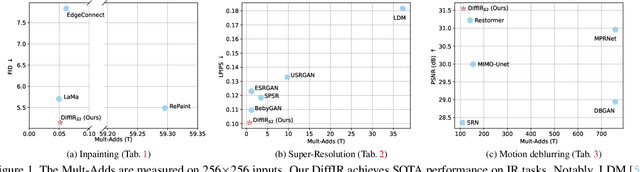
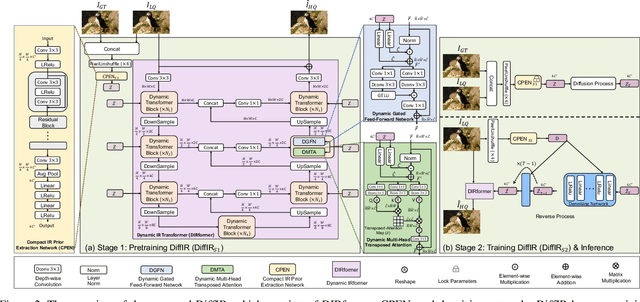
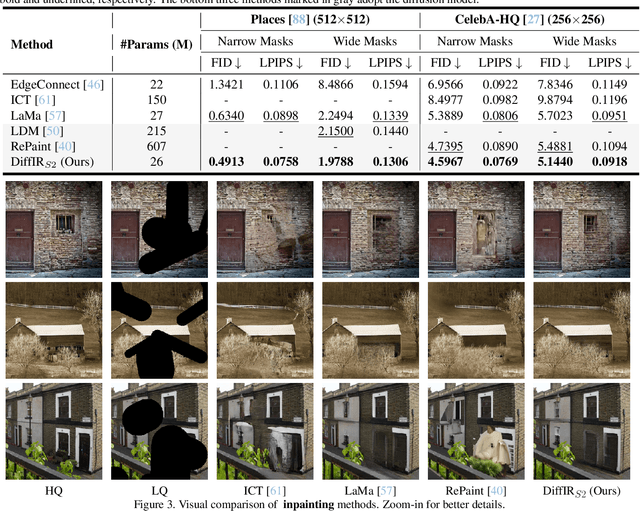
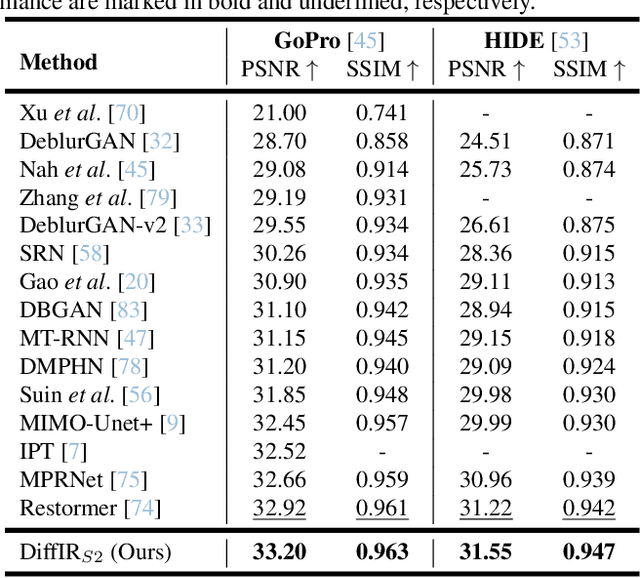
Diffusion model (DM) has achieved SOTA performance by modeling the image synthesis process into a sequential application of a denoising network. However, different from image synthesis generating each pixel from scratch, most pixels of image restoration (IR) are given. Thus, for IR, traditional DMs running massive iterations on a large model to estimate whole images or feature maps is inefficient. To address this issue, we propose an efficient DM for IR (DiffIR), which consists of a compact IR prior extraction network (CPEN), dynamic IR transformer (DIRformer), and denoising network. Specifically, DiffIR has two training stages: pretraining and training DM. In pretraining, we input ground-truth images into CPEN$_{S1}$ to capture a compact IR prior representation (IPR) to guide DIRformer. In the second stage, we train the DM to directly estimate the same IRP as pretrained CPEN$_{S1}$ only using LQ images. We observe that since the IPR is only a compact vector, DiffIR can use fewer iterations than traditional DM to obtain accurate estimations and generate more stable and realistic results. Since the iterations are few, our DiffIR can adopt a joint optimization of CPEN$_{S2}$, DIRformer, and denoising network, which can further reduce the estimation error influence. We conduct extensive experiments on several IR tasks and achieve SOTA performance while consuming less computational costs.
Spherical Space Feature Decomposition for Guided Depth Map Super-Resolution
Mar 15, 2023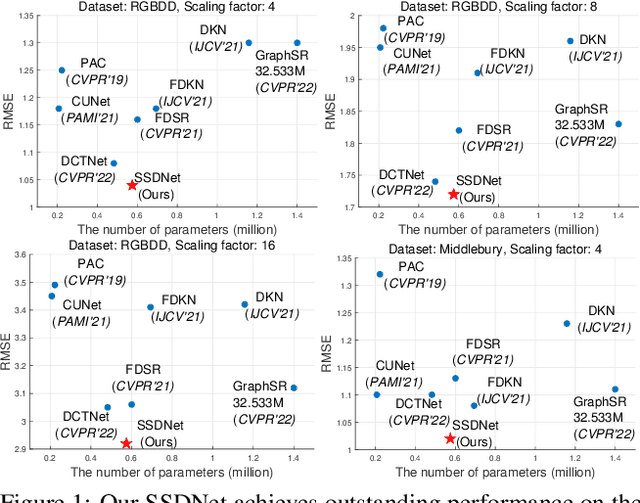

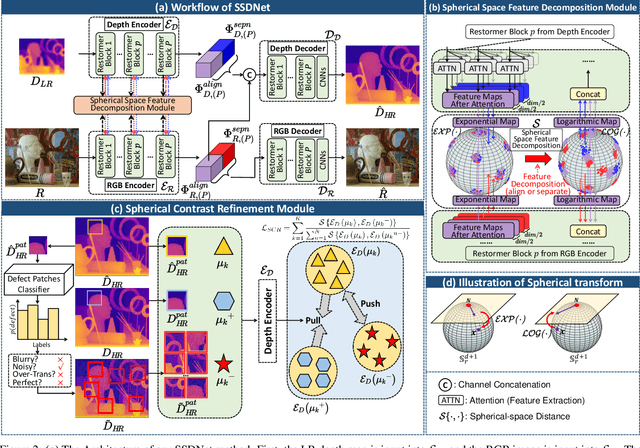

Guided depth map super-resolution (GDSR), as a hot topic in multi-modal image processing, aims to upsample low-resolution (LR) depth maps with additional information involved in high-resolution (HR) RGB images from the same scene. The critical step of this task is to effectively extract domain-shared and domain-private RGB/depth features. In addition, three detailed issues, namely blurry edges, noisy surfaces, and over-transferred RGB texture, need to be addressed. In this paper, we propose the Spherical Space feature Decomposition Network (SSDNet) to solve the above issues. To better model cross-modality features, Restormer block-based RGB/depth encoders are employed for extracting local-global features. Then, the extracted features are mapped to the spherical space to complete the separation of private features and the alignment of shared features. Shared features of RGB are fused with the depth features to complete the GDSR task. Subsequently, a spherical contrast refinement (SCR) module is proposed to further address the detail issues. Patches that are classified according to imperfect categories are input to the SCR module, where the patch features are pulled closer to the ground truth and pushed away from the corresponding imperfect samples in the spherical feature space via contrastive learning. Extensive experiments demonstrate that our method can achieve state-of-the-art results on four test datasets and can successfully generalize to real-world scenes. Code will be released.
Graph Transformer GANs for Graph-Constrained House Generation
Mar 14, 2023We present a novel graph Transformer generative adversarial network (GTGAN) to learn effective graph node relations in an end-to-end fashion for the challenging graph-constrained house generation task. The proposed graph-Transformer-based generator includes a novel graph Transformer encoder that combines graph convolutions and self-attentions in a Transformer to model both local and global interactions across connected and non-connected graph nodes. Specifically, the proposed connected node attention (CNA) and non-connected node attention (NNA) aim to capture the global relations across connected nodes and non-connected nodes in the input graph, respectively. The proposed graph modeling block (GMB) aims to exploit local vertex interactions based on a house layout topology. Moreover, we propose a new node classification-based discriminator to preserve the high-level semantic and discriminative node features for different house components. Finally, we propose a novel graph-based cycle-consistency loss that aims at maintaining the relative spatial relationships between ground truth and predicted graphs. Experiments on two challenging graph-constrained house generation tasks (i.e., house layout and roof generation) with two public datasets demonstrate the effectiveness of GTGAN in terms of objective quantitative scores and subjective visual realism. New state-of-the-art results are established by large margins on both tasks.
DDFM: Denoising Diffusion Model for Multi-Modality Image Fusion
Mar 13, 2023Multi-modality image fusion aims to combine different modalities to produce fused images that retain the complementary features of each modality, such as functional highlights and texture details. To leverage strong generative priors and address challenges such as unstable training and lack of interpretability for GAN-based generative methods, we propose a novel fusion algorithm based on the denoising diffusion probabilistic model (DDPM). The fusion task is formulated as a conditional generation problem under the DDPM sampling framework, which is further divided into an unconditional generation subproblem and a maximum likelihood subproblem. The latter is modeled in a hierarchical Bayesian manner with latent variables and inferred by the expectation-maximization algorithm. By integrating the inference solution into the diffusion sampling iteration, our method can generate high-quality fused images with natural image generative priors and cross-modality information from source images. Note that all we required is an unconditional pre-trained generative model, and no fine-tuning is needed. Our extensive experiments indicate that our approach yields promising fusion results in infrared-visible image fusion and medical image fusion. The code will be released.