 Add to Chrome
 Add to Firefox
 Add to Edge
Identity-Faithful Audio-Visual Target Speaker Extraction with REAL-2MIX and VOXBLINK2-AVSE
Aug 06, 2026
Audio-visual target speaker extraction should return the speaker indicated by the video, yet a separator can ignore the visual cue and repeatedly output the acoustically dominant voice. We introduce REAL-2MIX, a Mandarin AV-TSE benchmark of jointly recorded real two-speaker mixtures with synchronized multi-view video. Each scene also contains preceding A-only and B-only stages that provide in-scene speaker references. It contains 77 scenes and 7,598 clips (11.84 hours), including 6,042 dual-annotated mixtures. After processing there leave 6,038 evaluable mixtures and 12,076 target-speaker rows. We additionally curate VOXBLINK2-AVSE from VoxBlink2, comprising 250,828 synchronized audio--lip-ROI pairs from 28,421 identities and 766.17 hours of speech. Our extractor uses frozen, 1,280-dimensional projected AV-HuBERT features, target-conditioned training, and layer-wise feature modulation. We jointly evaluate content with Qwen3-ASR-1.7B CER and target identity with WeSpeaker ResNet34 plus Overlapped Speech Detection (OSD). On the complete manifest, the best archived checkpoint obtains 0.2261 CER, 82.22% strict output correctness, and 69.53% both-output strict success.

Child-Oriented AIGC Video Risk Reviewing: A Benchmark and Knowledge-Supported Iterative Reasoning Framework
Jul 21, 2026The rapid growth of Artificial Intelligence-generated content (AIGC) is reshaping video production and circulation, exposing children to an increasing volume of AIGC videos. Unlike traditionally produced videos, AIGC videos often exhibit greater uncertainty in visual details, narrative coherence, and content expression, which may introduce developmentally inappropriate risks for children. However, existing video safety research is largely designed for general violation detection from an adult perspective and remains insufficient for identifying the fine-grained, implicit, and context-dependent risks that children may encounter when viewing AIGC videos. To address this gap, we study child-oriented AIGC video reviewing, making three contributions. First, we construct CAVSR, a benchmark of 605 real-world videos collected from multiple platforms, and develop a hierarchical risk taxonomy comprising 6 top-level categories and 26 fine-grained labels to support systematic evaluation of children's viewing risks. Second, we propose QVRS-E, a knowledge- and experience-augmented video reviewing framework that combines multi-agent collaboration with expert and experiential knowledge to support targeted evidence acquisition and fact-grounded reviewing decisions. Third, extensive experiments demonstrate that our method significantly enhances the reviewing of child-related risks integrated with vision-language models, and yields more robust review reports.
ECHOv2: Two-Level Band-Splitting Representation Learning for Anomalous Sound Detection
Jul 12, 2026Machine anomalous sound detection (ASD) requires robust audio representations capable of capturing subtle deviations in machine sounds under limited supervision. Existing pre-trained audio backbones do not fully capture frequency-specific characteristics of machine sounds. To address this, we propose ECHOv2, a band-splitting model that learns localized intra-band representations to capture fine-grained spectral patterns while also incorporating a two-level self-distillation strategy with explicit inter-band supervision to model cross-frequency dependencies. The inter-band branch performs global context alignment and masked sub-band reconstruction, and multiple summary tokens are introduced for structured aggregation with controllable frequency granularity, enabling region-aware interaction across sub-bands during training. This design allows ECHOv2 to robustly handle diverse machine types and noisy operating conditions while maintaining stable representation quality. To enable fair and consistent evaluation of pre-trained audio backbones, we establish a unified ASD benchmark over DCASE 2020-2025 with two complementary protocols: embedding-based evaluation for frozen representation discriminability and adaptation-based evaluation for downstream transferability. Ablation studies confirm the effectiveness of intra-band learning, inter-band supervision, and structured aggregation granularity for robust ASD representation learning. These findings demonstrate that structured cross-band modeling provides a powerful and adaptable framework for ASD representation learning and can serve as a strong foundation for future research. The model and benchmark are fully open-sourced at https://github.com/yucongzh/ECHOv2 and https://github.com/yucongzh/ASD_Benchmark to promote reproducible research.
M2S-AVSR: Modality-aware Multi-view Self-supervised Representation for Robust Audio-Visual Speech Recognition
Jun 04, 2026Audio-Visual Speech Recognition (AVSR) enhances speech recognition robustness by leveraging visual cues, while real-world scenarios remain challenging due to viewpoint variation, audio distortion, and visual occlusion, which degrade modality quality and increase audio-visual asynchrony. In this paper, we propose a novel Modality-aware Multi-view Self-supervised representation framework for robust Audio-Visual Speech Recognition (M2S-AVSR). First, we introduce a multi-view representation learning encoder to learn view-invariant visual speech representations. Next, we employ a modality-aware module that explicitly models modality quality and cross-modal synchrony to perform fine-grained modality-aware fusion, enabling fine-grained visual information injection during decoding. In addition, we present AISHELL8-RealScene, a public multi-scenario, multi-view conversational audio-visual dataset recorded in real-world environments, and establish a speech recognition benchmark on it. Experiments on English and Mandarin benchmarks demonstrate the effectiveness of the proposed method under challenging conditions. On LRS3, M2S-AVSR achieves up to 29.4% relative improvement under viewpoint perturbation and visual degradation settings. Our method also achieves new state-of-the-art performance on the MISP2021-AVSR test set. On AISHELL8-RealScene, it achieves the best result in outdoor scenes. The proposed method and dataset provide useful support for future research on robust speech and multimodal tasks under realistic conditions.
DM-ASR: Diarization-aware Multi-speaker ASR with Large Language Models
Apr 24, 2026Multi-speaker automatic speech recognition (ASR) aims to transcribe conversational speech involving multiple speakers, requiring the model to capture not only what was said, but also who said it and sometimes when it was spoken. Recent Speech-LLM approaches have shown the potential of unified modeling for this task, but jointly learning speaker attribution, temporal structure, and lexical recognition remains difficult and data-intensive. At the current stage, leveraging reliable speaker diarization as an explicit structural prior provides a practical and efficient way to simplify this task. To effectively exploit such priors, we propose DM-ASR, a diarization-aware multi-speaker ASR framework that reformulates the task as a multi-turn dialogue generation process. Given an audio chunk and diarization results, DM-ASR decomposes transcription into a sequence of speaker- and time-conditioned queries, each corresponding to one speaker in one time segment. This formulation converts multi-speaker recognition into a series of structured sub-tasks, explicitly decoupling speaker-temporal structure from linguistic content and enabling effective integration of diarization cues with the reasoning capability of large language models. We further introduce an optional word-level timestamp prediction mechanism that interleaves word and timestamp tokens, yielding richer structured outputs and better transcription quality. Our analysis shows that diarization systems provide more reliable speaker identities and segment-level boundaries, while LLMs excel at modeling linguistic content and long-range dependencies, demonstrating their complementary strengths. Experiments on Mandarin and English benchmarks show that the proposed approach achieves strong performance with relatively small models and training data, while remaining competitive with or outperforming existing unified approaches.
Multi-View Based Audio Visual Target Speaker Extraction
Mar 11, 2026Audio-Visual Target Speaker Extraction (AVTSE) aims to separate a target speaker's voice from a mixed audio signal using the corresponding visual cues. While most existing AVTSE methods rely exclusively on frontal-view videos, this limitation restricts their robustness in real-world scenarios where non-frontal views are prevalent. Such visual perspectives often contain complementary articulatory information that could enhance speech extraction. In this work, we propose Multi-View Tensor Fusion (MVTF), a novel framework that transforms multi-view learning into single-view performance gains. During the training stage, we leverage synchronized multi-perspective lip videos to learn cross-view correlations through MVTF, where pairwise outer products explicitly model multiplicative interactions between different views of input lip embeddings. At the inference stage, the system supports both single-view and multi-view inputs. Experimental results show that in the single-view inputs, our framework leverages multi-view knowledge to achieve significant performance gains, while in the multi-view mode, it further improves overall performance and enhances the robustness. Our demo, code and data are available at https://anonymous.4open.science/w/MVTF-Gridnet-209C/
Language-Invariant Multilingual Speaker Verification for the TidyVoice 2026 Challenge
Mar 09, 2026Multilingual speaker verification (SV) remains challenging due to limited cross-lingual data and language-dependent information in speaker embeddings. This paper presents a language-invariant multilingual SV system for the TidyVoice 2026 Challenge. We adopt the multilingual self-supervised w2v-BERT 2.0 model as the backbone, enhanced with Layer Adapters and Multi-scale Feature Aggregation to better exploit multi-layer representations. A language-adversarial training strategy with a Gradient Reversal Layer is applied to promote language-invariant speaker embeddings. Moreover, a multilingual zero-shot text-to-speech system is used to synthesize speech in multiple languages, improving language diversity. Experimental results demonstrate that fine-tuning the large-scale pretrained model yields competitive performance, while language-adversarial training further enhances robustness. In addition, synthetic speech augmentation provides additional gains under limited training data conditions. Source code is available at https://github.com/ZXHY-82/LI-MSV-TidyVoice2026.
Robust LLM-based Audio-Visual Speech Recognition with Sparse Modality Alignment and Visual Unit-Guided Refinement
Mar 04, 2026Audio-Visual Speech Recognition (AVSR) integrates acoustic and visual information to enhance robustness in adverse acoustic conditions. Recent advances in Large Language Models (LLMs) have yielded competitive automatic speech recognition performance and shown effectiveness for AVSR. However, prior approaches project audio and visual features independently or apply shallow fusion, limiting cross-modal alignment and complementary exchange while increasing the LLM's computational load. To address this, we propose AVUR-LLM, an LLM-based Audio-Visual Speech Recognition via Sparse Modality Alignment and Visual Unit-Guided Refinement. Experiments on LRS3 demonstrate state-of-the-art results for AVSR. Under additive-noise conditions at 0 dB SNR, it achieves 37% relative improvement over the baseline system.
Spatially-Augmented Sequence-to-Sequence Neural Diarization for Meetings
Oct 10, 2025This paper proposes a Spatially-Augmented Sequence-to-Sequence Neural Diarization (SA-S2SND) framework, which integrates direction-of-arrival (DOA) cues estimated by SRP-DNN into the S2SND backbone. A two-stage training strategy is adopted: the model is first trained with single-channel audio and DOA features, and then further optimized with multi-channel inputs under DOA guidance. In addition, a simulated DOA generation scheme is introduced to alleviate dependence on matched multi-channel corpora. On the AliMeeting dataset, SA-S2SND consistently outperform the S2SND baseline, achieving a 7.4% relative DER reduction in the offline mode and over 19% improvement when combined with channel attention. These results demonstrate that spatial cues are highly complementary to cross-channel modeling, yielding good performance in both online and offline settings.
ECHO: Frequency-aware Hierarchical Encoding for Variable-length Signal
Aug 20, 2025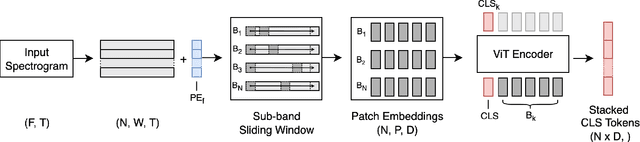
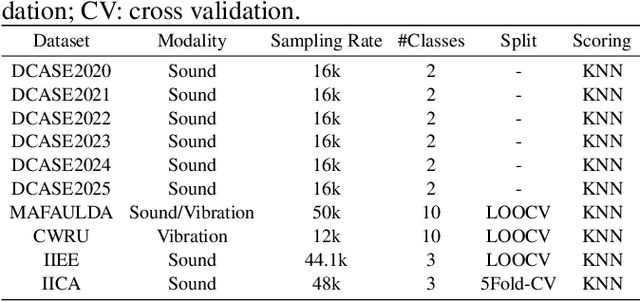
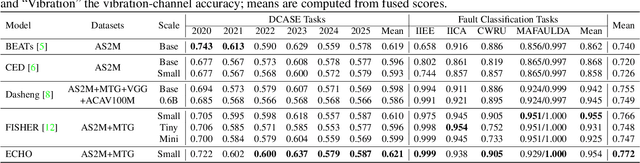
Pre-trained foundation models have demonstrated remarkable success in vision and language, yet their potential for general machine signal modeling-covering acoustic, vibration, and other industrial sensor data-remains under-explored. Existing approach using sub-band-based encoders has achieved competitive results but are limited by fixed input lengths, and the absence of explicit frequency positional encoding. In this work, we propose a novel foundation model that integrates an advanced band-split architecture with relative frequency positional embeddings, enabling precise spectral localization across arbitrary sampling configurations. The model supports inputs of arbitrary length without padding or segmentation, producing a concise embedding that retains both temporal and spectral fidelity. We evaluate our method on SIREN (https://github.com/yucongzh/SIREN), a newly introduced large-scale benchmark for machine signal encoding that unifies multiple datasets, including all DCASE task 2 challenges (2020-2025) and widely-used industrial signal corpora. Experimental results demonstrate consistent state-of-the-art performance in anomaly detection and fault identification, confirming the effectiveness and generalization capability of the proposed model. We open-sourced ECHO on https://github.com/yucongzh/ECHO.