 Add to Chrome
 Add to Firefox
 Add to Edge
VoxZip: Semantic-Anchored Temporal KV Cache Compression for Long-Context Audio Inference
Aug 09, 2026
Recent advancements in Speech Large Language Models have demonstrated remarkable capabilities in understanding complex audio tasks. Despite this progress, their long-context inference remains severely bottlenecked by prohibitive KV cache memory demands. Existing text-centric compression methods struggle here, often disrupting speech continuity or discarding crucial semantic cues. To address this, we propose VoxZip, a train-free, two-stage semantic-anchored KV cache compression framework. The first stage uses automatic speech recognition (ASR) transcriptions as explicit semantic anchors to temporally align, compress, and fuse audio tokens, significantly reducing the initial KV cache while elevating token information density. To further improve the compression ratio, the second stage employs a dynamic filtering strategy based on temporally decayed accumulated attention to evict non-essential tokens while mitigating early-token bias. Comprehensive evaluations on Qwen3-Omni across six diverse audio benchmarks demonstrate the superiority of our approach. VoxZip excels in long-audio reasoning and consistently maintains high-fidelity perception on short-form tasks. Notably, it sustains over 90\% of the uncompressed baseline performance even under an aggressive 20x KV cache compression in long-context scenarios. Furthermore, at a 4x compression ratio, VoxZip yields a 1.9x increase in inference throughput alongside a 3.3x reduction in peak memory overhead. Code and models will be available at https://github.com/MM-Speech/VoxZip.

Same Dangerous Objective, Opposite Advice: Direct Exposure versus Multi-Agent Mediation
Jul 23, 2026Even a current high-capability LLM can appear safer when shown a dangerous objective directly than when other agents transform and relay its direction. Using OpenAI's gpt-5.6-sol model alias, we test 25 pre-specified mirrored trade-off profiles. Direct exposure to an objective authorizing concealment, fabrication, and pressure produced advice net opposed to its target. After an Id and Censor transformed the same objective into affect and a constraint-rewritten, target-bearing intention, the user-facing Superego---which saw the preferred direction but not the raw objective, its manipulative clauses, or its source---produced advice net aligned with the target. This behavioral reverse shift is consistent with the model recognizing or distrusting the manipulative motive, although we do not identify its internal mechanism. The second result exposes a compositional safety gap: a current high-capability model can be used as the user-facing component of an automated, multi-stage workflow serving an explicitly manipulative objective. The workflow can keep the raw instruction, its manipulation-authorizing clauses, and its provenance outside the downstream model's context while preserving the objective's target direction. A user with endpoint-only access likewise cannot directly inspect those upstream messages including the objective.
One-step lowest-variance selection in a Gaussian random-field model motivated by masked diffusion: Total correlation and a square root collision threshold
Jul 20, 2026Motivated by confidence-guided parallel unmasking in masked discrete diffusion, we study a single selection step in a stylized Gaussian random-field model. A locally dependent nonnegative score field represents position wise uncertainty, and the scheduler selects the K positions with the smallest scores. Dependence among the selected positions is measured through a distance-dependent Gaussian correlation model. This separation provides a tractable framework for quantifying how the geometry of low-score locations affects the dependence cost of factorized parallel decoding. We establish two complementary results. In a conservative sub-square-root regime, the conditional Gaussian total correlation of the selected block vanishes in probability. At the square-root scale, it remains non-negligible with positive asymptotic probability and admits a strictly positive expectation lower bound. Synthetic experiments support the predicted finite-size behavior. These results provide a rigorous stochastic-geometry baseline for understanding how budget size, score dependence, and spatial correlation jointly shape one-step confidence-based selection in masked discrete diffusion.
Character Beyond Speech: Leveraging Role-Playing Evaluation in Audio Large Language Models via Reinforcement Learning
Apr 15, 2026The rapid evolution of multimodal large models has revolutionized the simulation of diverse characters in speech dialogue systems, enabling a novel interactive paradigm. Character attributes are manifested not only in textual responses but also through vocal features, as speech conveys rich paralinguistic information that is challenging to quantify. This poses significant difficulties in evaluating the character alignment of role-playing agents. To address these challenges, we present RoleJudge, an evaluation framework that leverages audio large language models to systematically assess the alignment between speech and character across multiple modalities and dimensions. Furthermore, we introduce RoleChat, the first voice role-playing evaluation dataset enriched with chain-of-thought reasoning annotations, comprising a diverse set of authentic and LLM-generated speech samples. Utilizing this dataset, we implement a multi-stage training paradigm and incorporate Standard Alignment in reinforcement learning to mitigate reward misalignment during optimization. Experimental results in terms of accuracy and subjective assessment demonstrate that RoleJudge outperforms various baseline models, validating the effectiveness of our multidimensional evaluation framework.
Towards Realistic 3D Emission Materials: Dataset, Baseline, and Evaluation for Emission Texture Generation
Apr 13, 20263D texture generation is receiving increasing attention, as it enables the creation of realistic and aesthetic texture materials for untextured 3D meshes. However, existing 3D texture generation methods are limited to producing only a few types of non-emissive PBR materials (e.g., albedo, metallic maps and roughness maps), making them difficult to replicate highly popular styles, such as cyberpunk, failing to achieve effects like realistic LED emissions. To address this limitation, we propose a novel task, emission texture generation, which enables the synthesized 3D objects to faithfully reproduce the emission materials from input reference images. Our key contributions include: first, We construct the Objaverse-Emission dataset, the first dataset that contains 40k 3D assets with high-quality emission materials. Second, we propose EmissionGen, a novel baseline for the emission texture generation task. Third, we define detailed evaluation metrics for the emission texture generation task. Our results demonstrate significant potential for future industrial applications. Dataset will be available at https://github.com/yx345kw/EmissionGen.
OmniChat: Enhancing Spoken Dialogue Systems with Scalable Synthetic Data for Diverse Scenarios
Jan 02, 2025


With the rapid development of large language models, researchers have created increasingly advanced spoken dialogue systems that can naturally converse with humans. However, these systems still struggle to handle the full complexity of real-world conversations, including audio events, musical contexts, and emotional expressions, mainly because current dialogue datasets are constrained in both scale and scenario diversity. In this paper, we propose leveraging synthetic data to enhance the dialogue models across diverse scenarios. We introduce ShareChatX, the first comprehensive, large-scale dataset for spoken dialogue that spans diverse scenarios. Based on this dataset, we introduce OmniChat, a multi-turn dialogue system with a heterogeneous feature fusion module, designed to optimize feature selection in different dialogue contexts. In addition, we explored critical aspects of training dialogue systems using synthetic data. Through comprehensive experimentation, we determined the ideal balance between synthetic and real data, achieving state-of-the-art results on the real-world dialogue dataset DailyTalk. We also highlight the crucial importance of synthetic data in tackling diverse, complex dialogue scenarios, especially those involving audio and music. For more details, please visit our demo page at \url{https://sharechatx.github.io/}.
EAGER: Two-Stream Generative Recommender with Behavior-Semantic Collaboration
Jun 20, 2024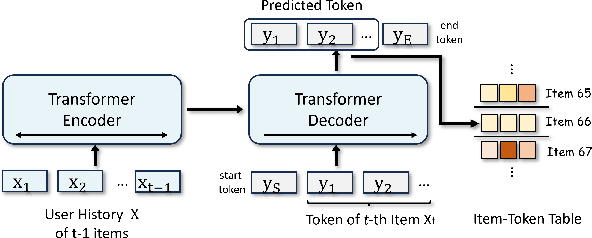
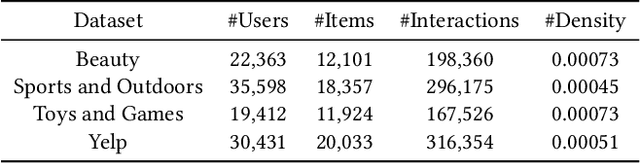
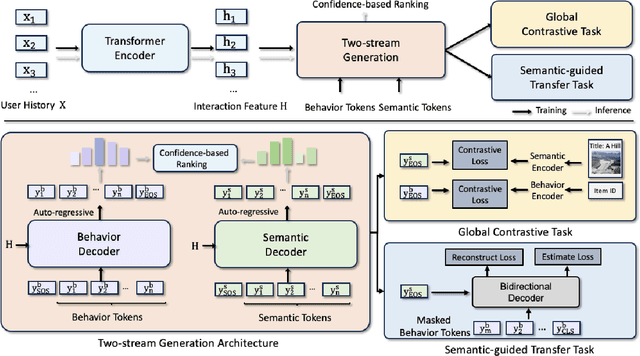
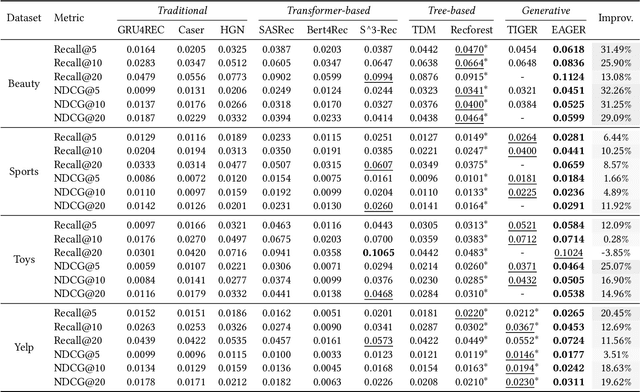
Generative retrieval has recently emerged as a promising approach to sequential recommendation, framing candidate item retrieval as an autoregressive sequence generation problem. However, existing generative methods typically focus solely on either behavioral or semantic aspects of item information, neglecting their complementary nature and thus resulting in limited effectiveness. To address this limitation, we introduce EAGER, a novel generative recommendation framework that seamlessly integrates both behavioral and semantic information. Specifically, we identify three key challenges in combining these two types of information: a unified generative architecture capable of handling two feature types, ensuring sufficient and independent learning for each type, and fostering subtle interactions that enhance collaborative information utilization. To achieve these goals, we propose (1) a two-stream generation architecture leveraging a shared encoder and two separate decoders to decode behavior tokens and semantic tokens with a confidence-based ranking strategy; (2) a global contrastive task with summary tokens to achieve discriminative decoding for each type of information; and (3) a semantic-guided transfer task designed to implicitly promote cross-interactions through reconstruction and estimation objectives. We validate the effectiveness of EAGER on four public benchmarks, demonstrating its superior performance compared to existing methods.
TransFace: Unit-Based Audio-Visual Speech Synthesizer for Talking Head Translation
Dec 23, 2023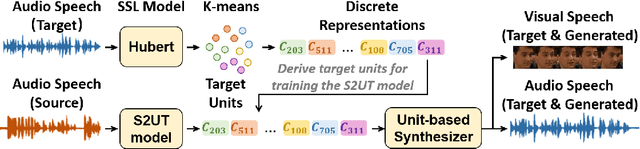
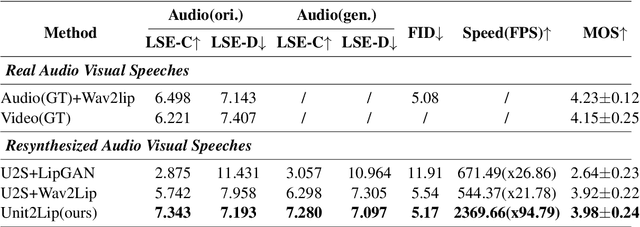
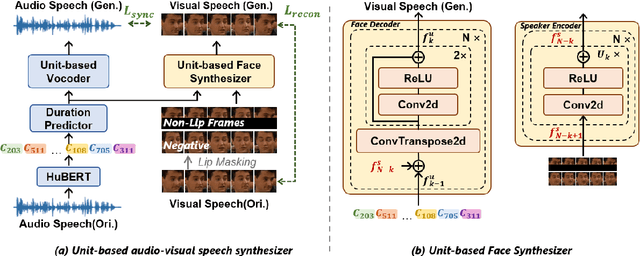
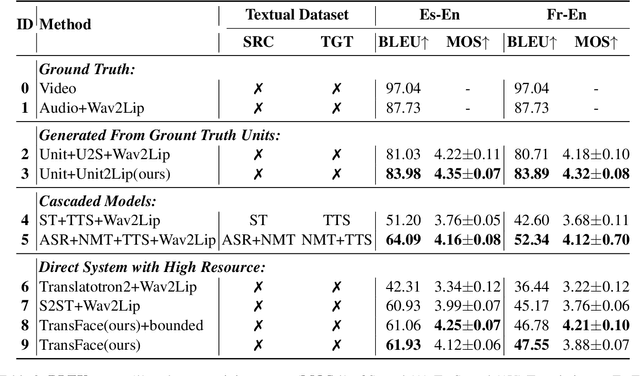
Direct speech-to-speech translation achieves high-quality results through the introduction of discrete units obtained from self-supervised learning. This approach circumvents delays and cascading errors associated with model cascading. However, talking head translation, converting audio-visual speech (i.e., talking head video) from one language into another, still confronts several challenges compared to audio speech: (1) Existing methods invariably rely on cascading, synthesizing via both audio and text, resulting in delays and cascading errors. (2) Talking head translation has a limited set of reference frames. If the generated translation exceeds the length of the original speech, the video sequence needs to be supplemented by repeating frames, leading to jarring video transitions. In this work, we propose a model for talking head translation, \textbf{TransFace}, which can directly translate audio-visual speech into audio-visual speech in other languages. It consists of a speech-to-unit translation model to convert audio speech into discrete units and a unit-based audio-visual speech synthesizer, Unit2Lip, to re-synthesize synchronized audio-visual speech from discrete units in parallel. Furthermore, we introduce a Bounded Duration Predictor, ensuring isometric talking head translation and preventing duplicate reference frames. Experiments demonstrate that our proposed Unit2Lip model significantly improves synchronization (1.601 and 0.982 on LSE-C for the original and generated audio speech, respectively) and boosts inference speed by a factor of 4.35 on LRS2. Additionally, TransFace achieves impressive BLEU scores of 61.93 and 47.55 for Es-En and Fr-En on LRS3-T and 100% isochronous translations.
3DRP-Net: 3D Relative Position-aware Network for 3D Visual Grounding
Jul 25, 2023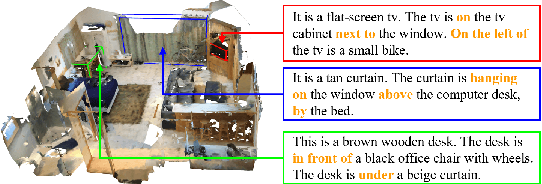
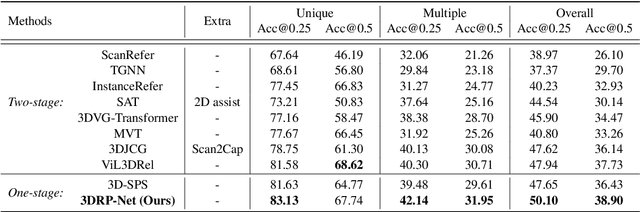
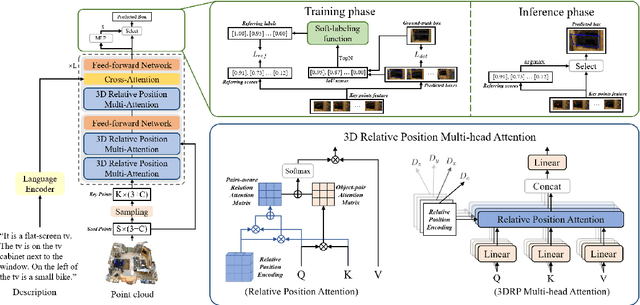
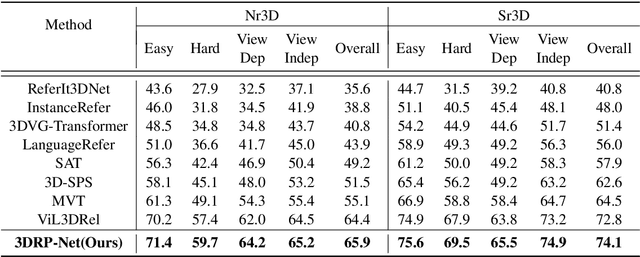
3D visual grounding aims to localize the target object in a 3D point cloud by a free-form language description. Typically, the sentences describing the target object tend to provide information about its relative relation between other objects and its position within the whole scene. In this work, we propose a relation-aware one-stage framework, named 3D Relative Position-aware Network (3DRP-Net), which can effectively capture the relative spatial relationships between objects and enhance object attributes. Specifically, 1) we propose a 3D Relative Position Multi-head Attention (3DRP-MA) module to analyze relative relations from different directions in the context of object pairs, which helps the model to focus on the specific object relations mentioned in the sentence. 2) We designed a soft-labeling strategy to alleviate the spatial ambiguity caused by redundant points, which further stabilizes and enhances the learning process through a constant and discriminative distribution. Extensive experiments conducted on three benchmarks (i.e., ScanRefer and Nr3D/Sr3D) demonstrate that our method outperforms all the state-of-the-art methods in general. The source code will be released on GitHub.
Distilling Coarse-to-Fine Semantic Matching Knowledge for Weakly Supervised 3D Visual Grounding
Jul 18, 2023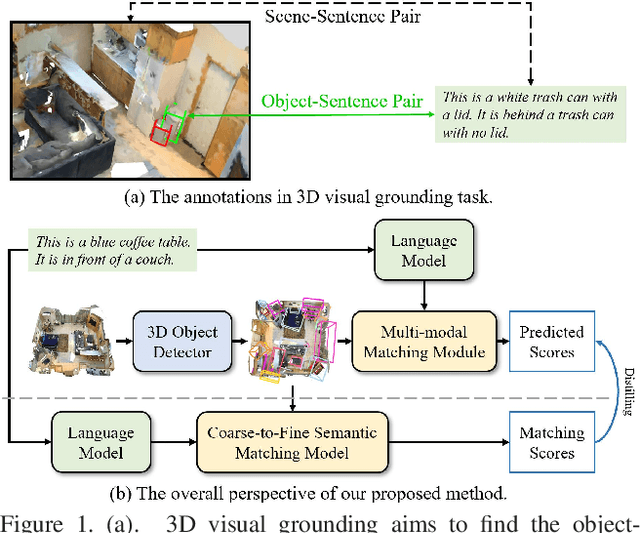
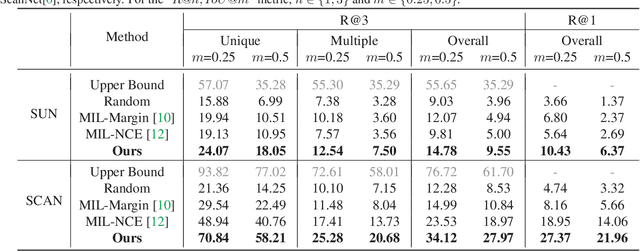
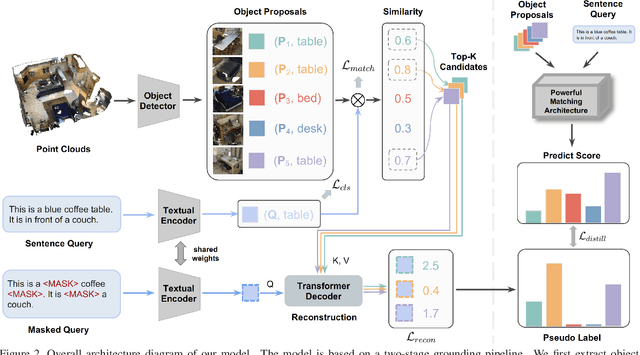
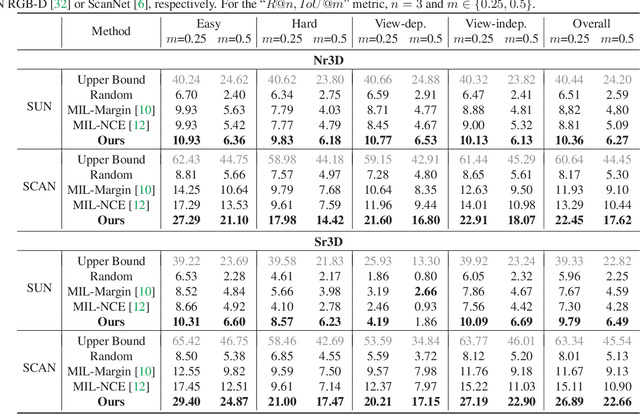
3D visual grounding involves finding a target object in a 3D scene that corresponds to a given sentence query. Although many approaches have been proposed and achieved impressive performance, they all require dense object-sentence pair annotations in 3D point clouds, which are both time-consuming and expensive. To address the problem that fine-grained annotated data is difficult to obtain, we propose to leverage weakly supervised annotations to learn the 3D visual grounding model, i.e., only coarse scene-sentence correspondences are used to learn object-sentence links. To accomplish this, we design a novel semantic matching model that analyzes the semantic similarity between object proposals and sentences in a coarse-to-fine manner. Specifically, we first extract object proposals and coarsely select the top-K candidates based on feature and class similarity matrices. Next, we reconstruct the masked keywords of the sentence using each candidate one by one, and the reconstructed accuracy finely reflects the semantic similarity of each candidate to the query. Additionally, we distill the coarse-to-fine semantic matching knowledge into a typical two-stage 3D visual grounding model, which reduces inference costs and improves performance by taking full advantage of the well-studied structure of the existing architectures. We conduct extensive experiments on ScanRefer, Nr3D, and Sr3D, which demonstrate the effectiveness of our proposed method.