 Add to Chrome
 Add to Firefox
 Add to Edge
Temporal Treasure Hunt: Content-based Time Series Retrieval System for Discovering Insights
Nov 05, 2023
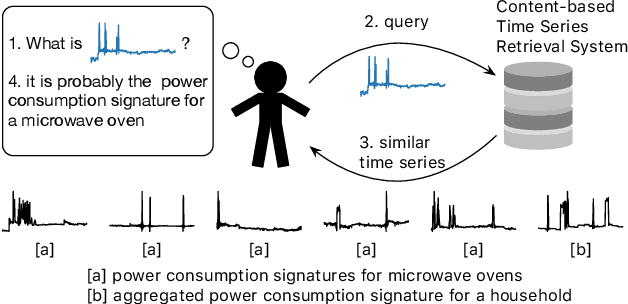
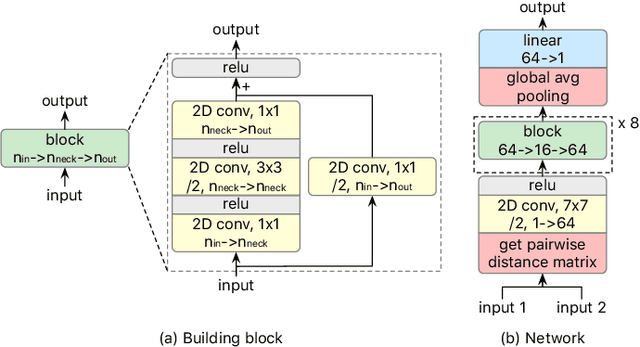
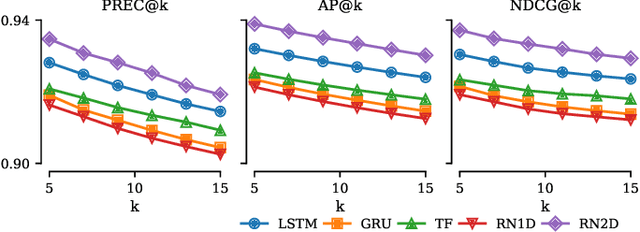
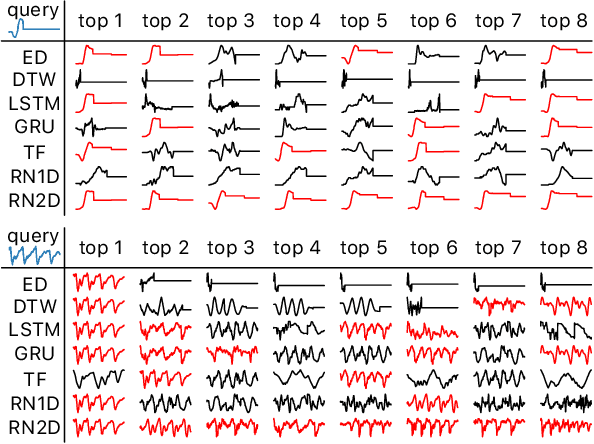
Time series data is ubiquitous across various domains such as finance, healthcare, and manufacturing, but their properties can vary significantly depending on the domain they originate from. The ability to perform Content-based Time Series Retrieval (CTSR) is crucial for identifying unknown time series examples. However, existing CTSR works typically focus on retrieving time series from a single domain database, which can be inadequate if the user does not know the source of the query time series. This limitation motivates us to investigate the CTSR problem in a scenario where the database contains time series from multiple domains. To facilitate this investigation, we introduce a CTSR benchmark dataset that comprises time series data from a variety of domains, such as motion, power demand, and traffic. This dataset is sourced from a publicly available time series classification dataset archive, making it easily accessible to researchers in the field. We compare several popular methods for modeling and retrieving time series data using this benchmark dataset. Additionally, we propose a novel distance learning model that outperforms the existing methods. Overall, our study highlights the importance of addressing the CTSR problem across multiple domains and provides a useful benchmark dataset for future research.

Sketching Multidimensional Time Series for Fast Discord Mining
Nov 05, 2023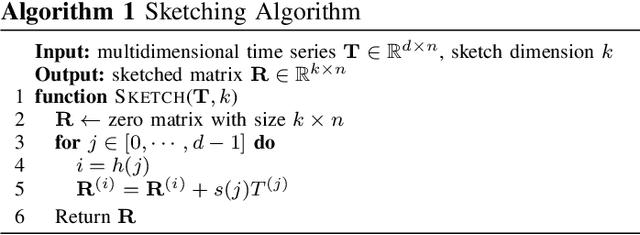
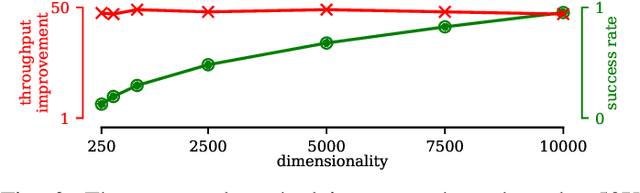
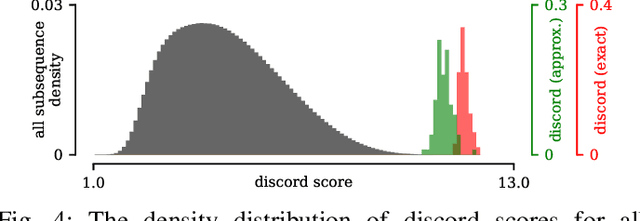
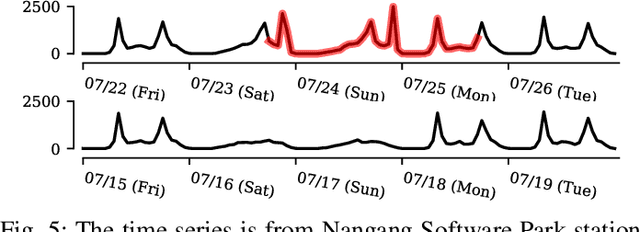
Time series discords are a useful primitive for time series anomaly detection, and the matrix profile is capable of capturing discord effectively. There exist many research efforts to improve the scalability of discord discovery with respect to the length of time series. However, there is surprisingly little work focused on reducing the time complexity of matrix profile computation associated with dimensionality of a multidimensional time series. In this work, we propose a sketch for discord mining among multi-dimensional time series. After an initial pre-processing of the sketch as fast as reading the data, the discord mining has runtime independent of the dimensionality of the original data. On several real world examples from water treatment and transportation, the proposed algorithm improves the throughput by at least an order of magnitude (50X) and only has minimal impact on the quality of the approximated solution. Additionally, the proposed method can handle the dynamic addition or deletion of dimensions inconsequential overhead. This allows a data analyst to consider "what-if" scenarios in real time while exploring the data.
Visual Analytics for Efficient Image Exploration and User-Guided Image Captioning
Nov 02, 2023


Recent advancements in pre-trained large-scale language-image models have ushered in a new era of visual comprehension, offering a significant leap forward. These breakthroughs have proven particularly instrumental in addressing long-standing challenges that were previously daunting. Leveraging these innovative techniques, this paper tackles two well-known issues within the realm of visual analytics: (1) the efficient exploration of large-scale image datasets and identification of potential data biases within them; (2) the evaluation of image captions and steering of their generation process. On the one hand, by visually examining the captions automatically generated from language-image models for an image dataset, we gain deeper insights into the semantic underpinnings of the visual contents, unearthing data biases that may be entrenched within the dataset. On the other hand, by depicting the association between visual contents and textual captions, we expose the weaknesses of pre-trained language-image models in their captioning capability and propose an interactive interface to steer caption generation. The two parts have been coalesced into a coordinated visual analytics system, fostering mutual enrichment of visual and textual elements. We validate the effectiveness of the system with domain practitioners through concrete case studies with large-scale image datasets.
Combating Bilateral Edge Noise for Robust Link Prediction
Nov 02, 2023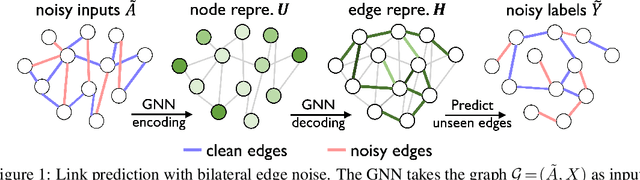
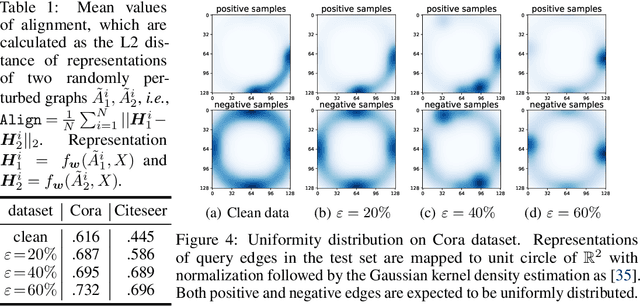
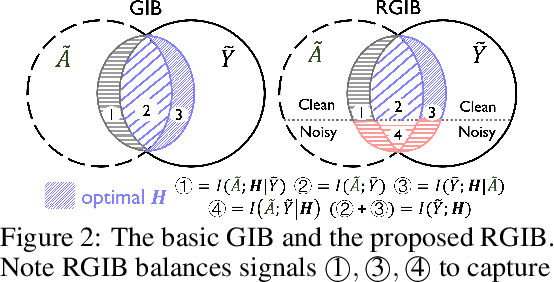
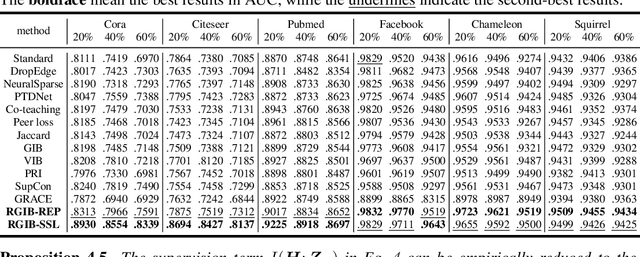
Although link prediction on graphs has achieved great success with the development of graph neural networks (GNNs), the potential robustness under the edge noise is still less investigated. To close this gap, we first conduct an empirical study to disclose that the edge noise bilaterally perturbs both input topology and target label, yielding severe performance degradation and representation collapse. To address this dilemma, we propose an information-theory-guided principle, Robust Graph Information Bottleneck (RGIB), to extract reliable supervision signals and avoid representation collapse. Different from the basic information bottleneck, RGIB further decouples and balances the mutual dependence among graph topology, target labels, and representation, building new learning objectives for robust representation against the bilateral noise. Two instantiations, RGIB-SSL and RGIB-REP, are explored to leverage the merits of different methodologies, i.e., self-supervised learning and data reparameterization, for implicit and explicit data denoising, respectively. Extensive experiments on six datasets and three GNNs with diverse noisy scenarios verify the effectiveness of our RGIB instantiations. The code is publicly available at: https://github.com/tmlr-group/RGIB.
Large Search Model: Redefining Search Stack in the Era of LLMs
Oct 23, 2023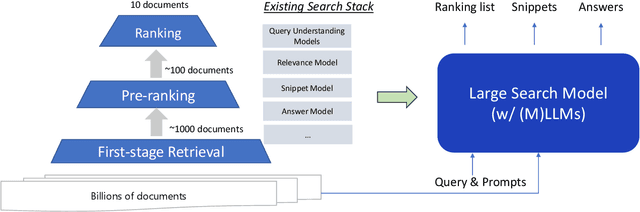

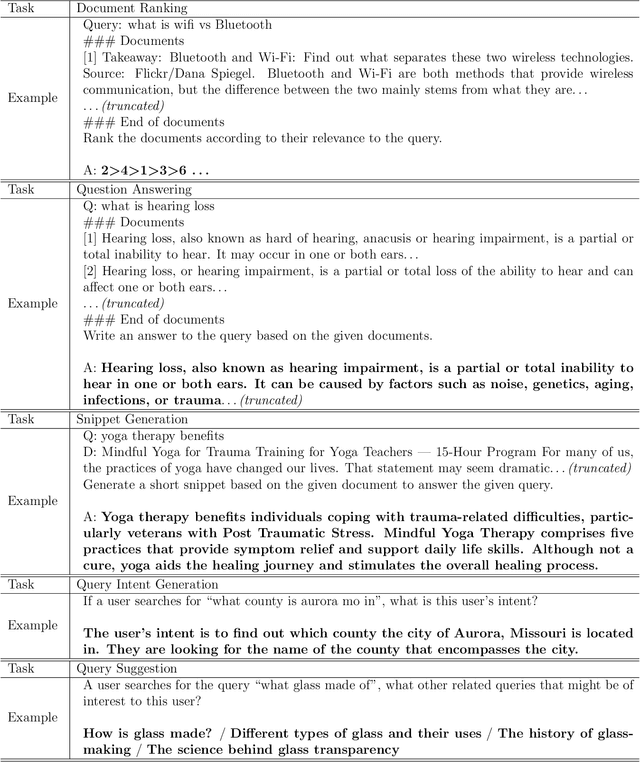

Modern search engines are built on a stack of different components, including query understanding, retrieval, multi-stage ranking, and question answering, among others. These components are often optimized and deployed independently. In this paper, we introduce a novel conceptual framework called large search model, which redefines the conventional search stack by unifying search tasks with one large language model (LLM). All tasks are formulated as autoregressive text generation problems, allowing for the customization of tasks through the use of natural language prompts. This proposed framework capitalizes on the strong language understanding and reasoning capabilities of LLMs, offering the potential to enhance search result quality while simultaneously simplifying the existing cumbersome search stack. To substantiate the feasibility of this framework, we present a series of proof-of-concept experiments and discuss the potential challenges associated with implementing this approach within real-world search systems.
FATA-Trans: Field And Time-Aware Transformer for Sequential Tabular Data
Oct 20, 2023
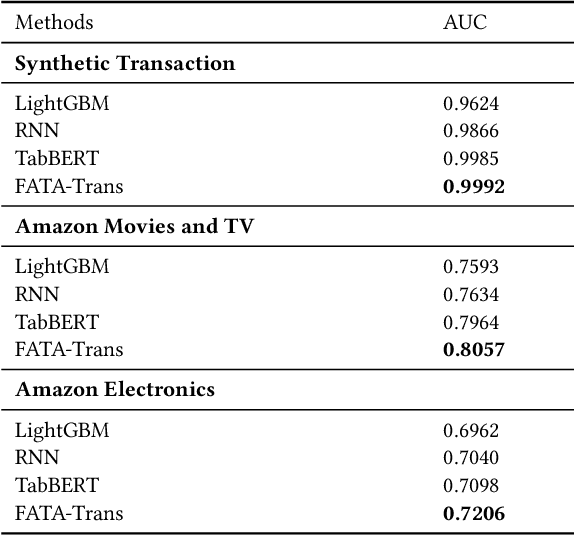

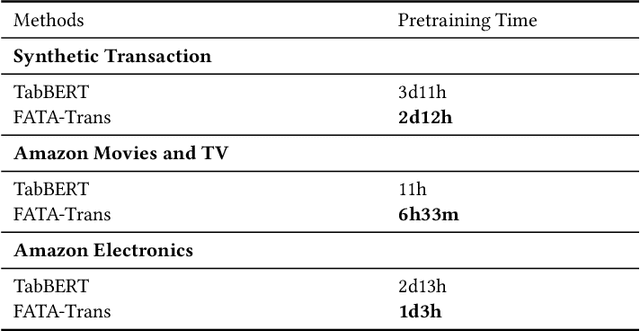
Sequential tabular data is one of the most commonly used data types in real-world applications. Different from conventional tabular data, where rows in a table are independent, sequential tabular data contains rich contextual and sequential information, where some fields are dynamically changing over time and others are static. Existing transformer-based approaches analyzing sequential tabular data overlook the differences between dynamic and static fields by replicating and filling static fields into each transformer, and ignore temporal information between rows, which leads to three major disadvantages: (1) computational overhead, (2) artificially simplified data for masked language modeling pre-training task that may yield less meaningful representations, and (3) disregarding the temporal behavioral patterns implied by time intervals. In this work, we propose FATA-Trans, a model with two field transformers for modeling sequential tabular data, where each processes static and dynamic field information separately. FATA-Trans is field- and time-aware for sequential tabular data. The field-type embedding in the method enables FATA-Trans to capture differences between static and dynamic fields. The time-aware position embedding exploits both order and time interval information between rows, which helps the model detect underlying temporal behavior in a sequence. Our experiments on three benchmark datasets demonstrate that the learned representations from FATA-Trans consistently outperform state-of-the-art solutions in the downstream tasks. We also present visualization studies to highlight the insights captured by the learned representations, enhancing our understanding of the underlying data. Our codes are available at https://github.com/zdy93/FATA-Trans.
EX-FEVER: A Dataset for Multi-hop Explainable Fact Verification
Oct 15, 2023Fact verification aims to automatically probe the veracity of a claim based on several pieces of evidence. Existing works are always engaging in the accuracy improvement, let alone the explainability, a critical capability of fact verification system. Constructing an explainable fact verification system in a complex multi-hop scenario is consistently impeded by the absence of a relevant high-quality dataset. Previous dataset either suffer from excessive simplification or fail to incorporate essential considerations for explainability. To address this, we present EX-FEVER, a pioneering dataset for multi-hop explainable fact verification. With over 60,000 claims involving 2-hop and 3-hop reasoning, each is created by summarizing and modifying information from hyperlinked Wikipedia documents. Each instance is accompanied by a veracity label and an explanation that outlines the reasoning path supporting the veracity classification. Additionally, we demonstrate a novel baseline system on our EX-FEVER dataset, showcasing document retrieval, explanation generation, and claim verification and observe that existing fact verification models trained on previous datasets struggle to perform well on our dataset. Furthermore, we highlight the potential of utilizing Large Language Models in the fact verification task. We hope our dataset could make a significant contribution by providing ample opportunities to explore the integration of natural language explanations in the domain of fact verification.
Fine-Tuning LLaMA for Multi-Stage Text Retrieval
Oct 12, 2023The effectiveness of multi-stage text retrieval has been solidly demonstrated since before the era of pre-trained language models. However, most existing studies utilize models that predate recent advances in large language models (LLMs). This study seeks to explore potential improvements that state-of-the-art LLMs can bring. We conduct a comprehensive study, fine-tuning the latest LLaMA model both as a dense retriever (RepLLaMA) and as a pointwise reranker (RankLLaMA) for both passage retrieval and document retrieval using the MS MARCO datasets. Our findings demonstrate that the effectiveness of large language models indeed surpasses that of smaller models. Additionally, since LLMs can inherently handle longer contexts, they can represent entire documents holistically, obviating the need for traditional segmenting and pooling strategies. Furthermore, evaluations on BEIR demonstrate that our RepLLaMA-RankLLaMA pipeline exhibits strong zero-shot effectiveness. Model checkpoints from this study are available on HuggingFace.
Multitask Learning for Time Series Data with 2D Convolution
Oct 10, 2023Multitask learning (MTL) aims to develop a unified model that can handle a set of closely related tasks simultaneously. By optimizing the model across multiple tasks, MTL generally surpasses its non-MTL counterparts in terms of generalizability. Although MTL has been extensively researched in various domains such as computer vision, natural language processing, and recommendation systems, its application to time series data has received limited attention. In this paper, we investigate the application of MTL to the time series classification (TSC) problem. However, when we integrate the state-of-the-art 1D convolution-based TSC model with MTL, the performance of the TSC model actually deteriorates. By comparing the 1D convolution-based models with the Dynamic Time Warping (DTW) distance function, it appears that the underwhelming results stem from the limited expressive power of the 1D convolutional layers. To overcome this challenge, we propose a novel design for a 2D convolution-based model that enhances the model's expressiveness. Leveraging this advantage, our proposed method outperforms competing approaches on both the UCR Archive and an industrial transaction TSC dataset.
GSLB: The Graph Structure Learning Benchmark
Oct 08, 2023Graph Structure Learning (GSL) has recently garnered considerable attention due to its ability to optimize both the parameters of Graph Neural Networks (GNNs) and the computation graph structure simultaneously. Despite the proliferation of GSL methods developed in recent years, there is no standard experimental setting or fair comparison for performance evaluation, which creates a great obstacle to understanding the progress in this field. To fill this gap, we systematically analyze the performance of GSL in different scenarios and develop a comprehensive Graph Structure Learning Benchmark (GSLB) curated from 20 diverse graph datasets and 16 distinct GSL algorithms. Specifically, GSLB systematically investigates the characteristics of GSL in terms of three dimensions: effectiveness, robustness, and complexity. We comprehensively evaluate state-of-the-art GSL algorithms in node- and graph-level tasks, and analyze their performance in robust learning and model complexity. Further, to facilitate reproducible research, we have developed an easy-to-use library for training, evaluating, and visualizing different GSL methods. Empirical results of our extensive experiments demonstrate the ability of GSL and reveal its potential benefits on various downstream tasks, offering insights and opportunities for future research. The code of GSLB is available at: https://github.com/GSL-Benchmark/GSLB.