 Add to Chrome
 Add to Firefox
 Add to Edge
S-Agents: self-organizing agents in open-ended environment
Feb 08, 2024


Leveraging large language models (LLMs), autonomous agents have significantly improved, gaining the ability to handle a variety of tasks. In open-ended settings, optimizing collaboration for efficiency and effectiveness demands flexible adjustments. Despite this, current research mainly emphasizes fixed, task-oriented workflows and overlooks agent-centric organizational structures. Drawing inspiration from human organizational behavior, we introduce a self-organizing agent system (S-Agents) with a "tree of agents" structure for dynamic workflow, an "hourglass agent architecture" for balancing information priorities, and a "non-obstructive collaboration" method to allow asynchronous task execution among agents. This structure can autonomously coordinate a group of agents, efficiently addressing the challenges of an open and dynamic environment without human intervention. Our experiments demonstrate that S-Agents proficiently execute collaborative building tasks and resource collection in the Minecraft environment, validating their effectiveness.

RA-Rec: An Efficient ID Representation Alignment Framework for LLM-based Recommendation
Feb 07, 2024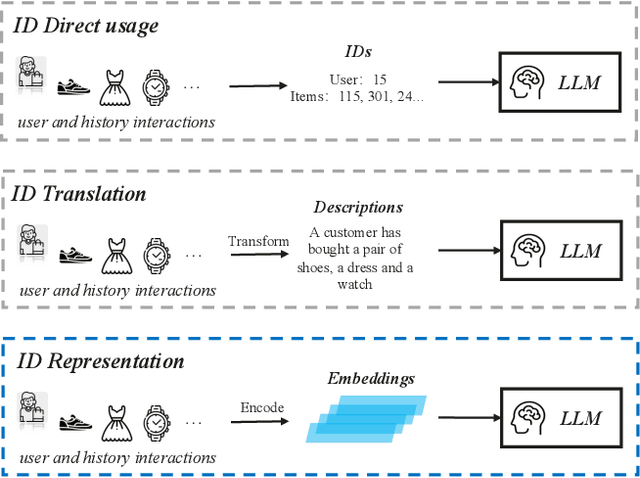
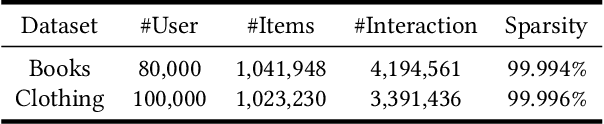
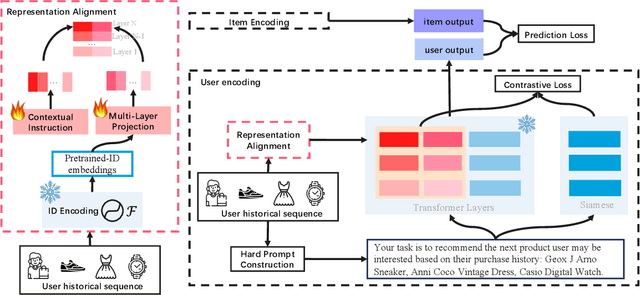
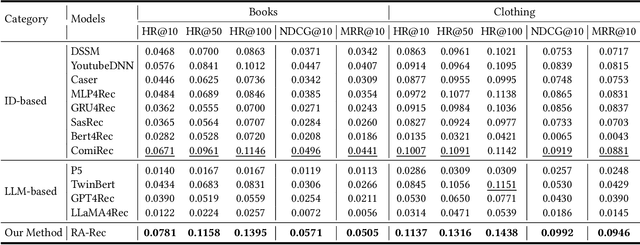
Large language models (LLM) have recently emerged as a powerful tool for a variety of natural language processing tasks, bringing a new surge of combining LLM with recommendation systems, termed as LLM-based RS. Current approaches generally fall into two main paradigms, the ID direct usage paradigm and the ID translation paradigm, noting their core weakness stems from lacking recommendation knowledge and uniqueness. To address this limitation, we propose a new paradigm, ID representation, which incorporates pre-trained ID embeddings into LLMs in a complementary manner. In this work, we present RA-Rec, an efficient ID representation alignment framework for LLM-based recommendation, which is compatible with multiple ID-based methods and LLM architectures. Specifically, we treat ID embeddings as soft prompts and design an innovative alignment module and an efficient tuning method with tailored data construction for alignment. Extensive experiments demonstrate RA-Rec substantially outperforms current state-of-the-art methods, achieving up to 3.0% absolute HitRate@100 improvements while utilizing less than 10x training data.
LVC-LGMC: Joint Local and Global Motion Compensation for Learned Video Compression
Feb 04, 2024Existing learned video compression models employ flow net or deformable convolutional networks (DCN) to estimate motion information. However, the limited receptive fields of flow net and DCN inherently direct their attentiveness towards the local contexts. Global contexts, such as large-scale motions and global correlations among frames are ignored, presenting a significant bottleneck for capturing accurate motions. To address this issue, we propose a joint local and global motion compensation module (LGMC) for leaned video coding. More specifically, we adopt flow net for local motion compensation. To capture global context, we employ the cross attention in feature domain for motion compensation. In addition, to avoid the quadratic complexity of vanilla cross attention, we divide the softmax operations in attention into two independent softmax operations, leading to linear complexity. To validate the effectiveness of our proposed LGMC, we integrate it with DCVC-TCM and obtain learned video compression with joint local and global motion compensation (LVC-LGMC). Extensive experiments demonstrate that our LVC-LGMC has significant rate-distortion performance improvements over baseline DCVC-TCM.
* Fix typos and Fig.1 and Fig.2. Accepted at ICASSP 2024. The first attempt to use cross attention for bits-free motion estimation and motion compensation
TimeSiam: A Pre-Training Framework for Siamese Time-Series Modeling
Feb 04, 2024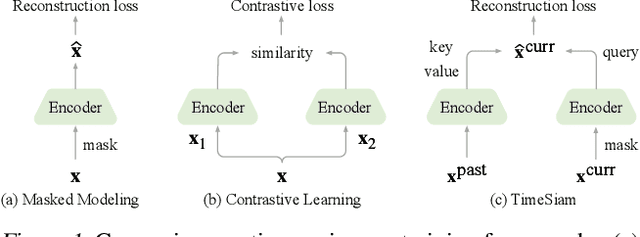
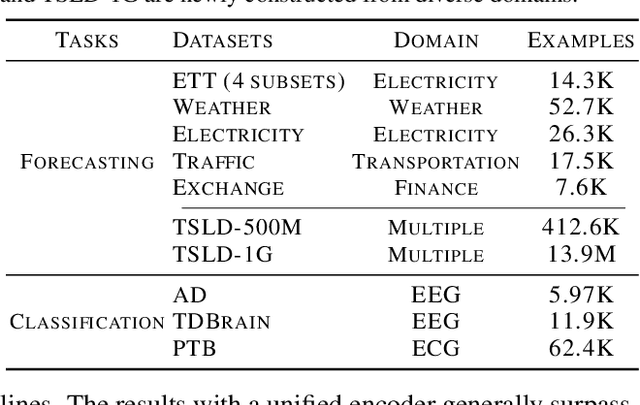
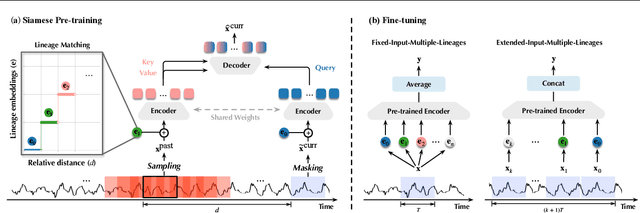
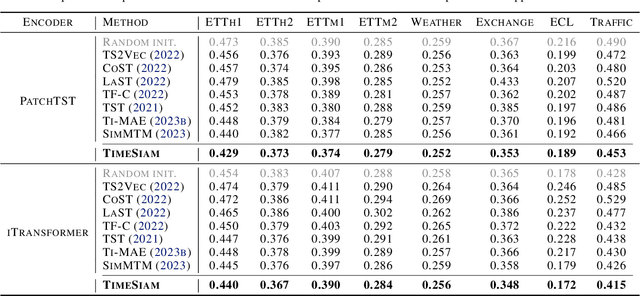
Time series pre-training has recently garnered wide attention for its potential to reduce labeling expenses and benefit various downstream tasks. Prior methods are mainly based on pre-training techniques well-acknowledged in vision or language, such as masked modeling and contrastive learning. However, randomly masking time series or calculating series-wise similarity will distort or neglect inherent temporal correlations crucial in time series data. To emphasize temporal correlation modeling, this paper proposes TimeSiam as a simple but effective self-supervised pre-training framework for Time series based on Siamese networks. Concretely, TimeSiam pre-trains Siamese encoders to capture intrinsic temporal correlations between randomly sampled past and current subseries. With a simple data augmentation method (e.g.~masking), TimeSiam can benefit from diverse augmented subseries and learn internal time-dependent representations through a past-to-current reconstruction. Moreover, learnable lineage embeddings are also introduced to distinguish temporal distance between sampled series and further foster the learning of diverse temporal correlations. TimeSiam consistently outperforms extensive advanced pre-training baselines, demonstrating superior forecasting and classification capabilities across 13 standard benchmarks in both intra- and cross-domain scenarios.
S-NeRF++: Autonomous Driving Simulation via Neural Reconstruction and Generation
Feb 03, 2024
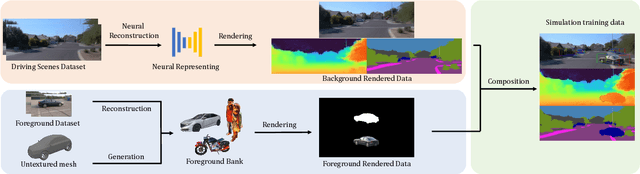


Autonomous driving simulation system plays a crucial role in enhancing self-driving data and simulating complex and rare traffic scenarios, ensuring navigation safety. However, traditional simulation systems, which often heavily rely on manual modeling and 2D image editing, struggled with scaling to extensive scenes and generating realistic simulation data. In this study, we present S-NeRF++, an innovative autonomous driving simulation system based on neural reconstruction. Trained on widely-used self-driving datasets such as nuScenes and Waymo, S-NeRF++ can generate a large number of realistic street scenes and foreground objects with high rendering quality as well as offering considerable flexibility in manipulation and simulation. Specifically, S-NeRF++ is an enhanced neural radiance field for synthesizing large-scale scenes and moving vehicles, with improved scene parameterization and camera pose learning. The system effectively utilizes noisy and sparse LiDAR data to refine training and address depth outliers, ensuring high quality reconstruction and novel-view rendering. It also provides a diverse foreground asset bank through reconstructing and generating different foreground vehicles to support comprehensive scenario creation. Moreover, we have developed an advanced foreground-background fusion pipeline that skillfully integrates illumination and shadow effects, further enhancing the realism of our simulations. With the high-quality simulated data provided by our S-NeRF++, we found the perception methods enjoy performance boost on several autonomous driving downstream tasks, which further demonstrate the effectiveness of our proposed simulator.
LaneGraph2Seq: Lane Topology Extraction with Language Model via Vertex-Edge Encoding and Connectivity Enhancement
Jan 31, 2024Understanding road structures is crucial for autonomous driving. Intricate road structures are often depicted using lane graphs, which include centerline curves and connections forming a Directed Acyclic Graph (DAG). Accurate extraction of lane graphs relies on precisely estimating vertex and edge information within the DAG. Recent research highlights Transformer-based language models' impressive sequence prediction abilities, making them effective for learning graph representations when graph data are encoded as sequences. However, existing studies focus mainly on modeling vertices explicitly, leaving edge information simply embedded in the network. Consequently, these approaches fall short in the task of lane graph extraction. To address this, we introduce LaneGraph2Seq, a novel approach for lane graph extraction. It leverages a language model with vertex-edge encoding and connectivity enhancement. Our serialization strategy includes a vertex-centric depth-first traversal and a concise edge-based partition sequence. Additionally, we use classifier-free guidance combined with nucleus sampling to improve lane connectivity. We validate our method on prominent datasets, nuScenes and Argoverse 2, showcasing consistent and compelling results. Our LaneGraph2Seq approach demonstrates superior performance compared to state-of-the-art techniques in lane graph extraction.
A Survey of Resource-efficient LLM and Multimodal Foundation Models
Jan 16, 2024

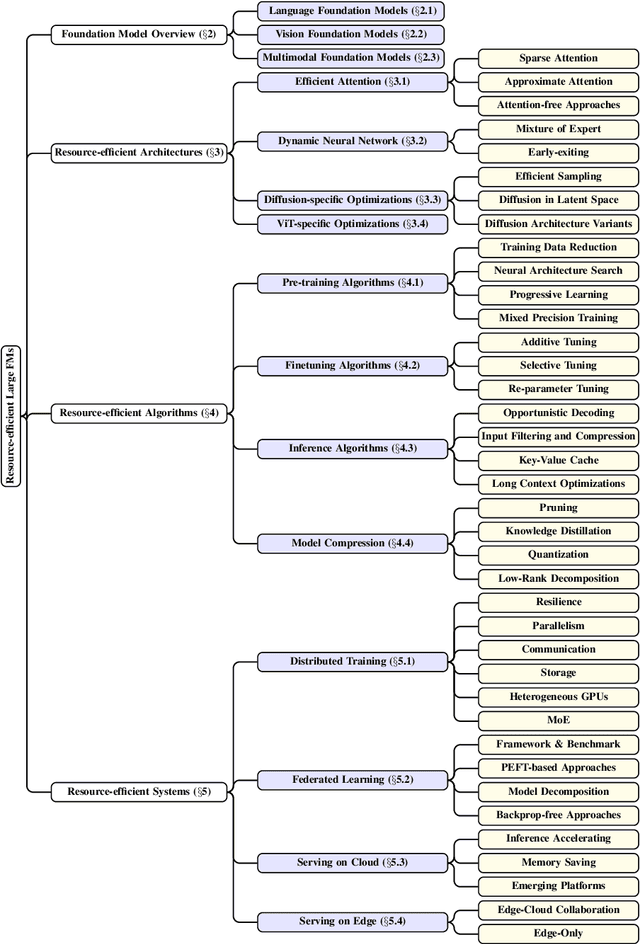

Large foundation models, including large language models (LLMs), vision transformers (ViTs), diffusion, and LLM-based multimodal models, are revolutionizing the entire machine learning lifecycle, from training to deployment. However, the substantial advancements in versatility and performance these models offer come at a significant cost in terms of hardware resources. To support the growth of these large models in a scalable and environmentally sustainable way, there has been a considerable focus on developing resource-efficient strategies. This survey delves into the critical importance of such research, examining both algorithmic and systemic aspects. It offers a comprehensive analysis and valuable insights gleaned from existing literature, encompassing a broad array of topics from cutting-edge model architectures and training/serving algorithms to practical system designs and implementations. The goal of this survey is to provide an overarching understanding of how current approaches are tackling the resource challenges posed by large foundation models and to potentially inspire future breakthroughs in this field.
Fast Dynamic 3D Object Generation from a Single-view Video
Jan 16, 2024Generating dynamic three-dimensional (3D) object from a single-view video is challenging due to the lack of 4D labeled data. Existing methods extend text-to-3D pipelines by transferring off-the-shelf image generation models such as score distillation sampling, but they are slow and expensive to scale (e.g., 150 minutes per object) due to the need for back-propagating the information-limited supervision signals through a large pretrained model. To address this limitation, we propose an efficient video-to-4D object generation framework called Efficient4D. It generates high-quality spacetime-consistent images under different camera views, and then uses them as labeled data to directly train a novel 4D Gaussian splatting model with explicit point cloud geometry, enabling real-time rendering under continuous camera trajectories. Extensive experiments on synthetic and real videos show that Efficient4D offers a remarkable 10-fold increase in speed when compared to prior art alternatives while preserving the same level of innovative view synthesis quality. For example, Efficient4D takes only 14 minutes to model a dynamic object.
UPDP: A Unified Progressive Depth Pruner for CNN and Vision Transformer
Jan 12, 2024Traditional channel-wise pruning methods by reducing network channels struggle to effectively prune efficient CNN models with depth-wise convolutional layers and certain efficient modules, such as popular inverted residual blocks. Prior depth pruning methods by reducing network depths are not suitable for pruning some efficient models due to the existence of some normalization layers. Moreover, finetuning subnet by directly removing activation layers would corrupt the original model weights, hindering the pruned model from achieving high performance. To address these issues, we propose a novel depth pruning method for efficient models. Our approach proposes a novel block pruning strategy and progressive training method for the subnet. Additionally, we extend our pruning method to vision transformer models. Experimental results demonstrate that our method consistently outperforms existing depth pruning methods across various pruning configurations. We obtained three pruned ConvNeXtV1 models with our method applying on ConvNeXtV1, which surpass most SOTA efficient models with comparable inference performance. Our method also achieves state-of-the-art pruning performance on the vision transformer model.
Optimal Transcoding Resolution Prediction for Efficient Per-Title Bitrate Ladder Estimation
Jan 09, 2024Adaptive video streaming requires efficient bitrate ladder construction to meet heterogeneous network conditions and end-user demands. Per-title optimized encoding typically traverses numerous encoding parameters to search the Pareto-optimal operating points for each video. Recently, researchers have attempted to predict the content-optimized bitrate ladder for pre-encoding overhead reduction. However, existing methods commonly estimate the encoding parameters on the Pareto front and still require subsequent pre-encodings. In this paper, we propose to directly predict the optimal transcoding resolution at each preset bitrate for efficient bitrate ladder construction. We adopt a Temporal Attentive Gated Recurrent Network to capture spatial-temporal features and predict transcoding resolutions as a multi-task classification problem. We demonstrate that content-optimized bitrate ladders can thus be efficiently determined without any pre-encoding. Our method well approximates the ground-truth bitrate-resolution pairs with a slight Bj{\o}ntegaard Delta rate loss of 1.21% and significantly outperforms the state-of-the-art fixed ladder.