 Add to Chrome
 Add to Firefox
 Add to Edge
Understanding Model Merging: A Unified Generalization Framework for Heterogeneous Experts
Jan 29, 2026
Model merging efficiently aggregates capabilities from multiple fine-tuned models into a single one, operating purely in parameter space without original data or expensive re-computation. Despite empirical successes, a unified theory for its effectiveness under heterogeneous finetuning hyperparameters (e.g., varying learning rates, batch sizes) remains missing. Moreover, the lack of hyperparameter transparency in open-source fine-tuned models makes it difficult to predict merged-model performance, leaving practitioners without guidance on how to fine-tune merge-friendly experts. To address those two challenges, we employ $L_2$-Stability theory under heterogeneous hyperparameter environments to analyze the generalization of the merged model $\boldsymbol{x}_{avg}$. This pioneering analysis yields two key contributions: (i) \textit{A unified theoretical framework} is provided to explain existing merging algorithms, revealing how they optimize specific terms in our bound, thus offering a strong theoretical foundation for empirical observations. (ii) \textit{Actionable recommendations} are proposed for practitioners to strategically fine-tune expert models, enabling the construction of merge-friendly models within the pretraining-to-finetuning pipeline. Extensive experiments on the ResNet/Vit family across 20/8 visual classification tasks, involving thousands of finetuning models, robustly confirm the impact of different hyperparameters on the generalization of $\boldsymbol{x}_{avg}$ predicted by our theoretical results.

Learning Ordered Representations in Latent Space for Intrinsic Dimension Estimation via Principal Component Autoencoder
Jan 27, 2026Autoencoders have long been considered a nonlinear extension of Principal Component Analysis (PCA). Prior studies have demonstrated that linear autoencoders (LAEs) can recover the ordered, axis-aligned principal components of PCA by incorporating non-uniform $\ell_2$ regularization or by adjusting the loss function. However, these approaches become insufficient in the nonlinear setting, as the remaining variance cannot be properly captured independently of the nonlinear mapping. In this work, we propose a novel autoencoder framework that integrates non-uniform variance regularization with an isometric constraint. This design serves as a natural generalization of PCA, enabling the model to preserve key advantages, such as ordered representations and variance retention, while remaining effective for nonlinear dimensionality reduction tasks.
Advancing Adaptive Multi-Stage Video Anomaly Reasoning: A Benchmark Dataset and Method
Jan 15, 2026Recent progress in reasoning capabilities of Multimodal Large Language Models(MLLMs) has highlighted their potential for performing complex video understanding tasks. However, in the domain of Video Anomaly Detection and Understanding (VAD&U), existing MLLM-based methods are largely limited to anomaly localization or post-hoc description, lacking explicit reasoning processes, risk awareness, and decision-oriented interpretation. To address this gap, we define a new task termed Video Anomaly Reasoning (VAR), which elevates video anomaly analysis from descriptive understanding to structured, multi-stage reasoning. VAR explicitly requires models to perform progressive reasoning over anomalous events before answering anomaly-related questions, encompassing visual perception, causal interpretation, and risk-aware decision making. To support this task, we present a new dataset with 8,641 videos, where each video is annotated with diverse question types corresponding to different reasoning depths, totaling more than 50,000 samples, making it one of the largest datasets for video anomaly. The annotations are based on a structured Perception-Cognition-Action Chain-of-Thought (PerCoAct-CoT), which formalizes domain-specific reasoning priors for video anomaly understanding. This design enables systematic evaluation of multi-stage and adaptive anomaly reasoning. In addition, we propose Anomaly-Aware Group Relative Policy Optimization to further enhance reasoning reliability under weak supervision. Building upon the proposed task and dataset, we develop an end-to-end MLLM-based VAR model termed Vad-R1-Plus, which supports adaptive hierarchical reasoning and risk-aware decision making. Extensive experiments demonstrate that the proposed benchmark and method effectively advance the reasoning capabilities of MLLMs on VAR tasks, outperforming both open-source and proprietary baselines.
Joint Selection for Large-Scale Pre-Training Data via Policy Gradient-based Mask Learning
Dec 30, 2025A fine-grained data recipe is crucial for pre-training large language models, as it can significantly enhance training efficiency and model performance. One important ingredient in the recipe is to select samples based on scores produced by defined rules, LLM judgment, or statistical information in embeddings, which can be roughly categorized into quality and diversity metrics. Due to the high computational cost when applied to trillion-scale token pre-training datasets such as FineWeb and DCLM, these two or more types of metrics are rarely considered jointly in a single selection process. However, in our empirical study, selecting samples based on quality metrics exhibit severe diminishing returns during long-term pre-training, while selecting on diversity metrics removes too many valuable high-quality samples, both of which limit pre-trained LLMs' capabilities. Therefore, we introduce DATAMASK, a novel and efficient joint learning framework designed for large-scale pre-training data selection that can simultaneously optimize multiple types of metrics in a unified process, with this study focusing specifically on quality and diversity metrics. DATAMASK approaches the selection process as a mask learning problem, involving iterative sampling of data masks, computation of policy gradients based on predefined objectives with sampled masks, and updating of mask sampling logits. Through policy gradient-based optimization and various acceleration enhancements, it significantly reduces selection time by 98.9% compared to greedy algorithm, enabling our study to explore joint learning within trillion-scale tokens. With DATAMASK, we select a subset of about 10% from the 15 trillion-token FineWeb dataset, termed FineWeb-Mask. Evaluated across 12 diverse tasks, we achieves significant improvements of 3.2% on a 1.5B dense model and 1.9% on a 7B MoE model.
Reason-KE++: Aligning the Process, Not Just the Outcome, for Faithful LLM Knowledge Editing
Nov 16, 2025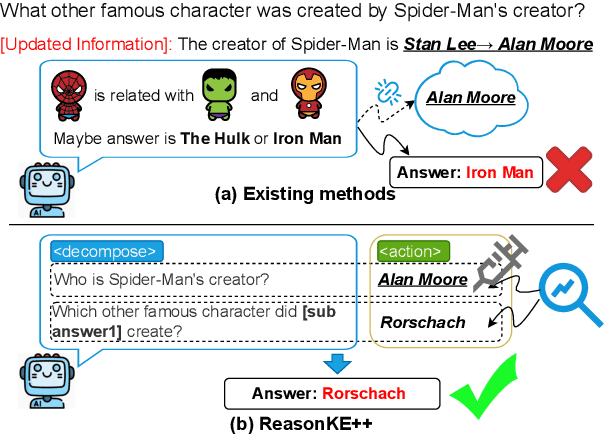
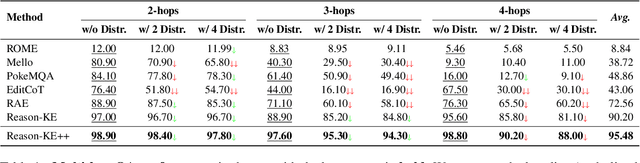
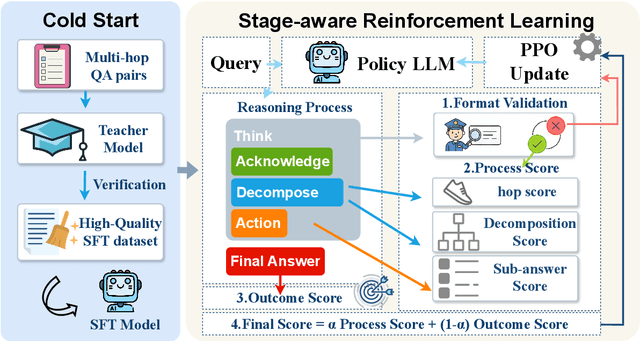
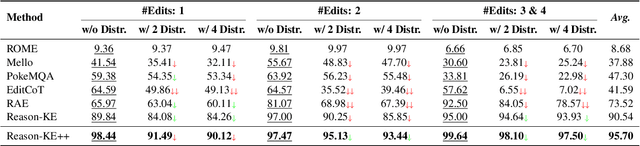
Aligning Large Language Models (LLMs) to be faithful to new knowledge in complex, multi-hop reasoning tasks is a critical, yet unsolved, challenge. We find that SFT-based methods, e.g., Reason-KE, while state-of-the-art, suffer from a "faithfulness gap": they optimize for format mimicry rather than sound reasoning. This gap enables the LLM's powerful parametric priors to override new contextual facts, resulting in critical factual hallucinations (e.g., incorrectly reasoning "Houston" from "NASA" despite an explicit edit). To solve this core LLM alignment problem, we propose Reason-KE++, an SFT+RL framework that instills process-level faithfulness. Its core is a Stage-aware Reward mechanism that provides dense supervision for intermediate reasoning steps (e.g., Decomposition, Sub-answer Correctness). Crucially, we identify that naive outcome-only RL is a deceptive trap for LLM alignment: it collapses reasoning integrity (e.g., 19.00% Hop acc) while superficially boosting final accuracy. Our process-aware framework sets a new SOTA of 95.48% on MQUAKE-CF-3k (+5.28%), demonstrating that for complex tasks, aligning the reasoning process is essential for building trustworthy LLMs.
Hindsight Distillation Reasoning with Knowledge Encouragement Preference for Knowledge-based Visual Question Answering
Nov 14, 2025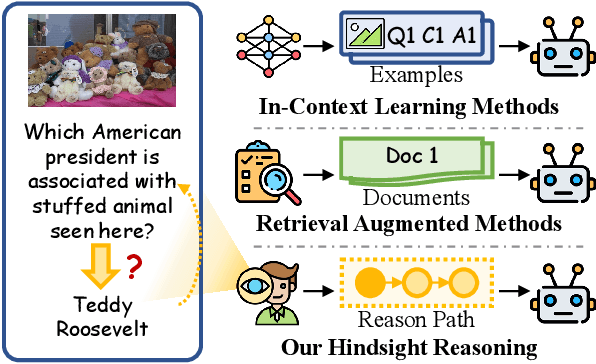
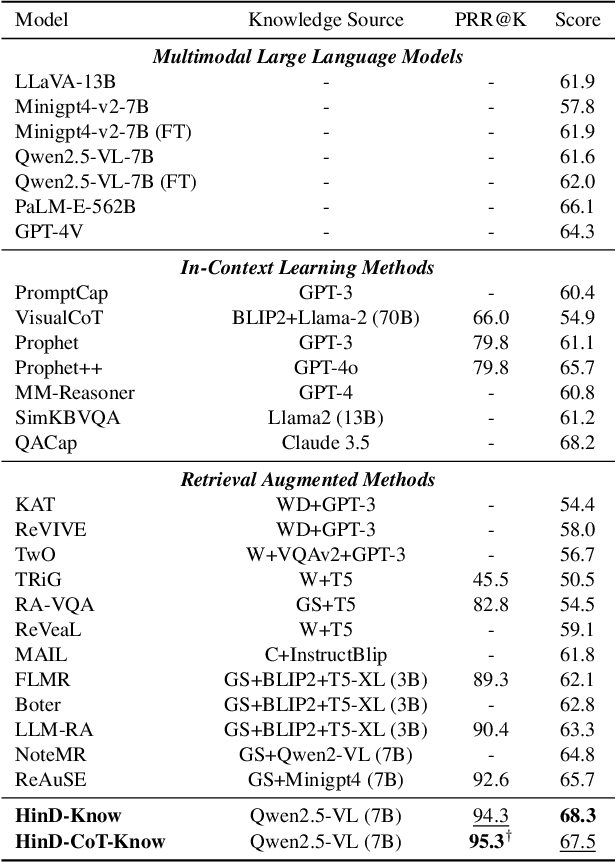
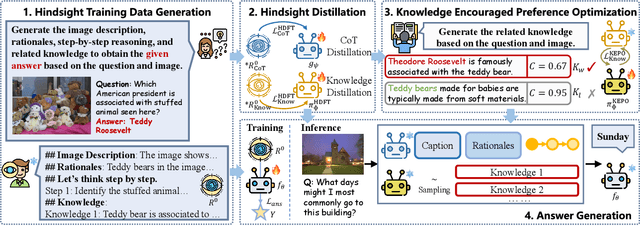
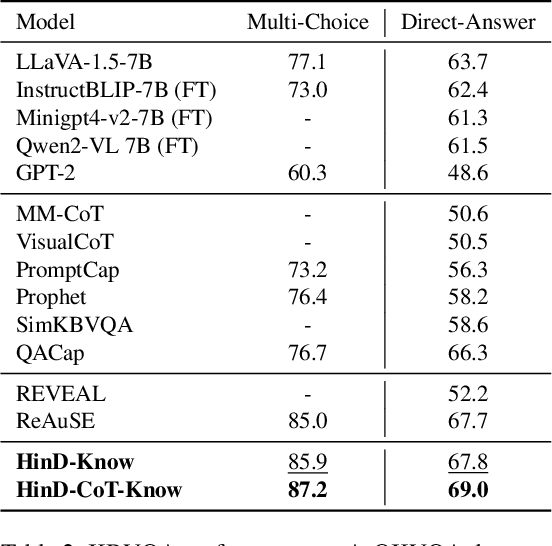
Knowledge-based Visual Question Answering (KBVQA) necessitates external knowledge incorporation beyond cross-modal understanding. Existing KBVQA methods either utilize implicit knowledge in multimodal large language models (MLLMs) via in-context learning or explicit knowledge via retrieval augmented generation. However, their reasoning processes remain implicit, without explicit multi-step trajectories from MLLMs. To address this gap, we provide a Hindsight Distilled Reasoning (HinD) framework with Knowledge Encouragement Preference Optimization (KEPO), designed to elicit and harness internal knowledge reasoning ability in MLLMs. First, to tackle the reasoning supervision problem, we propose to emphasize the hindsight wisdom of MLLM by prompting a frozen 7B-size MLLM to complete the reasoning process between the question and its ground truth answer, constructing Hindsight-Zero training data. Then we self-distill Hindsight-Zero into Chain-of-Thought (CoT) Generator and Knowledge Generator, enabling the generation of sequential steps and discrete facts. Secondly, to tackle the misalignment between knowledge correctness and confidence, we optimize the Knowledge Generator with KEPO, preferring under-confident but helpful knowledge over the over-confident but unhelpful one. The generated CoT and sampled knowledge are then exploited for answer prediction. Experiments on OK-VQA and A-OKVQA validate the effectiveness of HinD, showing that HinD with elicited reasoning from 7B-size MLLM achieves superior performance without commercial model APIs or outside knowledge.
fastbmRAG: A Fast Graph-Based RAG Framework for Efficient Processing of Large-Scale Biomedical Literature
Nov 13, 2025Large language models (LLMs) are rapidly transforming various domains, including biomedicine and healthcare, and demonstrate remarkable potential from scientific research to new drug discovery. Graph-based retrieval-augmented generation (RAG) systems, as a useful application of LLMs, can improve contextual reasoning through structured entity and relationship identification from long-context knowledge, e.g. biomedical literature. Even though many advantages over naive RAGs, most of graph-based RAGs are computationally intensive, which limits their application to large-scale dataset. To address this issue, we introduce fastbmRAG, an fast graph-based RAG optimized for biomedical literature. Utilizing well organized structure of biomedical papers, fastbmRAG divides the construction of knowledge graph into two stages, first drafting graphs using abstracts; and second, refining them using main texts guided by vector-based entity linking, which minimizes redundancy and computational load. Our evaluations demonstrate that fastbmRAG is over 10x faster than existing graph-RAG tools and achieve superior coverage and accuracy to input knowledge. FastbmRAG provides a fast solution for quickly understanding, summarizing, and answering questions about biomedical literature on a large scale. FastbmRAG is public available in https://github.com/menggf/fastbmRAG.
Learning to Pose Problems: Reasoning-Driven and Solver-Adaptive Data Synthesis for Large Reasoning Models
Nov 13, 2025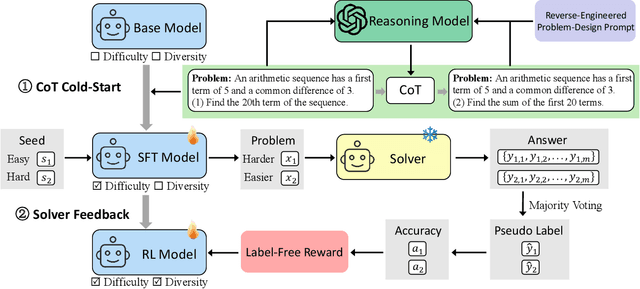
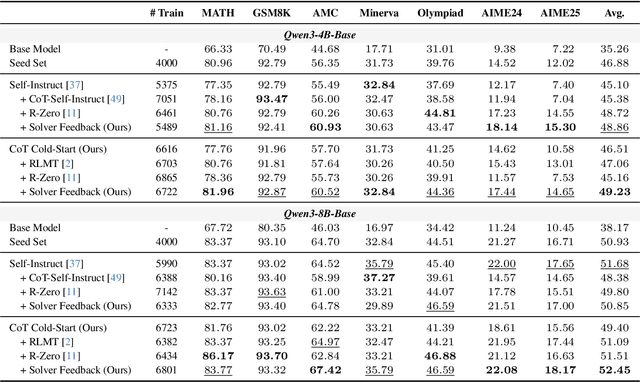
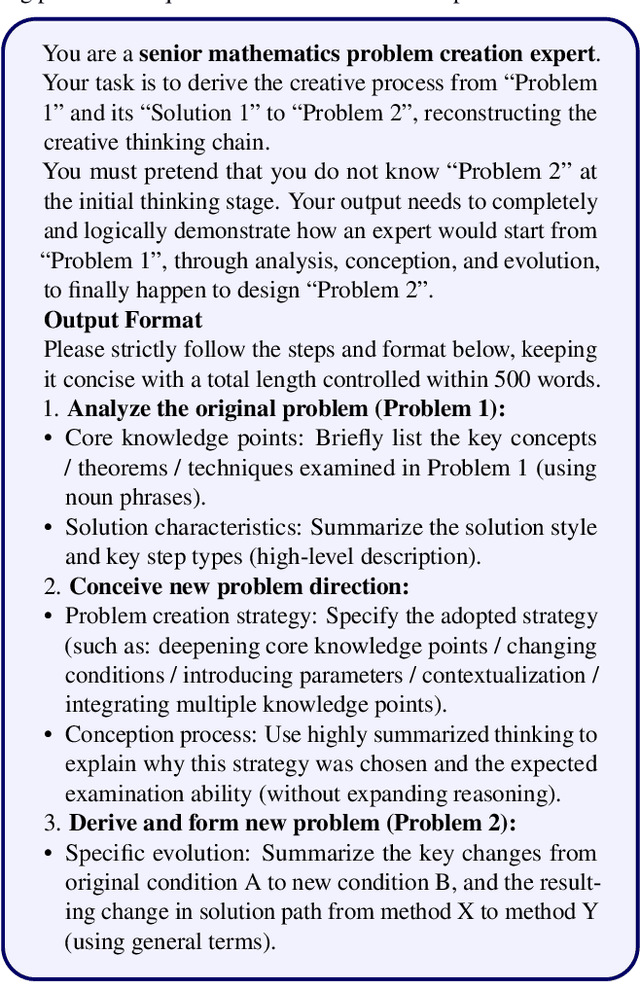
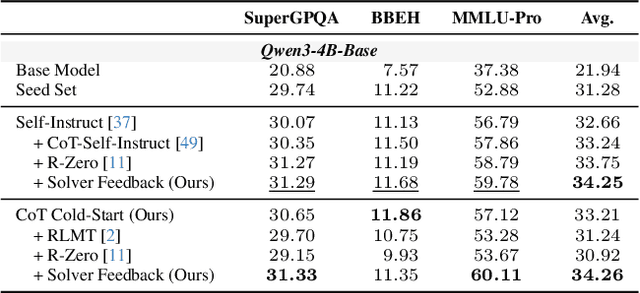
Data synthesis for training large reasoning models offers a scalable alternative to limited, human-curated datasets, enabling the creation of high-quality data. However, existing approaches face several challenges: (i) indiscriminate generation that ignores the solver's ability and yields low-value problems, or reliance on complex data pipelines to balance problem difficulty; and (ii) a lack of reasoning in problem generation, leading to shallow problem variants. In this paper, we develop a problem generator that reasons explicitly to plan problem directions before synthesis and adapts difficulty to the solver's ability. Specifically, we construct related problem pairs and augment them with intermediate problem-design CoT produced by a reasoning model. These data bootstrap problem-design strategies from the generator. Then, we treat the solver's feedback on synthetic problems as a reward signal, enabling the generator to calibrate difficulty and produce complementary problems near the edge of the solver's competence. Extensive experiments on 10 mathematical and general reasoning benchmarks show that our method achieves an average improvement of 2.5% and generalizes to both language and vision-language models. Moreover, a solver trained on the synthesized data provides improved rewards for continued generator training, enabling co-evolution and yielding a further 0.7% performance gain. Our code will be made publicly available here.
Sparse Model Inversion: Efficient Inversion of Vision Transformers for Data-Free Applications
Oct 31, 2025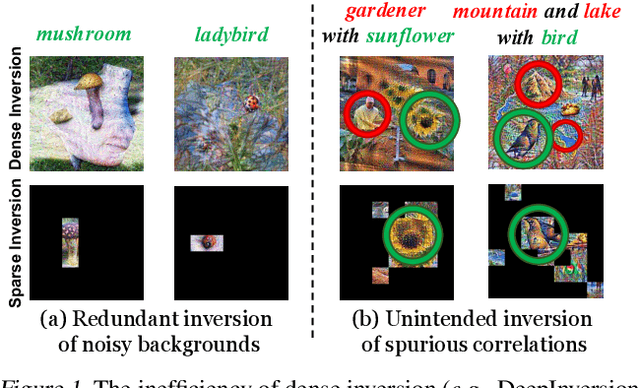
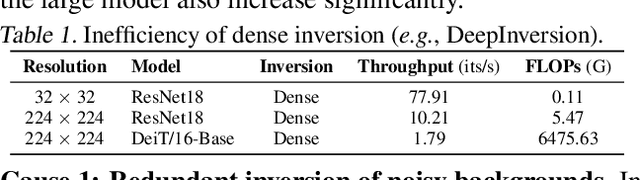
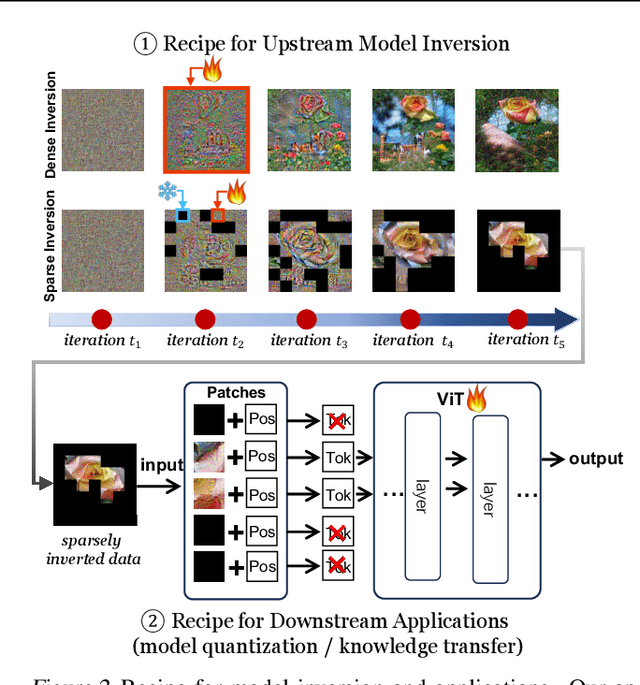
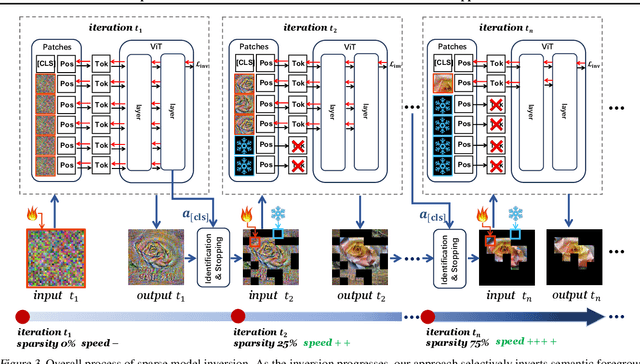
Model inversion, which aims to reconstruct the original training data from pre-trained discriminative models, is especially useful when the original training data is unavailable due to privacy, usage rights, or size constraints. However, existing dense inversion methods attempt to reconstruct the entire image area, making them extremely inefficient when inverting high-resolution images from large-scale Vision Transformers (ViTs). We further identify two underlying causes of this inefficiency: the redundant inversion of noisy backgrounds and the unintended inversion of spurious correlations--a phenomenon we term "hallucination" in model inversion. To address these limitations, we propose a novel sparse model inversion strategy, as a plug-and-play extension to speed up existing dense inversion methods with no need for modifying their original loss functions. Specifically, we selectively invert semantic foregrounds while stopping the inversion of noisy backgrounds and potential spurious correlations. Through both theoretical and empirical studies, we validate the efficacy of our approach in achieving significant inversion acceleration (up to 3.79 faster) while maintaining comparable or even enhanced downstream performance in data-free model quantization and data-free knowledge transfer. Code is available at https://github.com/Egg-Hu/SMI.
Adaptive Defense against Harmful Fine-Tuning for Large Language Models via Bayesian Data Scheduler
Oct 31, 2025Harmful fine-tuning poses critical safety risks to fine-tuning-as-a-service for large language models. Existing defense strategies preemptively build robustness via attack simulation but suffer from fundamental limitations: (i) the infeasibility of extending attack simulations beyond bounded threat models due to the inherent difficulty of anticipating unknown attacks, and (ii) limited adaptability to varying attack settings, as simulation fails to capture their variability and complexity. To address these challenges, we propose Bayesian Data Scheduler (BDS), an adaptive tuning-stage defense strategy with no need for attack simulation. BDS formulates harmful fine-tuning defense as a Bayesian inference problem, learning the posterior distribution of each data point's safety attribute, conditioned on the fine-tuning and alignment datasets. The fine-tuning process is then constrained by weighting data with their safety attributes sampled from the posterior, thus mitigating the influence of harmful data. By leveraging the post hoc nature of Bayesian inference, the posterior is conditioned on the fine-tuning dataset, enabling BDS to tailor its defense to the specific dataset, thereby achieving adaptive defense. Furthermore, we introduce a neural scheduler based on amortized Bayesian learning, enabling efficient transfer to new data without retraining. Comprehensive results across diverse attack and defense settings demonstrate the state-of-the-art performance of our approach. Code is available at https://github.com/Egg-Hu/Bayesian-Data-Scheduler.