 Add to Chrome
 Add to Firefox
 Add to Edge
Online Dynamic Batching with Formal Guarantees for LLM Training
Jun 18, 2026
Modern LLM training breaks a core assumption behind offline batch samplers: the true training cost of a sample is only observable after preprocessing, augmentation, templating, tokenization, and multimodal visual-token expansion. Unless one pays for a preprocessing- and augmentation-dependent length cache, batch construction is therefore blind to the quantity that determines padding, memory use, and GPU saturation. We introduce Online Dynamic Batching (ODB), a DataLoader-side drop-in system that moves batch formation to this point of accurate observability while preserving DDP step alignment. We formalize this synchronization requirement as the Distributed Group Alignment Problem and prove deadlock-free bounded termination with default join-mode identity coverage and opt-in non-join sample-quota closure. ODB requires no model, optimizer, or attention-kernel changes and is released as online-dynamic-batching with lightweight trainer adapters. Across public 2B/8B Qwen3-VL runs on UltraChat/LLaVA/ShareGPT4o, ODB improves literal emitted-sample throughput vs. fixed-batch Standard by 1.58-2.51x on single-node Full FT/LoRA and 1.71-3.78x on two-node Full FT, with Standard-comparable quality; production MM-Mix reaches 4.43x. Against GMT/BMT offline token-budget oracles, ODB is within 15% on UltraChat/LLaVA and faster on high-CV ShareGPT4o: 2.24-2.39x single-node Full FT/LoRA and 3.06-3.69x two-node Full FT. Together, ODB occupies the online/drop-in regime for high-heterogeneity LLM fine-tuning: large throughput gains at Standard-comparable quality, formal DGAP guarantees, and no length-cache precompute or kernel rewrites.

Enhancing Multimodal In-Context Learning via Inductive-Deductive Reasoning
May 04, 2026In-context learning (ICL) allows large models to adapt to tasks using a few examples, yet its extension to vision-language models (VLMs) remains fragile. Our analysis reveals that the fundamental limitation lies in an inductive gap, models often produce correct answers from flawed reasoning, while struggling to extract consistent rules across demonstrations. This gap is further exacerbated by two visual-level obstacles: an overwhelming proportion of redundant visual tokens that obscure textual cues, and a skewed attention distribution that favors the initial image at the expense of subsequent context. To address these issues, we introduce a framework that restructures multimodal ICL as a principled inductive-deductive process. The framework incorporates a similarity-based visual token compression module to filter out redundant patches, a dynamic attention rebalancing mechanism to distribute focus equitably across all images, and a chain-of-thought paradigm that explicitly guides the model to analyze individual examples, derive a generalizable rule, and then apply it to the query. An auxiliary learning pipeline combines supervised fine-tuning with reinforcement learning using verifiable rewards to reinforce faithful citation and noise filtering. Evaluations across eight benchmarks covering visual perception, logical reasoning, STEM problems, and sarcasm detection demonstrate consistent and significant improvements over standard ICL baselines for multiple open-source VLMs, highlighting the potential of equipping models with genuine inductive capabilities in multimodal settings.
Concise Geometric Description as a Bridge: Unleashing the Potential of LLM for Plane Geometry Problem Solving
Jan 29, 2026Plane Geometry Problem Solving (PGPS) is a multimodal reasoning task that aims to solve a plane geometric problem based on a geometric diagram and problem textual descriptions. Although Large Language Models (LLMs) possess strong reasoning skills, their direct application to PGPS is hindered by their inability to process visual diagrams. Existing works typically fine-tune Multimodal LLMs (MLLMs) end-to-end on large-scale PGPS data to enhance visual understanding and reasoning simultaneously. However, such joint optimization may compromise base LLMs' inherent reasoning capability. In this work, we observe that LLM itself is potentially a powerful PGPS solver when appropriately formulating visual information as textual descriptions. We propose to train a MLLM Interpreter to generate geometric descriptions for the visual diagram, and an off-the-shelf LLM is utilized to perform reasoning. Specifically, we choose Conditional Declaration Language (CDL) as the geometric description as its conciseness eases the MLLM Interpreter training. The MLLM Interpreter is fine-tuned via CoT (Chain-of-Thought)-augmented SFT followed by GRPO to generate CDL. Instead of using a conventional solution-based reward that compares the reasoning result with the ground-truth answer, we design CDL matching rewards to facilitate more effective GRPO training, which provides more direct and denser guidance for CDL generation. To support training, we construct a new dataset, Formalgeo7k-Rec-CoT, by manually reviewing Formalgeo7k v2 and incorporating CoT annotations. Extensive experiments on Formalgeo7k-Rec-CoT, Unigeo, and MathVista show our method (finetuned on only 5.5k data) performs favorably against leading open-source and closed-source MLLMs.
Learning to Pose Problems: Reasoning-Driven and Solver-Adaptive Data Synthesis for Large Reasoning Models
Nov 13, 2025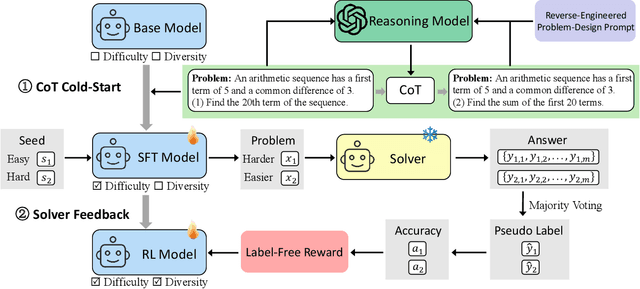
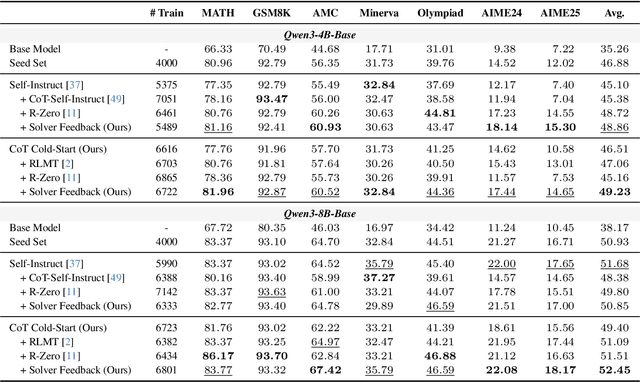
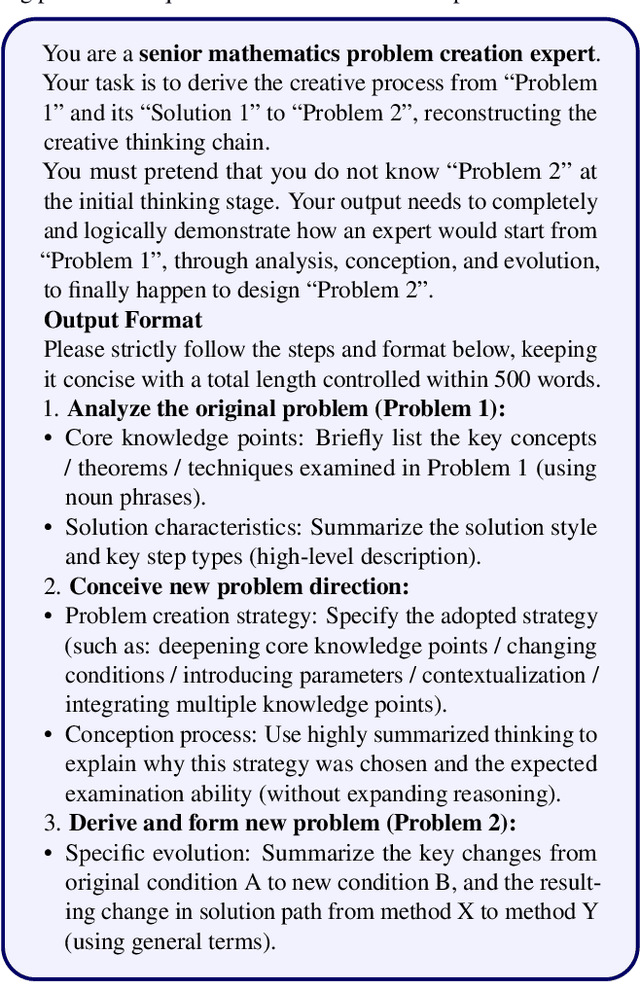
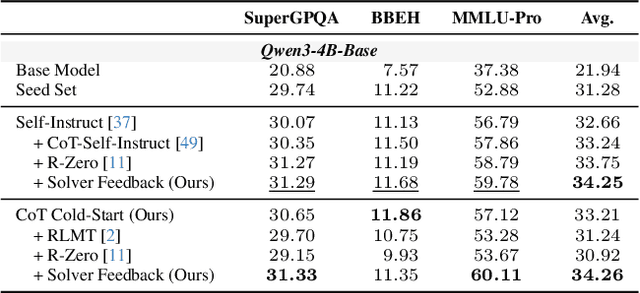
Data synthesis for training large reasoning models offers a scalable alternative to limited, human-curated datasets, enabling the creation of high-quality data. However, existing approaches face several challenges: (i) indiscriminate generation that ignores the solver's ability and yields low-value problems, or reliance on complex data pipelines to balance problem difficulty; and (ii) a lack of reasoning in problem generation, leading to shallow problem variants. In this paper, we develop a problem generator that reasons explicitly to plan problem directions before synthesis and adapts difficulty to the solver's ability. Specifically, we construct related problem pairs and augment them with intermediate problem-design CoT produced by a reasoning model. These data bootstrap problem-design strategies from the generator. Then, we treat the solver's feedback on synthetic problems as a reward signal, enabling the generator to calibrate difficulty and produce complementary problems near the edge of the solver's competence. Extensive experiments on 10 mathematical and general reasoning benchmarks show that our method achieves an average improvement of 2.5% and generalizes to both language and vision-language models. Moreover, a solver trained on the synthesized data provides improved rewards for continued generator training, enabling co-evolution and yielding a further 0.7% performance gain. Our code will be made publicly available here.
Fact-R1: Towards Explainable Video Misinformation Detection with Deep Reasoning
May 22, 2025The rapid spread of multimodal misinformation on social media has raised growing concerns, while research on video misinformation detection remains limited due to the lack of large-scale, diverse datasets. Existing methods often overfit to rigid templates and lack deep reasoning over deceptive content. To address these challenges, we introduce FakeVV, a large-scale benchmark comprising over 100,000 video-text pairs with fine-grained, interpretable annotations. In addition, we further propose Fact-R1, a novel framework that integrates deep reasoning with collaborative rule-based reinforcement learning. Fact-R1 is trained through a three-stage process: (1) misinformation long-Chain-of-Thought (CoT) instruction tuning, (2) preference alignment via Direct Preference Optimization (DPO), and (3) Group Relative Policy Optimization (GRPO) using a novel verifiable reward function. This enables Fact-R1 to exhibit emergent reasoning behaviors comparable to those observed in advanced text-based reinforcement learning systems, but in the more complex multimodal misinformation setting. Our work establishes a new paradigm for misinformation detection, bridging large-scale video understanding, reasoning-guided alignment, and interpretable verification.