 Add to Chrome
 Add to Firefox
 Add to Edge
Bi-Lipschitz Autoencoder With Injectivity Guarantee
Apr 08, 2026
Autoencoders are widely used for dimensionality reduction, based on the assumption that high-dimensional data lies on low-dimensional manifolds. Regularized autoencoders aim to preserve manifold geometry during dimensionality reduction, but existing approaches often suffer from non-injective mappings and overly rigid constraints that limit their effectiveness and robustness. In this work, we identify encoder non-injectivity as a core bottleneck that leads to poor convergence and distorted latent representations. To ensure robustness across data distributions, we formalize the concept of admissible regularization and provide sufficient conditions for its satisfaction. In this work, we propose the Bi-Lipschitz Autoencoder (BLAE), which introduces two key innovations: (1) an injective regularization scheme based on a separation criterion to eliminate pathological local minima, and (2) a bi-Lipschitz relaxation that preserves geometry and exhibits robustness to data distribution drift. Empirical results on diverse datasets show that BLAE consistently outperforms existing methods in preserving manifold structure while remaining resilient to sampling sparsity and distribution shifts. Code is available at https://github.com/qipengz/BLAE.

WorldTravel: A Realistic Multimodal Travel-Planning Benchmark with Tightly Coupled Constraints
Feb 09, 2026Real-world autonomous planning requires coordinating tightly coupled constraints where a single decision dictates the feasibility of all subsequent actions. However, existing benchmarks predominantly feature loosely coupled constraints solvable through local greedy decisions and rely on idealized data, failing to capture the complexity of extracting parameters from dynamic web environments. We introduce \textbf{WorldTravel}, a benchmark comprising 150 real-world travel scenarios across 5 cities that demand navigating an average of 15+ interdependent temporal and logical constraints. To evaluate agents in realistic deployments, we develop \textbf{WorldTravel-Webscape}, a multi-modal environment featuring over 2,000 rendered webpages where agents must perceive constraint parameters directly from visual layouts to inform their planning. Our evaluation of 10 frontier models reveals a significant performance collapse: even the state-of-the-art GPT-5.2 achieves only 32.67\% feasibility in text-only settings, which plummets to 19.33\% in multi-modal environments. We identify a critical Perception-Action Gap and a Planning Horizon threshold at approximately 10 constraints where model reasoning consistently fails, suggesting that perception and reasoning remain independent bottlenecks. These findings underscore the need for next-generation agents that unify high-fidelity visual perception with long-horizon reasoning to handle brittle real-world logistics.
Learning Ordered Representations in Latent Space for Intrinsic Dimension Estimation via Principal Component Autoencoder
Jan 27, 2026Autoencoders have long been considered a nonlinear extension of Principal Component Analysis (PCA). Prior studies have demonstrated that linear autoencoders (LAEs) can recover the ordered, axis-aligned principal components of PCA by incorporating non-uniform $\ell_2$ regularization or by adjusting the loss function. However, these approaches become insufficient in the nonlinear setting, as the remaining variance cannot be properly captured independently of the nonlinear mapping. In this work, we propose a novel autoencoder framework that integrates non-uniform variance regularization with an isometric constraint. This design serves as a natural generalization of PCA, enabling the model to preserve key advantages, such as ordered representations and variance retention, while remaining effective for nonlinear dimensionality reduction tasks.
Combining Optimal Transport and Embedding-Based Approaches for More Expressiveness in Unsupervised Graph Alignment
Jun 19, 2024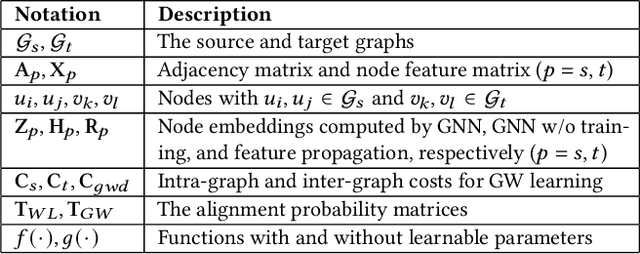


Unsupervised graph alignment finds the one-to-one node correspondence between a pair of attributed graphs by only exploiting graph structure and node features. One category of existing works first computes the node representation and then matches nodes with close embeddings, which is intuitive but lacks a clear objective tailored for graph alignment in the unsupervised setting. The other category reduces the problem to optimal transport (OT) via Gromov-Wasserstein (GW) learning with a well-defined objective but leaves a large room for exploring the design of transport cost. We propose a principled approach to combine their advantages motivated by theoretical analysis of model expressiveness. By noticing the limitation of discriminative power in separating matched and unmatched node pairs, we improve the cost design of GW learning with feature transformation, which enables feature interaction across dimensions. Besides, we propose a simple yet effective embedding-based heuristic inspired by the Weisfeiler-Lehman test and add its prior knowledge to OT for more expressiveness when handling non-Euclidean data. Moreover, we are the first to guarantee the one-to-one matching constraint by reducing the problem to maximum weight matching. The algorithm design effectively combines our OT and embedding-based predictions via stacking, an ensemble learning strategy. We propose a model framework named \texttt{CombAlign} integrating all the above modules to refine node alignment progressively. Through extensive experiments, we demonstrate significant improvements in alignment accuracy compared to state-of-the-art approaches and validate the effectiveness of the proposed modules.