 Add to Chrome
 Add to Firefox
 Add to Edge
Towards Accurate and Calibrated Classification: Regularizing Cross-Entropy From A Generative Perspective
Apr 08, 2026
Accurate classification requires not only high predictive accuracy but also well-calibrated confidence estimates. Yet, modern deep neural networks (DNNs) are often overconfident, primarily due to overfitting on the negative log-likelihood (NLL). While focal loss variants alleviate this issue, they typically reduce accuracy, revealing a persistent trade-off between calibration and predictive performance. Motivated by the complementary strengths of generative and discriminative classifiers, we propose Generative Cross-Entropy (GCE), which maximizes $p(x|y)$ and is equivalent to cross-entropy augmented with a class-level confidence regularizer. Under mild conditions, GCE is strictly proper. Across CIFAR-10/100, Tiny-ImageNet, and a medical imaging benchmark, GCE improves both accuracy and calibration over cross-entropy, especially in the long-tailed scenario. Combined with adaptive piecewise temperature scaling (ATS), GCE attains calibration competitive with focal-loss variants without sacrificing accuracy.

Bi-Lipschitz Autoencoder With Injectivity Guarantee
Apr 08, 2026Autoencoders are widely used for dimensionality reduction, based on the assumption that high-dimensional data lies on low-dimensional manifolds. Regularized autoencoders aim to preserve manifold geometry during dimensionality reduction, but existing approaches often suffer from non-injective mappings and overly rigid constraints that limit their effectiveness and robustness. In this work, we identify encoder non-injectivity as a core bottleneck that leads to poor convergence and distorted latent representations. To ensure robustness across data distributions, we formalize the concept of admissible regularization and provide sufficient conditions for its satisfaction. In this work, we propose the Bi-Lipschitz Autoencoder (BLAE), which introduces two key innovations: (1) an injective regularization scheme based on a separation criterion to eliminate pathological local minima, and (2) a bi-Lipschitz relaxation that preserves geometry and exhibits robustness to data distribution drift. Empirical results on diverse datasets show that BLAE consistently outperforms existing methods in preserving manifold structure while remaining resilient to sampling sparsity and distribution shifts. Code is available at https://github.com/qipengz/BLAE.
Learning Ordered Representations in Latent Space for Intrinsic Dimension Estimation via Principal Component Autoencoder
Jan 27, 2026Autoencoders have long been considered a nonlinear extension of Principal Component Analysis (PCA). Prior studies have demonstrated that linear autoencoders (LAEs) can recover the ordered, axis-aligned principal components of PCA by incorporating non-uniform $\ell_2$ regularization or by adjusting the loss function. However, these approaches become insufficient in the nonlinear setting, as the remaining variance cannot be properly captured independently of the nonlinear mapping. In this work, we propose a novel autoencoder framework that integrates non-uniform variance regularization with an isometric constraint. This design serves as a natural generalization of PCA, enabling the model to preserve key advantages, such as ordered representations and variance retention, while remaining effective for nonlinear dimensionality reduction tasks.
Fairness-Aware Estimation of Graphical Models
Aug 30, 2024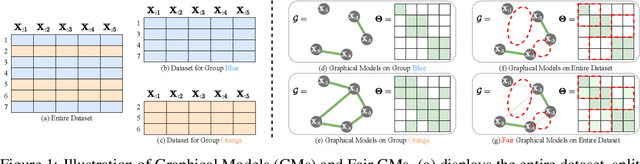

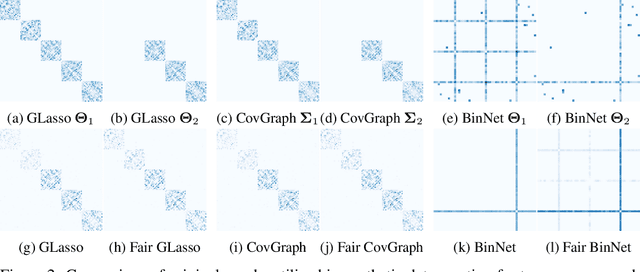
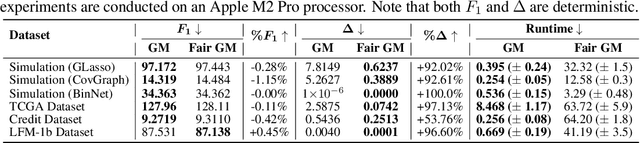
This paper examines the issue of fairness in the estimation of graphical models (GMs), particularly Gaussian, Covariance, and Ising models. These models play a vital role in understanding complex relationships in high-dimensional data. However, standard GMs can result in biased outcomes, especially when the underlying data involves sensitive characteristics or protected groups. To address this, we introduce a comprehensive framework designed to reduce bias in the estimation of GMs related to protected attributes. Our approach involves the integration of the pairwise graph disparity error and a tailored loss function into a nonsmooth multi-objective optimization problem, striving to achieve fairness across different sensitive groups while maintaining the effectiveness of the GMs. Experimental evaluations on synthetic and real-world datasets demonstrate that our framework effectively mitigates bias without undermining GMs' performance.
Fair Canonical Correlation Analysis
Sep 27, 2023
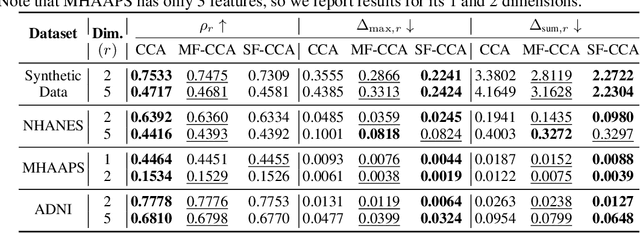
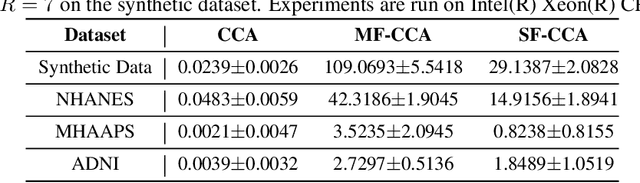
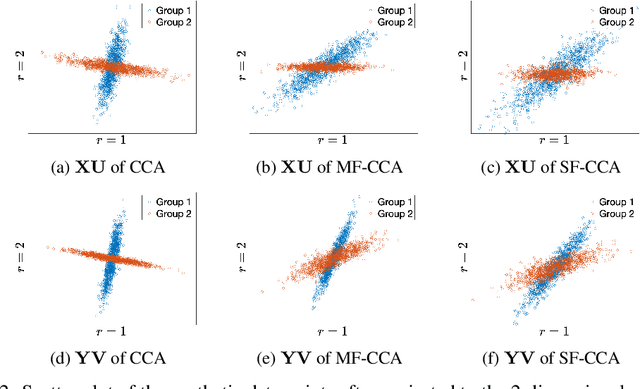
This paper investigates fairness and bias in Canonical Correlation Analysis (CCA), a widely used statistical technique for examining the relationship between two sets of variables. We present a framework that alleviates unfairness by minimizing the correlation disparity error associated with protected attributes. Our approach enables CCA to learn global projection matrices from all data points while ensuring that these matrices yield comparable correlation levels to group-specific projection matrices. Experimental evaluation on both synthetic and real-world datasets demonstrates the efficacy of our method in reducing correlation disparity error without compromising CCA accuracy.