 Add to Chrome
 Add to Firefox
 Add to Edge
Visual Point Cloud Forecasting enables Scalable Autonomous Driving
Dec 29, 2023
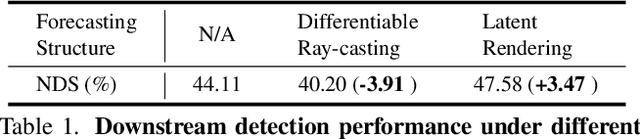
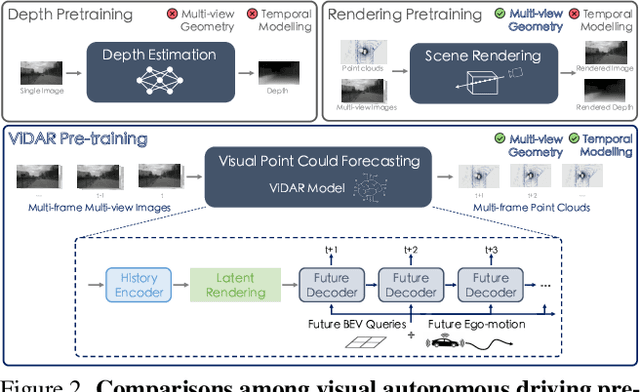
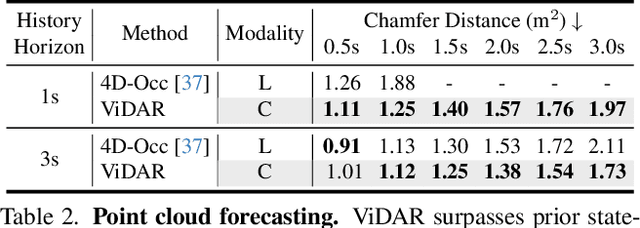
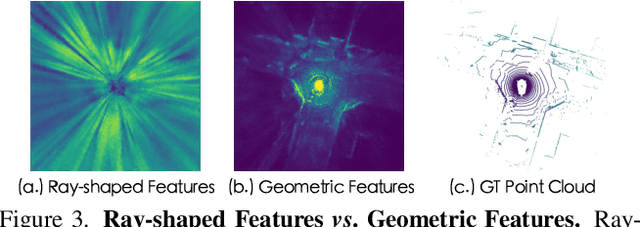
In contrast to extensive studies on general vision, pre-training for scalable visual autonomous driving remains seldom explored. Visual autonomous driving applications require features encompassing semantics, 3D geometry, and temporal information simultaneously for joint perception, prediction, and planning, posing dramatic challenges for pre-training. To resolve this, we bring up a new pre-training task termed as visual point cloud forecasting - predicting future point clouds from historical visual input. The key merit of this task captures the synergic learning of semantics, 3D structures, and temporal dynamics. Hence it shows superiority in various downstream tasks. To cope with this new problem, we present ViDAR, a general model to pre-train downstream visual encoders. It first extracts historical embeddings by the encoder. These representations are then transformed to 3D geometric space via a novel Latent Rendering operator for future point cloud prediction. Experiments show significant gain in downstream tasks, e.g., 3.1% NDS on 3D detection, ~10% error reduction on motion forecasting, and ~15% less collision rate on planning.

LaneSegNet: Map Learning with Lane Segment Perception for Autonomous Driving
Dec 26, 2023A map, as crucial information for downstream applications of an autonomous driving system, is usually represented in lanelines or centerlines. However, existing literature on map learning primarily focuses on either detecting geometry-based lanelines or perceiving topology relationships of centerlines. Both of these methods ignore the intrinsic relationship of lanelines and centerlines, that lanelines bind centerlines. While simply predicting both types of lane in one model is mutually excluded in learning objective, we advocate lane segment as a new representation that seamlessly incorporates both geometry and topology information. Thus, we introduce LaneSegNet, the first end-to-end mapping network generating lane segments to obtain a complete representation of the road structure. Our algorithm features two key modifications. One is a lane attention module to capture pivotal region details within the long-range feature space. Another is an identical initialization strategy for reference points, which enhances the learning of positional priors for lane attention. On the OpenLane-V2 dataset, LaneSegNet outperforms previous counterparts by a substantial gain across three tasks, \textit{i.e.}, map element detection (+4.8 mAP), centerline perception (+6.9 DET$_l$), and the newly defined one, lane segment perception (+5.6 mAP). Furthermore, it obtains a real-time inference speed of 14.7 FPS. Code is accessible at https://github.com/OpenDriveLab/LaneSegNet.
DriveLM: Driving with Graph Visual Question Answering
Dec 21, 2023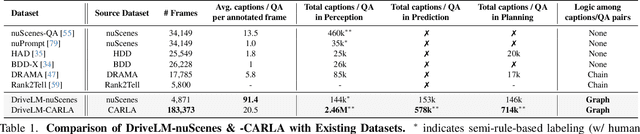
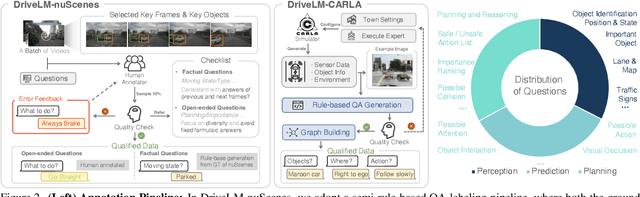
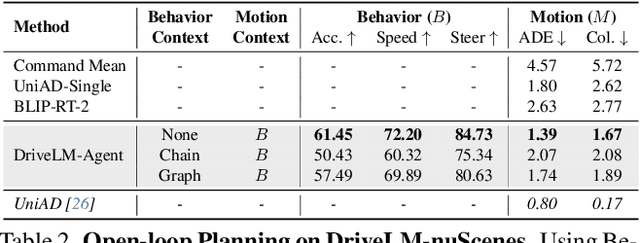
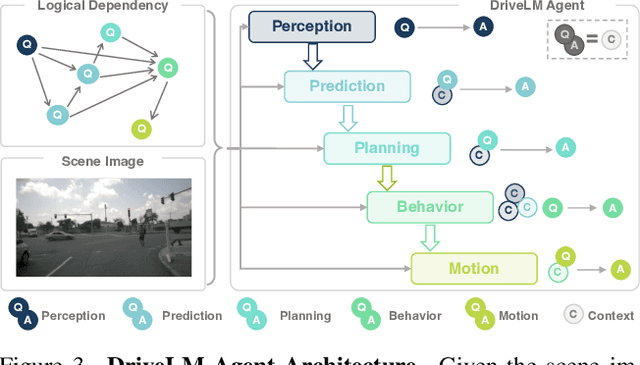
We study how vision-language models (VLMs) trained on web-scale data can be integrated into end-to-end driving systems to boost generalization and enable interactivity with human users. While recent approaches adapt VLMs to driving via single-round visual question answering (VQA), human drivers reason about decisions in multiple steps. Starting from the localization of key objects, humans estimate object interactions before taking actions. The key insight is that with our proposed task, Graph VQA, where we model graph-structured reasoning through perception, prediction and planning question-answer pairs, we obtain a suitable proxy task to mimic the human reasoning process. We instantiate datasets (DriveLM-Data) built upon nuScenes and CARLA, and propose a VLM-based baseline approach (DriveLM-Agent) for jointly performing Graph VQA and end-to-end driving. The experiments demonstrate that Graph VQA provides a simple, principled framework for reasoning about a driving scene, and DriveLM-Data provides a challenging benchmark for this task. Our DriveLM-Agent baseline performs end-to-end autonomous driving competitively in comparison to state-of-the-art driving-specific architectures. Notably, its benefits are pronounced when it is evaluated zero-shot on unseen objects or sensor configurations. We hope this work can be the starting point to shed new light on how to apply VLMs for autonomous driving. To facilitate future research, all code, data, and models are available to the public.
Optimal coordination in Minority Game: A solution from reinforcement learning
Dec 20, 2023Efficient allocation is important in nature and human society where individuals often compete for finite resources. The Minority Game is perhaps the simplest model that provides deep insights into how human coordinate to maximize the resource utilization. However, this model assumes the static strategies that are provided a priori, failing to capture their adaptive nature. Here, we turn to the paradigm of reinforcement learning, where individuals' strategies are evolving by evaluating both the past experience and rewards in the future. Specifically, we adopt the Q-learning algorithm, each player is endowed with a Q-table that guides their decision-making. We reveal that the population is able to reach the optimal allocation when individuals appreciate both the past experience and rewards in the future, and they are able to balance the exploitation of their Q-tables and the exploration by randomly acting. The optimal allocation is ruined when individuals tend to use either exploitation-only or exploration-only, where only partial coordination and even anti-coordination are observed. Mechanism analysis reveals that a moderate level of exploration can escape local minimums of metastable periodic states, and reaches the optimal coordination as the global minimum. Interestingly, the optimal coordination is underlined by a symmetry-breaking of action preferences, where nearly half of the population choose one side while the other half prefer the other side. The emergence of optimal coordination is robust to the population size and other game parameters. Our work therefore provides a natural solution to the Minority Game and sheds insights into the resource allocation problem in general. Besides, our work demonstrates the potential of the proposed reinforcement learning paradigm in deciphering many puzzles in the socio-economic context.
Opara: Exploiting Operator Parallelism for Expediting DNN Inference on GPUs
Dec 16, 2023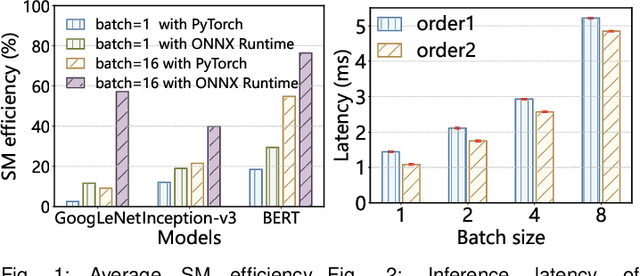

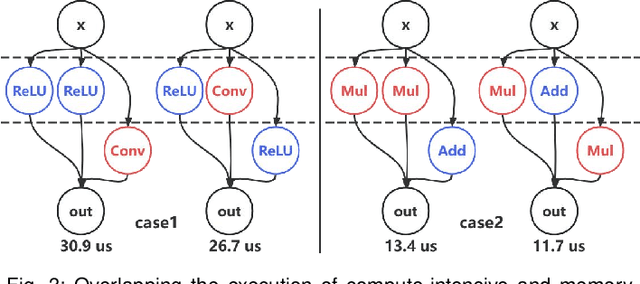
GPUs have become the defacto hardware devices to accelerate Deep Neural Network (DNN) inference in deep learning(DL) frameworks. However, the conventional sequential execution mode of DNN operators in mainstream DL frameworks cannot fully utilize GPU resources, due to the increasing complexity of DNN model structures and the progressively smaller computational sizes of DNN operators. Moreover, the inadequate operator launch order in parallelized execution scenarios can lead to GPU resource wastage and unexpected performance interference among operators. To address such performance issues above, we propose Opara, a resource- and interference-aware DNN Operator parallel scheduling framework to accelerate the execution of DNN inference on GPUs. Specifically, Opara first employs CUDA Streams and CUDA Graph to automatically parallelize the execution of multiple DNN operators. It further leverages the resource demands of DNN operators to judiciously adjust the operator launch order on GPUs by overlapping the execution of compute-intensive and memory-intensive operators, so as to expedite DNN inference. We implement and open source a prototype of Opara based on PyTorch in a non-intrusive manner. Extensive prototype experiments with representative DNN and Transformer-based models demonstrate that Opara outperforms the default sequential CUDA Graph in PyTorch and the state-of-the-art DNN operator parallelism systems by up to 1.68$\times$ and 1.29$\times$, respectively, yet with acceptable runtime overhead.
Audio-visual Saliency for Omnidirectional Videos
Nov 09, 2023Visual saliency prediction for omnidirectional videos (ODVs) has shown great significance and necessity for omnidirectional videos to help ODV coding, ODV transmission, ODV rendering, etc.. However, most studies only consider visual information for ODV saliency prediction while audio is rarely considered despite its significant influence on the viewing behavior of ODV. This is mainly due to the lack of large-scale audio-visual ODV datasets and corresponding analysis. Thus, in this paper, we first establish the largest audio-visual saliency dataset for omnidirectional videos (AVS-ODV), which comprises the omnidirectional videos, audios, and corresponding captured eye-tracking data for three video sound modalities including mute, mono, and ambisonics. Then we analyze the visual attention behavior of the observers under various omnidirectional audio modalities and visual scenes based on the AVS-ODV dataset. Furthermore, we compare the performance of several state-of-the-art saliency prediction models on the AVS-ODV dataset and construct a new benchmark. Our AVS-ODV datasets and the benchmark will be released to facilitate future research.
FMMRec: Fairness-aware Multimodal Recommendation
Oct 26, 2023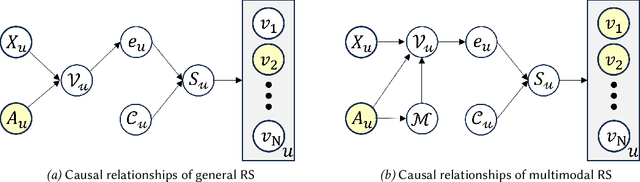

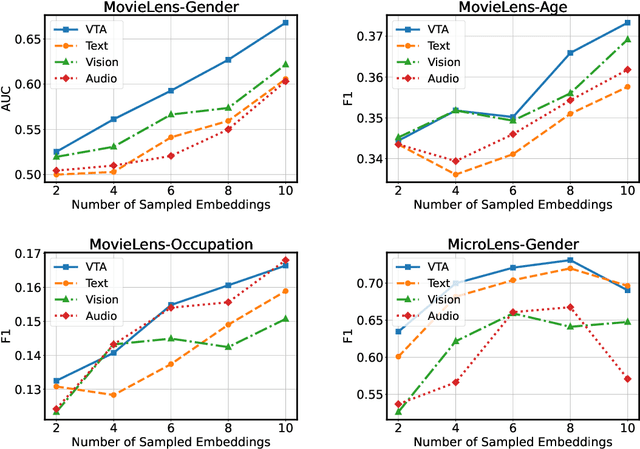
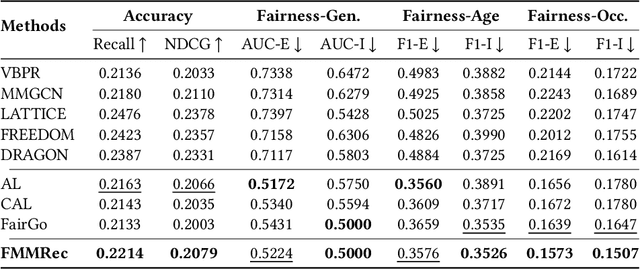
Recently, multimodal recommendations have gained increasing attention for effectively addressing the data sparsity problem by incorporating modality-based representations. Although multimodal recommendations excel in accuracy, the introduction of different modalities (e.g., images, text, and audio) may expose more users' sensitive information (e.g., gender and age) to recommender systems, resulting in potentially more serious unfairness issues. Despite many efforts on fairness, existing fairness-aware methods are either incompatible with multimodal scenarios, or lead to suboptimal fairness performance due to neglecting sensitive information of multimodal content. To achieve counterfactual fairness in multimodal recommendations, we propose a novel fairness-aware multimodal recommendation approach (dubbed as FMMRec) to disentangle the sensitive and non-sensitive information from modal representations and leverage the disentangled modal representations to guide fairer representation learning. Specifically, we first disentangle biased and filtered modal representations by maximizing and minimizing their sensitive attribute prediction ability respectively. With the disentangled modal representations, we mine the modality-based unfair and fair (corresponding to biased and filtered) user-user structures for enhancing explicit user representation with the biased and filtered neighbors from the corresponding structures, followed by adversarially filtering out sensitive information. Experiments on two real-world public datasets demonstrate the superiority of our FMMRec relative to the state-of-the-art baselines. Our source code is available at https://anonymous.4open.science/r/FMMRec.
Near-Field Positioning and Attitude Sensing Based on Electromagnetic Propagation Modeling
Oct 26, 2023Positioning and sensing over wireless networks are imperative for many emerging applications. However, traditional wireless channel models cannot be used for sensing the attitude of the user equipment (UE), since they over-simplify the UE as a point target. In this paper, a comprehensive electromagnetic propagation modeling (EPM) based on electromagnetic theory is developed to precisely model the near-field channel. For the noise-free case, the EPM model establishes the non-linear functional dependence of observed signals on both the position and attitude of the UE. To address the difficulty in the non-linear coupling, we first propose to divide the distance domain into three regions, separated by the defined Phase ambiguity distance and Spacing constraint distance. Then, for each region, we obtain the closed-form solutions for joint position and attitude estimation with low complexity. Next, to investigate the impact of random noise on the joint estimation performance, the Ziv-Zakai bound (ZZB) is derived to yield useful insights. The expected Cram\'er-Rao bound (ECRB) is further provided to obtain the simplified closed-form expressions for the performance lower bounds. Our numerical results demonstrate that the derived ZZB can provide accurate predictions of the performance of estimators in all signal-to-noise ratio (SNR) regimes. More importantly, we achieve the millimeter-level accuracy in position estimation and attain the 0.1-level accuracy in attitude estimation.
Near-field Integrated Sensing and Communication: Opportunities and Challenges
Oct 17, 2023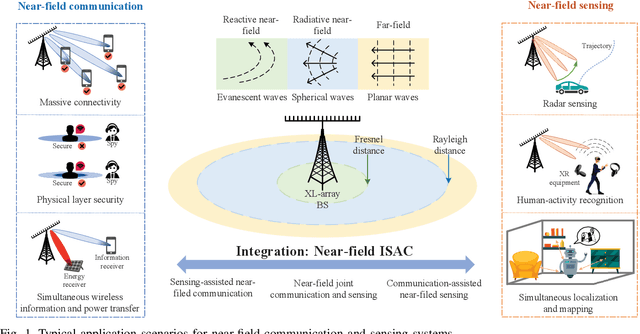
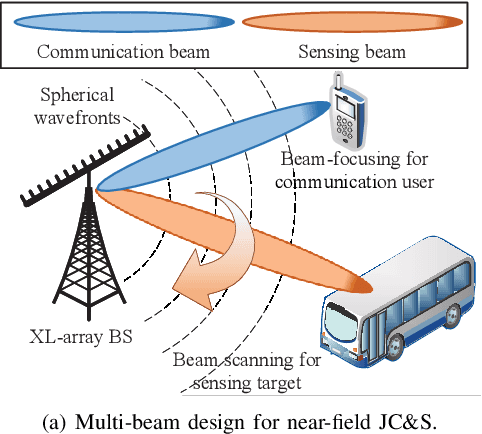
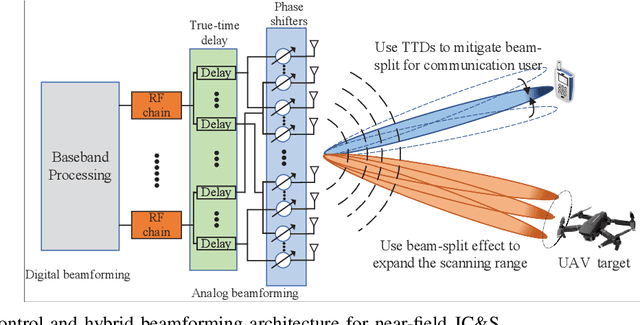
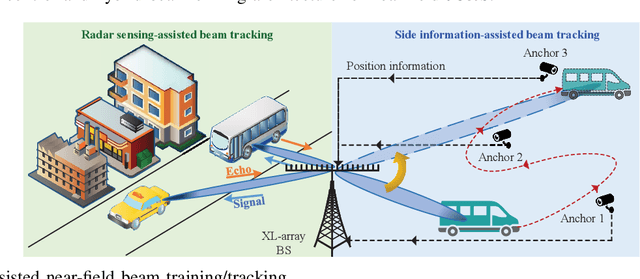
With the extremely large-scale array XL-array deployed in future wireless systems, wireless communication and sensing are expected to operate in the radiative near-field region, which needs to be characterized by the spherical rather than planar wavefronts. Unlike most existing works that considered far-field integrated sensing and communication (ISAC), we study in this article the new near-field ISAC, which integrates both functions of sensing and communication in the near-field region. To this end, we first discuss the appealing advantages of near-field communication and sensing over their far-field counterparts, respectively. Then, we introduce three approaches for near-field ISAC, including joint near-field communication and sensing, sensing-assisted near-field communication, and communication-assisted near-field sensing. We discuss their individual research opportunities, new design issues, as well as propose promising solutions. Finally, several important directions in near-field ISAC are also highlighted to motivate future work.
Contrastive Self-Supervised Learning for Spatio-Temporal Analysis of Lung Ultrasound Videos
Oct 14, 2023Self-supervised learning (SSL) methods have shown promise for medical imaging applications by learning meaningful visual representations, even when the amount of labeled data is limited. Here, we extend state-of-the-art contrastive learning SSL methods to 2D+time medical ultrasound video data by introducing a modified encoder and augmentation method capable of learning meaningful spatio-temporal representations, without requiring constraints on the input data. We evaluate our method on the challenging clinical task of identifying lung consolidations (an important pathological feature) in ultrasound videos. Using a multi-center dataset of over 27k lung ultrasound videos acquired from over 500 patients, we show that our method can significantly improve performance on downstream localization and classification of lung consolidation. Comparisons against baseline models trained without SSL show that the proposed methods are particularly advantageous when the size of labeled training data is limited (e.g., as little as 5% of the training set).