 Add to Chrome
 Add to Firefox
 Add to Edge
The Second LoViF 2026 Challenge on Real-World All-in-One Image Restoration: Methods and Results
Jul 23, 2026
This paper presents a review of the second LoViF Challenge on Real-World All-in-One Image Restoration. The challenge aims to advance unified image restoration under diverse real-world degradation conditions, including blur, low-light, haze, rain, and snow. It provides a common benchmark for evaluating the restoration accuracy, robustness, and generalization capability of models across multiple degradation categories within a unified framework. The competition attracted 158 registered participants, and 20 teams were included in the final ranking after their submitted results were successfully reproduced and verified. This report provides a comprehensive analysis of the submitted solutions and corresponding results, highlighting recent advances in real-world all-in-one image restoration. The summarized methods and empirical findings reveal effective design strategies and establish an updated benchmark for future research in real-world low-level vision.

LoViF 2026 Challenge on Real-World All-in-One Image Restoration: Methods and Results
Apr 21, 2026This paper presents a review for the LoViF Challenge on Real-World All-in-One Image Restoration. The challenge aimed to advance research on real-world all-in-one image restoration under diverse real-world degradation conditions, including blur, low-light, haze, rain, and snow. It provided a unified benchmark to evaluate the robustness and generalization ability of restoration models across multiple degradation categories within a common framework. The competition attracted 124 registered participants and received 9 valid final submissions with corresponding fact sheets, significantly contributing to the progress of real-world all-in-one image restoration. This report provides a detailed analysis of the submitted methods and corresponding results, emphasizing recent progress in unified real-world image restoration. The analysis highlights effective approaches and establishes a benchmark for future research in real-world low-level vision.
LoViF 2026 The First Challenge on Weather Removal in Videos
Apr 14, 2026This paper presents a review of the LoViF 2026 Challenge on Weather Removal in Videos. The challenge encourages the development of methods for restoring clean videos from inputs degraded by adverse weather conditions such as rain and snow, with an emphasis on achieving visually plausible and temporally consistent results while preserving scene structure and motion dynamics. To support this task, we introduce a new short-form WRV dataset tailored for video weather removal. It consists of 18 videos 1,216 synthesized frames paired with 1,216 real-world ground-truth frames at a resolution of 832 x 480, and is split into training, validation, and test sets with a ratio of 1:1:1. The goal of this challenge is to advance robust and realistic video restoration under real-world weather conditions, with evaluation protocols that jointly consider fidelity and perceptual quality. The challenge attracted 37 participants and received 5 valid final submissions with corresponding fact sheets, contributing to progress in weather removal for videos. The project is publicly available at https://www.codabench.org/competitions/13462/.
NTIRE 2026 Challenge on Short-form UGC Video Restoration in the Wild with Generative Models: Datasets, Methods and Results
Apr 12, 2026This paper presents an overview of the NTIRE 2026 Challenge on Short-form UGC Video Restoration in the Wild with Generative Models. This challenge utilizes a new short-form UGC (S-UGC) video restoration benchmark, termed KwaiVIR, which is contributed by USTC and Kuaishou Technology. It contains both synthetically distorted videos and real-world short-form UGC videos in the wild. For this edition, the released data include 200 synthetic training videos, 48 wild training videos, 11 validation videos, and 20 testing videos. The primary goal of this challenge is to establish a strong and practical benchmark for restoring short-form UGC videos under complex real-world degradations, especially in the emerging paradigm of generative-model-based S-UGC video restoration. This challenge has two tracks: (i) the primary track is a subjective track, where the evaluation is based on a user study; (ii) the second track is an objective track. These two tracks enable a comprehensive assessment of restoration quality. In total, 95 teams have registered for this competition. And 12 teams submitted valid final solutions and fact sheets for the testing phase. The submitted methods achieved strong performance on the KwaiVIR benchmark, demonstrating encouraging progress in short-form UGC video restoration in the wild.
NTIRE 2026 Challenge on Bitstream-Corrupted Video Restoration: Methods and Results
Apr 09, 2026This paper reports on the NTIRE 2026 Challenge on Bitstream-Corrupted Video Restoration (BSCVR). The challenge aims to advance research on recovering visually coherent videos from corrupted bitstreams, whose decoding often produces severe spatial-temporal artifacts and content distortion. Built upon recent progress in bitstream-corrupted video recovery, the challenge provides a common benchmark for evaluating restoration methods under realistic corruption settings. We describe the dataset, evaluation protocol, and participating methods, and summarize the final results and main technical trends. The challenge highlights the difficulty of this emerging task and provides useful insights for future research on robust video restoration under practical bitstream corruption.
ESVQA: Perceptual Quality Assessment of Egocentric Spatial Videos
Dec 29, 2024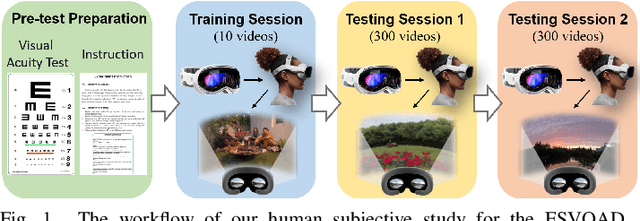
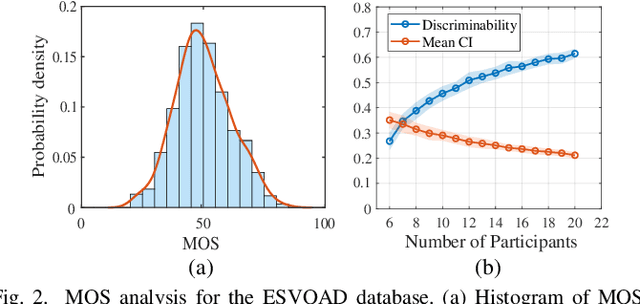


With the rapid development of eXtended Reality (XR), egocentric spatial shooting and display technologies have further enhanced immersion and engagement for users. Assessing the quality of experience (QoE) of egocentric spatial videos is crucial to ensure a high-quality viewing experience. However, the corresponding research is still lacking. In this paper, we use the embodied experience to highlight this more immersive experience and study the new problem, i.e., embodied perceptual quality assessment for egocentric spatial videos. Specifically, we introduce the first Egocentric Spatial Video Quality Assessment Database (ESVQAD), which comprises 600 egocentric spatial videos and their mean opinion scores (MOSs). Furthermore, we propose a novel multi-dimensional binocular feature fusion model, termed ESVQAnet, which integrates binocular spatial, motion, and semantic features to predict the perceptual quality. Experimental results demonstrate the ESVQAnet outperforms 16 state-of-the-art VQA models on the embodied perceptual quality assessment task, and exhibits strong generalization capability on traditional VQA tasks. The database and codes will be released upon the publication.
How Does Audio Influence Visual Attention in Omnidirectional Videos? Database and Model
Aug 10, 2024


Understanding and predicting viewer attention in omnidirectional videos (ODVs) is crucial for enhancing user engagement in virtual and augmented reality applications. Although both audio and visual modalities are essential for saliency prediction in ODVs, the joint exploitation of these two modalities has been limited, primarily due to the absence of large-scale audio-visual saliency databases and comprehensive analyses. This paper comprehensively investigates audio-visual attention in ODVs from both subjective and objective perspectives. Specifically, we first introduce a new audio-visual saliency database for omnidirectional videos, termed AVS-ODV database, containing 162 ODVs and corresponding eye movement data collected from 60 subjects under three audio modes including mute, mono, and ambisonics. Based on the constructed AVS-ODV database, we perform an in-depth analysis of how audio influences visual attention in ODVs. To advance the research on audio-visual saliency prediction for ODVs, we further establish a new benchmark based on the AVS-ODV database by testing numerous state-of-the-art saliency models, including visual-only models and audio-visual models. In addition, given the limitations of current models, we propose an innovative omnidirectional audio-visual saliency prediction network (OmniAVS), which is built based on the U-Net architecture, and hierarchically fuses audio and visual features from the multimodal aligned embedding space. Extensive experimental results demonstrate that the proposed OmniAVS model outperforms other state-of-the-art models on both ODV AVS prediction and traditional AVS predcition tasks. The AVS-ODV database and OmniAVS model will be released to facilitate future research.
ESIQA: Perceptual Quality Assessment of Vision-Pro-based Egocentric Spatial Images
Jul 31, 2024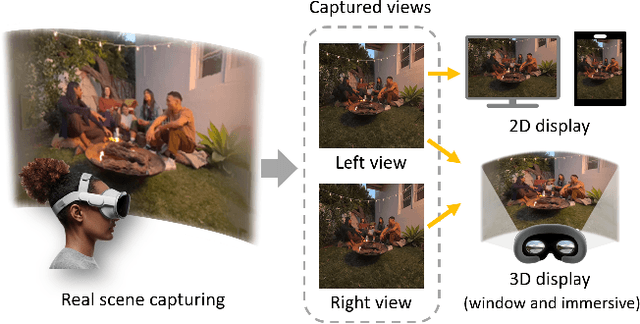
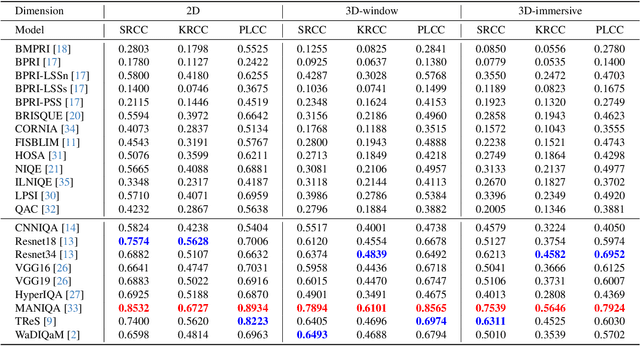
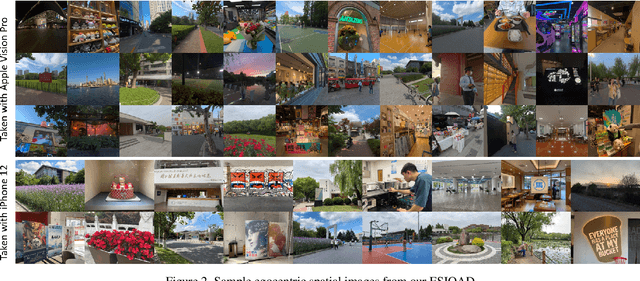
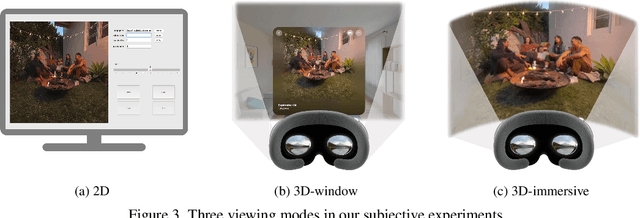
With the development of eXtended Reality (XR), head-mounted shooting and display technology have experienced significant advancement and gained considerable attention. Egocentric spatial images and videos are emerging as a compelling form of stereoscopic XR content. Different from traditional 2D images, egocentric spatial images present challenges for perceptual quality assessment due to their special shooting, processing methods, and stereoscopic characteristics. However, the corresponding image quality assessment (IQA) research for egocentric spatial images is still lacking. In this paper, we establish the Egocentric Spatial Images Quality Assessment Database (ESIQAD), the first IQA database dedicated for egocentric spatial images as far as we know. Our ESIQAD includes 500 egocentric spatial images, containing 400 images captured with the Apple Vision Pro and 100 images generated via an iPhone's "Spatial Camera" app. The corresponding mean opinion scores (MOSs) are collected under three viewing modes, including 2D display, 3D-window display, and 3D-immersive display. Furthermore, based on our database, we conduct a benchmark experiment and evaluate the performance of 22 state-of-the-art IQA models under three different viewing modes. We hope this research can facilitate future IQA research on egocentric spatial images. The database is available at https://github.com/IntMeGroup/ESIQA.
Audio-visual Saliency for Omnidirectional Videos
Nov 09, 2023Visual saliency prediction for omnidirectional videos (ODVs) has shown great significance and necessity for omnidirectional videos to help ODV coding, ODV transmission, ODV rendering, etc.. However, most studies only consider visual information for ODV saliency prediction while audio is rarely considered despite its significant influence on the viewing behavior of ODV. This is mainly due to the lack of large-scale audio-visual ODV datasets and corresponding analysis. Thus, in this paper, we first establish the largest audio-visual saliency dataset for omnidirectional videos (AVS-ODV), which comprises the omnidirectional videos, audios, and corresponding captured eye-tracking data for three video sound modalities including mute, mono, and ambisonics. Then we analyze the visual attention behavior of the observers under various omnidirectional audio modalities and visual scenes based on the AVS-ODV dataset. Furthermore, we compare the performance of several state-of-the-art saliency prediction models on the AVS-ODV dataset and construct a new benchmark. Our AVS-ODV datasets and the benchmark will be released to facilitate future research.
Perceptual Quality Assessment of Omnidirectional Audio-visual Signals
Jul 20, 2023Omnidirectional videos (ODVs) play an increasingly important role in the application fields of medical, education, advertising, tourism, etc. Assessing the quality of ODVs is significant for service-providers to improve the user's Quality of Experience (QoE). However, most existing quality assessment studies for ODVs only focus on the visual distortions of videos, while ignoring that the overall QoE also depends on the accompanying audio signals. In this paper, we first establish a large-scale audio-visual quality assessment dataset for omnidirectional videos, which includes 375 distorted omnidirectional audio-visual (A/V) sequences generated from 15 high-quality pristine omnidirectional A/V contents, and the corresponding perceptual audio-visual quality scores. Then, we design three baseline methods for full-reference omnidirectional audio-visual quality assessment (OAVQA), which combine existing state-of-the-art single-mode audio and video QA models via multimodal fusion strategies. We validate the effectiveness of the A/V multimodal fusion method for OAVQA on our dataset, which provides a new benchmark for omnidirectional QoE evaluation. Our dataset is available at https://github.com/iamazxl/OAVQA.