 Add to Chrome
 Add to Firefox
 Add to Edge
Fronto-parietal and fronto-temporal EEG coherence as predictive neuromarkers of transcutaneous auricular vagus nerve stimulation response in treatment-resistant schizophrenia: A machine learning study
Mar 14, 2026
Response variability limits the clinical utility of transcutaneous auricular vagus nerve stimulation (taVNS) for negative symptoms in treatment-resistant schizophrenia (TRS). This study aimed to develop an electroencephalography (EEG)-based machine learning (ML) model to predict individual response and explore associated neurophysiological mechanisms. We used ML to develop and validate predictive models based on pre-treatment EEG data features (power, coherence, and dynamic functional connectivity) from 50 TRS patients enrolled in the taVNS trial, within a nested cross-validation framework. Participants received 20 sessions of active or sham taVNS (n = 25 each) over two weeks, followed by a two-week follow-up. The prediction target was the percentage change in the positive and negative syndrome scale-factor score for negative symptoms (PANSS-FSNS) from baseline to post-treatment, with further evaluation of model specificity and neurophysiological relevance.The optimal model accurately predicted taVNS response in the active group, with predicted PANSS-FSNS changes strongly correlated with observed changes (r = 0.87, p < .001); permutation testing confirmed performance above chance (p < .001). Nine consistently retained features were identified, predominantly fronto-parietal and fronto-temporal coherence features. Negligible predictive performance in the sham group and failure to predict positive symptom change support the predictive specificity of this oscillatory signature for taVNS-related negative symptom improvement. Two coherence features within fronto-parietal-temporal networks showed post-taVNS changes significantly associated with symptom improvement, suggesting dual roles as predictors and potential therapeutic targets. EEG oscillatory neuromarkers enable accurate prediction of individual taVNS response in TRS, supporting mechanism-informed precision neuromodulation strategies.

ALTER: Asymmetric LoRA for Token-Entropy-Guided Unlearning of LLMs
Mar 02, 2026Large language models (LLMs) have advanced to encompass extensive knowledge across diverse domains. Yet controlling what a LLMs should not know is important for ensuring alignment and thus safe use. However, effective unlearning in LLMs is difficult due to the fuzzy boundary between knowledge retention and forgetting. This challenge is exacerbated by entangled parameter spaces from continuous multi-domain training, often resulting in collateral damage, especially under aggressive unlearning strategies. Furthermore, the computational overhead required to optimize State-of-the-Art (SOTA) models with billions of parameters poses an additional barrier. In this work, we present ALTER, a lightweight unlearning framework for LLMs to address both the challenges of knowledge entanglement and unlearning efficiency. ALTER operates through two phases: (I) high entropy tokens are captured and learned via the shared A matrix in LoRA, followed by (II) an asymmetric LoRA architecture that achieves a specified forgetting objective by parameter isolation and unlearning tokens within the target subdomains. Serving as a new research direction for achieving unlearning via token-level isolation in the asymmetric framework. ALTER achieves SOTA performance on TOFU, WMDP, and MUSE benchmarks with over 95% forget quality and shows minimal side effects through preserving foundational tokens. By decoupling unlearning from LLMs' billion-scale parameters, this framework delivers excellent efficiency while preserving over 90% of model utility, exceeding baseline preservation rates of 47.8-83.6%.
Low-complexity Design for Beam Coverage in Near-field and Far-field: A Fourier Transform Approach
Feb 05, 2026In this paper, we study efficient beam coverage design for multi-antenna systems in both far-field and near-field cases. To reduce the computational complexity of existing sampling-based optimization methods, we propose a new low-complexity yet efficient beam coverage design. To this end, we first formulate a general beam coverage optimization problem to maximize the worst-case beamforming gain over a target region. For the far-field case, we show that the beam coverage design can be viewed as a spatial-frequency filtering problem, where angular coverage can be achieved by weight-shaping in the antenna domain via an inverse FT, yielding an infinite-length weighting sequence. Under the constraint of a finite number of antennas, a surrogate scheme is proposed by directly truncating this sequence, which inevitably introduces a roll-off effect at the angular boundaries, yielding degraded worst-case beamforming gain. To address this issue, we characterize the finite-antenna-induced roll-off effect, based on which a roll-off-aware design with a protective zoom is developed to ensure a flat beamforming-gain profile within the target angular region. Next, we extend the proposed method to the near-field case. Specifically, by applying a first-order Taylor approximation to the near-field channel steering vector (CSV), the two-dimensional (2D) beam coverage design (in both angle and inverse-range) can be transformed into a 2D inverse FT, leading to a low-complexity beamforming design. Furthermore, an inherent near-field range defocusing effect is observed, indicating that sufficiently wide angular coverage results in range-insensitive beam steering. Finally, numerical results demonstrate that the proposed FT-based approach achieves a comparable worst-case beamforming performance with that of conventional sampling-based optimization methods while significantly reducing the computational complexity.
MA-enhanced Mixed Near-field and Far-field Covert Communications
Nov 11, 2025In this paper, we propose to employ a modular-based movable extremely large-scale array (XL-array) at Alice for enhancing covert communication performance. Compared with existing work that mostly considered either far-field or near-field covert communications, we consider in this paper a more general and practical mixed-field scenario, where multiple Bobs are located in either the near-field or far-field of Alice, in the presence of multiple near-field Willies. Specifically, we first consider a two-Bob-one-Willie system and show that conventional fixed-position XL-arrays suffer degraded sum-rate performance due to the energy-spread effect in mixed-field systems, which, however, can be greatly improved by subarray movement. On the other hand, for transmission covertness, it is revealed that sufficient angle difference between far-field Bob and Willie as well as adequate range difference between near-field Bob and Willie are necessary for ensuring covertness in fixed-position XL-array systems, while this requirement can be relaxed in movable XL-array systems thanks to flexible channel correlation control between Bobs and Willie. Next, for general system setups, we formulate an optimization problem to maximize the achievable sum-rate under covertness constraint. To solve this non-convex optimization problem, we first decompose it into two subproblems, corresponding to an inner problem for beamforming optimization given positions of subarrays and an outer problem for subarray movement optimization. Although these two subproblems are still non-convex, we obtain their high-quality solutions by using the successive convex approximation technique and devising a customized differential evolution algorithm, respectively. Last, numerical results demonstrate the effectiveness of proposed movable XL-array in balancing sum-rate and covert communication requirements.
Advancing the Control of Low-Altitude Wireless Networks: Architecture, Design Principles, and Future Directions
Aug 11, 2025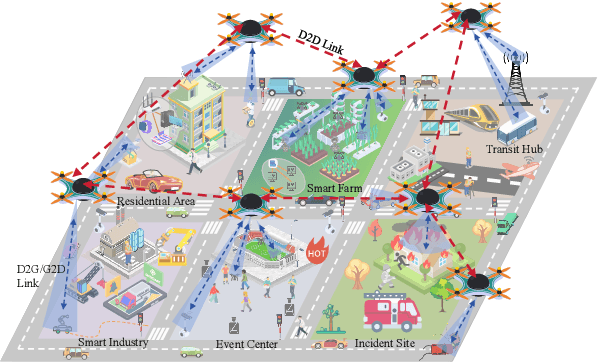

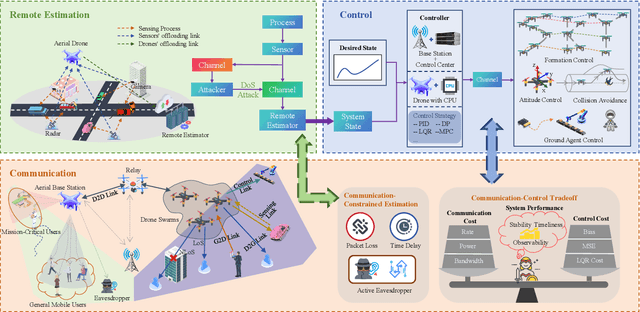
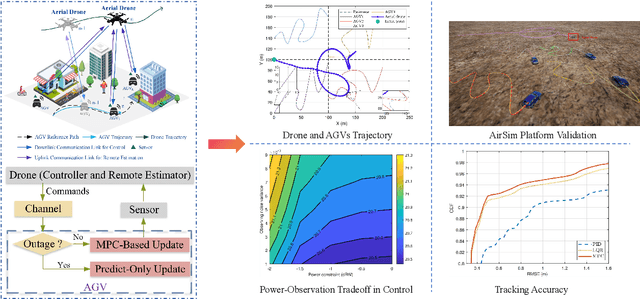
This article introduces a control-oriented low-altitude wireless network (LAWN) that integrates near-ground communications and remote estimation of the internal system state. This integration supports reliable networked control in dynamic aerial-ground environments. First, we introduce the network's modular architecture and key performance metrics. Then, we discuss core design trade-offs across the control, communication, and estimation layers. A case study illustrates closed-loop coordination under wireless constraints. Finally, we outline future directions for scalable, resilient LAWN deployments in real-time and resource-constrained scenarios.
Channel Estimation for Wideband XL-MIMO: A Constrained Deep Unrolling Approach
May 12, 2025Extremely large-scale multiple-input multipleoutput (XL-MIMO) enables the formation of narrow beams, effectively mitigating path loss in high-frequency communications. This capability makes the integration of wideband high-frequency communications with XL-MIMO a key enabler for future 6G networks. Realizing the full potential of such wideband XL-MIMO systems critically depends on acquiring accurate channel state information. However, this acquisition is significantly challenged by inherent wideband XLMIMO channel characteristics, including near-field propagation effects, beam split, and spatial non-stationarity. We formulate the channel estimation as a maximum a posteriori problem and propose an unrolled proximal gradient descent network. The network integrates learnable step sizes and replaces the proximal operator with a neural network to implicitly learn channel prior knowledge without requiring explicit regularization terms. To enhance the convergence behavior, we incorporated a monotonic descent constraint on the layer-wise estimation error during training. This constrained learning problem is addressed using a primal-dual training approach. Theoretical analysis is provided to characterize the duality gap and convergence behavior of the proposed method. Furthermore, simulation results are presented to validate its effectiveness, demonstrating gains in estimation accuracy over both traditional and deep learning-based methods.
Energy-Efficient SLAM via Joint Design of Sensing, Communication, and Exploration Speed
Dec 18, 2024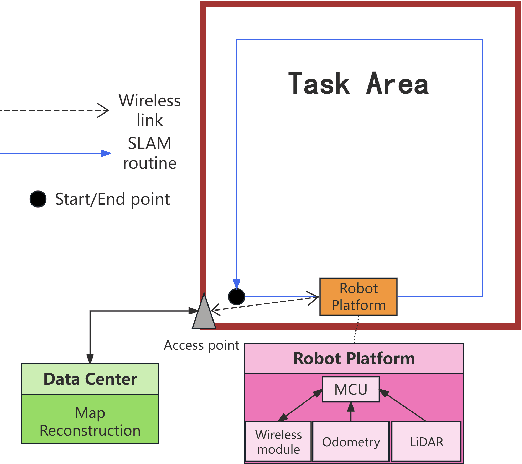
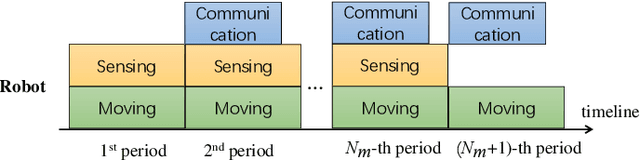
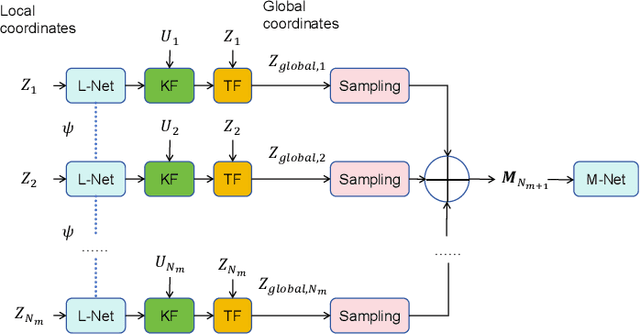
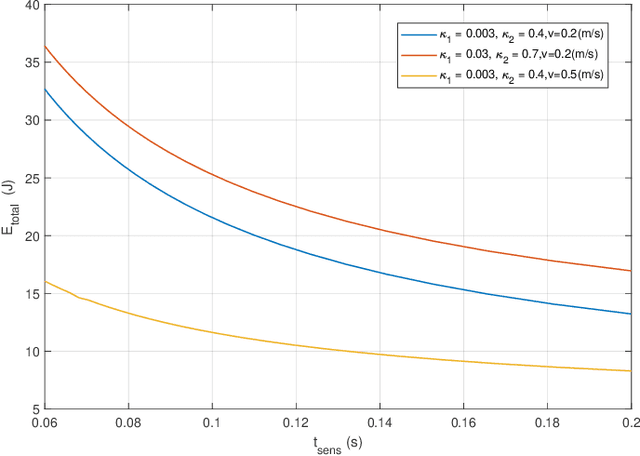
To support future spatial machine intelligence applications, lifelong simultaneous localization and mapping (SLAM) has drawn significant attentions. SLAM is usually realized based on various types of mobile robots performing simultaneous and continuous sensing and communication. This paper focuses on analyzing the energy efficiency of robot operation for lifelong SLAM by jointly considering sensing, communication and mechanical factors. The system model is built based on a robot equipped with a 2D light detection and ranging (LiDAR) and an odometry. The cloud point raw data as well as the odometry data are wirelessly transmitted to data center where real-time map reconstruction is realized based on an unsupervised deep learning based method. The sensing duration, transmit power, transmit duration and exploration speed are jointly optimized to minimize the energy consumption. Simulations and experiments demonstrate the performance of our proposed method.
Convolutional Dictionary Learning Based Hybrid-Field Channel Estimation for XL-RIS-Aided Massive MIMO Systems
Sep 25, 2024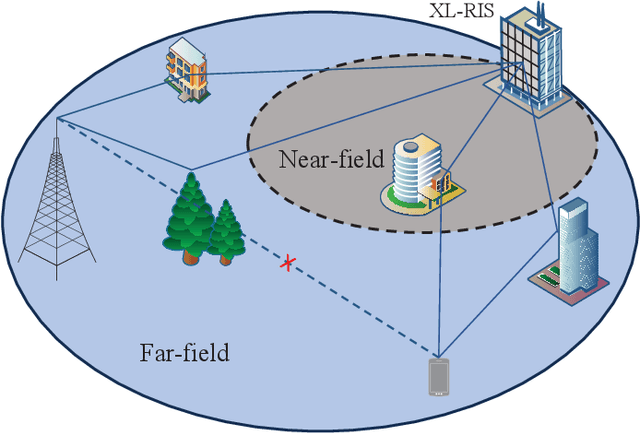
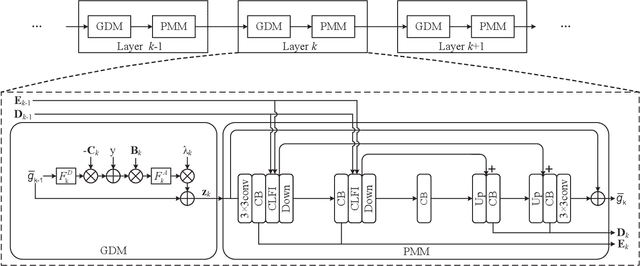
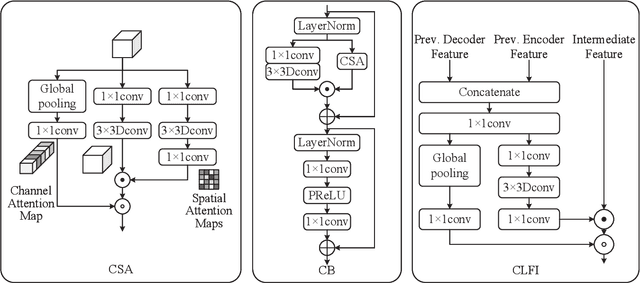
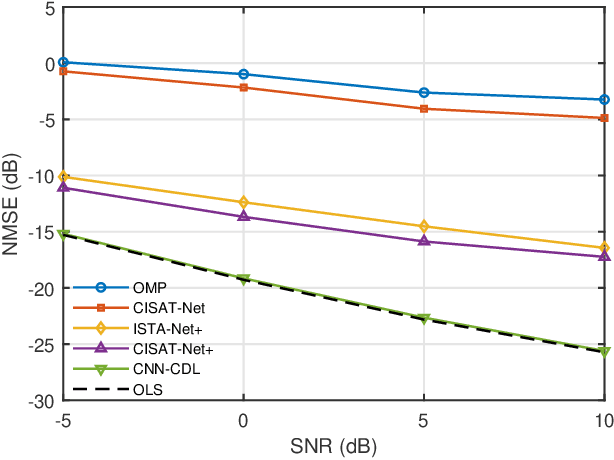
Extremely large reconfigurable intelligent surface (XL-RIS) is emerging as a promising key technology for 6G systems. To exploit XL-RIS's full potential, accurate channel estimation is essential. This paper investigates channel estimation in XL-RIS-aided massive MIMO systems under hybrid-field scenarios where far-field and near-field channels coexist. We formulate this problem using dictionary learning, which allows for joint optimization of the dictionary and estimated channel. To handle the high-dimensional nature of XL-RIS channels, we specifically adopt a convolutional dictionary learning (CDL) formulation. The CDL formulation is cast as a bilevel optimization problem, which we solve using a gradient-based approach. To address the challenge of computing the gradient of the upper-level objective, we introduce an unrolled optimization method based on proximal gradient descent (PGD) and its special case, the iterative soft-thresholding algorithm (ISTA). We propose two neural network architectures, Convolutional ISTA-Net and its enhanced version Convolutional ISTA-Net+, for end-to-end optimization of the CDL. To overcome the limitations of linear convolutional filters in capturing complex hybrid-field channel structures, we propose the CNN-CDL approach, which enhances PGD by replacing linear convolution filters with CNN blocks in its gradient descent step, employing a learnable proximal mapping module in its proximal mapping step, and incorporating cross-layer feature integration. Simulation results demonstrate the effectiveness of the proposed methods for channel estimation in hybrid-field XL-RIS systems.
Channel Estimation for XL-IRS Assisted Wireless Systems with Double-sided Visibility Regions
Aug 30, 2024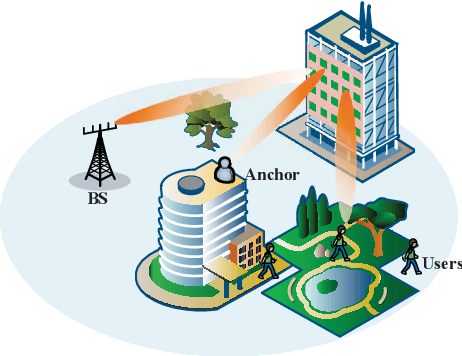
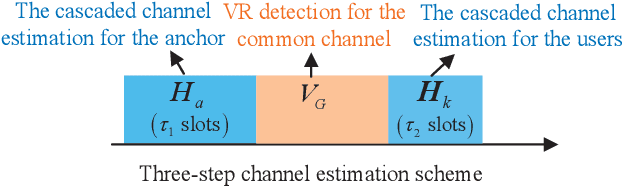


In this paper, we study efficient channel estimation design for an extremely large-scale intelligent reflecting surface (XL-IRS) assisted multi-user communication systems, where both the base station (BS) and users are located in the near-field region of the XL-IRS. Two unique channel characteristics of XL-IRS are considered, namely, the near-field spherical wavefronts and double-sided visibility regions (VRs) at the BS and users, which render the channel estimation for XL-IRS highly challenging. To address this issue, we propose in this paper an efficient three-step XL-IRS channel estimation method. Specifically, in the first step, an anchor node is delicately deployed near the XL-IRS to estimate the cascaded BS-IRS-anchor channel. Then, an efficient VR detection method is devised to estimate the VR information between the BS and XL-IRS. In this way, only the channels from the visible XL-IRS elements to the BS are estimated, thereby reducing the dimension of the cascaded BS-IRS-users channels to be estimated. Third, by leveraging the common BS-IRS channel, the cascaded channels for all users are consecutively estimated accounting for the VRs of the IRS-user channels. Finally, numerical results are provided to demonstrate the effectiveness of our proposed channel estimation scheme as compared to various benchmark schemes.
Multi-beam Training for Near-field Communications in High-frequency Bands
Jun 21, 2024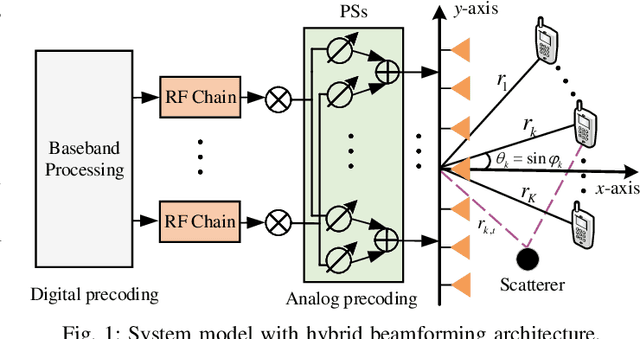
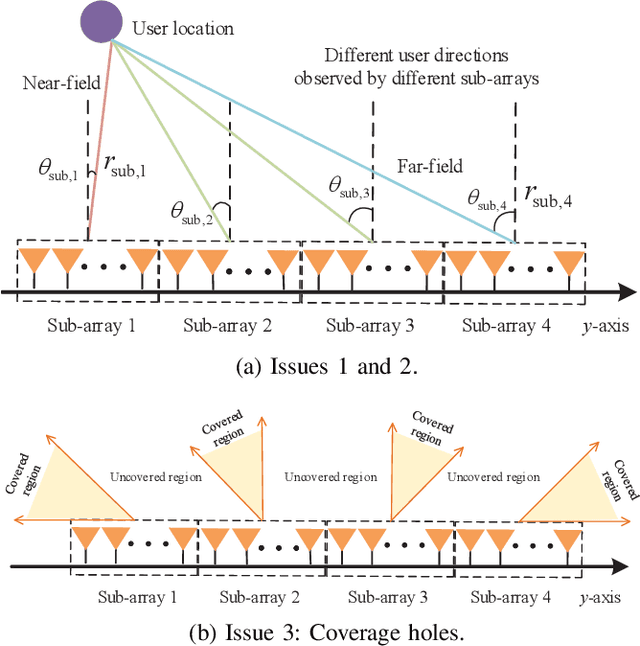
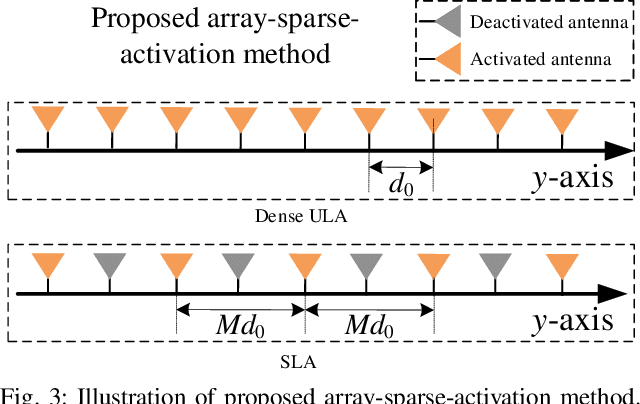
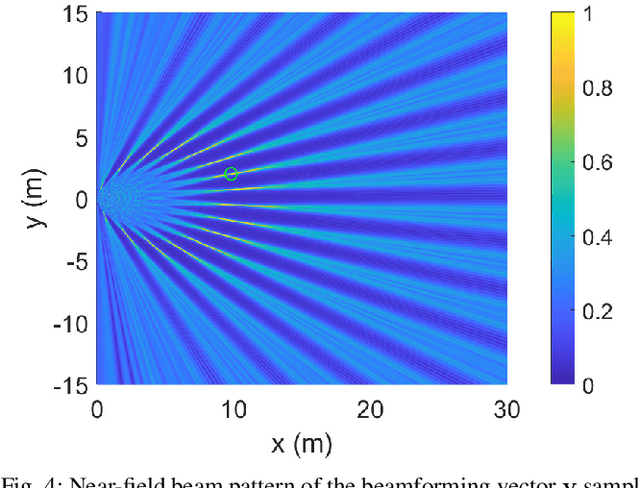
In this paper, we study efficient multi-beam training design for near-field communications to reduce the beam training overhead of conventional single-beam training methods. In particular, the array-division based multi-beam training method, which is widely used in far-field communications, cannot be directly applied to the near-field scenario, since different sub-arrays may observe different user angles and there exist coverage holes in the angular domain. To address these issues, we first devise a new near-field multi-beam codebook by sparsely activating a portion of antennas to form a sparse linear array (SLA), hence generating multiple beams simultaneously by effective exploiting the near-field grating-lobs. Next, a two-stage near-field beam training method is proposed, for which several candidate user locations are identified firstly based on multi-beam sweeping over time, followed by the second stage to further determine the true user location with a small number of single-beam sweeping. Finally, numerical results show that our proposed multi-beam training method significantly reduces the beam training overhead of conventional single-beam training methods, yet achieving comparable rate performance in data transmission.