 Add to Chrome
 Add to Firefox
 Add to Edge
StoryVideoQA: Scaling Deep Video Understanding with a Large-Scale, Multi-Genre and Auto-Generated Dataset
Jun 04, 2026
Video question answering (VideoQA) aims to answer questions about given videos. While existing approaches excel on factoid VideoQA, they struggle with deep video understanding (DVU), which requires the comprehension of complex storylines. This challenge arises from the inherent long-range video content, multi-faceted question types, and instance-level story elements, all of which constrain the scale and diversity of manually constructed DVU datasets. These difficulties constrain the scale and diversity of manually-constructed DVU dataset. To address these, we previously introduced StoryMind to automatically construct DVU datasets with balanced fine-grained topics. Though it can generate high-quality question-answer pairs (QAs) for TV series, it suffers significant performance degradation when handling longer and more complex movies. In this paper, we further design StoryMindv2, an enhanced multi-agent collaboration framework to generate high-quality DVU datasets for both TV series and movies. By integrating a novel supervisor-guided generation mechanism and a refined multi-reviewer voting strategy, the framework is utilized to construct StoryVideoQA, the largest DVU dataset to date, featuring over 363K QAs on 393.2 hours diverse story videos including TV series (avg. 1,635 seconds) and movies (avg. 7,878 seconds). Comprehensive evaluations of 20 state-of-the-art VideoQA methods on this large-scale benchmark reveal that they cannot fully maintain long-range character associations or construct a coherent understanding of complex storylines. To bridge this gap, we propose PlotTree, a novel video understanding agent, re-organizing long-range video content into a hierarchical plot structure, enabling efficient storyline reasoning on StoryVideoQA. Project page: https://github.com/nercms-mmap/StoryVideoQA/
* Accepted by IJCV 2026

Opara: Exploiting Operator Parallelism for Expediting DNN Inference on GPUs
Dec 16, 2023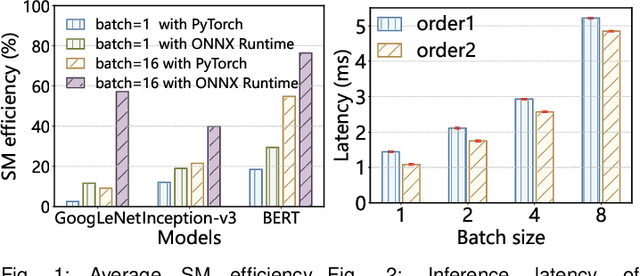

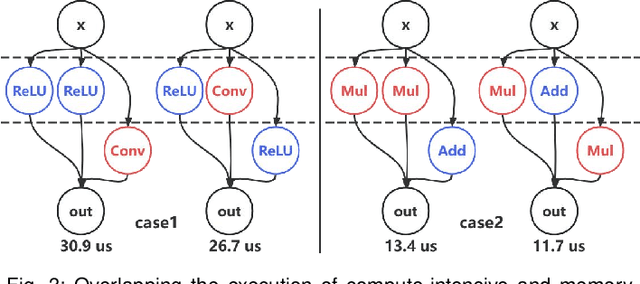
GPUs have become the defacto hardware devices to accelerate Deep Neural Network (DNN) inference in deep learning(DL) frameworks. However, the conventional sequential execution mode of DNN operators in mainstream DL frameworks cannot fully utilize GPU resources, due to the increasing complexity of DNN model structures and the progressively smaller computational sizes of DNN operators. Moreover, the inadequate operator launch order in parallelized execution scenarios can lead to GPU resource wastage and unexpected performance interference among operators. To address such performance issues above, we propose Opara, a resource- and interference-aware DNN Operator parallel scheduling framework to accelerate the execution of DNN inference on GPUs. Specifically, Opara first employs CUDA Streams and CUDA Graph to automatically parallelize the execution of multiple DNN operators. It further leverages the resource demands of DNN operators to judiciously adjust the operator launch order on GPUs by overlapping the execution of compute-intensive and memory-intensive operators, so as to expedite DNN inference. We implement and open source a prototype of Opara based on PyTorch in a non-intrusive manner. Extensive prototype experiments with representative DNN and Transformer-based models demonstrate that Opara outperforms the default sequential CUDA Graph in PyTorch and the state-of-the-art DNN operator parallelism systems by up to 1.68$\times$ and 1.29$\times$, respectively, yet with acceptable runtime overhead.