 Add to Chrome
 Add to Firefox
 Add to Edge
SpatialVLM: Endowing Vision-Language Models with Spatial Reasoning Capabilities
Jan 22, 2024
Understanding and reasoning about spatial relationships is a fundamental capability for Visual Question Answering (VQA) and robotics. While Vision Language Models (VLM) have demonstrated remarkable performance in certain VQA benchmarks, they still lack capabilities in 3D spatial reasoning, such as recognizing quantitative relationships of physical objects like distances or size differences. We hypothesize that VLMs' limited spatial reasoning capability is due to the lack of 3D spatial knowledge in training data and aim to solve this problem by training VLMs with Internet-scale spatial reasoning data. To this end, we present a system to facilitate this approach. We first develop an automatic 3D spatial VQA data generation framework that scales up to 2 billion VQA examples on 10 million real-world images. We then investigate various factors in the training recipe, including data quality, training pipeline, and VLM architecture. Our work features the first internet-scale 3D spatial reasoning dataset in metric space. By training a VLM on such data, we significantly enhance its ability on both qualitative and quantitative spatial VQA. Finally, we demonstrate that this VLM unlocks novel downstream applications in chain-of-thought spatial reasoning and robotics due to its quantitative estimation capability. Project website: https://spatial-vlm.github.io/

ProvNeRF: Modeling per Point Provenance in NeRFs as a Stochastic Process
Jan 18, 2024Neural radiance fields (NeRFs) have gained popularity across various applications. However, they face challenges in the sparse view setting, lacking sufficient constraints from volume rendering. Reconstructing and understanding a 3D scene from sparse and unconstrained cameras is a long-standing problem in classical computer vision with diverse applications. While recent works have explored NeRFs in sparse, unconstrained view scenarios, their focus has been primarily on enhancing reconstruction and novel view synthesis. Our approach takes a broader perspective by posing the question: "from where has each point been seen?" -- which gates how well we can understand and reconstruct it. In other words, we aim to determine the origin or provenance of each 3D point and its associated information under sparse, unconstrained views. We introduce ProvNeRF, a model that enriches a traditional NeRF representation by incorporating per-point provenance, modeling likely source locations for each point. We achieve this by extending implicit maximum likelihood estimation (IMLE) for stochastic processes. Notably, our method is compatible with any pre-trained NeRF model and the associated training camera poses. We demonstrate that modeling per-point provenance offers several advantages, including uncertainty estimation, criteria-based view selection, and improved novel view synthesis, compared to state-of-the-art methods. Please visit our project page at https://provnerf.github.io
GPT-4V is a Human-Aligned Evaluator for Text-to-3D Generation
Jan 09, 2024

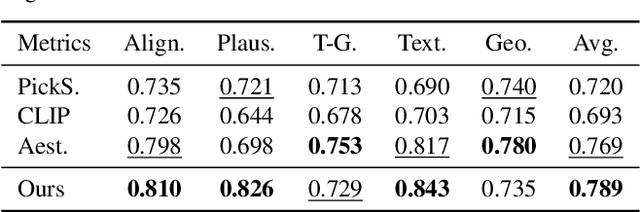

Despite recent advances in text-to-3D generative methods, there is a notable absence of reliable evaluation metrics. Existing metrics usually focus on a single criterion each, such as how well the asset aligned with the input text. These metrics lack the flexibility to generalize to different evaluation criteria and might not align well with human preferences. Conducting user preference studies is an alternative that offers both adaptability and human-aligned results. User studies, however, can be very expensive to scale. This paper presents an automatic, versatile, and human-aligned evaluation metric for text-to-3D generative models. To this end, we first develop a prompt generator using GPT-4V to generate evaluating prompts, which serve as input to compare text-to-3D models. We further design a method instructing GPT-4V to compare two 3D assets according to user-defined criteria. Finally, we use these pairwise comparison results to assign these models Elo ratings. Experimental results suggest our metric strongly align with human preference across different evaluation criteria.
CAD: Photorealistic 3D Generation via Adversarial Distillation
Dec 11, 2023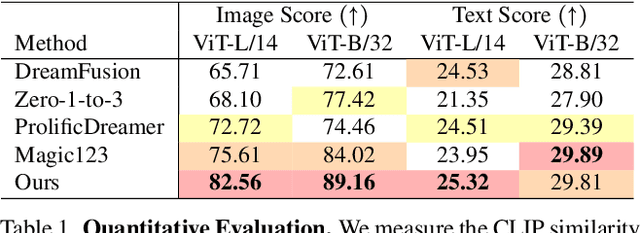
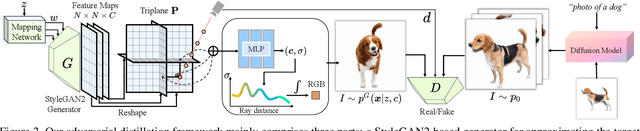
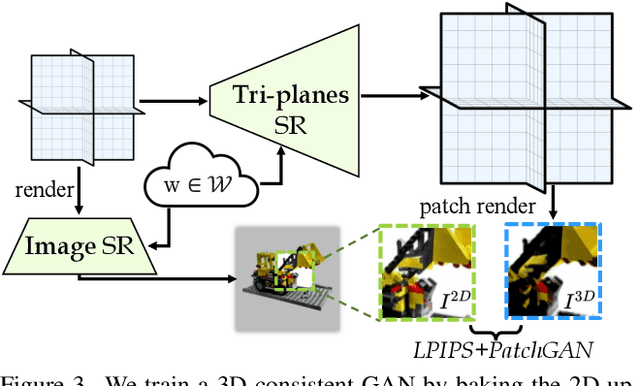

The increased demand for 3D data in AR/VR, robotics and gaming applications, gave rise to powerful generative pipelines capable of synthesizing high-quality 3D objects. Most of these models rely on the Score Distillation Sampling (SDS) algorithm to optimize a 3D representation such that the rendered image maintains a high likelihood as evaluated by a pre-trained diffusion model. However, finding a correct mode in the high-dimensional distribution produced by the diffusion model is challenging and often leads to issues such as over-saturation, over-smoothing, and Janus-like artifacts. In this paper, we propose a novel learning paradigm for 3D synthesis that utilizes pre-trained diffusion models. Instead of focusing on mode-seeking, our method directly models the distribution discrepancy between multi-view renderings and diffusion priors in an adversarial manner, which unlocks the generation of high-fidelity and photorealistic 3D content, conditioned on a single image and prompt. Moreover, by harnessing the latent space of GANs and expressive diffusion model priors, our method facilitates a wide variety of 3D applications including single-view reconstruction, high diversity generation and continuous 3D interpolation in the open domain. The experiments demonstrate the superiority of our pipeline compared to previous works in terms of generation quality and diversity.
SAGE: Bridging Semantic and Actionable Parts for GEneralizable Articulated-Object Manipulation under Language Instructions
Dec 03, 2023Generalizable manipulation of articulated objects remains a challenging problem in many real-world scenarios, given the diverse object structures, functionalities, and goals. In these tasks, both semantic interpretations and physical plausibilities are crucial for a policy to succeed. To address this problem, we propose SAGE, a novel framework that bridges the understanding of semantic and actionable parts of articulated objects to achieve generalizable manipulation under language instructions. Given a manipulation goal specified by natural language, an instruction interpreter with Large Language Models (LLMs) first translates them into programmatic actions on the object's semantic parts. This process also involves a scene context parser for understanding the visual inputs, which is designed to generate scene descriptions with both rich information and accurate interaction-related facts by joining the forces of generalist Visual-Language Models (VLMs) and domain-specialist part perception models. To further convert the action programs into executable policies, a part grounding module then maps the object semantic parts suggested by the instruction interpreter into so-called Generalizable Actionable Parts (GAParts). Finally, an interactive feedback module is incorporated to respond to failures, which greatly increases the robustness of the overall framework. Experiments both in simulation environments and on real robots show that our framework can handle a large variety of articulated objects with diverse language-instructed goals. We also provide a new benchmark for language-guided articulated-object manipulation in realistic scenarios.
4D-fy: Text-to-4D Generation Using Hybrid Score Distillation Sampling
Nov 29, 2023Recent breakthroughs in text-to-4D generation rely on pre-trained text-to-image and text-to-video models to generate dynamic 3D scenes. However, current text-to-4D methods face a three-way tradeoff between the quality of scene appearance, 3D structure, and motion. For example, text-to-image models and their 3D-aware variants are trained on internet-scale image datasets and can be used to produce scenes with realistic appearance and 3D structure -- but no motion. Text-to-video models are trained on relatively smaller video datasets and can produce scenes with motion, but poorer appearance and 3D structure. While these models have complementary strengths, they also have opposing weaknesses, making it difficult to combine them in a way that alleviates this three-way tradeoff. Here, we introduce hybrid score distillation sampling, an alternating optimization procedure that blends supervision signals from multiple pre-trained diffusion models and incorporates benefits of each for high-fidelity text-to-4D generation. Using hybrid SDS, we demonstrate synthesis of 4D scenes with compelling appearance, 3D structure, and motion.
Rethinking Directional Integration in Neural Radiance Fields
Nov 28, 2023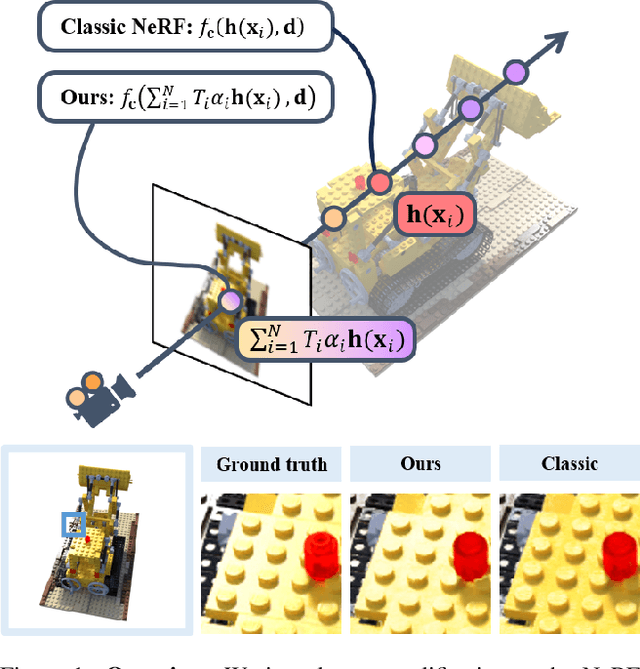
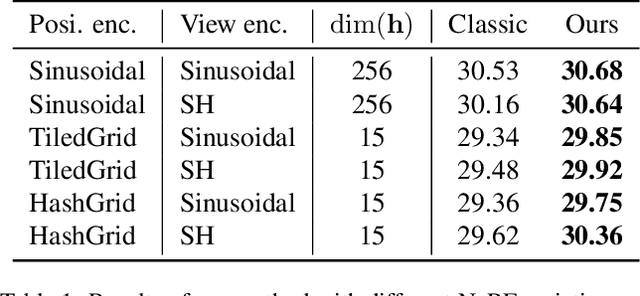
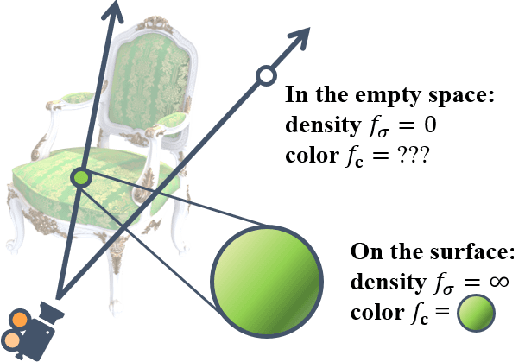
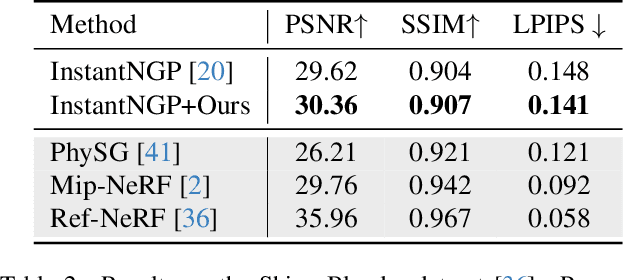
Recent works use the Neural radiance field (NeRF) to perform multi-view 3D reconstruction, providing a significant leap in rendering photorealistic scenes. However, despite its efficacy, NeRF exhibits limited capability of learning view-dependent effects compared to light field rendering or image-based view synthesis. To that end, we introduce a modification to the NeRF rendering equation which is as simple as a few lines of code change for any NeRF variations, while greatly improving the rendering quality of view-dependent effects. By swapping the integration operator and the direction decoder network, we only integrate the positional features along the ray and move the directional terms out of the integration, resulting in a disentanglement of the view-dependent and independent components. The modified equation is equivalent to the classical volumetric rendering in ideal cases on object surfaces with Dirac densities. Furthermore, we prove that with the errors caused by network approximation and numerical integration, our rendering equation exhibits better convergence properties with lower error accumulations compared to the classical NeRF. We also show that the modified equation can be interpreted as light field rendering with learned ray embeddings. Experiments on different NeRF variations show consistent improvements in the quality of view-dependent effects with our simple modification.
Make a Donut: Language-Guided Hierarchical EMD-Space Planning for Zero-shot Deformable Object Manipulation
Nov 05, 2023

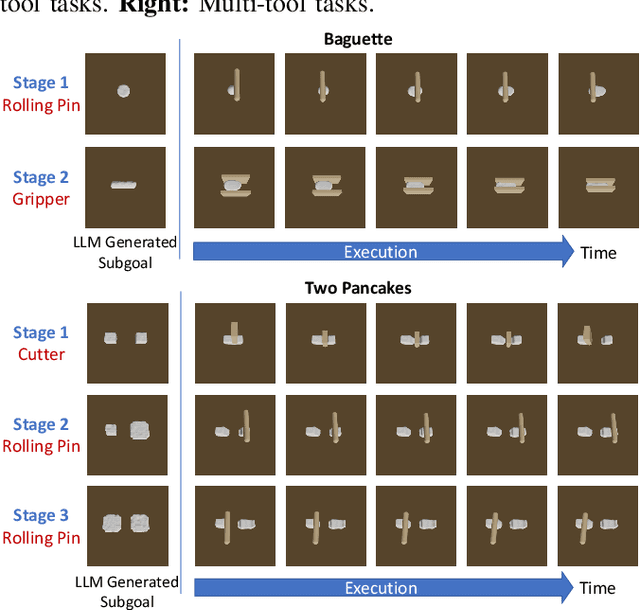
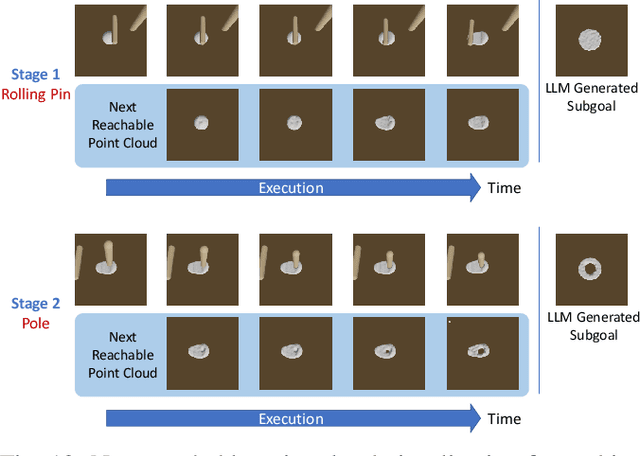
Deformable object manipulation stands as one of the most captivating yet formidable challenges in robotics. While previous techniques have predominantly relied on learning latent dynamics through demonstrations, typically represented as either particles or images, there exists a pertinent limitation: acquiring suitable demonstrations, especially for long-horizon tasks, can be elusive. Moreover, basing learning entirely on demonstrations can hamper the model's ability to generalize beyond the demonstrated tasks. In this work, we introduce a demonstration-free hierarchical planning approach capable of tackling intricate long-horizon tasks without necessitating any training. We employ large language models (LLMs) to articulate a high-level, stage-by-stage plan corresponding to a specified task. For every individual stage, the LLM provides both the tool's name and the Python code to craft intermediate subgoal point clouds. With the tool and subgoal for a particular stage at our disposal, we present a granular closed-loop model predictive control strategy. This leverages Differentiable Physics with Point-to-Point correspondence (DiffPhysics-P2P) loss in the earth mover distance (EMD) space, applied iteratively. Experimental findings affirm that our technique surpasses multiple benchmarks in dough manipulation, spanning both short and long horizons. Remarkably, our model demonstrates robust generalization capabilities to novel and previously unencountered complex tasks without any preliminary demonstrations. We further substantiate our approach with experimental trials on real-world robotic platforms.
NeRF Revisited: Fixing Quadrature Instability in Volume Rendering
Oct 31, 2023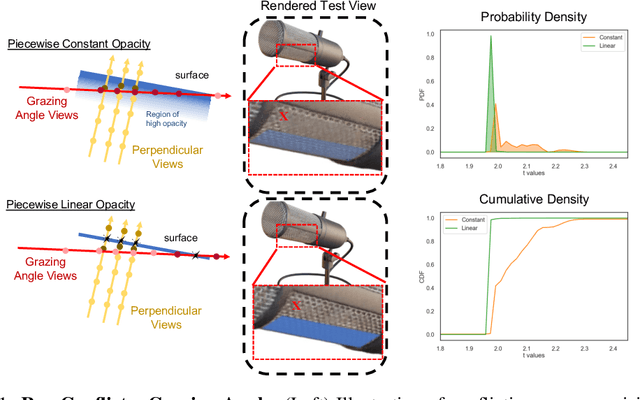
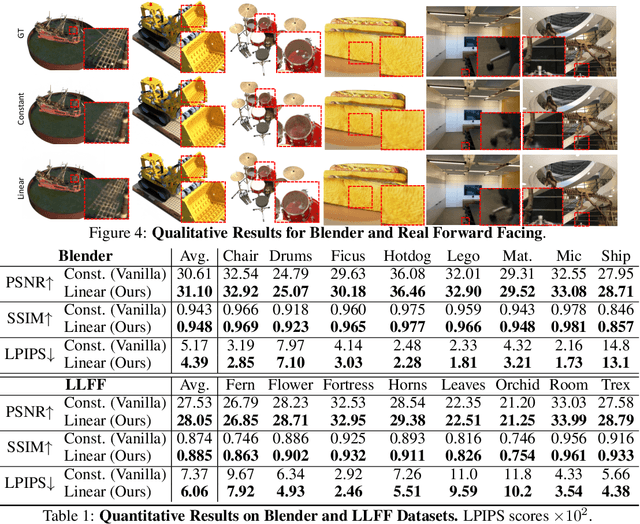
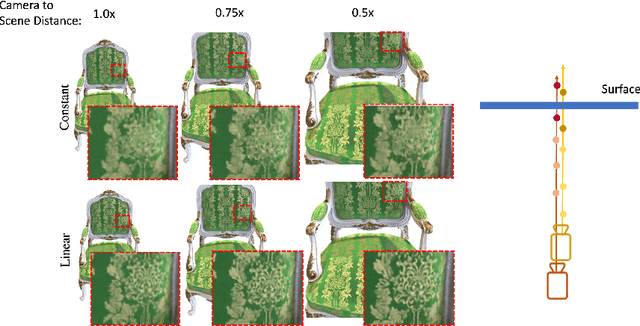
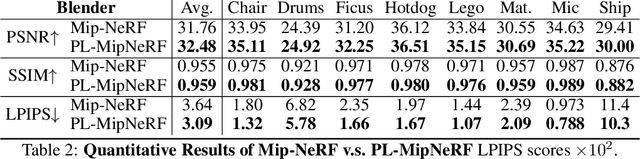
Neural radiance fields (NeRF) rely on volume rendering to synthesize novel views. Volume rendering requires evaluating an integral along each ray, which is numerically approximated with a finite sum that corresponds to the exact integral along the ray under piecewise constant volume density. As a consequence, the rendered result is unstable w.r.t. the choice of samples along the ray, a phenomenon that we dub quadrature instability. We propose a mathematically principled solution by reformulating the sample-based rendering equation so that it corresponds to the exact integral under piecewise linear volume density. This simultaneously resolves multiple issues: conflicts between samples along different rays, imprecise hierarchical sampling, and non-differentiability of quantiles of ray termination distances w.r.t. model parameters. We demonstrate several benefits over the classical sample-based rendering equation, such as sharper textures, better geometric reconstruction, and stronger depth supervision. Our proposed formulation can be also be used as a drop-in replacement to the volume rendering equation of existing NeRF-based methods. Our project page can be found at pl-nerf.github.io.
SparseDFF: Sparse-View Feature Distillation for One-Shot Dexterous Manipulation
Oct 25, 2023
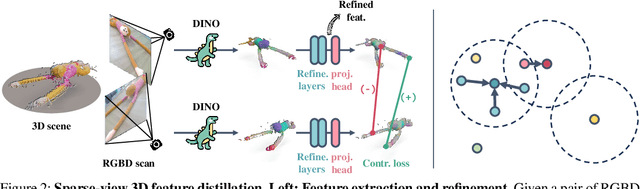

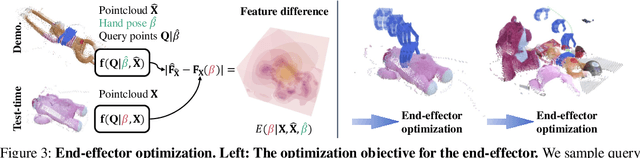
Humans excel at transferring manipulation skills across diverse object shapes, poses, and appearances due to their understanding of semantic correspondences between different instances. To endow robots with a similar high-level understanding, we develop a Distilled Feature Field (DFF) for 3D scenes, leveraging large 2D vision models to distill semantic features from multiview images. While current research demonstrates advanced performance in reconstructing DFFs from dense views, the development of learning a DFF from sparse views is relatively nascent, despite its prevalence in numerous manipulation tasks with fixed cameras. In this work, we introduce SparseDFF, a novel method for acquiring view-consistent 3D DFFs from sparse RGBD observations, enabling one-shot learning of dexterous manipulations that are transferable to novel scenes. Specifically, we map the image features to the 3D point cloud, allowing for propagation across the 3D space to establish a dense feature field. At the core of SparseDFF is a lightweight feature refinement network, optimized with a contrastive loss between pairwise views after back-projecting the image features onto the 3D point cloud. Additionally, we implement a point-pruning mechanism to augment feature continuity within each local neighborhood. By establishing coherent feature fields on both source and target scenes, we devise an energy function that facilitates the minimization of feature discrepancies w.r.t. the end-effector parameters between the demonstration and the target manipulation. We evaluate our approach using a dexterous hand, mastering real-world manipulations on both rigid and deformable objects, and showcase robust generalization in the face of object and scene-context variations.