 Add to Chrome
 Add to Firefox
 Add to Edge
DriveJudge: Rethinking Autonomous Driving Evaluation with Vision-Language Models
Jun 15, 2026
Autonomous driving has shifted towards end-to-end policy learning, where reliable, interpretable policy evaluation is a fundamental challenge as driving quality is highly context-dependent. Commonly used rule-based driving metrics like EPDMS are interpretable but lack context-awareness, while recent VLMbased evaluations are context-aware but limited by ambiguous VLM outputs and weak physical grounding. To evaluate driving in a manner that is both interpretable and context-aware, we introduce DriveJudge. DriveJudge is a driving evaluation agent that combines rule-grounded evaluation with Vision-Language Model (VLM) reasoning and selectively invokes physically-grounded deterministic rule functions after interpreting the environmental context. To train and evaluate DriveJudge, we curate a large-scale dataset of 33,577 challenging driving samples with human annotations on whether the driving behavior is reasonable in the given scenario. With this dataset, we address the underexplored problem of driving metric evaluation, and introduce two human-aligned benchmark tasks: Driving Quality Classification and Trajectory Preference Selection. DriveJudge outperforms EPDMS for driving quality classification by 21.23 AUC, and the recent VLM-based DriveCritic for trajectory preference selection by 6.5%, setting a new standard for interpretable and precise driving evaluation.

NVIDIA OmniDreams: Real-Time Generative World Model for Closed-Loop Autonomous Vehicle Simulation
Jun 02, 2026As autonomous vehicle capabilities advance, the safe evaluation of driving policies in long-tail scenarios remains a critical bottleneck. In closed-loop simulation, the driving policy model actively interacts with the environment, where its actions dynamically update the simulator state and directly influence the next set of generated sensor observations. While recent reconstruction-based neural simulators offer photorealism, they are fundamentally constrained by their initial captured data and struggle to generalize to highly dynamic or novel scenes. To overcome these limitations, we introduce OmniDreams, a foundation generative world model mid- and post-trained from the Cosmos diffusion model to autoregressively generate action-conditioned videos in real time. By leveraging the rich visual priors of Cosmos and mid- and post-training on 21k hours of driving scenarios, OmniDreams synthesizes complex, unobserved phenomena that are hard for traditional simulators to capture, such as extreme weather and unpredictable dynamic agent behaviors. Crucially, it autoregressively conditions its photorealistic sensor generation on past frames, the current simulator state, and immediate driving actions. Deployed in a closed-loop system with the Alpamayo 1 policy model and AlpaSim orchestrator, OmniDreams acts as a highly responsive, reactive environment, providing a scalable and comprehensive solution for training and evaluating next-generation autonomous driving policies. We additionally show preliminary results indicating that a world-action model (WAM) post-trained from OmniDreams achieves strong performance on the Physical AI Autonomous Vehicles NuRec dataset, surpassing the VLA-based Alpamayo 1.5 research policy model while using only 1/5 the total parameters. These results highlight the potential for a real-time world model like OmniDreams to also serve as a backbone for policy architectures.
Motion Attribution for Video Generation
Jan 13, 2026Despite the rapid progress of video generation models, the role of data in influencing motion is poorly understood. We present Motive (MOTIon attribution for Video gEneration), a motion-centric, gradient-based data attribution framework that scales to modern, large, high-quality video datasets and models. We use this to study which fine-tuning clips improve or degrade temporal dynamics. Motive isolates temporal dynamics from static appearance via motion-weighted loss masks, yielding efficient and scalable motion-specific influence computation. On text-to-video models, Motive identifies clips that strongly affect motion and guides data curation that improves temporal consistency and physical plausibility. With Motive-selected high-influence data, our method improves both motion smoothness and dynamic degree on VBench, achieving a 74.1% human preference win rate compared with the pretrained base model. To our knowledge, this is the first framework to attribute motion rather than visual appearance in video generative models and to use it to curate fine-tuning data.
VideoPanda: Video Panoramic Diffusion with Multi-view Attention
Apr 15, 2025High resolution panoramic video content is paramount for immersive experiences in Virtual Reality, but is non-trivial to collect as it requires specialized equipment and intricate camera setups. In this work, we introduce VideoPanda, a novel approach for synthesizing 360$^\circ$ videos conditioned on text or single-view video data. VideoPanda leverages multi-view attention layers to augment a video diffusion model, enabling it to generate consistent multi-view videos that can be combined into immersive panoramic content. VideoPanda is trained jointly using two conditions: text-only and single-view video, and supports autoregressive generation of long-videos. To overcome the computational burden of multi-view video generation, we randomly subsample the duration and camera views used during training and show that the model is able to gracefully generalize to generating more frames during inference. Extensive evaluations on both real-world and synthetic video datasets demonstrate that VideoPanda generates more realistic and coherent 360$^\circ$ panoramas across all input conditions compared to existing methods. Visit the project website at https://research-staging.nvidia.com/labs/toronto-ai/VideoPanda/ for results.
Cosmos World Foundation Model Platform for Physical AI
Jan 07, 2025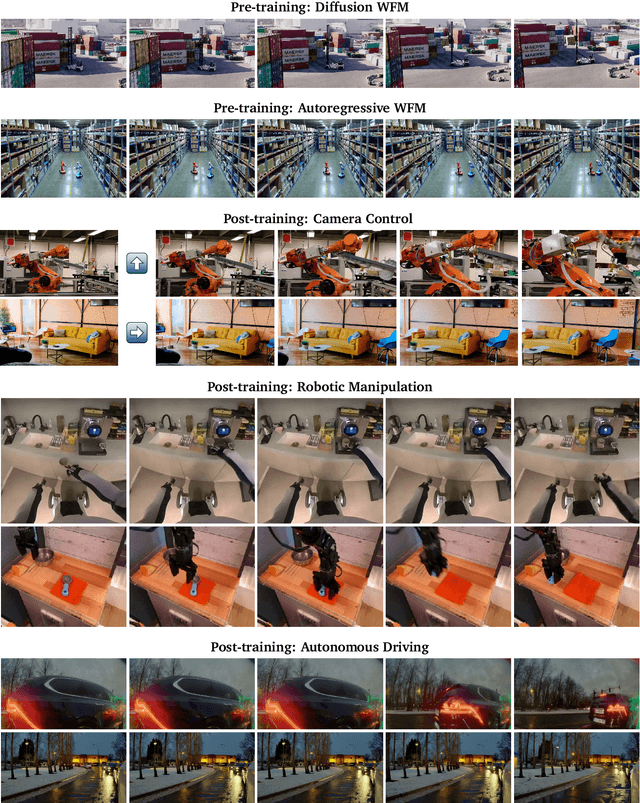
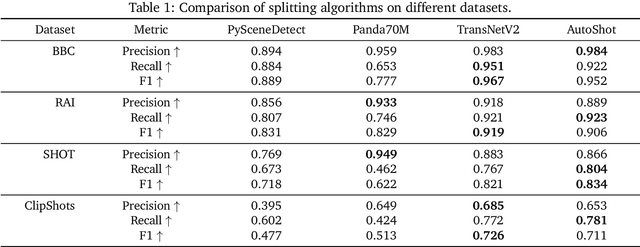
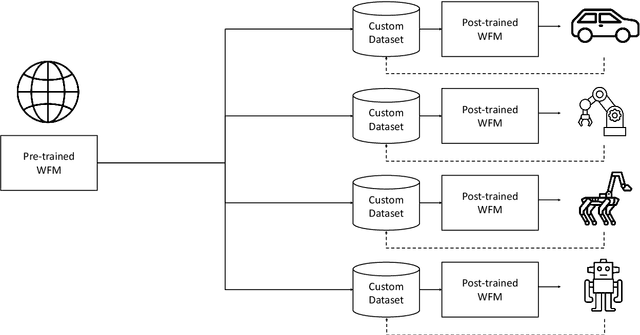

Physical AI needs to be trained digitally first. It needs a digital twin of itself, the policy model, and a digital twin of the world, the world model. In this paper, we present the Cosmos World Foundation Model Platform to help developers build customized world models for their Physical AI setups. We position a world foundation model as a general-purpose world model that can be fine-tuned into customized world models for downstream applications. Our platform covers a video curation pipeline, pre-trained world foundation models, examples of post-training of pre-trained world foundation models, and video tokenizers. To help Physical AI builders solve the most critical problems of our society, we make our platform open-source and our models open-weight with permissive licenses available via https://github.com/NVIDIA/Cosmos.
ReMatching Dynamic Reconstruction Flow
Nov 01, 2024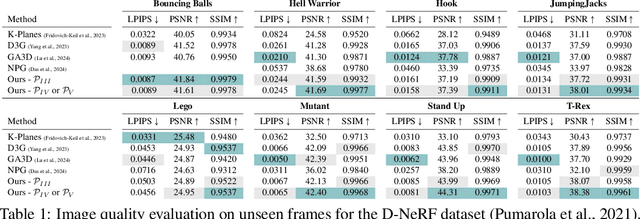
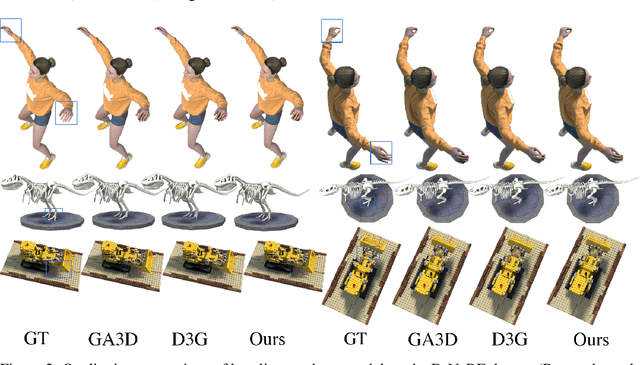
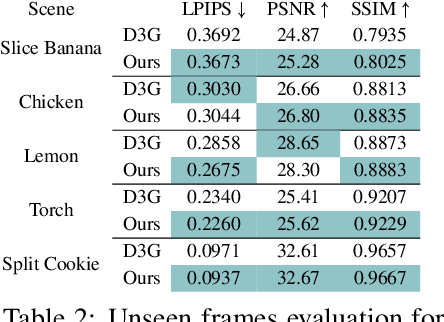
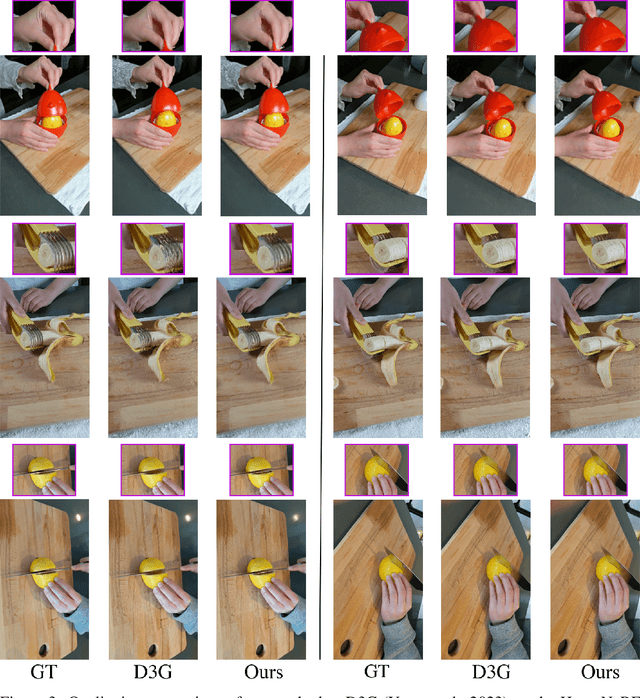
Reconstructing dynamic scenes from image inputs is a fundamental computer vision task with many downstream applications. Despite recent advancements, existing approaches still struggle to achieve high-quality reconstructions from unseen viewpoints and timestamps. This work introduces the ReMatching framework, designed to improve generalization quality by incorporating deformation priors into dynamic reconstruction models. Our approach advocates for velocity-field-based priors, for which we suggest a matching procedure that can seamlessly supplement existing dynamic reconstruction pipelines. The framework is highly adaptable and can be applied to various dynamic representations. Moreover, it supports integrating multiple types of model priors and enables combining simpler ones to create more complex classes. Our evaluations on popular benchmarks involving both synthetic and real-world dynamic scenes demonstrate a clear improvement in reconstruction accuracy of current state-of-the-art models.
PASTA: Controllable Part-Aware Shape Generation with Autoregressive Transformers
Jul 18, 2024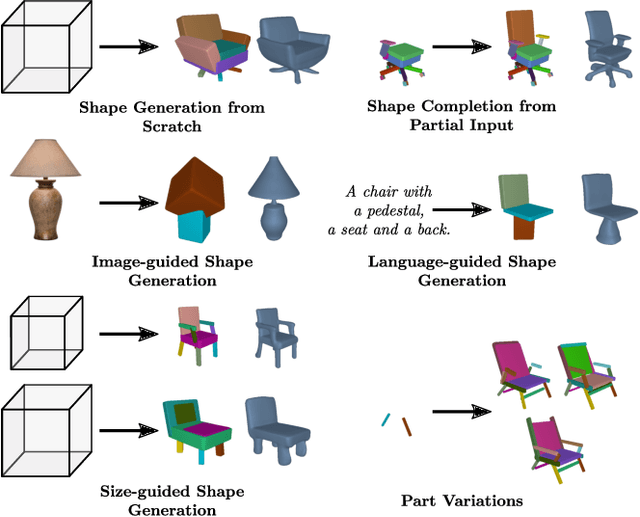
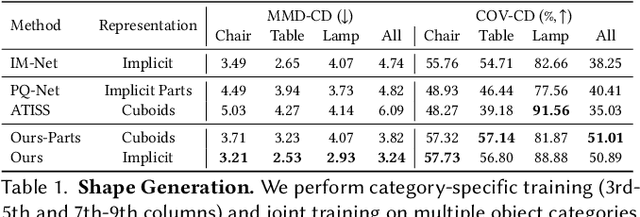

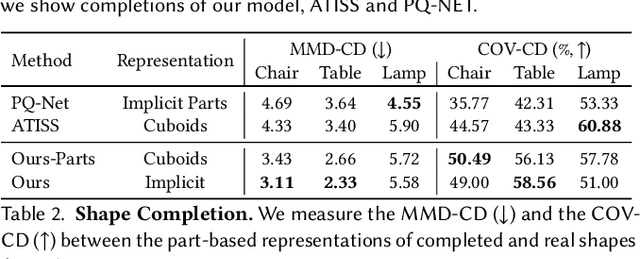
The increased demand for tools that automate the 3D content creation process led to tremendous progress in deep generative models that can generate diverse 3D objects of high fidelity. In this paper, we present PASTA, an autoregressive transformer architecture for generating high quality 3D shapes. PASTA comprises two main components: An autoregressive transformer that generates objects as a sequence of cuboidal primitives and a blending network, implemented with a transformer decoder that composes the sequences of cuboids and synthesizes high quality meshes for each object. Our model is trained in two stages: First we train our autoregressive generative model using only annotated cuboidal parts as supervision and next, we train our blending network using explicit 3D supervision, in the form of watertight meshes. Evaluations on various ShapeNet objects showcase the ability of our model to perform shape generation from diverse inputs \eg from scratch, from a partial object, from text and images, as well size-guided generation, by explicitly conditioning on a bounding box that defines the object's boundaries. Moreover, as our model considers the underlying part-based structure of a 3D object, we are able to select a specific part and produce shapes with meaningful variations of this part. As evidenced by our experiments, our model generates 3D shapes that are both more realistic and diverse than existing part-based and non part-based methods, while at the same time is simpler to implement and train.
MultiPhys: Multi-Person Physics-aware 3D Motion Estimation
Apr 18, 2024



We introduce MultiPhys, a method designed for recovering multi-person motion from monocular videos. Our focus lies in capturing coherent spatial placement between pairs of individuals across varying degrees of engagement. MultiPhys, being physically aware, exhibits robustness to jittering and occlusions, and effectively eliminates penetration issues between the two individuals. We devise a pipeline in which the motion estimated by a kinematic-based method is fed into a physics simulator in an autoregressive manner. We introduce distinct components that enable our model to harness the simulator's properties without compromising the accuracy of the kinematic estimates. This results in final motion estimates that are both kinematically coherent and physically compliant. Extensive evaluations on three challenging datasets characterized by substantial inter-person interaction show that our method significantly reduces errors associated with penetration and foot skating, while performing competitively with the state-of-the-art on motion accuracy and smoothness. Results and code can be found on our project page (http://www.iri.upc.edu/people/nugrinovic/multiphys/).
CAD: Photorealistic 3D Generation via Adversarial Distillation
Dec 11, 2023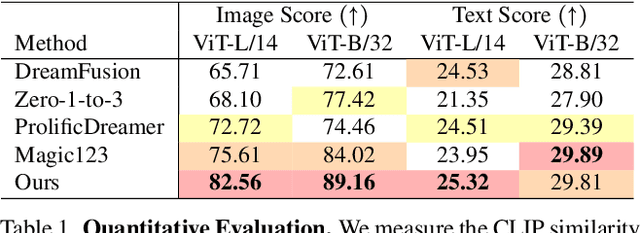
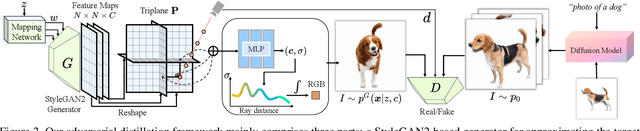
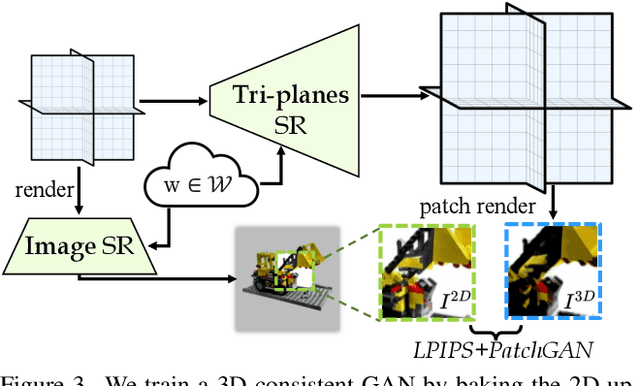

The increased demand for 3D data in AR/VR, robotics and gaming applications, gave rise to powerful generative pipelines capable of synthesizing high-quality 3D objects. Most of these models rely on the Score Distillation Sampling (SDS) algorithm to optimize a 3D representation such that the rendered image maintains a high likelihood as evaluated by a pre-trained diffusion model. However, finding a correct mode in the high-dimensional distribution produced by the diffusion model is challenging and often leads to issues such as over-saturation, over-smoothing, and Janus-like artifacts. In this paper, we propose a novel learning paradigm for 3D synthesis that utilizes pre-trained diffusion models. Instead of focusing on mode-seeking, our method directly models the distribution discrepancy between multi-view renderings and diffusion priors in an adversarial manner, which unlocks the generation of high-fidelity and photorealistic 3D content, conditioned on a single image and prompt. Moreover, by harnessing the latent space of GANs and expressive diffusion model priors, our method facilitates a wide variety of 3D applications including single-view reconstruction, high diversity generation and continuous 3D interpolation in the open domain. The experiments demonstrate the superiority of our pipeline compared to previous works in terms of generation quality and diversity.
CC3D: Layout-Conditioned Generation of Compositional 3D Scenes
Mar 21, 2023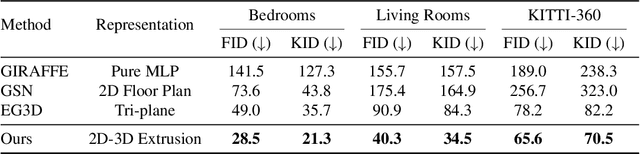
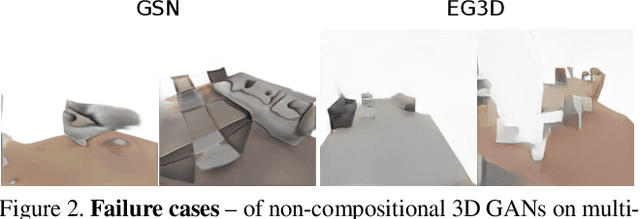
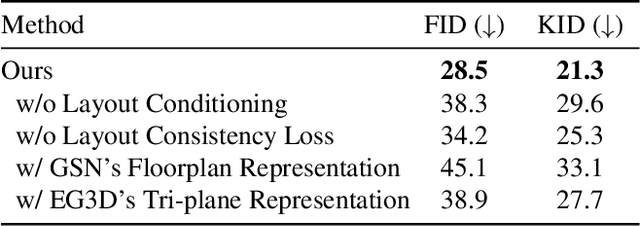
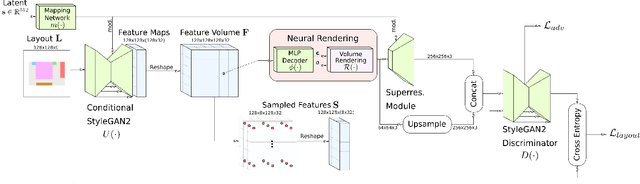
In this work, we introduce CC3D, a conditional generative model that synthesizes complex 3D scenes conditioned on 2D semantic scene layouts, trained using single-view images. Different from most existing 3D GANs that limit their applicability to aligned single objects, we focus on generating complex scenes with multiple objects, by modeling the compositional nature of 3D scenes. By devising a 2D layout-based approach for 3D synthesis and implementing a new 3D field representation with a stronger geometric inductive bias, we have created a 3D GAN that is both efficient and of high quality, while allowing for a more controllable generation process. Our evaluations on synthetic 3D-FRONT and real-world KITTI-360 datasets demonstrate that our model generates scenes of improved visual and geometric quality in comparison to previous works.