 Add to Chrome
 Add to Firefox
 Add to Edge
Mint-Agent: Introducing Finance-Native Agentic Foundation Models
Aug 17, 2026
Financial agents must do more than recall domain knowledge: they must be both reliable, executing precise operations over grounded evidence, and executive, sustaining long-horizon research whose conclusions remain auditable. We present Mint-Agent, a family of finance-native agentic models designed around these two scales of financial intelligence. Mint-Agent is built upon three pillars: data, harness, and algorithm. Our data engine constructs clean, specialized tasks for atomic financial capabilities and long-horizon agentic execution from real-world financial sources. MintHarness enables stable interaction with open-ended environments and maintains auditable evidence trails across extended research trajectories. Our training recipe combines SFT, critical-step OPD, and RLVR to develop separate financial reasoning and agentic execution experts, which are then unified through model merging and multi-teacher on-policy distillation into compact, general-purpose financial agents. This pipeline yields two flagship models, Mint-Cu (9B) and Mint-Ag (27B). Across professional financial benchmarks, our models demonstrate two defining strengths: (1) Reliability: Mint-Ag achieves 98.33% on RFC-Bench, surpassing GPT-5.6-Sol and Claude-Opus-4.8 by 3.66 and 3.00 points; and (2) Executability: Mint-Cu reaches 69.86% on FinSearchComp T2, outperforming Agents-A1-35B and Nex-N2-mini by 22.83 and 12.78 points, while Mint-Ag achieves 76.00% and 60.49% on FinanceAgentBench v1.1 and v2, respectively. These results establish a path toward trustworthy financial intelligence in which domain expertise, long-horizon execution, and auditable evidence are jointly engineered as a unified foundation for frontier agentic models.

ISPCloak: Weaponizing ISP for Optimization-Free Physical Camouflage against Deepfake Detectors
Jul 24, 2026The rapid advancement of generative models has spurred the critical need to evaluate the worst-case robustness of deepfake detectors. In this paper, we reveal a fundamental blind spot in current forensic paradigms: while existing detectors excel at capturing digital synthesis artifacts, their effectiveness drops drastically when AI-generated content is cloaked in authentic physical imaging characteristics. We posit that genuine photographs inherently possess hardware-intrinsic statistical signatures, which are imperceptible footprints imprinted by optical sensors and Image Signal Processing (ISP) pipelines, and are fundamentally absent in purely data-driven generative models. Driven by this insight, we propose ISPCloak, a novel optimization-free adversarial attack framework that explicitly weaponizes the ISP pipeline to mislead the judgment of deepfake detectors. Rather than relying on computationally expensive gradient perturbations, our method first employs an Invertible ISP network to project images into the RAW domain. Then, we seamlessly imprint the complex statistical priors of real cameras onto AI-generated images by injecting realistic Poisson-Gaussian sensor noise and conducting forward ISP reconstruction. Synergized with generative artifact suppression and adaptive masking, this streamlined physical simulation enables ultra-fast generation of adversarial examples. Extensive experiments show that embedding authentic physical perturbations fundamentally disrupts a broad range of current detection mechanisms, yielding universally evasive adversarial examples with imperceptible visual alterations.
MagicSelector: Joint Optimization for Agent Tool Selection via Counterfactual Decomposition and Progressive Reranking
Jul 20, 2026We present MagicSelector, a joint optimization framework integrating Counterfactual task decomposition, Progressive reranking, and Dynamic Top-K, designed to address the fundamental challenges of tool retrieval in agents. MagicSelector is a specialized framework capable of translating ambiguous user instructions into executable atomic subtasks and guiding high-precision tool retrieval, effectively mitigating redundant noise and severe context distraction in out-of-domain (OOD) scenarios.We empower MagicSelector with these capabilities through three key contributions: (1) a preferenceguided counterfactual task decomposition mechanism that utilizes a counterfactual reward to quantify the marginal causal gain of decomposition on retrieval ranking, effectively imposing fine-grained structural supervision on logical coherence; (2) a progressive tool reranking method driven by self-distillation hard negative mining, which optimizes both point-wise and list-wise relevance to enhance fine-grained discrimination among highly similar tools; and (3) a dual semantic boundary-aware dynamic Top-K strategy that adaptively monitors reranking score cliffs and inter-tool semantic shifts to dynamically truncate the candidate list, maximizing relevant tool recall while filtering long-tail noise. Evaluated on MTDTool, the first task decomposition benchmark we constructed tailored for mobile multi-turn interactions with process-level annotations, MagicSelector yields promising performance. Extensive experiments demonstrate that MagicSelector significantly outperforms state-of-the-art methods in terms of tool retrieval accuracy, OOD generalization capability, and overall token efficiency, thereby demonstrating the effectiveness of our proposed framework.
PCTD: Preference-Guided Counterfactual Task Decomposition for Agent Tool Retrieval
Jul 17, 2026Task decomposition aims to transform ambiguous instructions into executable atomic subtasks, thereby guiding high-precision tool retrieval. However, our analysis reveals that directly adopting tool retrieval metrics, i.e., Recall or NDCG, as rewards for task decomposition can easily induce reward hacking in reinforcement learning-based methods. Specifically, models tend to maximize retrieval matching through strategies such as repetitive decomposition. This spurious correlation between the shallow features of decomposition results and retrieval metric impairs generalization in Out-of-Domain (OOD) scenarios involving unseen tools. To address this issue, we propose PCTD, a Preference-guided Counterfactual Task Decomposition framework. PCTD quantifies the marginal causal gain of decomposition on retrieval ranking through a counterfactual reward, thereby cutting off spurious correlations at their source. Meanwhile, it introduces a preference reward to impose fine-grained structural supervision on logical coherence and atomicity, encouraging the model to generate high-quality decompositions. In addition, we construct MTDTool, the task decomposition benchmark specifically designed for mobile multi-turn interactions. Extensive experiments demonstrate that PCTD alleviates repetitive decomposition and surpasses SOTA methods in retrieval, decomposition quality, and OOD generalization.
AI-Driven Automated Tool for Abdominal CT Body Composition Analysis in Gastrointestinal Cancer Management
Mar 10, 2025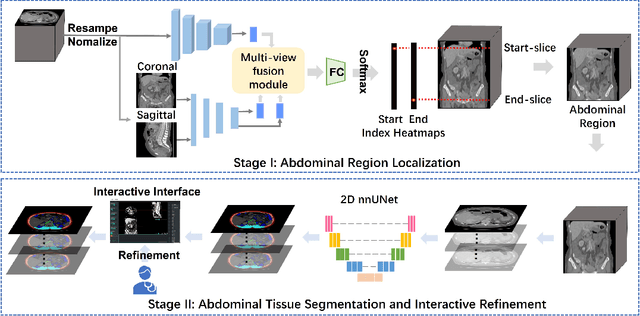


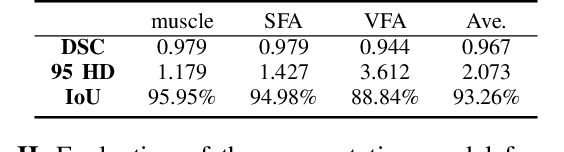
The incidence of gastrointestinal cancers remains significantly high, particularly in China, emphasizing the importance of accurate prognostic assessments and effective treatment strategies. Research shows a strong correlation between abdominal muscle and fat tissue composition and patient outcomes. However, existing manual methods for analyzing abdominal tissue composition are time-consuming and costly, limiting clinical research scalability. To address these challenges, we developed an AI-driven tool for automated analysis of abdominal CT scans to effectively identify and segment muscle, subcutaneous fat, and visceral fat. Our tool integrates a multi-view localization model and a high-precision 2D nnUNet-based segmentation model, demonstrating a localization accuracy of 90% and a Dice Score Coefficient of 0.967 for segmentation. Furthermore, it features an interactive interface that allows clinicians to refine the segmentation results, ensuring high-quality outcomes effectively. Our tool offers a standardized method for effectively extracting critical abdominal tissues, potentially enhancing the management and treatment for gastrointestinal cancers. The code is available at https://github.com/NanXinyu/AI-Tool4Abdominal-Seg.git}{https://github.com/NanXinyu/AI-Tool4Abdominal-Seg.git.
Adaptive Few-shot Prompting for Machine Translation with Pre-trained Language Models
Jan 03, 2025Recently, Large language models (LLMs) with in-context learning have demonstrated remarkable potential in handling neural machine translation. However, existing evidence shows that LLMs are prompt-sensitive and it is sub-optimal to apply the fixed prompt to any input for downstream machine translation tasks. To address this issue, we propose an adaptive few-shot prompting (AFSP) framework to automatically select suitable translation demonstrations for various source input sentences to further elicit the translation capability of an LLM for better machine translation. First, we build a translation demonstration retrieval module based on LLM's embedding to retrieve top-k semantic-similar translation demonstrations from aligned parallel translation corpus. Rather than using other embedding models for semantic demonstration retrieval, we build a hybrid demonstration retrieval module based on the embedding layer of the deployed LLM to build better input representation for retrieving more semantic-related translation demonstrations. Then, to ensure better semantic consistency between source inputs and target outputs, we force the deployed LLM itself to generate multiple output candidates in the target language with the help of translation demonstrations and rerank these candidates. Besides, to better evaluate the effectiveness of our AFSP framework on the latest language and extend the research boundary of neural machine translation, we construct a high-quality diplomatic Chinese-English parallel dataset that consists of 5,528 parallel Chinese-English sentences. Finally, extensive experiments on the proposed diplomatic Chinese-English parallel dataset and the United Nations Parallel Corpus (Chinese-English part) show the effectiveness and superiority of our proposed AFSP.
PropSAM: A Propagation-Based Model for Segmenting Any 3D Objects in Multi-Modal Medical Images
Aug 25, 2024


Volumetric segmentation is crucial for medical imaging but is often constrained by labor-intensive manual annotations and the need for scenario-specific model training. Furthermore, existing general segmentation models are inefficient due to their design and inferential approaches. Addressing this clinical demand, we introduce PropSAM, a propagation-based segmentation model that optimizes the use of 3D medical structure information. PropSAM integrates a CNN-based UNet for intra-slice processing with a Transformer-based module for inter-slice propagation, focusing on structural and semantic continuities to enhance segmentation across various modalities. Distinctively, PropSAM operates on a one-view prompt, such as a 2D bounding box or sketch mask, unlike conventional models that require two-view prompts. It has demonstrated superior performance, significantly improving the Dice Similarity Coefficient (DSC) across 44 medical datasets and various imaging modalities, outperforming models like MedSAM and SegVol with an average DSC improvement of 18.1%. PropSAM also maintains stable predictions despite prompt deviations and varying propagation configurations, confirmed by one-way ANOVA tests with P>0.5985 and P>0.6131, respectively. Moreover, PropSAM's efficient architecture enables faster inference speeds (Wilcoxon rank-sum test, P<0.001) and reduces user interaction time by 37.8% compared to two-view prompt models. Its ability to handle irregular and complex objects with robust performance further demonstrates its potential in clinical settings, facilitating more automated and reliable medical imaging analyses with minimal retraining.
Progressive Dual Priori Network for Generalized Breast Tumor Segmentation
Oct 20, 2023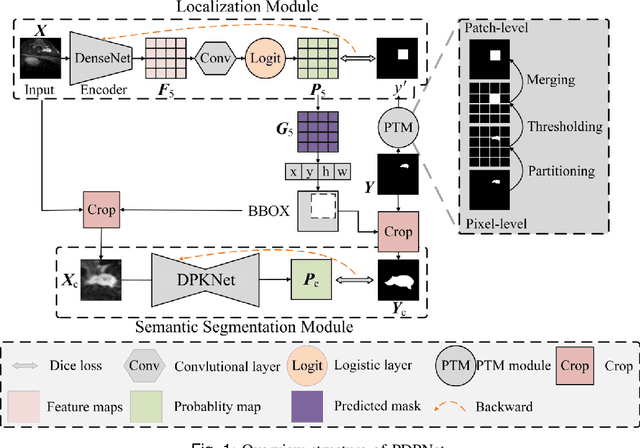

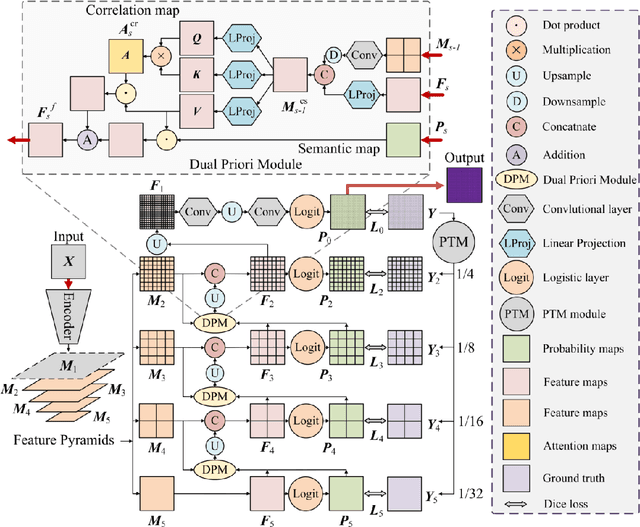
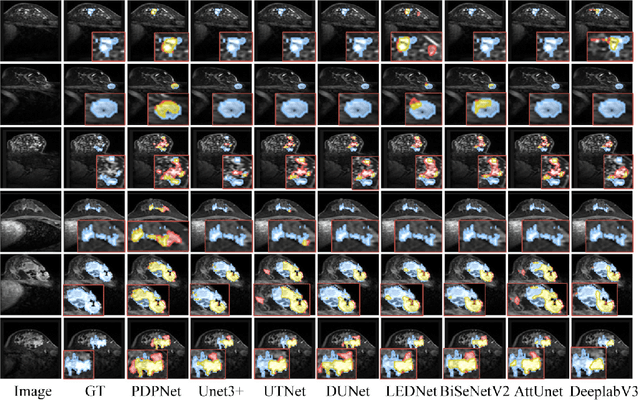
To promote the generalization ability of breast tumor segmentation models, as well as to improve the segmentation performance for breast tumors with smaller size, low-contrast amd irregular shape, we propose a progressive dual priori network (PDPNet) to segment breast tumors from dynamic enhanced magnetic resonance images (DCE-MRI) acquired at different sites. The PDPNet first cropped tumor regions with a coarse-segmentation based localization module, then the breast tumor mask was progressively refined by using the weak semantic priori and cross-scale correlation prior knowledge. To validate the effectiveness of PDPNet, we compared it with several state-of-the-art methods on multi-center datasets. The results showed that, comparing against the suboptimal method, the DSC, SEN, KAPPA and HD95 of PDPNet were improved 3.63\%, 8.19\%, 5.52\%, and 3.66\% respectively. In addition, through ablations, we demonstrated that the proposed localization module can decrease the influence of normal tissues and therefore improve the generalization ability of the model. The weak semantic priors allow focusing on tumor regions to avoid missing small tumors and low-contrast tumors. The cross-scale correlation priors are beneficial for promoting the shape-aware ability for irregual tumors. Thus integrating them in a unified framework improved the multi-center breast tumor segmentation performance.
propnet: Propagating 2D Annotation to 3D Segmentation for Gastric Tumors on CT Scans
May 29, 2023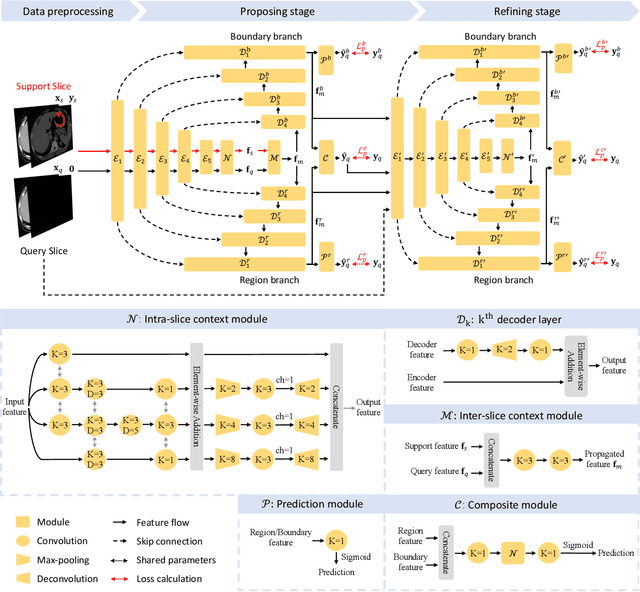

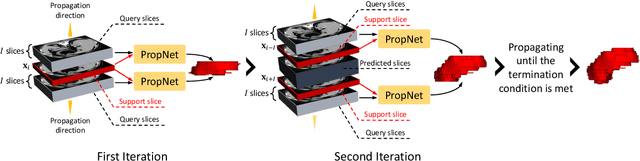

**Background:** Accurate 3D CT scan segmentation of gastric tumors is pivotal for diagnosis and treatment. The challenges lie in the irregular shapes, blurred boundaries of tumors, and the inefficiency of existing methods. **Purpose:** We conducted a study to introduce a model, utilizing human-guided knowledge and unique modules, to address the challenges of 3D tumor segmentation. **Methods:** We developed the PropNet framework, propagating radiologists' knowledge from 2D annotations to the entire 3D space. This model consists of a proposing stage for coarse segmentation and a refining stage for improved segmentation, using two-way branches for enhanced performance and an up-down strategy for efficiency. **Results:** With 98 patient scans for training and 30 for validation, our method achieves a significant agreement with manual annotation (Dice of 0.803) and improves efficiency. The performance is comparable in different scenarios and with various radiologists' annotations (Dice between 0.785 and 0.803). Moreover, the model shows improved prognostic prediction performance (C-index of 0.620 vs. 0.576) on an independent validation set of 42 patients with advanced gastric cancer. **Conclusions:** Our model generates accurate tumor segmentation efficiently and stably, improving prognostic performance and reducing high-throughput image reading workload. This model can accelerate the quantitative analysis of gastric tumors and enhance downstream task performance.
JDSR-GAN: Constructing A Joint and Collaborative Learning Network for Masked Face Super-Resolution
Mar 25, 2021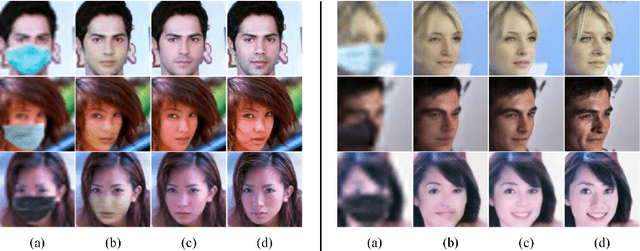
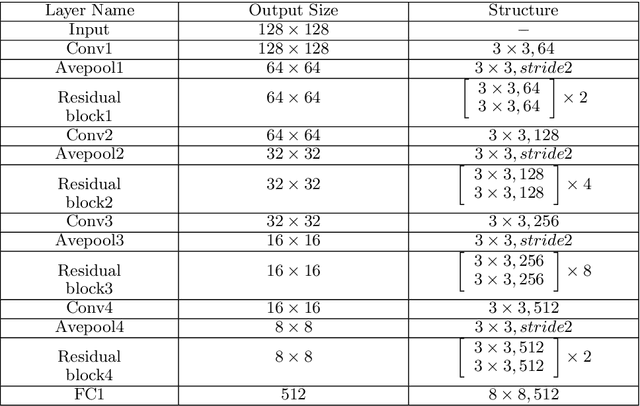
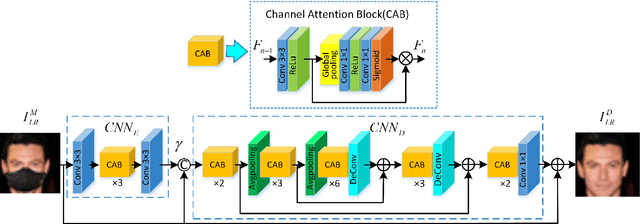

With the growing importance of preventing the COVID-19 virus, face images obtained in most video surveillance scenarios are low resolution with mask simultaneously. However, most of the previous face super-resolution solutions can not handle both tasks in one model. In this work, we treat the mask occlusion as image noise and construct a joint and collaborative learning network, called JDSR-GAN, for the masked face super-resolution task. Given a low-quality face image with the mask as input, the role of the generator composed of a denoising module and super-resolution module is to acquire a high-quality high-resolution face image. The discriminator utilizes some carefully designed loss functions to ensure the quality of the recovered face images. Moreover, we incorporate the identity information and attention mechanism into our network for feasible correlated feature expression and informative feature learning. By jointly performing denoising and face super-resolution, the two tasks can complement each other and attain promising performance. Extensive qualitative and quantitative results show the superiority of our proposed JDSR-GAN over some comparable methods which perform the previous two tasks separately.