 Add to Chrome
 Add to Firefox
 Add to Edge
Learning Preference Adaptation for Large Language Model Personalization via Verbal Reinforcement Learning
Aug 12, 2026
Natural language user preferences provide an interpretable interface for LLM personalization. However, universal preference summaries often contain information irrelevant to a particular downstream task. Directly supplying the full preference summary therefore wastes context capacity and introduces cross-task distraction, while manually designing task-specific preference views is difficult to scale. In this work, we study \emph{task-specific preference adaptation}: given a universal user preference summary and a downstream task, derive a task-conditioned representation that preserves sufficient decision-relevant evidence while removing redundant context. To this end, we propose \textsc{AlignXada}, a training-free meta-learning framework that induces reusable textual refinement policies for adapting universal preference summaries to task-specific ones. The refinement policy is iteratively optimized by a meta learner through verbal reinforcement learning. Across 13 tasks and three downstream models (39 task--model cells), \textsc{AlignXada} achieves an average gain of 3.82 points, improving 33 cells while retaining only 22.8\% of the original profile tokens and outperforming RAG in 36 cells. An extended faithfulness analysis further shows that the refined profiles remain largely grounded in the source preferences while preserving task-relevant personalization signals, suggesting that profile-side adaptation serves as a practical complement to universal memory construction for lifelong personalized agents.

PCTD: Preference-Guided Counterfactual Task Decomposition for Agent Tool Retrieval
Jul 17, 2026Task decomposition aims to transform ambiguous instructions into executable atomic subtasks, thereby guiding high-precision tool retrieval. However, our analysis reveals that directly adopting tool retrieval metrics, i.e., Recall or NDCG, as rewards for task decomposition can easily induce reward hacking in reinforcement learning-based methods. Specifically, models tend to maximize retrieval matching through strategies such as repetitive decomposition. This spurious correlation between the shallow features of decomposition results and retrieval metric impairs generalization in Out-of-Domain (OOD) scenarios involving unseen tools. To address this issue, we propose PCTD, a Preference-guided Counterfactual Task Decomposition framework. PCTD quantifies the marginal causal gain of decomposition on retrieval ranking through a counterfactual reward, thereby cutting off spurious correlations at their source. Meanwhile, it introduces a preference reward to impose fine-grained structural supervision on logical coherence and atomicity, encouraging the model to generate high-quality decompositions. In addition, we construct MTDTool, the task decomposition benchmark specifically designed for mobile multi-turn interactions. Extensive experiments demonstrate that PCTD alleviates repetitive decomposition and surpasses SOTA methods in retrieval, decomposition quality, and OOD generalization.
Causal Direct Preference Optimization for Distributionally Robust Generative Recommendation
Mar 21, 2026Direct Preference Optimization (DPO) guides large language models (LLMs) to generate recommendations aligned with user historical behavior distributions by minimizing preference alignment loss. However, our systematic empirical research and theoretical analysis reveal that DPO tends to amplify spurious correlations caused by environmental confounders during the alignment process, significantly undermining the generalization capability of LLM-based generative recommendation methods in out of distribution (OOD) scenarios. To mitigate this issue, we propose CausalDPO, an extension of DPO that incorporates a causal invariance learning mechanism. This method introduces a backdoor adjustment strategy during the preference alignment phase to eliminate interference from environmental confounders, explicitly models the latent environmental distribution using a soft clustering approach, and enhances robust consistency across diverse environments through invariance constraints. Theoretical analysis demonstrates that CausalDPO can effectively capture users stable preference structures across multiple environments, thereby improving the OOD generalization performance of LLM-based recommendation models. We conduct extensive experiments under four representative distribution shift settings to validate the effectiveness of CausalDPO, achieving an average performance improvement of 17.17% across four evaluation metrics.
ECHO: Entropy-Confidence Hybrid Optimization for Test-Time Reinforcement Learning
Feb 02, 2026Test-time reinforcement learning generates multiple candidate answers via repeated rollouts and performs online updates using pseudo-labels constructed by majority voting. To reduce overhead and improve exploration, prior work introduces tree structured rollouts, which share reasoning prefixes and branch at key nodes to improve sampling efficiency. However, this paradigm still faces two challenges: (1) high entropy branching can trigger rollout collapse, where the branching budget concentrates on a few trajectories with consecutive high-entropy segments, rapidly reducing the number of effective branches; (2) early pseudo-labels are noisy and biased, which can induce self-reinforcing overfitting, causing the policy to sharpen prematurely and suppress exploration. To address these issues, we propose Entropy Confidence Hybrid Group Relative Policy Optimization (ECHO). During rollout, ECHO jointly leverages local entropy and group level confidence to adaptively control branch width, and further introduces online confidence-based pruning to terminate persistently low confidence branches, avoiding high entropy traps and mitigating collapse. During policy updates, ECHO employs confidence adaptive clipping and an entropy confidence hybrid advantage shaping approach to enhance training robustness and mitigate early stage bias. Experiments demonstrate that ECHO achieves consistent gains on multiple mathematical and visual reasoning benchmarks, and generalizes more effectively under a limited rollout budget.
Tail-Aware Data Augmentation for Long-Tail Sequential Recommendation
Jan 16, 2026Sequential recommendation (SR) learns user preferences based on their historical interaction sequences and provides personalized suggestions. In real-world scenarios, most users can only interact with a handful of items, while the majority of items are seldom consumed. This pervasive long-tail challenge limits the model's ability to learn user preferences. Despite previous efforts to enrich tail items/users with knowledge from head parts or improve tail learning through additional contextual information, they still face the following issues: 1) They struggle to improve the situation where interactions of tail users/items are scarce, leading to incomplete preferences learning for the tail parts. 2) Existing methods often degrade overall or head parts performance when improving accuracy for tail users/items, thereby harming the user experience. We propose Tail-Aware Data Augmentation (TADA) for long-tail sequential recommendation, which enhances the interaction frequency for tail items/users while maintaining head performance, thereby promoting the model's learning capabilities for the tail. Specifically, we first capture the co-occurrence and correlation among low-popularity items by a linear model. Building upon this, we design two tail-aware augmentation operators, T-Substitute and T-Insert. The former replaces the head item with a relevant item, while the latter utilizes co-occurrence relationships to extend the original sequence by incorporating both head and tail items. The augmented and original sequences are mixed at the representation level to preserve preference knowledge. We further extend the mix operation across different tail-user sequences and augmented sequences to generate richer augmented samples, thereby improving tail performance. Comprehensive experiments demonstrate the superiority of our method. The codes are provided at https://github.com/KingGugu/TADA.
Text as a Universal Interface for Transferable Personalization
Jan 08, 2026We study the problem of personalization in large language models (LLMs). Prior work predominantly represents user preferences as implicit, model-specific vectors or parameters, yielding opaque ``black-box'' profiles that are difficult to interpret and transfer across models and tasks. In contrast, we advocate natural language as a universal, model- and task-agnostic interface for preference representation. The formulation leads to interpretable and reusable preference descriptions, while naturally supporting continual evolution as new interactions are observed. To learn such representations, we introduce a two-stage training framework that combines supervised fine-tuning on high-quality synthesized data with reinforcement learning to optimize long-term utility and cross-task transferability. Based on this framework, we develop AlignXplore+, a universal preference reasoning model that generates textual preference summaries. Experiments on nine benchmarks show that our 8B model achieves state-of-the-art performanc -- outperforming substantially larger open-source models -- while exhibiting strong transferability across tasks, model families, and interaction formats.
Causal Negative Sampling via Diffusion Model for Out-of-Distribution Recommendation
Aug 10, 2025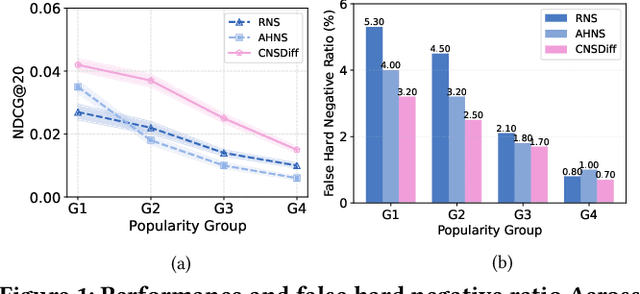
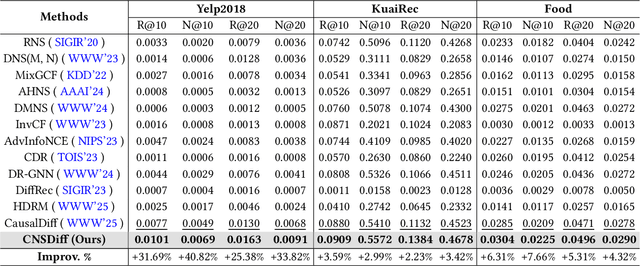
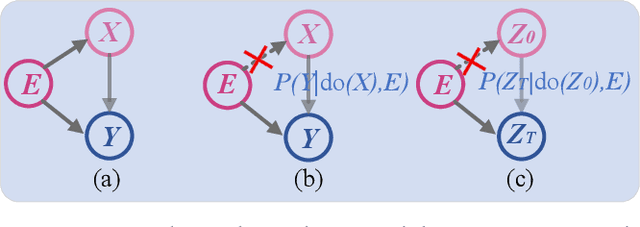
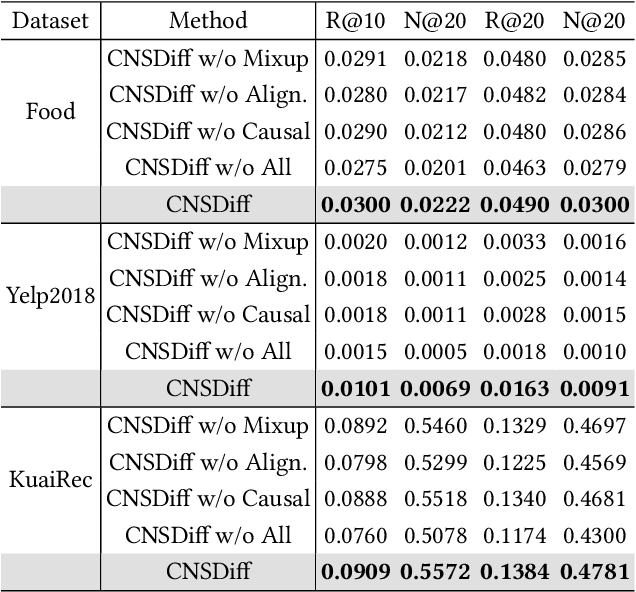
Heuristic negative sampling enhances recommendation performance by selecting negative samples of varying hardness levels from predefined candidate pools to guide the model toward learning more accurate decision boundaries. However, our empirical and theoretical analyses reveal that unobserved environmental confounders (e.g., exposure or popularity biases) in candidate pools may cause heuristic sampling methods to introduce false hard negatives (FHNS). These misleading samples can encourage the model to learn spurious correlations induced by such confounders, ultimately compromising its generalization ability under distribution shifts. To address this issue, we propose a novel method named Causal Negative Sampling via Diffusion (CNSDiff). By synthesizing negative samples in the latent space via a conditional diffusion process, CNSDiff avoids the bias introduced by predefined candidate pools and thus reduces the likelihood of generating FHNS. Moreover, it incorporates a causal regularization term to explicitly mitigate the influence of environmental confounders during the negative sampling process, leading to robust negatives that promote out-of-distribution (OOD) generalization. Comprehensive experiments under four representative distribution shift scenarios demonstrate that CNSDiff achieves an average improvement of 13.96% across all evaluation metrics compared to state-of-the-art baselines, verifying its effectiveness and robustness in OOD recommendation tasks.
Data Augmentation as Free Lunch: Exploring the Test-Time Augmentation for Sequential Recommendation
Apr 07, 2025Data augmentation has become a promising method of mitigating data sparsity in sequential recommendation. Existing methods generate new yet effective data during model training to improve performance. However, deploying them requires retraining, architecture modification, or introducing additional learnable parameters. The above steps are time-consuming and costly for well-trained models, especially when the model scale becomes large. In this work, we explore the test-time augmentation (TTA) for sequential recommendation, which augments the inputs during the model inference and then aggregates the model's predictions for augmented data to improve final accuracy. It avoids significant time and cost overhead from loss calculation and backward propagation. We first experimentally disclose the potential of existing augmentation operators for TTA and find that the Mask and Substitute consistently achieve better performance. Further analysis reveals that these two operators are effective because they retain the original sequential pattern while adding appropriate perturbations. Meanwhile, we argue that these two operators still face time-consuming item selection or interference information from mask tokens. Based on the analysis and limitations, we present TNoise and TMask. The former injects uniform noise into the original representation, avoiding the computational overhead of item selection. The latter blocks mask token from participating in model calculations or directly removes interactions that should have been replaced with mask tokens. Comprehensive experiments demonstrate the effectiveness, efficiency, and generalizability of our method. We provide an anonymous implementation at https://github.com/KingGugu/TTA4SR.
Can LLM-Driven Hard Negative Sampling Empower Collaborative Filtering? Findings and Potentials
Apr 07, 2025Hard negative samples can accelerate model convergence and optimize decision boundaries, which is key to improving the performance of recommender systems. Although large language models (LLMs) possess strong semantic understanding and generation capabilities, systematic research has not yet been conducted on how to generate hard negative samples effectively. To fill this gap, this paper introduces the concept of Semantic Negative Sampling and exploreshow to optimize LLMs for high-quality, hard negative sampling. Specifically, we design an experimental pipeline that includes three main modules, profile generation, semantic negative sampling, and semantic alignment, to verify the potential of LLM-driven hard negative sampling in enhancing the accuracy of collaborative filtering (CF). Experimental results indicate that hard negative samples generated based on LLMs, when semantically aligned and integrated into CF, can significantly improve CF performance, although there is still a certain gap compared to traditional negative sampling methods. Further analysis reveals that this gap primarily arises from two major challenges: noisy samples and lack of behavioral constraints. To address these challenges, we propose a framework called HNLMRec, based on fine-tuning LLMs supervised by collaborative signals. Experimental results show that this framework outperforms traditional negative sampling and other LLM-driven recommendation methods across multiple datasets, providing new solutions for empowering traditional RS with LLMs. Additionally, we validate the excellent generalization ability of the LLM-based semantic negative sampling method on new datasets, demonstrating its potential in alleviating issues such as data sparsity, popularity bias, and the problem of false hard negative samples. Our implementation code is available at https://github.com/user683/HNLMRec.
Distributionally Robust Graph Out-of-Distribution Recommendation via Diffusion Model
Jan 26, 2025The distributionally robust optimization (DRO)-based graph neural network methods improve recommendation systems' out-of-distribution (OOD) generalization by optimizing the model's worst-case performance. However, these studies fail to consider the impact of noisy samples in the training data, which results in diminished generalization capabilities and lower accuracy. Through experimental and theoretical analysis, this paper reveals that current DRO-based graph recommendation methods assign greater weight to noise distribution, leading to model parameter learning being dominated by it. When the model overly focuses on fitting noise samples in the training data, it may learn irrelevant or meaningless features that cannot be generalized to OOD data. To address this challenge, we design a Distributionally Robust Graph model for OOD recommendation (DRGO). Specifically, our method first employs a simple and effective diffusion paradigm to alleviate the noisy effect in the latent space. Additionally, an entropy regularization term is introduced in the DRO objective function to avoid extreme sample weights in the worst-case distribution. Finally, we provide a theoretical proof of the generalization error bound of DRGO as well as a theoretical analysis of how our approach mitigates noisy sample effects, which helps to better understand the proposed framework from a theoretical perspective. We conduct extensive experiments on four datasets to evaluate the effectiveness of our framework against three typical distribution shifts, and the results demonstrate its superiority in both independently and identically distributed distributions (IID) and OOD.