 Add to Chrome
 Add to Firefox
 Add to Edge
Mint-Agent: Introducing Finance-Native Agentic Foundation Models
Aug 17, 2026
Financial agents must do more than recall domain knowledge: they must be both reliable, executing precise operations over grounded evidence, and executive, sustaining long-horizon research whose conclusions remain auditable. We present Mint-Agent, a family of finance-native agentic models designed around these two scales of financial intelligence. Mint-Agent is built upon three pillars: data, harness, and algorithm. Our data engine constructs clean, specialized tasks for atomic financial capabilities and long-horizon agentic execution from real-world financial sources. MintHarness enables stable interaction with open-ended environments and maintains auditable evidence trails across extended research trajectories. Our training recipe combines SFT, critical-step OPD, and RLVR to develop separate financial reasoning and agentic execution experts, which are then unified through model merging and multi-teacher on-policy distillation into compact, general-purpose financial agents. This pipeline yields two flagship models, Mint-Cu (9B) and Mint-Ag (27B). Across professional financial benchmarks, our models demonstrate two defining strengths: (1) Reliability: Mint-Ag achieves 98.33% on RFC-Bench, surpassing GPT-5.6-Sol and Claude-Opus-4.8 by 3.66 and 3.00 points; and (2) Executability: Mint-Cu reaches 69.86% on FinSearchComp T2, outperforming Agents-A1-35B and Nex-N2-mini by 22.83 and 12.78 points, while Mint-Ag achieves 76.00% and 60.49% on FinanceAgentBench v1.1 and v2, respectively. These results establish a path toward trustworthy financial intelligence in which domain expertise, long-horizon execution, and auditable evidence are jointly engineered as a unified foundation for frontier agentic models.

HalluTracer: Hallucination Detection via Depth-Averaging Truth Signals
Aug 17, 2026Even well-aligned large language models confidently generate factually incorrect text, making hallucination a persistent reliability risk in high-stakes deployments. These models nonetheless carry linearly separable truthfulness signals in their internal representations. Existing white-box detectors, however, collapse this evidence to isolated components or a single depth, discarding discriminative information distributed across the full forward pass. We introduce HalluTracer, a detection framework that reads and aggregates truthfulness evidence across every layer of the forward pass before the model emits any answer token. A geometric analysis reveals that the per-layer signals are weakly correlated, so that simple depth averaging suppresses layer-specific noise and captures nearly all linearly accessible information. Across six open-source language models and five hallucination benchmarks, HalluTracer consistently outperforms matched white-box baselines, with gains ranging from one to fourteen points. Collectively, our work recasts hallucination detection from a layer-selection problem into a depth-aggregation problem governed by the geometric sparsity of the truthfulness signal.
When GNNs Fail: Quantifying and Overcoming Temporal Correlation Volatility in Time Series
Aug 07, 2026Modeling multivariate time series by representing them as graphs, where individual series act as nodes and pairwise temporal corre- lations serve as edges, has gained significant traction. Recent advances in Graph Neural Networks (GNNs) have demonstrated strong perfor- mance by assuming a static graph topology and aggregating information from neighboring series. In this work, we investigate the representa- tional power of GNNs for forecasting under both static and dynamic settings (i.e., when pairwise correlations evolve drastically over time) and identify critical limitations in current architectures. To formalize this, we first propose Temporal Correlation Volatility (TCV), a model- agnostic metric designed to quantify the distributional evolution of these latent structures. We establish a clear connection between TCV and performance degradation, demonstrating that many popular models, including Transformers, generalize poorly in high-TCV settings and are often outperformed by simple structure-agnostic baselines. To address these limitations, we propose Graph Layer for Inference in Dynamic En- vironments (GLIDE), a novel GNN layer enhanced by two theoretically grounded design mechanisms: (D1) Path-based Message Passing, which captures path-based neighborhoods and (D2) Static and Dynamic Propagation Separation, which identifies optimal dynamics via local static approximation. These components significantly improve learning under dynamic topology while preserving robustness in static scenarios. Ex- tensive experiments on synthetic and real-world benchmarks show that GLIDE improves average performance by up to 45.6% across static and dynamic settings, with the largest gain reaching 85.7%. The source code is available at https://github.com/ChenS676/GLIDE.
* 6 figures, 3 tables, 16 pages
DART: Semantic Recoverability for Structured Tool Agents
May 22, 2026When a structured tool agent fails mid-execution, the runtime faces a dilemma: replaying the entire task is safe but wasteful, while restoring from a local checkpoint is efficient but can leave committed downstream work tied to an upstream history that no longer exists. This tension is acute in commitment-sensitive settings, where rollback targets a single failed instance yet downstream consumers have already acted on its output. Existing recovery approaches provide mechanical rollback but no criterion for whether a local restore remains semantically valid after downstream commitment. We formalize this gap as semantic recoverability and address it in DART, a modular runtime that localizes the failed instance, certifies semantically recoverable boundaries of that instance, aligns checkpoints to those boundaries, and selects an admissible restore point that preserves committed downstream work under dependency and effect constraints-or blocks otherwise. Across three LLM-driven domains and external validation on a LangGraph-based substrate, DART correctly recovers all evaluated commitment-sensitive cases where baseline local recovery fails, and a five-domain safety audit finds no unsafe admitted rollbacks. These results show that controller legality does not imply semantic validity, and that sound local recovery requires an explicit admissibility check.
A Comprehensive Survey of Knowledge-Based Vision Question Answering Systems: The Lifecycle of Knowledge in Visual Reasoning Task
Apr 24, 2025Knowledge-based Vision Question Answering (KB-VQA) extends general Vision Question Answering (VQA) by not only requiring the understanding of visual and textual inputs but also extensive range of knowledge, enabling significant advancements across various real-world applications. KB-VQA introduces unique challenges, including the alignment of heterogeneous information from diverse modalities and sources, the retrieval of relevant knowledge from noisy or large-scale repositories, and the execution of complex reasoning to infer answers from the combined context. With the advancement of Large Language Models (LLMs), KB-VQA systems have also undergone a notable transformation, where LLMs serve as powerful knowledge repositories, retrieval-augmented generators and strong reasoners. Despite substantial progress, no comprehensive survey currently exists that systematically organizes and reviews the existing KB-VQA methods. This survey aims to fill this gap by establishing a structured taxonomy of KB-VQA approaches, and categorizing the systems into main stages: knowledge representation, knowledge retrieval, and knowledge reasoning. By exploring various knowledge integration techniques and identifying persistent challenges, this work also outlines promising future research directions, providing a foundation for advancing KB-VQA models and their applications.
UniRVQA: A Unified Framework for Retrieval-Augmented Vision Question Answering via Self-Reflective Joint Training
Apr 05, 2025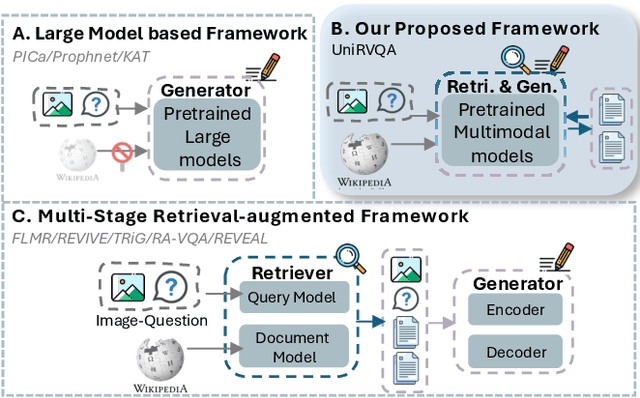
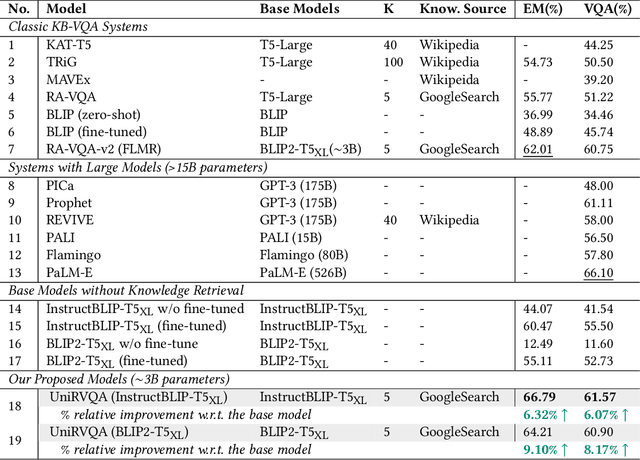
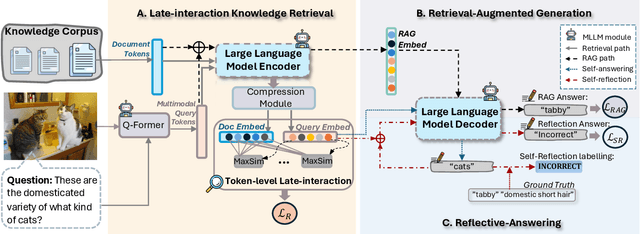
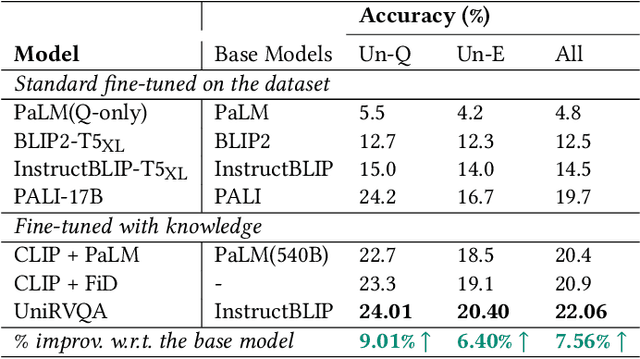
Knowledge-based Vision Question Answering (KB-VQA) systems address complex visual-grounded questions requiring external knowledge, such as web-sourced encyclopedia articles. Existing methods often use sequential and separate frameworks for the retriever and the generator with limited parametric knowledge sharing. However, since both retrieval and generation tasks require accurate understanding of contextual and external information, such separation can potentially lead to suboptimal system performance. Another key challenge is the integration of multimodal information. General-purpose multimodal pre-trained models, while adept at multimodal representation learning, struggle with fine-grained retrieval required for knowledge-intensive visual questions. Recent specialized pre-trained models mitigate the issue, but are computationally expensive. To bridge the gap, we propose a Unified Retrieval-Augmented VQA framework (UniRVQA). UniRVQA adapts general multimodal pre-trained models for fine-grained knowledge-intensive tasks within a unified framework, enabling cross-task parametric knowledge sharing and the extension of existing multimodal representation learning capability. We further introduce a reflective-answering mechanism that allows the model to explicitly evaluate and refine its knowledge boundary. Additionally, we integrate late interaction into the retrieval-augmented generation joint training process to enhance fine-grained understanding of queries and documents. Our approach achieves competitive performance against state-of-the-art models, delivering a significant 4.7% improvement in answering accuracy, and brings an average 7.5% boost in base MLLMs' VQA performance.
Personalized Federated Learning With Structure
Mar 08, 2022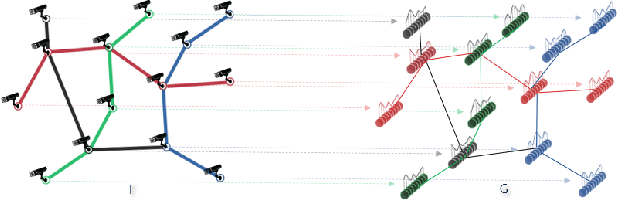

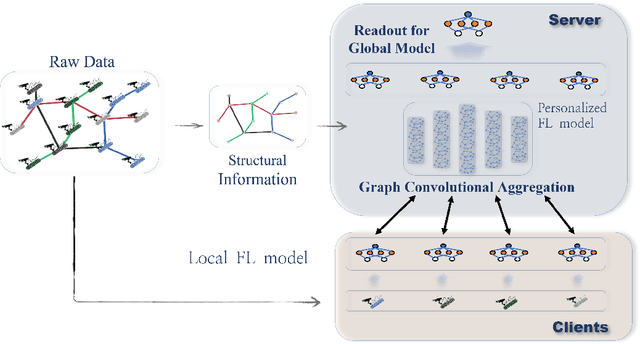
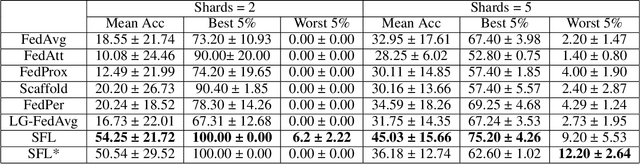
Knowledge sharing and model personalization are two key components to impact the performance of personalized federated learning (PFL). Existing PFL methods simply treat knowledge sharing as an aggregation of all clients regardless of the hidden relations among them. This paper is to enhance the knowledge-sharing process in PFL by leveraging the structural information among clients. We propose a novel structured federated learning(SFL) framework to simultaneously learn the global model and personalized model using each client's local relations with others and its private dataset. This proposed framework has been formulated to a new optimization problem to model the complex relationship among personalized models and structural topology information into a unified framework. Moreover, in contrast to a pre-defined structure, our framework could be further enhanced by adding a structure learning component to automatically learn the structure using the similarities between clients' models' parameters. By conducting extensive experiments, we first demonstrate how federated learning can be benefited by introducing structural information into the server aggregation process with a real-world dataset, and then the effectiveness of the proposed method has been demonstrated in varying degrees of data non-iid settings.
Spatio-Temporal Joint Graph Convolutional Networks for Traffic Forecasting
Dec 02, 2021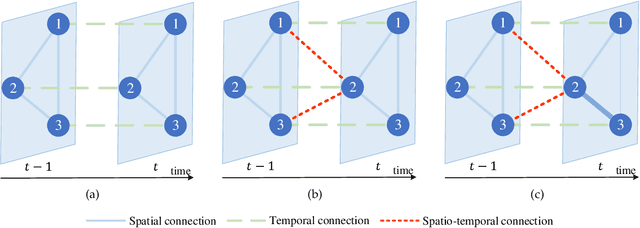
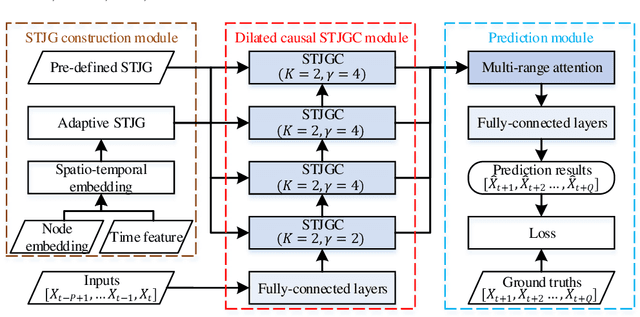
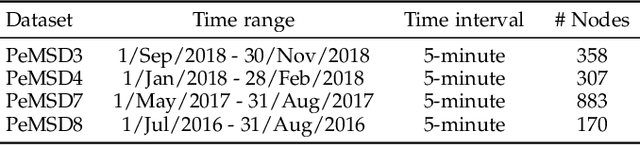
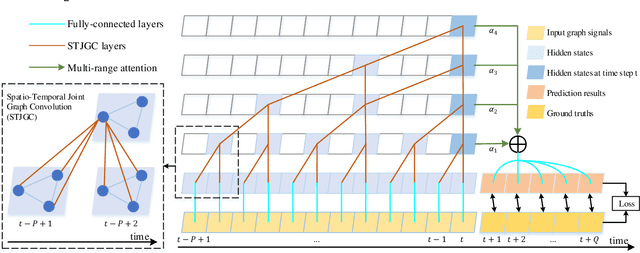
Recent studies focus on formulating the traffic forecasting as a spatio-temporal graph modeling problem. They typically construct a static spatial graph at each time step and then connect each node with itself between adjacent time steps to construct the spatio-temporal graph. In such a graph, the correlations between different nodes at different time steps are not explicitly reflected, which may restrict the learning ability of graph neural networks. Meanwhile, those models ignore the dynamic spatio-temporal correlations among nodes as they use the same adjacency matrix at different time steps. To overcome these limitations, we propose a Spatio-Temporal Joint Graph Convolutional Networks (STJGCN) for traffic forecasting over several time steps ahead on a road network. Specifically, we construct both pre-defined and adaptive spatio-temporal joint graphs (STJGs) between any two time steps, which represent comprehensive and dynamic spatio-temporal correlations. We further design dilated causal spatio-temporal joint graph convolution layers on STJG to capture the spatio-temporal dependencies from distinct perspectives with multiple ranges. A multi-range attention mechanism is proposed to aggregate the information of different ranges. Experiments on four public traffic datasets demonstrate that STJGCN is computationally efficient and outperforms 11 state-of-the-art baseline methods.
ConTIG: Continuous Representation Learning on Temporal Interaction Graphs
Sep 27, 2021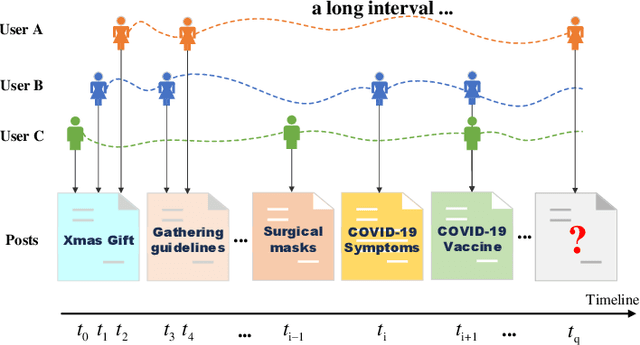
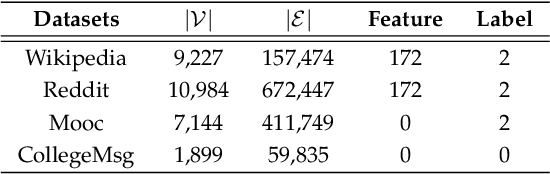
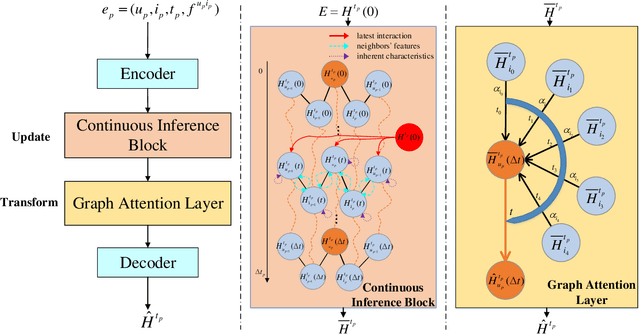
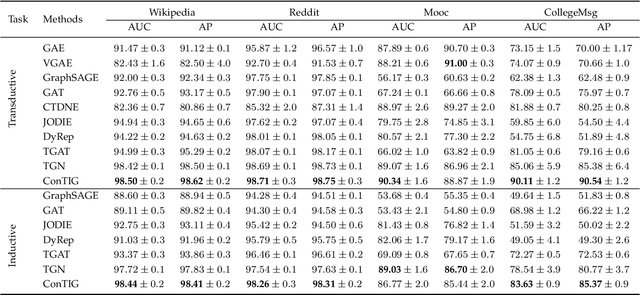
Representation learning on temporal interaction graphs (TIG) is to model complex networks with the dynamic evolution of interactions arising in a broad spectrum of problems. Existing dynamic embedding methods on TIG discretely update node embeddings merely when an interaction occurs. They fail to capture the continuous dynamic evolution of embedding trajectories of nodes. In this paper, we propose a two-module framework named ConTIG, a continuous representation method that captures the continuous dynamic evolution of node embedding trajectories. With two essential modules, our model exploit three-fold factors in dynamic networks which include latest interaction, neighbor features and inherent characteristics. In the first update module, we employ a continuous inference block to learn the nodes' state trajectories by learning from time-adjacent interaction patterns between node pairs using ordinary differential equations. In the second transform module, we introduce a self-attention mechanism to predict future node embeddings by aggregating historical temporal interaction information. Experiments results demonstrate the superiority of ConTIG on temporal link prediction, temporal node recommendation and dynamic node classification tasks compared with a range of state-of-the-art baselines, especially for long-interval interactions prediction.
TraverseNet: Unifying Space and Time in Message Passing
Aug 25, 2021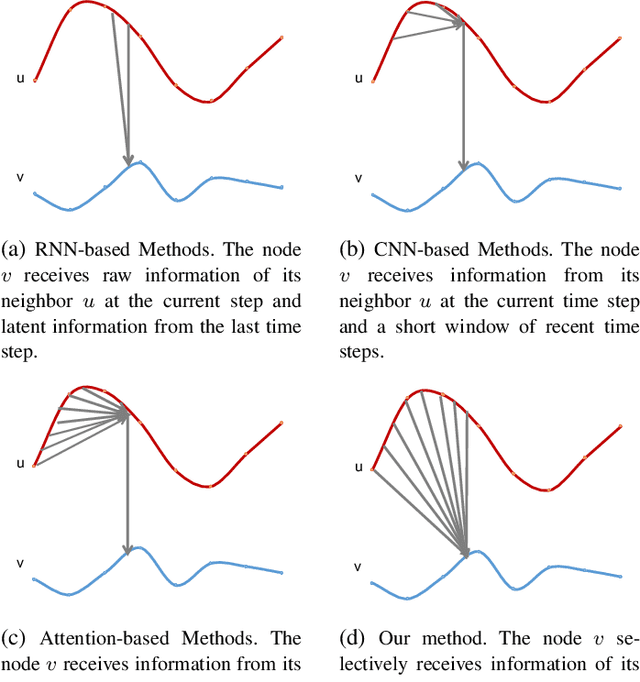
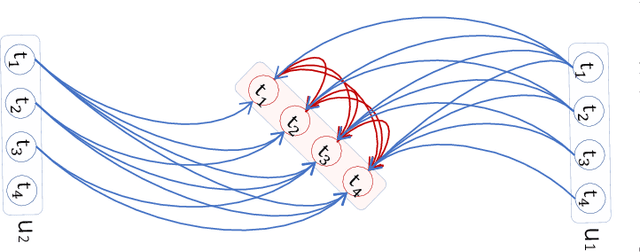
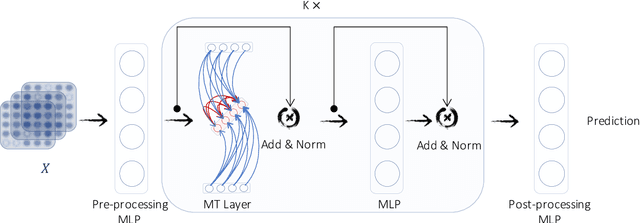

This paper aims to unify spatial dependency and temporal dependency in a non-Euclidean space while capturing the inner spatial-temporal dependencies for spatial-temporal graph data. For spatial-temporal attribute entities with topological structure, the space-time is consecutive and unified while each node's current status is influenced by its neighbors' past states over variant periods of each neighbor. Most spatial-temporal neural networks study spatial dependency and temporal correlation separately in processing, gravely impaired the space-time continuum, and ignore the fact that the neighbors' temporal dependency period for a node can be delayed and dynamic. To model this actual condition, we propose TraverseNet, a novel spatial-temporal graph neural network, viewing space and time as an inseparable whole, to mine spatial-temporal graphs while exploiting the evolving spatial-temporal dependencies for each node via message traverse mechanisms. Experiments with ablation and parameter studies have validated the effectiveness of the proposed TraverseNets, and the detailed implementation can be found from https://github.com/nnzhan/TraverseNet.