 Add to Chrome
 Add to Firefox
 Add to Edge
Enhancing Image Aesthetics with Dual-Conditioned Diffusion Models Guided by Multimodal Perception
Mar 12, 2026
Image aesthetic enhancement aims to perceive aesthetic deficiencies in images and perform corresponding editing operations, which is highly challenging and requires the model to possess creativity and aesthetic perception capabilities. Although recent advancements in image editing models have significantly enhanced their controllability and flexibility, they struggle with enhancing image aesthetic. The primary challenges are twofold: first, following editing instructions with aesthetic perception is difficult, and second, there is a scarcity of "perfectly-paired" images that have consistent content but distinct aesthetic qualities. In this paper, we propose Dual-supervised Image Aesthetic Enhancement (DIAE), a diffusion-based generative model with multimodal aesthetic perception. First, DIAE incorporates Multimodal Aesthetic Perception (MAP) to convert the ambiguous aesthetic instruction into explicit guidance by (i) employing detailed, standardized aesthetic instructions across multiple aesthetic attributes, and (ii) utilizing multimodal control signals derived from text-image pairs that maintain consistency within the same aesthetic attribute. Second, to mitigate the lack of "perfectly-paired" images, we collect "imperfectly-paired" dataset called IIAEData, consisting of images with varying aesthetic qualities while sharing identical semantics. To better leverage the weak matching characteristics of IIAEData during training, a dual-branch supervision framework is also introduced for weakly supervised image aesthetic enhancement. Experimental results demonstrate that DIAE outperforms the baselines and obtains superior image aesthetic scores and image content consistency scores.

AI-Driven Automated Tool for Abdominal CT Body Composition Analysis in Gastrointestinal Cancer Management
Mar 10, 2025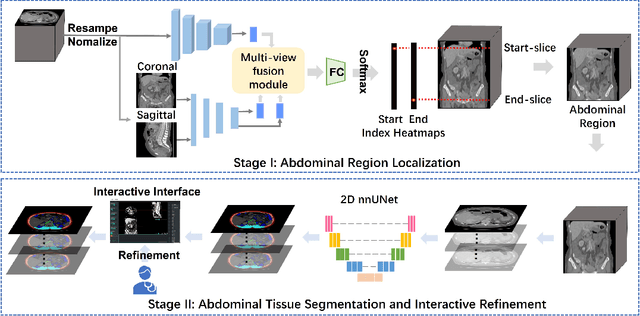


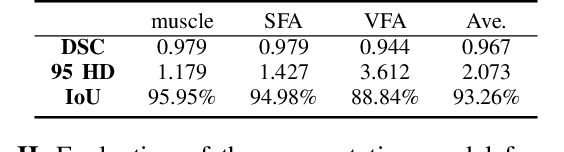
The incidence of gastrointestinal cancers remains significantly high, particularly in China, emphasizing the importance of accurate prognostic assessments and effective treatment strategies. Research shows a strong correlation between abdominal muscle and fat tissue composition and patient outcomes. However, existing manual methods for analyzing abdominal tissue composition are time-consuming and costly, limiting clinical research scalability. To address these challenges, we developed an AI-driven tool for automated analysis of abdominal CT scans to effectively identify and segment muscle, subcutaneous fat, and visceral fat. Our tool integrates a multi-view localization model and a high-precision 2D nnUNet-based segmentation model, demonstrating a localization accuracy of 90% and a Dice Score Coefficient of 0.967 for segmentation. Furthermore, it features an interactive interface that allows clinicians to refine the segmentation results, ensuring high-quality outcomes effectively. Our tool offers a standardized method for effectively extracting critical abdominal tissues, potentially enhancing the management and treatment for gastrointestinal cancers. The code is available at https://github.com/NanXinyu/AI-Tool4Abdominal-Seg.git}{https://github.com/NanXinyu/AI-Tool4Abdominal-Seg.git.
PropSAM: A Propagation-Based Model for Segmenting Any 3D Objects in Multi-Modal Medical Images
Aug 25, 2024


Volumetric segmentation is crucial for medical imaging but is often constrained by labor-intensive manual annotations and the need for scenario-specific model training. Furthermore, existing general segmentation models are inefficient due to their design and inferential approaches. Addressing this clinical demand, we introduce PropSAM, a propagation-based segmentation model that optimizes the use of 3D medical structure information. PropSAM integrates a CNN-based UNet for intra-slice processing with a Transformer-based module for inter-slice propagation, focusing on structural and semantic continuities to enhance segmentation across various modalities. Distinctively, PropSAM operates on a one-view prompt, such as a 2D bounding box or sketch mask, unlike conventional models that require two-view prompts. It has demonstrated superior performance, significantly improving the Dice Similarity Coefficient (DSC) across 44 medical datasets and various imaging modalities, outperforming models like MedSAM and SegVol with an average DSC improvement of 18.1%. PropSAM also maintains stable predictions despite prompt deviations and varying propagation configurations, confirmed by one-way ANOVA tests with P>0.5985 and P>0.6131, respectively. Moreover, PropSAM's efficient architecture enables faster inference speeds (Wilcoxon rank-sum test, P<0.001) and reduces user interaction time by 37.8% compared to two-view prompt models. Its ability to handle irregular and complex objects with robust performance further demonstrates its potential in clinical settings, facilitating more automated and reliable medical imaging analyses with minimal retraining.