 Add to Chrome
 Add to Firefox
 Add to Edge
Mint-Agent: Introducing Finance-Native Agentic Foundation Models
Aug 17, 2026
Financial agents must do more than recall domain knowledge: they must be both reliable, executing precise operations over grounded evidence, and executive, sustaining long-horizon research whose conclusions remain auditable. We present Mint-Agent, a family of finance-native agentic models designed around these two scales of financial intelligence. Mint-Agent is built upon three pillars: data, harness, and algorithm. Our data engine constructs clean, specialized tasks for atomic financial capabilities and long-horizon agentic execution from real-world financial sources. MintHarness enables stable interaction with open-ended environments and maintains auditable evidence trails across extended research trajectories. Our training recipe combines SFT, critical-step OPD, and RLVR to develop separate financial reasoning and agentic execution experts, which are then unified through model merging and multi-teacher on-policy distillation into compact, general-purpose financial agents. This pipeline yields two flagship models, Mint-Cu (9B) and Mint-Ag (27B). Across professional financial benchmarks, our models demonstrate two defining strengths: (1) Reliability: Mint-Ag achieves 98.33% on RFC-Bench, surpassing GPT-5.6-Sol and Claude-Opus-4.8 by 3.66 and 3.00 points; and (2) Executability: Mint-Cu reaches 69.86% on FinSearchComp T2, outperforming Agents-A1-35B and Nex-N2-mini by 22.83 and 12.78 points, while Mint-Ag achieves 76.00% and 60.49% on FinanceAgentBench v1.1 and v2, respectively. These results establish a path toward trustworthy financial intelligence in which domain expertise, long-horizon execution, and auditable evidence are jointly engineered as a unified foundation for frontier agentic models.

DeepSeek LLM: Scaling Open-Source Language Models with Longtermism
Jan 05, 2024
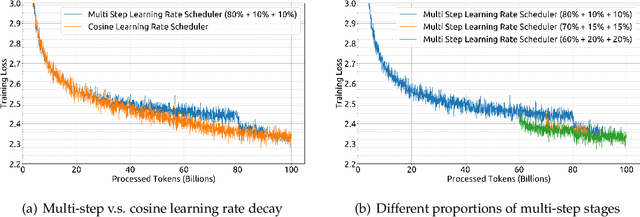


The rapid development of open-source large language models (LLMs) has been truly remarkable. However, the scaling law described in previous literature presents varying conclusions, which casts a dark cloud over scaling LLMs. We delve into the study of scaling laws and present our distinctive findings that facilitate scaling of large scale models in two commonly used open-source configurations, 7B and 67B. Guided by the scaling laws, we introduce DeepSeek LLM, a project dedicated to advancing open-source language models with a long-term perspective. To support the pre-training phase, we have developed a dataset that currently consists of 2 trillion tokens and is continuously expanding. We further conduct supervised fine-tuning (SFT) and Direct Preference Optimization (DPO) on DeepSeek LLM Base models, resulting in the creation of DeepSeek Chat models. Our evaluation results demonstrate that DeepSeek LLM 67B surpasses LLaMA-2 70B on various benchmarks, particularly in the domains of code, mathematics, and reasoning. Furthermore, open-ended evaluations reveal that DeepSeek LLM 67B Chat exhibits superior performance compared to GPT-3.5.
Effectiveness of random deep feature selection for securing image manipulation detectors against adversarial examples
Oct 25, 2019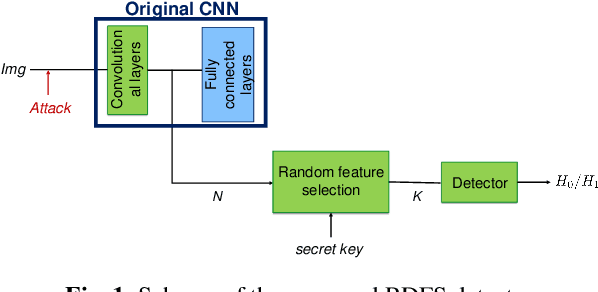
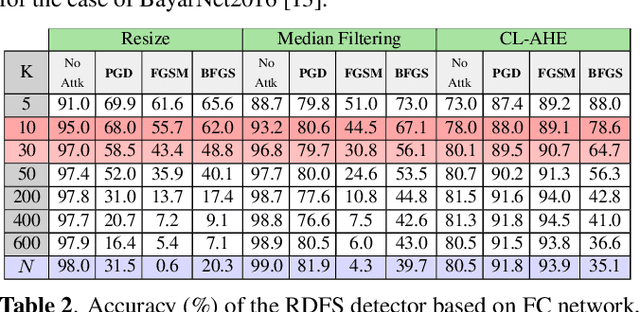
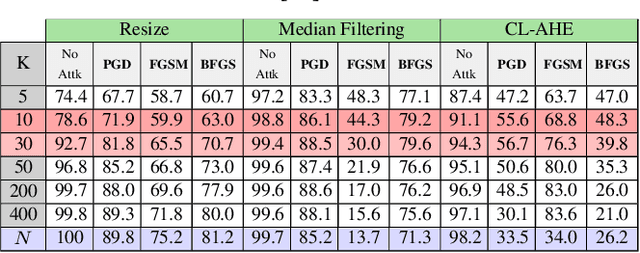
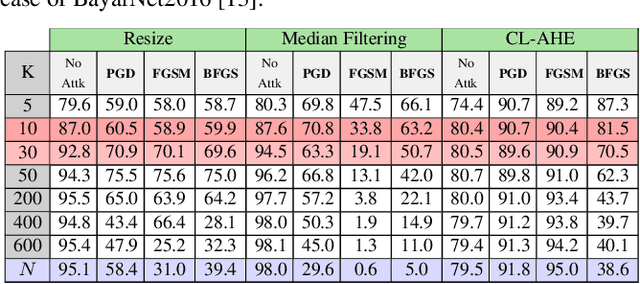
We investigate if the random feature selection approach proposed in [1] to improve the robustness of forensic detectors to targeted attacks, can be extended to detectors based on deep learning features. In particular, we study the transferability of adversarial examples targeting an original CNN image manipulation detector to other detectors (a fully connected neural network and a linear SVM) that rely on a random subset of the features extracted from the flatten layer of the original network. The results we got by considering three image manipulation detection tasks (resizing, median filtering and adaptive histogram equalization), two original network architectures and three classes of attacks, show that feature randomization helps to hinder attack transferability, even if, in some cases, simply changing the architecture of the detector, or even retraining the detector is enough to prevent the transferability of the attacks.