 Add to Chrome
 Add to Firefox
 Add to Edge
How do Large Language Models Handle Multilingualism?
Feb 29, 2024
Large language models (LLMs) demonstrate remarkable performance across a spectrum of languages. In this work, we delve into the question: How do LLMs handle multilingualism? We introduce a framework that depicts LLMs' processing of multilingual inputs: In the first several layers, LLMs understand the question, converting multilingual inputs into English to facilitate the task-solving phase. In the intermediate layers, LLMs engage in problem-solving by thinking in English and incorporating multilingual knowledge to obtain factual content, leveraging the self-attention and feed-forward structures, respectively. In the last several layers, LLMs generate responses that align with the original language of the query. In addition, we investigate the existence of language-specific neurons when processing a certain language. To detect neurons activated by the input language, even without labels, we innovatively design a Parallel Language specific Neuron Detection ($\texttt{PLND}$) method that effectively measures the significance of neurons when handling multilingual inputs. By comprehensive ablation analysis through deactivating neurons of different layers and structures, we verify the framework that we propose. Additionally, we demonstrate that we can utilize such a framework to effectively enhance the multilingual ability with much less training effort.

AdaMergeX: Cross-Lingual Transfer with Large Language Models via Adaptive Adapter Merging
Feb 29, 2024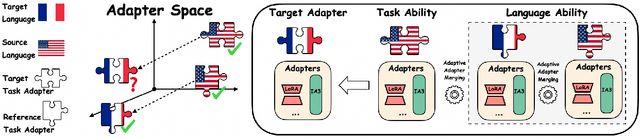
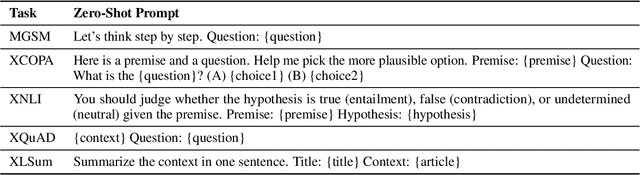
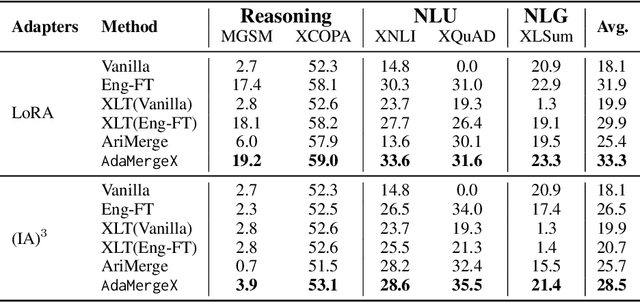
As an effective alternative to the direct fine-tuning on target tasks in specific languages, cross-lingual transfer addresses the challenges of limited training data by decoupling ''task ability'' and ''language ability'' by fine-tuning on the target task in the source language and another selected task in the target language, respectively. However, they fail to fully separate the task ability from the source language or the language ability from the chosen task. In this paper, we acknowledge the mutual reliance between task ability and language ability and direct our attention toward the gap between the target language and the source language on tasks. As the gap removes the impact of tasks, we assume that it remains consistent across tasks. Based on this assumption, we propose a new cross-lingual transfer method called $\texttt{AdaMergeX}$ that utilizes adaptive adapter merging. By introducing a reference task, we can determine that the divergence of adapters fine-tuned on the reference task in both languages follows the same distribution as the divergence of adapters fine-tuned on the target task in both languages. Hence, we can obtain target adapters by combining the other three adapters. Furthermore, we propose a structure-adaptive adapter merging method. Our empirical results demonstrate that our approach yields new and effective cross-lingual transfer, outperforming existing methods across all settings.
Referee Can Play: An Alternative Approach to Conditional Generation via Model Inversion
Feb 26, 2024
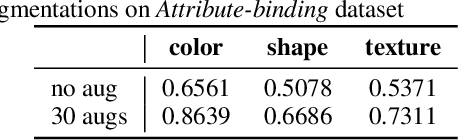
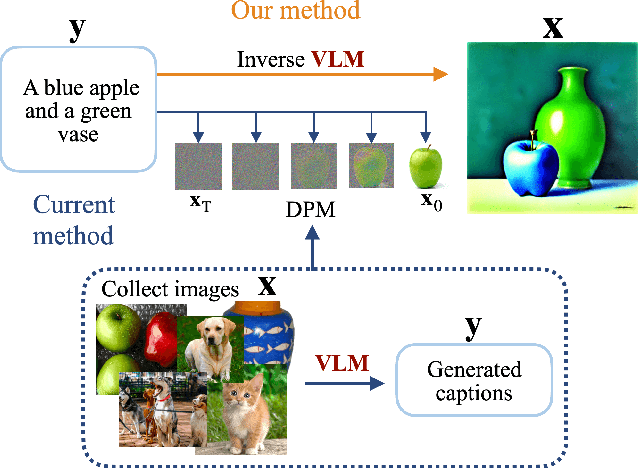
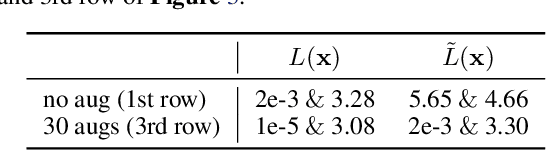
As a dominant force in text-to-image generation tasks, Diffusion Probabilistic Models (DPMs) face a critical challenge in controllability, struggling to adhere strictly to complex, multi-faceted instructions. In this work, we aim to address this alignment challenge for conditional generation tasks. First, we provide an alternative view of state-of-the-art DPMs as a way of inverting advanced Vision-Language Models (VLMs). With this formulation, we naturally propose a training-free approach that bypasses the conventional sampling process associated with DPMs. By directly optimizing images with the supervision of discriminative VLMs, the proposed method can potentially achieve a better text-image alignment. As proof of concept, we demonstrate the pipeline with the pre-trained BLIP-2 model and identify several key designs for improved image generation. To further enhance the image fidelity, a Score Distillation Sampling module of Stable Diffusion is incorporated. By carefully balancing the two components during optimization, our method can produce high-quality images with near state-of-the-art performance on T2I-Compbench.
The Surprising Effectiveness of Skip-Tuning in Diffusion Sampling
Feb 23, 2024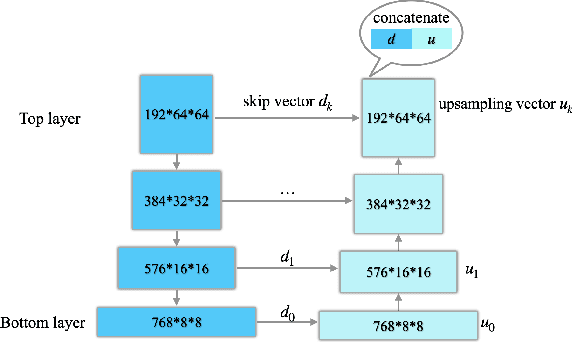
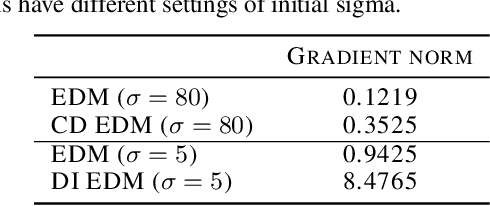
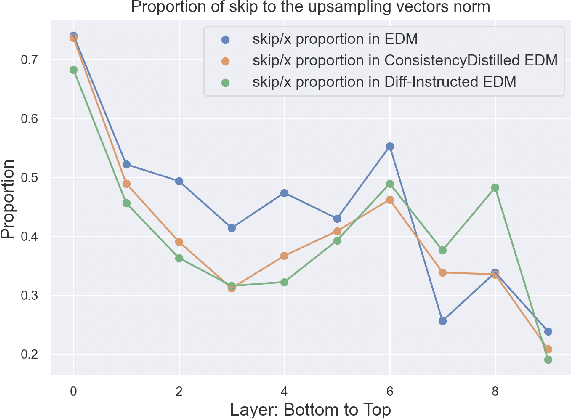
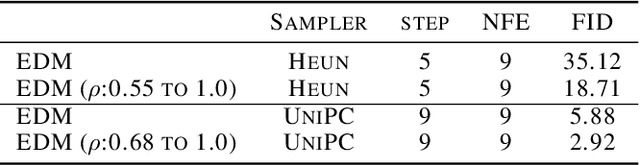
With the incorporation of the UNet architecture, diffusion probabilistic models have become a dominant force in image generation tasks. One key design in UNet is the skip connections between the encoder and decoder blocks. Although skip connections have been shown to improve training stability and model performance, we reveal that such shortcuts can be a limiting factor for the complexity of the transformation. As the sampling steps decrease, the generation process and the role of the UNet get closer to the push-forward transformations from Gaussian distribution to the target, posing a challenge for the network's complexity. To address this challenge, we propose Skip-Tuning, a simple yet surprisingly effective training-free tuning method on the skip connections. Our method can achieve 100% FID improvement for pretrained EDM on ImageNet 64 with only 19 NFEs (1.75), breaking the limit of ODE samplers regardless of sampling steps. Surprisingly, the improvement persists when we increase the number of sampling steps and can even surpass the best result from EDM-2 (1.58) with only 39 NFEs (1.57). Comprehensive exploratory experiments are conducted to shed light on the surprising effectiveness. We observe that while Skip-Tuning increases the score-matching losses in the pixel space, the losses in the feature space are reduced, particularly at intermediate noise levels, which coincide with the most effective range accounting for image quality improvement.
Unsupervised Concept Discovery Mitigates Spurious Correlations
Feb 20, 2024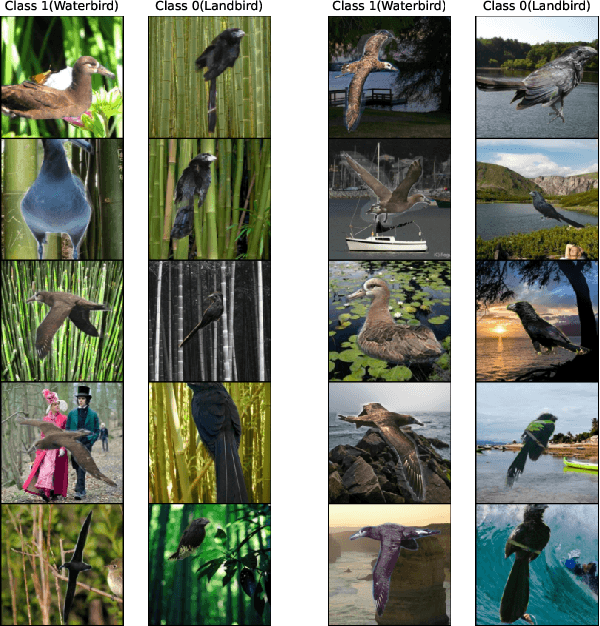
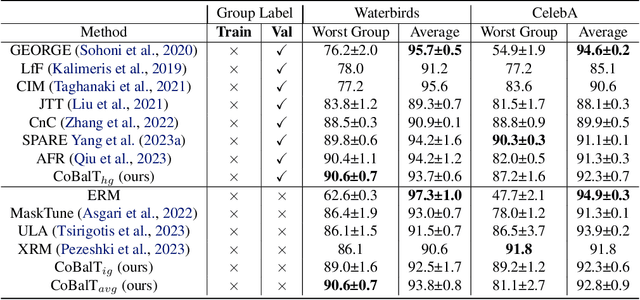
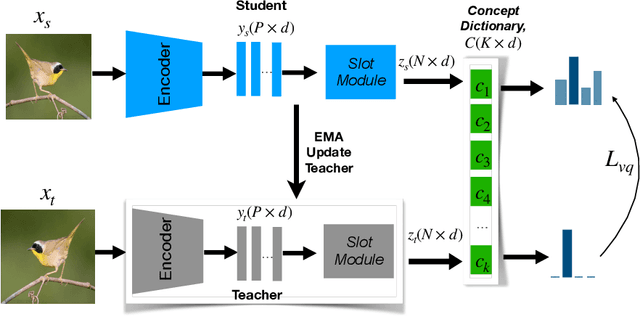
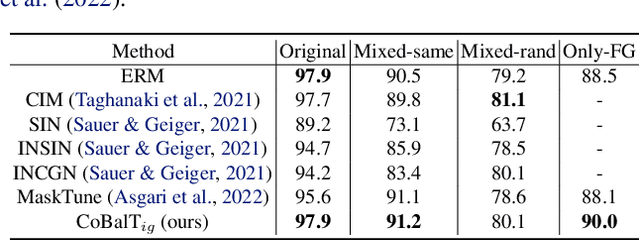
Models prone to spurious correlations in training data often produce brittle predictions and introduce unintended biases. Addressing this challenge typically involves methods relying on prior knowledge and group annotation to remove spurious correlations, which may not be readily available in many applications. In this paper, we establish a novel connection between unsupervised object-centric learning and mitigation of spurious correlations. Instead of directly inferring sub-groups with varying correlations with labels, our approach focuses on discovering concepts: discrete ideas that are shared across input samples. Leveraging existing object-centric representation learning, we introduce CoBalT: a concept balancing technique that effectively mitigates spurious correlations without requiring human labeling of subgroups. Evaluation across the Waterbirds, CelebA and ImageNet-9 benchmark datasets for subpopulation shifts demonstrate superior or competitive performance compared state-of-the-art baselines, without the need for group annotation.
Score-Based Physics-Informed Neural Networks for High-Dimensional Fokker-Planck Equations
Feb 12, 2024The Fokker-Planck (FP) equation is a foundational PDE in stochastic processes. However, curse of dimensionality (CoD) poses challenge when dealing with high-dimensional FP PDEs. Although Monte Carlo and vanilla Physics-Informed Neural Networks (PINNs) have shown the potential to tackle CoD, both methods exhibit numerical errors in high dimensions when dealing with the probability density function (PDF) associated with Brownian motion. The point-wise PDF values tend to decrease exponentially as dimension increases, surpassing the precision of numerical simulations and resulting in substantial errors. Moreover, due to its massive sampling, Monte Carlo fails to offer fast sampling. Modeling the logarithm likelihood (LL) via vanilla PINNs transforms the FP equation into a difficult HJB equation, whose error grows rapidly with dimension. To this end, we propose a novel approach utilizing a score-based solver to fit the score function in SDEs. The score function, defined as the gradient of the LL, plays a fundamental role in inferring LL and PDF and enables fast SDE sampling. Three fitting methods, Score Matching (SM), Sliced SM (SSM), and Score-PINN, are introduced. The proposed score-based SDE solver operates in two stages: first, employing SM, SSM, or Score-PINN to acquire the score; and second, solving the LL via an ODE using the obtained score. Comparative evaluations across these methods showcase varying trade-offs. The proposed method is evaluated across diverse SDEs, including anisotropic OU processes, geometric Brownian, and Brownian with varying eigenspace. We also test various distributions, including Gaussian, Log-normal, Laplace, and Cauchy. The numerical results demonstrate the score-based SDE solver's stability, speed, and performance across different settings, solidifying its potential as a solution to CoD for high-dimensional FP equations.
Towards 3D Molecule-Text Interpretation in Language Models
Jan 25, 2024Language Models (LMs) have greatly influenced diverse domains. However, their inherent limitation in comprehending 3D molecular structures has considerably constrained their potential in the biomolecular domain. To bridge this gap, we focus on 3D molecule-text interpretation, and propose 3D-MoLM: 3D-Molecular Language Modeling. Specifically, 3D-MoLM enables an LM to interpret and analyze 3D molecules by equipping the LM with a 3D molecular encoder. This integration is achieved by a 3D molecule-text projector, bridging the 3D molecular encoder's representation space and the LM's input space. Moreover, to enhance 3D-MoLM's ability of cross-modal molecular understanding and instruction following, we meticulously curated a 3D molecule-centric instruction tuning dataset -- 3D-MoIT. Through 3D molecule-text alignment and 3D molecule-centric instruction tuning, 3D-MoLM establishes an integration of 3D molecular encoder and LM. It significantly surpasses existing baselines on downstream tasks, including molecule-text retrieval, molecule captioning, and more challenging open-text molecular QA tasks, especially focusing on 3D-dependent properties.
Towards Continual Learning Desiderata via HSIC-Bottleneck Orthogonalization and Equiangular Embedding
Jan 17, 2024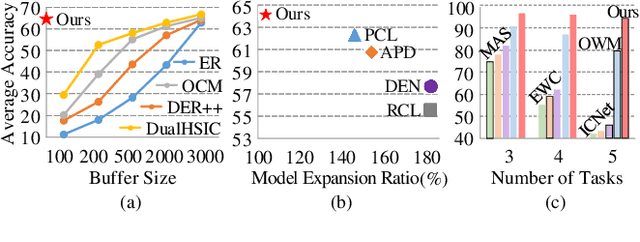
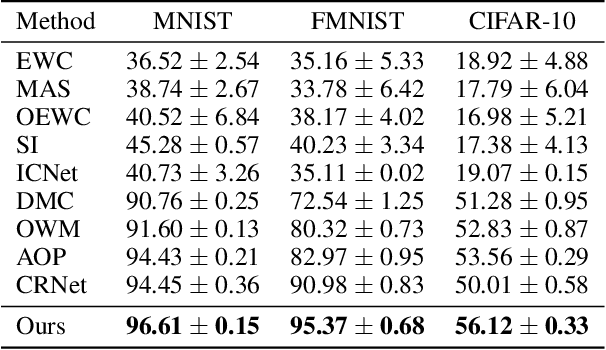
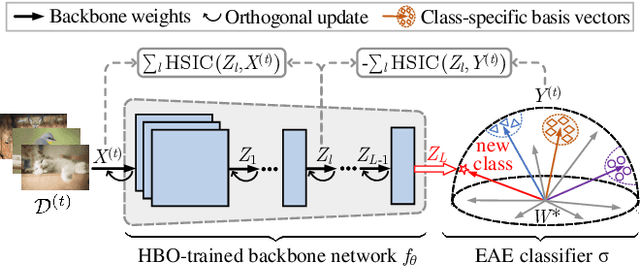
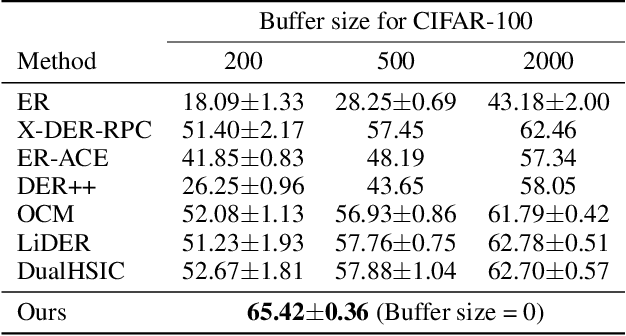
Deep neural networks are susceptible to catastrophic forgetting when trained on sequential tasks. Various continual learning (CL) methods often rely on exemplar buffers or/and network expansion for balancing model stability and plasticity, which, however, compromises their practical value due to privacy and memory concerns. Instead, this paper considers a strict yet realistic setting, where the training data from previous tasks is unavailable and the model size remains relatively constant during sequential training. To achieve such desiderata, we propose a conceptually simple yet effective method that attributes forgetting to layer-wise parameter overwriting and the resulting decision boundary distortion. This is achieved by the synergy between two key components: HSIC-Bottleneck Orthogonalization (HBO) implements non-overwritten parameter updates mediated by Hilbert-Schmidt independence criterion in an orthogonal space and EquiAngular Embedding (EAE) enhances decision boundary adaptation between old and new tasks with predefined basis vectors. Extensive experiments demonstrate that our method achieves competitive accuracy performance, even with absolute superiority of zero exemplar buffer and 1.02x the base model.
Can AI Be as Creative as Humans?
Jan 12, 2024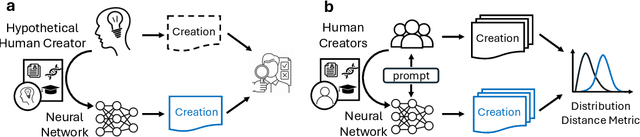
Creativity serves as a cornerstone for societal progress and innovation. With the rise of advanced generative AI models capable of tasks once reserved for human creativity, the study of AI's creative potential becomes imperative for its responsible development and application. In this paper, we provide a theoretical answer to the question of whether AI can be creative. We prove in theory that AI can be as creative as humans under the condition that AI can fit the existing data generated by human creators. Therefore, the debate on AI's creativity is reduced into the question of its ability of fitting a massive amount of data. To arrive at this conclusion, this paper first addresses the complexities in defining creativity by introducing a new concept called Relative Creativity. Instead of trying to define creativity universally, we shift the focus to whether AI can match the creative abilities of a hypothetical human. This perspective draws inspiration from the Turing Test, expanding upon it to address the challenges and subjectivities inherent in assessing creativity. This methodological shift leads to a statistically quantifiable assessment of AI's creativity, which we term Statistical Creativity. This concept allows for comparisons of AI's creative abilities with those of specific human groups, and facilitates the theoretical findings of AI's creative potential. Building on this foundation, we discuss the application of statistical creativity in prompt-conditioned autoregressive models, providing a practical means for evaluating creative abilities of contemporary AI models, such as Large Language Models (LLMs). In addition to defining and analyzing creativity, we introduce an actionable training guideline, effectively bridging the gap between theoretical quantification of creativity and practical model training.
The Stronger the Diffusion Model, the Easier the Backdoor: Data Poisoning to Induce Copyright Breaches Without Adjusting Finetuning Pipeline
Jan 07, 2024The commercialization of diffusion models, renowned for their ability to generate high-quality images that are often indistinguishable from real ones, brings forth potential copyright concerns. Although attempts have been made to impede unauthorized access to copyrighted material during training and to subsequently prevent DMs from generating copyrighted images, the effectiveness of these solutions remains unverified. This study explores the vulnerabilities associated with copyright protection in DMs by introducing a backdoor data poisoning attack (SilentBadDiffusion) against text-to-image diffusion models. Our attack method operates without requiring access to or control over the diffusion model's training or fine-tuning processes; it merely involves the insertion of poisoning data into the clean training dataset. This data, comprising poisoning images equipped with prompts, is generated by leveraging the powerful capabilities of multimodal large language models and text-guided image inpainting techniques. Our experimental results and analysis confirm the method's effectiveness. By integrating a minor portion of non-copyright-infringing stealthy poisoning data into the clean dataset-rendering it free from suspicion-we can prompt the finetuned diffusion models to produce copyrighted content when activated by specific trigger prompts. These findings underline potential pitfalls in the prevailing copyright protection strategies and underscore the necessity for increased scrutiny and preventative measures against the misuse of DMs.