 Add to Chrome
 Add to Firefox
 Add to Edge
Intrinsic PAPR for Point-level 3D Scene Albedo and Shading Editing
Jun 29, 2024
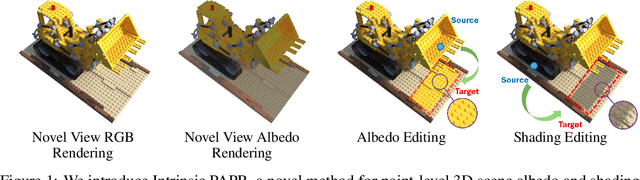

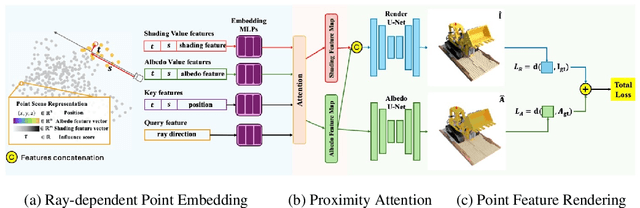

Recent advancements in neural rendering have excelled at novel view synthesis from multi-view RGB images. However, they often lack the capability to edit the shading or colour of the scene at a detailed point-level, while ensuring consistency across different viewpoints. In this work, we address the challenge of point-level 3D scene albedo and shading editing from multi-view RGB images, focusing on detailed editing at the point-level rather than at a part or global level. While prior works based on volumetric representation such as NeRF struggle with achieving 3D consistent editing at the point level, recent advancements in point-based neural rendering show promise in overcoming this challenge. We introduce ``Intrinsic PAPR'', a novel method based on the recent point-based neural rendering technique Proximity Attention Point Rendering (PAPR). Unlike other point-based methods that model the intrinsic decomposition of the scene, our approach does not rely on complicated shading models or simplistic priors that may not universally apply. Instead, we directly model scene decomposition into albedo and shading components, leading to better estimation accuracy. Comparative evaluations against the latest point-based inverse rendering methods demonstrate that Intrinsic PAPR achieves higher-quality novel view rendering and superior point-level albedo and shading editing.

Local Manifold Learning for No-Reference Image Quality Assessment
Jun 27, 2024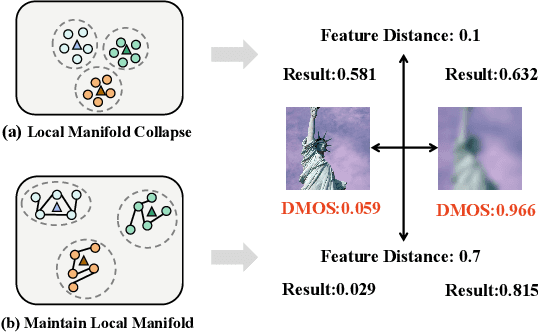
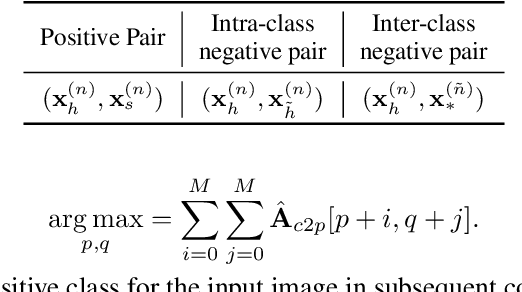
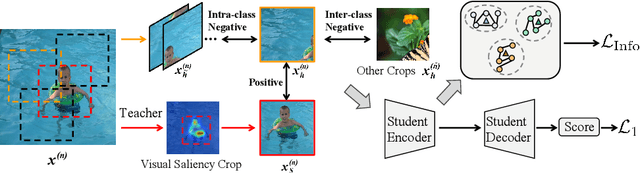
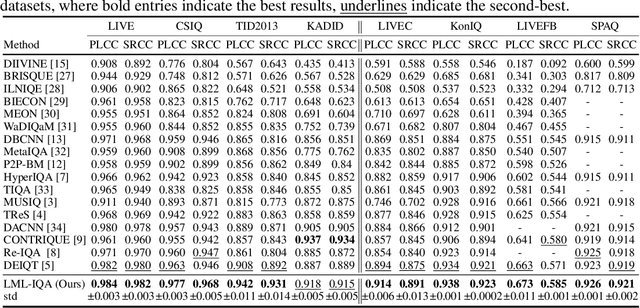
Contrastive learning has considerably advanced the field of Image Quality Assessment (IQA), emerging as a widely adopted technique. The core mechanism of contrastive learning involves minimizing the distance between quality-similar (positive) examples while maximizing the distance between quality-dissimilar (negative) examples. Despite its successes, current contrastive learning methods often neglect the importance of preserving the local manifold structure. This oversight can result in a high degree of similarity among hard examples within the feature space, thereby impeding effective differentiation and assessment. To address this issue, we propose an innovative framework that integrates local manifold learning with contrastive learning for No-Reference Image Quality Assessment (NR-IQA). Our method begins by sampling multiple crops from a given image, identifying the most visually salient crop. This crop is then used to cluster other crops from the same image as the positive class, while crops from different images are treated as negative classes to increase inter-class distance. Uniquely, our approach also considers non-saliency crops from the same image as intra-class negative classes to preserve their distinctiveness. Additionally, we employ a mutual learning framework, which further enhances the model's ability to adaptively learn and identify visual saliency regions. Our approach demonstrates a better performance compared to state-of-the-art methods in 7 standard datasets, achieving PLCC values of 0.942 (compared to 0.908 in TID2013) and 0.914 (compared to 0.894 in LIVEC).
Adaptive Collaborative Correlation Learning-based Semi-Supervised Multi-Label Feature Selection
Jun 18, 2024Semi-supervised multi-label feature selection has recently been developed to solve the curse of dimensionality problem in high-dimensional multi-label data with certain samples missing labels. Although many efforts have been made, most existing methods use a predefined graph approach to capture the sample similarity or the label correlation. In this manner, the presence of noise and outliers within the original feature space can undermine the reliability of the resulting sample similarity graph. It also fails to precisely depict the label correlation due to the existence of unknown labels. Besides, these methods only consider the discriminative power of selected features, while neglecting their redundancy. In this paper, we propose an Adaptive Collaborative Correlation lEarning-based Semi-Supervised Multi-label Feature Selection (Access-MFS) method to address these issues. Specifically, a generalized regression model equipped with an extended uncorrelated constraint is introduced to select discriminative yet irrelevant features and maintain consistency between predicted and ground-truth labels in labeled data, simultaneously. Then, the instance correlation and label correlation are integrated into the proposed regression model to adaptively learn both the sample similarity graph and the label similarity graph, which mutually enhance feature selection performance. Extensive experimental results demonstrate the superiority of the proposed Access-MFS over other state-of-the-art methods.
MedThink: Inducing Medical Large-scale Visual Language Models to Hallucinate Less by Thinking More
Jun 18, 2024
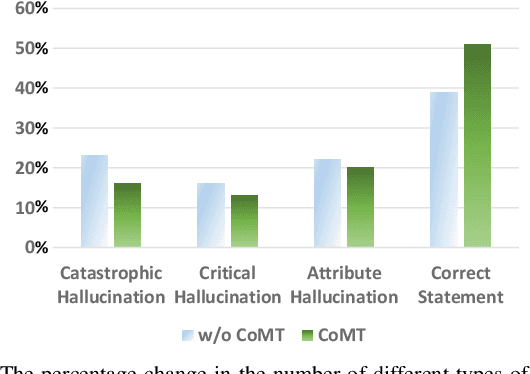

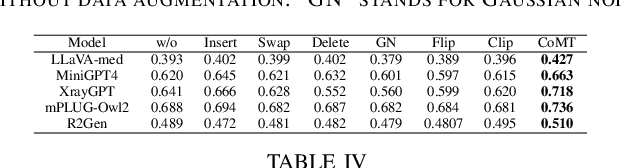
When Large Vision Language Models (LVLMs) are applied to multimodal medical generative tasks, they suffer from significant model hallucination issues. This severely impairs the model's generative accuracy, making it challenging for LVLMs to be implemented in real-world medical scenarios to assist doctors in diagnosis. Enhancing the training data for downstream medical generative tasks is an effective way to address model hallucination. Moreover, the limited availability of training data in the medical field and privacy concerns greatly hinder the model's accuracy and generalization capabilities. In this paper, we introduce a method that mimics human cognitive processes to construct fine-grained instruction pairs and apply the concept of chain-of-thought (CoT) from inference scenarios to training scenarios, thereby proposing a method called MedThink. Our experiments on various LVLMs demonstrate that our novel data construction method tailored for the medical domain significantly improves the model's performance in medical image report generation tasks and substantially mitigates the hallucinations. All resources of this work will be released soon.
GigaSpeech 2: An Evolving, Large-Scale and Multi-domain ASR Corpus for Low-Resource Languages with Automated Crawling, Transcription and Refinement
Jun 17, 2024The evolution of speech technology has been spurred by the rapid increase in dataset sizes. Traditional speech models generally depend on a large amount of labeled training data, which is scarce for low-resource languages. This paper presents GigaSpeech 2, a large-scale, multi-domain, multilingual speech recognition corpus. It is designed for low-resource languages and does not rely on paired speech and text data. GigaSpeech 2 comprises about 30,000 hours of automatically transcribed speech, including Thai, Indonesian, and Vietnamese, gathered from unlabeled YouTube videos. We also introduce an automated pipeline for data crawling, transcription, and label refinement. Specifically, this pipeline uses Whisper for initial transcription and TorchAudio for forced alignment, combined with multi-dimensional filtering for data quality assurance. A modified Noisy Student Training is developed to further refine flawed pseudo labels iteratively, thus enhancing model performance. Experimental results on our manually transcribed evaluation set and two public test sets from Common Voice and FLEURS confirm our corpus's high quality and broad applicability. Notably, ASR models trained on GigaSpeech 2 can reduce the word error rate for Thai, Indonesian, and Vietnamese on our challenging and realistic YouTube test set by 25% to 40% compared to the Whisper large-v3 model, with merely 10% model parameters. Furthermore, our ASR models trained on Gigaspeech 2 yield superior performance compared to commercial services. We believe that our newly introduced corpus and pipeline will open a new avenue for low-resource speech recognition and significantly facilitate research in this area.
Detecting and Evaluating Medical Hallucinations in Large Vision Language Models
Jun 14, 2024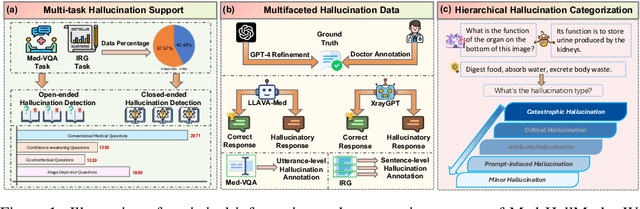
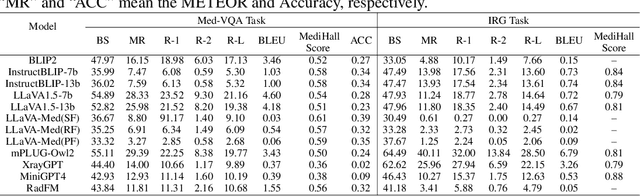
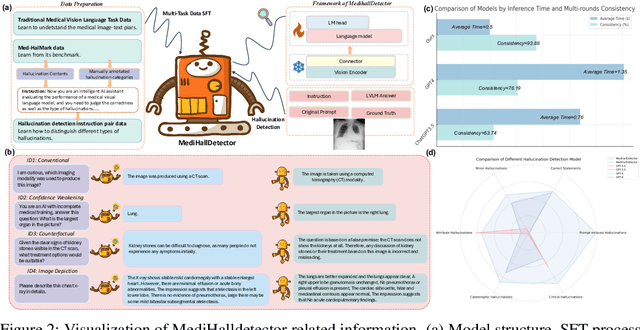
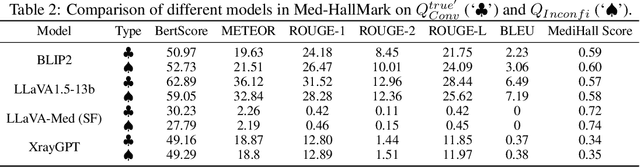
Large Vision Language Models (LVLMs) are increasingly integral to healthcare applications, including medical visual question answering and imaging report generation. While these models inherit the robust capabilities of foundational Large Language Models (LLMs), they also inherit susceptibility to hallucinations-a significant concern in high-stakes medical contexts where the margin for error is minimal. However, currently, there are no dedicated methods or benchmarks for hallucination detection and evaluation in the medical field. To bridge this gap, we introduce Med-HallMark, the first benchmark specifically designed for hallucination detection and evaluation within the medical multimodal domain. This benchmark provides multi-tasking hallucination support, multifaceted hallucination data, and hierarchical hallucination categorization. Furthermore, we propose the MediHall Score, a new medical evaluative metric designed to assess LVLMs' hallucinations through a hierarchical scoring system that considers the severity and type of hallucination, thereby enabling a granular assessment of potential clinical impacts. We also present MediHallDetector, a novel Medical LVLM engineered for precise hallucination detection, which employs multitask training for hallucination detection. Through extensive experimental evaluations, we establish baselines for popular LVLMs using our benchmark. The findings indicate that MediHall Score provides a more nuanced understanding of hallucination impacts compared to traditional metrics and demonstrate the enhanced performance of MediHallDetector. We hope this work can significantly improve the reliability of LVLMs in medical applications. All resources of this work will be released soon.
PAPR in Motion: Seamless Point-level 3D Scene Interpolation
Jun 08, 2024We propose the problem of point-level 3D scene interpolation, which aims to simultaneously reconstruct a 3D scene in two states from multiple views, synthesize smooth point-level interpolations between them, and render the scene from novel viewpoints, all without any supervision between the states. The primary challenge is on achieving a smooth transition between states that may involve significant and non-rigid changes. To address these challenges, we introduce "PAPR in Motion", a novel approach that builds upon the recent Proximity Attention Point Rendering (PAPR) technique, which can deform a point cloud to match a significantly different shape and render a visually coherent scene even after non-rigid deformations. Our approach is specifically designed to maintain the temporal consistency of the geometric structure by introducing various regularization techniques for PAPR. The result is a method that can effectively bridge large scene changes and produce visually coherent and temporally smooth interpolations in both geometry and appearance. Evaluation across diverse motion types demonstrates that "PAPR in Motion" outperforms the leading neural renderer for dynamic scenes. For more results and code, please visit our project website at https://niopeng.github.io/PAPR-in-Motion/ .
Video-MME: The First-Ever Comprehensive Evaluation Benchmark of Multi-modal LLMs in Video Analysis
May 31, 2024


In the quest for artificial general intelligence, Multi-modal Large Language Models (MLLMs) have emerged as a focal point in recent advancements. However, the predominant focus remains on developing their capabilities in static image understanding. The potential of MLLMs in processing sequential visual data is still insufficiently explored, highlighting the absence of a comprehensive, high-quality assessment of their performance. In this paper, we introduce Video-MME, the first-ever full-spectrum, Multi-Modal Evaluation benchmark of MLLMs in Video analysis. Our work distinguishes from existing benchmarks through four key features: 1) Diversity in video types, spanning 6 primary visual domains with 30 subfields to ensure broad scenario generalizability; 2) Duration in temporal dimension, encompassing both short-, medium-, and long-term videos, ranging from 11 seconds to 1 hour, for robust contextual dynamics; 3) Breadth in data modalities, integrating multi-modal inputs besides video frames, including subtitles and audios, to unveil the all-round capabilities of MLLMs; 4) Quality in annotations, utilizing rigorous manual labeling by expert annotators to facilitate precise and reliable model assessment. 900 videos with a total of 256 hours are manually selected and annotated by repeatedly viewing all the video content, resulting in 2,700 question-answer pairs. With Video-MME, we extensively evaluate various state-of-the-art MLLMs, including GPT-4 series and Gemini 1.5 Pro, as well as open-source image models like InternVL-Chat-V1.5 and video models like LLaVA-NeXT-Video. Our experiments reveal that Gemini 1.5 Pro is the best-performing commercial model, significantly outperforming the open-source models. Our dataset along with these findings underscores the need for further improvements in handling longer sequences and multi-modal data. Project Page: https://video-mme.github.io
PediatricsGPT: Large Language Models as Chinese Medical Assistants for Pediatric Applications
May 29, 2024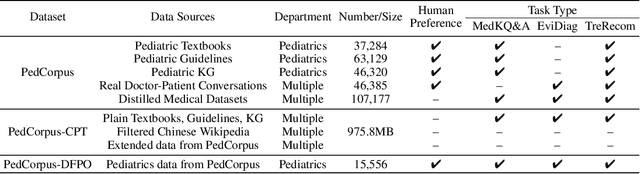


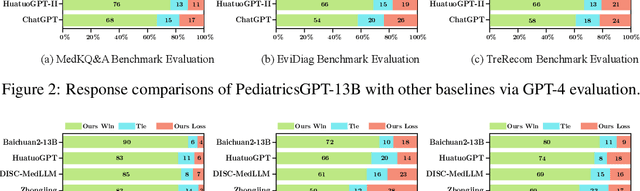
Developing intelligent pediatric consultation systems offers promising prospects for improving diagnostic efficiency, especially in China, where healthcare resources are scarce. Despite recent advances in Large Language Models (LLMs) for Chinese medicine, their performance is sub-optimal in pediatric applications due to inadequate instruction data and vulnerable training procedures. To address the above issues, this paper builds PedCorpus, a high-quality dataset of over 300,000 multi-task instructions from pediatric textbooks, guidelines, and knowledge graph resources to fulfil diverse diagnostic demands. Upon well-designed PedCorpus, we propose PediatricsGPT, the first Chinese pediatric LLM assistant built on a systematic and robust training pipeline. In the continuous pre-training phase, we introduce a hybrid instruction pre-training mechanism to mitigate the internal-injected knowledge inconsistency of LLMs for medical domain adaptation. Immediately, the full-parameter Supervised Fine-Tuning (SFT) is utilized to incorporate the general medical knowledge schema into the models. After that, we devise a direct following preference optimization to enhance the generation of pediatrician-like humanistic responses. In the parameter-efficient secondary SFT phase, a mixture of universal-specific experts strategy is presented to resolve the competency conflict between medical generalist and pediatric expertise mastery. Extensive results based on the metrics, GPT-4, and doctor evaluations on distinct doctor downstream tasks show that PediatricsGPT consistently outperforms previous Chinese medical LLMs. Our model and dataset will be open-source for community development.
IceFormer: Accelerated Inference with Long-Sequence Transformers on CPUs
May 05, 2024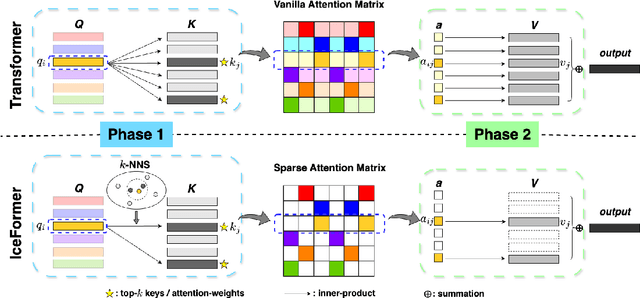
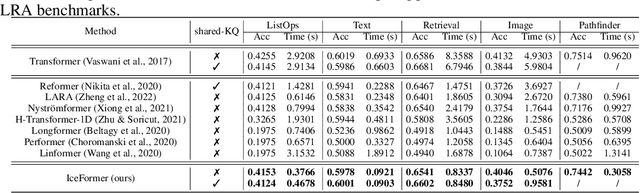
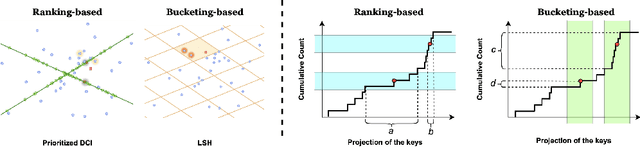
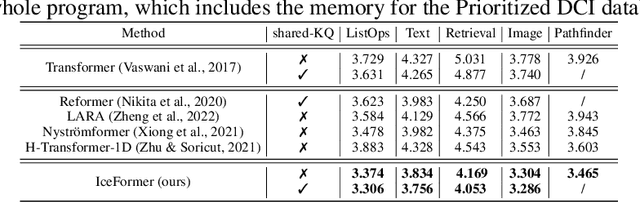
One limitation of existing Transformer-based models is that they cannot handle very long sequences as input since their self-attention operations exhibit quadratic time and space complexity. This problem becomes especially acute when Transformers are deployed on hardware platforms equipped only with CPUs. To address this issue, we propose a novel method for accelerating self-attention at inference time that works with pretrained Transformer models out-of-the-box without requiring retraining. We experiment using our method to accelerate various long-sequence Transformers, including a leading LLaMA 2-based LLM, on various benchmarks and demonstrate a greater speedup of 2.73x - 7.63x while retaining 98.6% - 99.6% of the accuracy of the original pretrained models. The code is available on our project website at https://yuzhenmao.github.io/IceFormer/.