 Add to Chrome
 Add to Firefox
 Add to Edge
Emergence of Human to Robot Transfer in Vision-Language-Action Models
Dec 27, 2025
Vision-language-action (VLA) models can enable broad open world generalization, but require large and diverse datasets. It is appealing to consider whether some of this data can come from human videos, which cover diverse real-world situations and are easy to obtain. However, it is difficult to train VLAs with human videos alone, and establishing a mapping between humans and robots requires manual engineering and presents a major research challenge. Drawing inspiration from advances in large language models, where the ability to learn from diverse supervision emerges with scale, we ask whether a similar phenomenon holds for VLAs that incorporate human video data. We introduce a simple co-training recipe, and find that human-to-robot transfer emerges once the VLA is pre-trained on sufficient scenes, tasks, and embodiments. Our analysis suggests that this emergent capability arises because diverse pretraining produces embodiment-agnostic representations for human and robot data. We validate these findings through a series of experiments probing human to robot skill transfer and find that with sufficiently diverse robot pre-training our method can nearly double the performance on generalization settings seen only in human data.

$π^{*}_{0.6}$: a VLA That Learns From Experience
Nov 19, 2025We study how vision-language-action (VLA) models can improve through real-world deployments via reinforcement learning (RL). We present a general-purpose method, RL with Experience and Corrections via Advantage-conditioned Policies (RECAP), that provides for RL training of VLAs via advantage conditioning. Our method incorporates heterogeneous data into the self-improvement process, including demonstrations, data from on-policy collection, and expert teleoperated interventions provided during autonomous execution. RECAP starts by pre-training a generalist VLA with offline RL, which we call $π^{*}_{0.6}$, that can then be specialized to attain high performance on downstream tasks through on-robot data collection. We show that the $π^{*}_{0.6}$ model trained with the full RECAP method can fold laundry in real homes, reliably assemble boxes, and make espresso drinks using a professional espresso machine. On some of the hardest tasks, RECAP more than doubles task throughput and roughly halves the task failure rate.
$π_{0.5}$: a Vision-Language-Action Model with Open-World Generalization
Apr 22, 2025
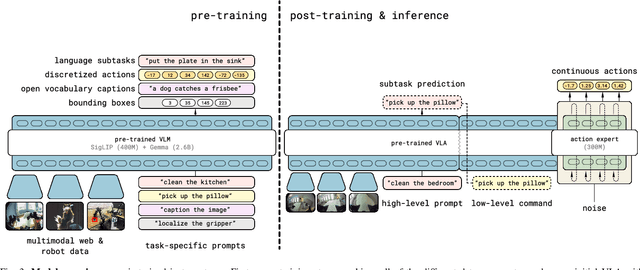
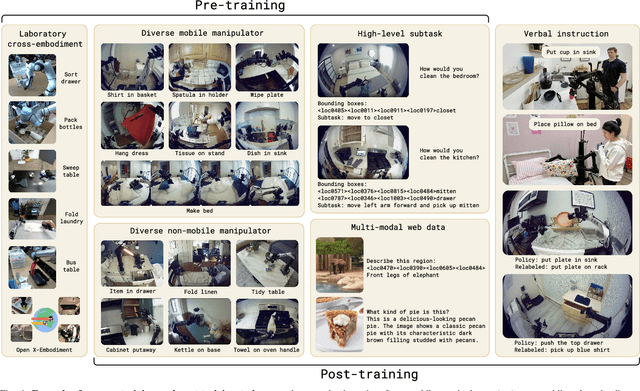
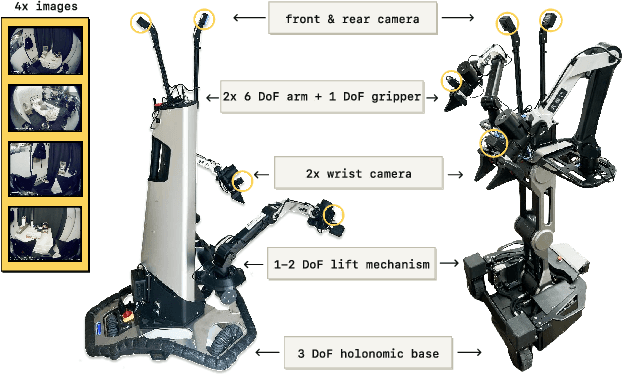
In order for robots to be useful, they must perform practically relevant tasks in the real world, outside of the lab. While vision-language-action (VLA) models have demonstrated impressive results for end-to-end robot control, it remains an open question how far such models can generalize in the wild. We describe $\pi_{0.5}$, a new model based on $\pi_{0}$ that uses co-training on heterogeneous tasks to enable broad generalization. $\pi_{0.5}$\ uses data from multiple robots, high-level semantic prediction, web data, and other sources to enable broadly generalizable real-world robotic manipulation. Our system uses a combination of co-training and hybrid multi-modal examples that combine image observations, language commands, object detections, semantic subtask prediction, and low-level actions. Our experiments show that this kind of knowledge transfer is essential for effective generalization, and we demonstrate for the first time that an end-to-end learning-enabled robotic system can perform long-horizon and dexterous manipulation skills, such as cleaning a kitchen or bedroom, in entirely new homes.