 Add to Chrome
 Add to Firefox
 Add to Edge
MEM: Multi-Scale Embodied Memory for Vision Language Action Models
Mar 04, 2026
Conventionally, memory in end-to-end robotic learning involves inputting a sequence of past observations into the learned policy. However, in complex multi-stage real-world tasks, the robot's memory must represent past events at multiple levels of granularity: from long-term memory that captures abstracted semantic concepts (e.g., a robot cooking dinner should remember which stages of the recipe are already done) to short-term memory that captures recent events and compensates for occlusions (e.g., a robot remembering the object it wants to pick up once its arm occludes it). In this work, our main insight is that an effective memory architecture for long-horizon robotic control should combine multiple modalities to capture these different levels of abstraction. We introduce Multi-Scale Embodied Memory (MEM), an approach for mixed-modal long-horizon memory in robot policies. MEM combines video-based short-horizon memory, compressed via a video encoder, with text-based long-horizon memory. Together, they enable robot policies to perform tasks that span up to fifteen minutes, like cleaning up a kitchen, or preparing a grilled cheese sandwich. Additionally, we find that memory enables MEM policies to intelligently adapt manipulation strategies in-context.

$π^{*}_{0.6}$: a VLA That Learns From Experience
Nov 19, 2025We study how vision-language-action (VLA) models can improve through real-world deployments via reinforcement learning (RL). We present a general-purpose method, RL with Experience and Corrections via Advantage-conditioned Policies (RECAP), that provides for RL training of VLAs via advantage conditioning. Our method incorporates heterogeneous data into the self-improvement process, including demonstrations, data from on-policy collection, and expert teleoperated interventions provided during autonomous execution. RECAP starts by pre-training a generalist VLA with offline RL, which we call $π^{*}_{0.6}$, that can then be specialized to attain high performance on downstream tasks through on-robot data collection. We show that the $π^{*}_{0.6}$ model trained with the full RECAP method can fold laundry in real homes, reliably assemble boxes, and make espresso drinks using a professional espresso machine. On some of the hardest tasks, RECAP more than doubles task throughput and roughly halves the task failure rate.
$π_{0.5}$: a Vision-Language-Action Model with Open-World Generalization
Apr 22, 2025
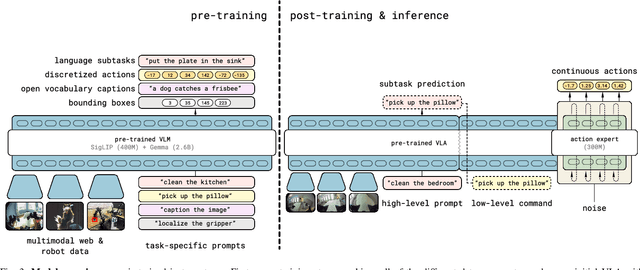
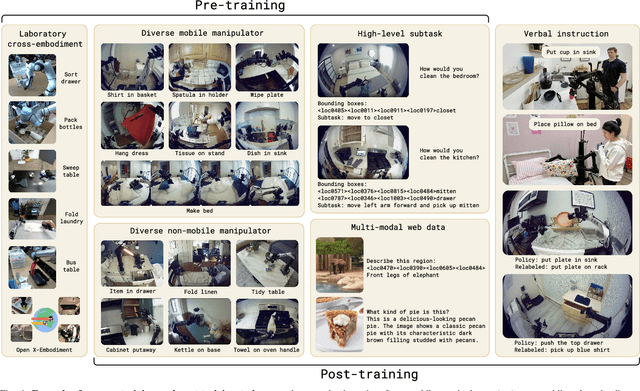
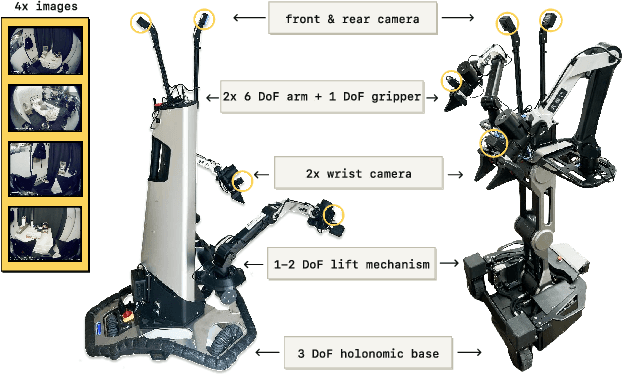
In order for robots to be useful, they must perform practically relevant tasks in the real world, outside of the lab. While vision-language-action (VLA) models have demonstrated impressive results for end-to-end robot control, it remains an open question how far such models can generalize in the wild. We describe $\pi_{0.5}$, a new model based on $\pi_{0}$ that uses co-training on heterogeneous tasks to enable broad generalization. $\pi_{0.5}$\ uses data from multiple robots, high-level semantic prediction, web data, and other sources to enable broadly generalizable real-world robotic manipulation. Our system uses a combination of co-training and hybrid multi-modal examples that combine image observations, language commands, object detections, semantic subtask prediction, and low-level actions. Our experiments show that this kind of knowledge transfer is essential for effective generalization, and we demonstrate for the first time that an end-to-end learning-enabled robotic system can perform long-horizon and dexterous manipulation skills, such as cleaning a kitchen or bedroom, in entirely new homes.