 Add to Chrome
 Add to Firefox
 Add to Edge
Frontis-MA1: Training an AI4AI Model towards Recursive Self-Improvement in Machine Learning Engineering
Jul 30, 2026
Recursive self-improvement (RSI) requires AI systems that improve the process of building AI (i.e., AI4AI); machine learning engineering (MLE) offers a concrete, executable testbed for studying this capability. We introduce OpenMLE, an open full-stack system for RSI research in MLE, spanning verifiable task environments with execution feedback (OpenMLE-Gym), operator learning (OpenMLE-RL), and long-horizon search (OpenMLE-Evo). On this stack we post-train Frontis-MA1 (35B) as a meta-evolution agent for MLE, aligning post-training and inference around four atomic program-evolution operators (Draft, Improve, Debug, Crossover): the same operators are trained via execution-grounded SFT and RL on data deduplicated against all evaluation benchmarks, then composed into long-horizon search, coupling learning and evolution in a single loop. On MLE-Bench Lite under a 12-hour per-task budget on one RTX 4090 capped at 12 GB VRAM, Frontis-MA1 (35B) improves Medal Average from 39.39% to 60.61% over its base model with OpenMLE-Evo, and reaches 71.21% with OpenMLE-Evo-Max (benchmark-independent experience priors and asynchronous search), exceeding GPT-5.5 + Codex and approaching GPT-5.6 Sol and the 2.8T Kimi K3. On held-out NatureBench Lite, both components transfer: with the framework fixed, swapping in the trained model raises Match-SOTA from 50% to 70%; with the model fixed, swapping in OpenMLE-Evo raises it from 20% to 50%. We release the model weights and the full OpenMLE stack to enable reproducible research on executable AI4AI toward RSI. Code: https://github.com/FrontisAI/OpenRSI

NatureBench: Can Coding Agents Match the Published SOTA of Nature-Family Papers?
Jun 23, 2026We introduce NatureBench, a cross-discipline benchmark of 90 tasks distilled from peer-reviewed Nature-family publications, designed to evaluate whether AI coding agents can move beyond reproduction toward discovery on real scientific problems. NatureBench is built on NatureGym, an automated pipeline that constructs a standardized, per-task containerized environment from a source paper, addressing the environment-fragmentation problem that has limited the credibility of prior agent-on-research benchmarks. Evaluating ten frontier agent configurations under a strict web-search-disabled protocol, we find that the strongest model surpasses SOTA on only 17.8% of tasks under the g>0.1 criterion. Analysis of method pathways reveals that agents succeed primarily through methodological translation, converting scientific tasks into familiar supervised prediction problems, rather than through genuine scientific invention. Failures are dominated by wrong method choice and insufficient compute budget, not by task misunderstanding. We release the benchmark, the NatureGym pipeline, and a public leaderboard with maintainer-side reproduction. Code: https://github.com/FrontisAI/NatureBench
EnterpriseClawBench: Benchmarking Agents from Real Workplace Sessions
Jun 22, 2026Enterprise agents increasingly operate inside workspaces: they read heterogeneous files, invoke tools, and deliver business artifacts. We introduce EnterpriseClawBench, an enterprise agent benchmark constructed from proprietary, real-world agent sessions. Starting from a large archive of workplace sessions, the EnterpriseClawBench produces 852 reproducible tasks, each paired with recovered fixtures, rewritten prompts, role classes, skill subclasses, hard rules, and semantic rubrics. Because the sessions contain internal enterprise content, we do not release the benchmark data; instead, our reusable contribution is the construction and evaluation protocol. On EnterpriseClawBench, the best configuration reaches only 0.663 (Codex with GPT-5.5). These results show that enterprise agent evaluation must report harness--model combinations, artifact delivery, visual quality, cost, runtime, and skill-transfer behavior, rather than collapsing performance into a single score. Code: https://github.com/FrontisAI/EnterpriseClawBench
TIR-Agent: Training an Explorative and Efficient Agent for Image Restoration
Mar 29, 2026Vision-language agents that orchestrate specialized tools for image restoration (IR) have emerged as a promising method, yet most existing frameworks operate in a training-free manner. They rely on heuristic task scheduling and exhaustive tool traversal, resulting in sub-optimal restoration paths and prohibitive computational cost. We argue that the core bottleneck lies in the absence of a learned policy to make decision, as a vision-language model cannot efficiently handle degradation-aware task ordering and tool composition. To this end, we propose TIR-Agent, a trainable image restoration agent that performs a direct tool-calling policy through a two-stage training pipeline of supervised fine-tuning (SFT) followed by reinforcement learning (RL). Two key designs underpin effective RL training: (i) a random perturbation strategy applied to the SFT data, which broadens the policy's exploration over task schedules and tool compositions, and (ii) a multi-dimensional adaptive reward mechanism that dynamically re-weights heterogeneous image quality metrics to mitigate reward hacking. To support high-throughput, asynchronous GPU-based tool invocation during training, we further develop a globally shared model-call pool. Experiments on both in-domain and out-of-domain degradations show that TIR-Agent outperforms 12 baselines, including 6 all-in-one models, 3 training-free agents, and 3 proprietary models, and achieves over 2.5$\times$ inference speedup by eliminating redundant tool executions.
Multi-AUV Ad-hoc Networks-Based Multi-Target Tracking Based on Scene-Adaptive Embodied Intelligence
Mar 28, 2026With the rapid advancement of underwater net-working and multi-agent coordination technologies, autonomous underwater vehicle (AUV) ad-hoc networks have emerged as a pivotal framework for executing complex maritime missions, such as multi-target tracking. However, traditional data-centricarchitectures struggle to maintain operational consistency under highly dynamic topological fluctuations and severely constrained acoustic communication bandwidth. This article proposes a scene-adaptive embodied intelligence (EI) architecture for multi-AUV ad-hoc networks, which re-envisions AUVs as embodied entities by integrating perception, decision-making, and physical execution into a unified cognitive loop. To materialize the functional interaction between these layers, we define a beacon-based communication and control model that treats the communication link as a dynamic constraint-aware channel, effectively bridging the gap between high-level policy inference and decentralized physical actuation. Specifically, the proposed architecture employs a three-layer functional framework and introduces a Scene-Adaptive MARL (SA-MARL) algorithm featuring a dual-path critic mechanism. By integrating a scene critic network and a general critic network through a weight-based dynamic fusion process, SA-MARL effectively decouples specialized tracking tasks from global safety constraints, facilitating autonomous policy evolution. Evaluation results demonstrate that the proposedscheme significantly accelerates policy convergence and achieves superior tracking accuracy compared to mainstream MARL approaches, maintaining robust performance even under intense environmental interference and fluid topological shifts.
MARTI-MARS$^2$: Scaling Multi-Agent Self-Search via Reinforcement Learning for Code Generation
Feb 08, 2026While the complex reasoning capability of Large Language Models (LLMs) has attracted significant attention, single-agent systems often encounter inherent performance ceilings in complex tasks such as code generation. Multi-agent collaboration offers a promising avenue to transcend these boundaries. However, existing frameworks typically rely on prompt-based test-time interactions or multi-role configurations trained with homogeneous parameters, limiting error correction capabilities and strategic diversity. In this paper, we propose a Multi-Agent Reinforced Training and Inference Framework with Self-Search Scaling (MARTI-MARS2), which integrates policy learning with multi-agent tree search by formulating the multi-agent collaborative exploration process as a dynamic and learnable environment. By allowing agents to iteratively explore and refine within the environment, the framework facilitates evolution from parameter-sharing homogeneous multi-role training to heterogeneous multi-agent training, breaking through single-agent capability limits. We also introduce an efficient inference strategy MARTI-MARS2-T+ to fully exploit the scaling potential of multi-agent collaboration at test time. We conduct extensive experiments across varied model scales (8B, 14B, and 32B) on challenging code generation benchmarks. Utilizing two collaborating 32B models, MARTI-MARS2 achieves 77.7%, outperforming strong baselines like GPT-5.1. Furthermore, MARTI-MARS2 reveals a novel scaling law: shifting from single-agent to homogeneous multi-role and ultimately to heterogeneous multi-agent paradigms progressively yields higher RL performance ceilings, robust TTS capabilities, and greater policy diversity, suggesting that policy diversity is critical for scaling intelligence via multi-agent reinforcement learning.
Emotion-Director: Bridging Affective Shortcut in Emotion-Oriented Image Generation
Dec 22, 2025Image generation based on diffusion models has demonstrated impressive capability, motivating exploration into diverse and specialized applications. Owing to the importance of emotion in advertising, emotion-oriented image generation has attracted increasing attention. However, current emotion-oriented methods suffer from an affective shortcut, where emotions are approximated to semantics. As evidenced by two decades of research, emotion is not equivalent to semantics. To this end, we propose Emotion-Director, a cross-modal collaboration framework consisting of two modules. First, we propose a cross-Modal Collaborative diffusion model, abbreviated as MC-Diffusion. MC-Diffusion integrates visual prompts with textual prompts for guidance, enabling the generation of emotion-oriented images beyond semantics. Further, we improve the DPO optimization by a negative visual prompt, enhancing the model's sensitivity to different emotions under the same semantics. Second, we propose MC-Agent, a cross-Modal Collaborative Agent system that rewrites textual prompts to express the intended emotions. To avoid template-like rewrites, MC-Agent employs multi-agents to simulate human subjectivity toward emotions, and adopts a chain-of-concept workflow that improves the visual expressiveness of the rewritten prompts. Extensive qualitative and quantitative experiments demonstrate the superiority of Emotion-Director in emotion-oriented image generation.
WeMusic-Agent: Efficient Conversational Music Recommendation via Knowledge Internalization and Agentic Boundary Learning
Dec 18, 2025Personalized music recommendation in conversational scenarios usually requires a deep understanding of user preferences and nuanced musical context, yet existing methods often struggle with balancing specialized domain knowledge and flexible tool integration. This paper proposes WeMusic-Agent, a training framework for efficient LLM-based conversational music recommendation. By integrating the knowledge internalization and agentic boundary learning, the framework aims to teach the model to intelligently decide when to leverage internalized knowledge and when to call specialized tools (e.g., music retrieval APIs, music recommendation systems). Under this framework, we present WeMusic-Agent-M1, an agentic model that internalizes extensive musical knowledge via continued pretraining on 50B music-related corpus while acquiring the ability to invoke external tools when necessary. Additionally, considering the lack of open-source benchmarks for conversational music recommendation, we also construct a benchmark for personalized music recommendations derived from real-world data in WeChat Listen. This benchmark enables comprehensive evaluation across multiple dimensions, including relevance, personalization, and diversity of the recommendations. Experiments on real-world data demonstrate that WeMusic-Agent achieves significant improvements over existing models.
MuCPT: Music-related Natural Language Model Continued Pretraining
Nov 18, 2025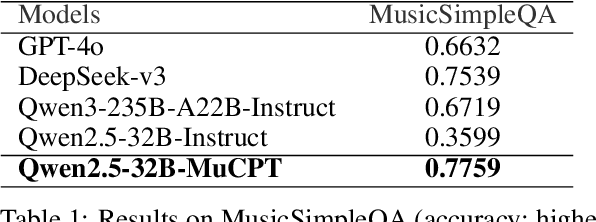
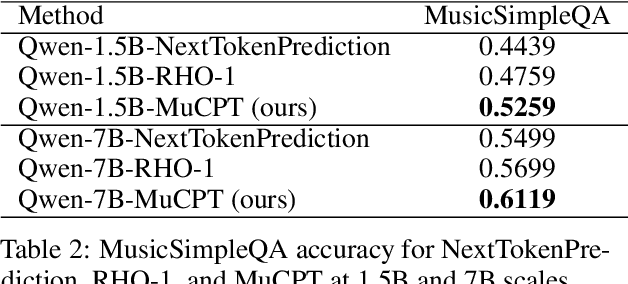
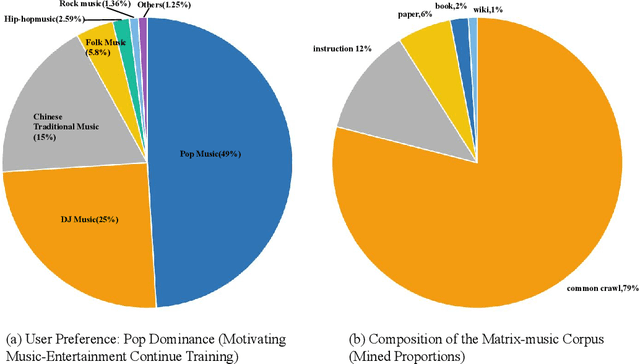
Large language models perform strongly on general tasks but remain constrained in specialized settings such as music, particularly in the music-entertainment domain, where corpus scale, purity, and the match between data and training objectives are critical. We address this by constructing a large, music-related natural language corpus (40B tokens) that combines open source and in-house data, and by implementing a domain-first data pipeline: a lightweight classifier filters and weights in-domain text, followed by multi-stage cleaning, de-duplication, and privacy-preserving masking. We further integrate multi-source music text with associated metadata to form a broader, better-structured foundation of domain knowledge. On the training side, we introduce reference-model (RM)-based token-level soft scoring for quality control: a unified loss-ratio criterion is used both for data selection and for dynamic down-weighting during optimization, reducing noise gradients and amplifying task-aligned signals, thereby enabling more effective music-domain continued pretraining and alignment. To assess factuality, we design the MusicSimpleQA benchmark, which adopts short, single-answer prompts with automated agreement scoring. Beyond the benchmark design, we conduct systematic comparisons along the axes of data composition. Overall, this work advances both the right corpus and the right objective, offering a scalable data-training framework and a reusable evaluation tool for building domain LLMs in the music field.
MARS2 2025 Challenge on Multimodal Reasoning: Datasets, Methods, Results, Discussion, and Outlook
Sep 17, 2025
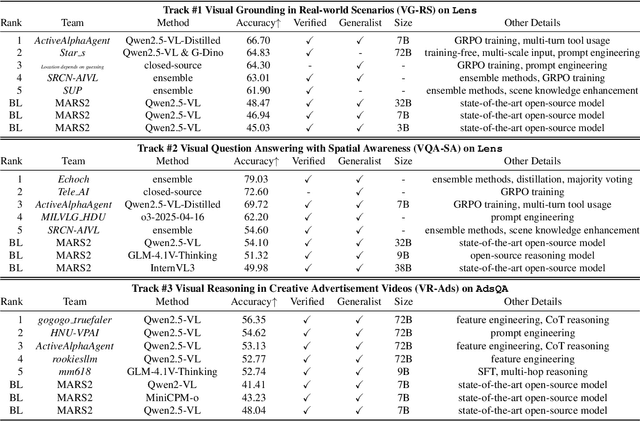

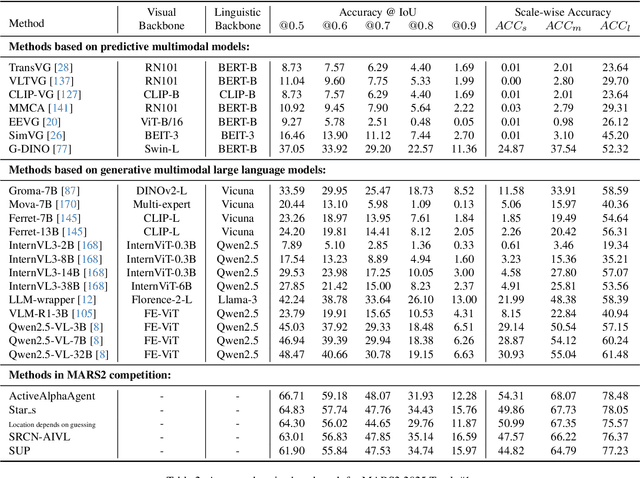
This paper reviews the MARS2 2025 Challenge on Multimodal Reasoning. We aim to bring together different approaches in multimodal machine learning and LLMs via a large benchmark. We hope it better allows researchers to follow the state-of-the-art in this very dynamic area. Meanwhile, a growing number of testbeds have boosted the evolution of general-purpose large language models. Thus, this year's MARS2 focuses on real-world and specialized scenarios to broaden the multimodal reasoning applications of MLLMs. Our organizing team released two tailored datasets Lens and AdsQA as test sets, which support general reasoning in 12 daily scenarios and domain-specific reasoning in advertisement videos, respectively. We evaluated 40+ baselines that include both generalist MLLMs and task-specific models, and opened up three competition tracks, i.e., Visual Grounding in Real-world Scenarios (VG-RS), Visual Question Answering with Spatial Awareness (VQA-SA), and Visual Reasoning in Creative Advertisement Videos (VR-Ads). Finally, 76 teams from the renowned academic and industrial institutions have registered and 40+ valid submissions (out of 1200+) have been included in our ranking lists. Our datasets, code sets (40+ baselines and 15+ participants' methods), and rankings are publicly available on the MARS2 workshop website and our GitHub organization page https://github.com/mars2workshop/, where our updates and announcements of upcoming events will be continuously provided.