 Add to Chrome
 Add to Firefox
 Add to Edge
MacAgentBench: Benchmarking AI Agents on Real-World macOS Desktop
Jun 21, 2026
Computer use agents (CUAs) have advanced rapidly in desktop automation, and a growing number of users deploy CUAs such as OpenClaw on Mac Mini for always-on automation. However, existing benchmarks, including those for macOS, evaluate agents without framework augmentation and rely on binary evaluation. As a result, they fail to capture both the framework capabilities leveraged by modern CUAs and the partial progress on long-horizon, multi-application tasks. We present MacAgentBench, a comprehensive macOS agent benchmark comprising 676 tasks across 25 applications, with nearly 60% involving both GUI and CLI interaction. The benchmark adopts deterministic rule-based evaluation and introduces fine-grained multi-checkpoint scoring with capability annotations for multi-application tasks. Experiments across three frameworks and 16 models show that the best configuration, Claude Opus 4.6 on OpenClaw, attains 73.7% Pass@1, while this advantage is primarily driven by the skill library rather than by framework design. Fine-grained metrics further reveal that models with similar Pass@1 can differ substantially in sub-goal completion. Our code and data are publicly available at https://github.com/JetAstra/MacAgentBench.

MARTI-MARS$^2$: Scaling Multi-Agent Self-Search via Reinforcement Learning for Code Generation
Feb 08, 2026While the complex reasoning capability of Large Language Models (LLMs) has attracted significant attention, single-agent systems often encounter inherent performance ceilings in complex tasks such as code generation. Multi-agent collaboration offers a promising avenue to transcend these boundaries. However, existing frameworks typically rely on prompt-based test-time interactions or multi-role configurations trained with homogeneous parameters, limiting error correction capabilities and strategic diversity. In this paper, we propose a Multi-Agent Reinforced Training and Inference Framework with Self-Search Scaling (MARTI-MARS2), which integrates policy learning with multi-agent tree search by formulating the multi-agent collaborative exploration process as a dynamic and learnable environment. By allowing agents to iteratively explore and refine within the environment, the framework facilitates evolution from parameter-sharing homogeneous multi-role training to heterogeneous multi-agent training, breaking through single-agent capability limits. We also introduce an efficient inference strategy MARTI-MARS2-T+ to fully exploit the scaling potential of multi-agent collaboration at test time. We conduct extensive experiments across varied model scales (8B, 14B, and 32B) on challenging code generation benchmarks. Utilizing two collaborating 32B models, MARTI-MARS2 achieves 77.7%, outperforming strong baselines like GPT-5.1. Furthermore, MARTI-MARS2 reveals a novel scaling law: shifting from single-agent to homogeneous multi-role and ultimately to heterogeneous multi-agent paradigms progressively yields higher RL performance ceilings, robust TTS capabilities, and greater policy diversity, suggesting that policy diversity is critical for scaling intelligence via multi-agent reinforcement learning.
Privacy-Preserving Explainable AIoT Application via SHAP Entropy Regularization
Nov 12, 2025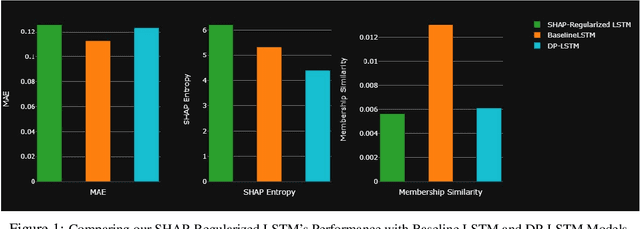
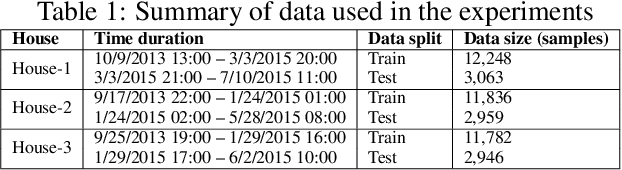
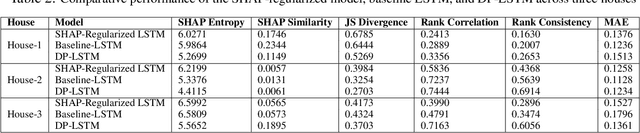
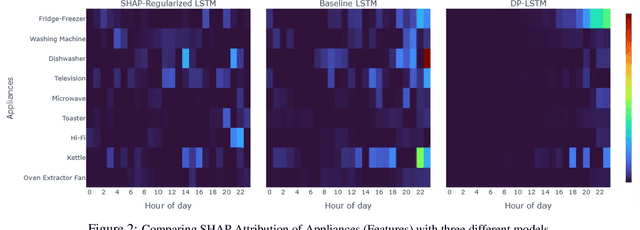
The widespread integration of Artificial Intelligence of Things (AIoT) in smart home environments has amplified the demand for transparent and interpretable machine learning models. To foster user trust and comply with emerging regulatory frameworks, the Explainable AI (XAI) methods, particularly post-hoc techniques such as SHapley Additive exPlanations (SHAP), and Local Interpretable Model-Agnostic Explanations (LIME), are widely employed to elucidate model behavior. However, recent studies have shown that these explanation methods can inadvertently expose sensitive user attributes and behavioral patterns, thereby introducing new privacy risks. To address these concerns, we propose a novel privacy-preserving approach based on SHAP entropy regularization to mitigate privacy leakage in explainable AIoT applications. Our method incorporates an entropy-based regularization objective that penalizes low-entropy SHAP attribution distributions during training, promoting a more uniform spread of feature contributions. To evaluate the effectiveness of our approach, we developed a suite of SHAP-based privacy attacks that strategically leverage model explanation outputs to infer sensitive information. We validate our method through comparative evaluations using these attacks alongside utility metrics on benchmark smart home energy consumption datasets. Experimental results demonstrate that SHAP entropy regularization substantially reduces privacy leakage compared to baseline models, while maintaining high predictive accuracy and faithful explanation fidelity. This work contributes to the development of privacy-preserving explainable AI techniques for secure and trustworthy AIoT applications.
Enhancing Adversarial Robustness of IoT Intrusion Detection via SHAP-Based Attribution Fingerprinting
Nov 09, 2025The rapid proliferation of Internet of Things (IoT) devices has transformed numerous industries by enabling seamless connectivity and data-driven automation. However, this expansion has also exposed IoT networks to increasingly sophisticated security threats, including adversarial attacks targeting artificial intelligence (AI) and machine learning (ML)-based intrusion detection systems (IDS) to deliberately evade detection, induce misclassification, and systematically undermine the reliability and integrity of security defenses. To address these challenges, we propose a novel adversarial detection model that enhances the robustness of IoT IDS against adversarial attacks through SHapley Additive exPlanations (SHAP)-based fingerprinting. Using SHAP's DeepExplainer, we extract attribution fingerprints from network traffic features, enabling the IDS to reliably distinguish between clean and adversarially perturbed inputs. By capturing subtle attribution patterns, the model becomes more resilient to evasion attempts and adversarial manipulations. We evaluated the model on a standard IoT benchmark dataset, where it significantly outperformed a state-of-the-art method in detecting adversarial attacks. In addition to enhanced robustness, this approach improves model transparency and interpretability, thereby increasing trust in the IDS through explainable AI.
A Unified Online-Offline Framework for Co-Branding Campaign Recommendations
May 28, 2025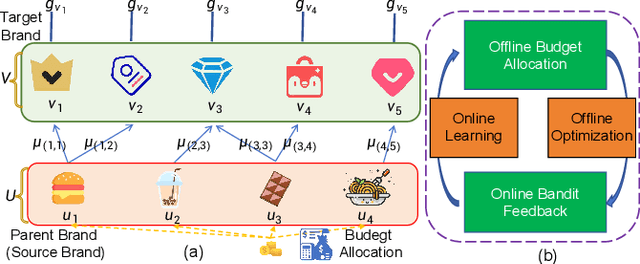
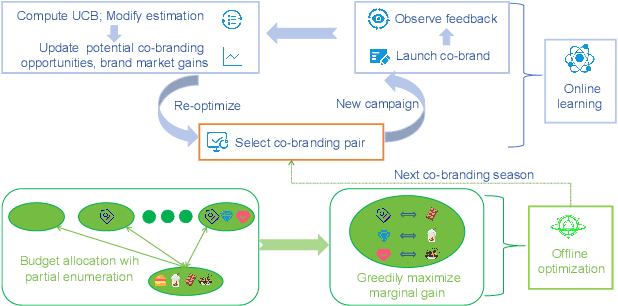
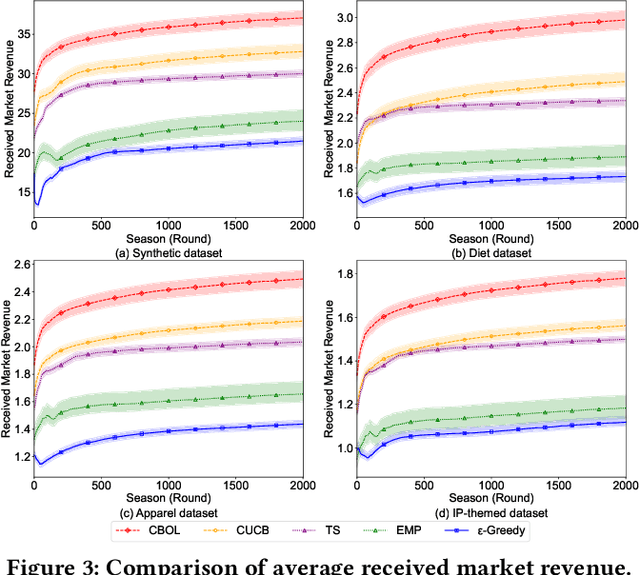
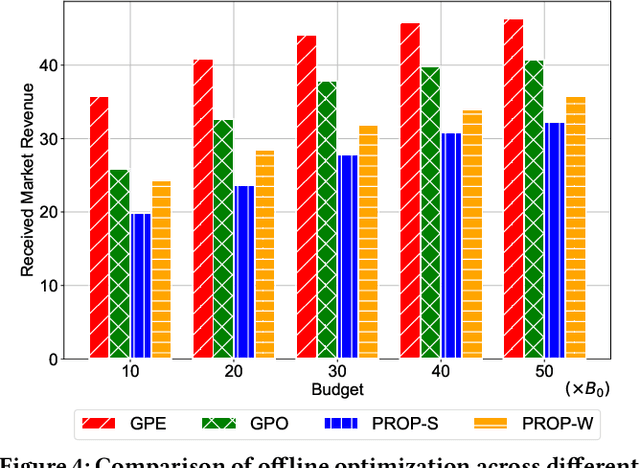
Co-branding has become a vital strategy for businesses aiming to expand market reach within recommendation systems. However, identifying effective cross-industry partnerships remains challenging due to resource imbalances, uncertain brand willingness, and ever-changing market conditions. In this paper, we provide the first systematic study of this problem and propose a unified online-offline framework to enable co-branding recommendations. Our approach begins by constructing a bipartite graph linking ``initiating'' and ``target'' brands to quantify co-branding probabilities and assess market benefits. During the online learning phase, we dynamically update the graph in response to market feedback, while striking a balance between exploring new collaborations for long-term gains and exploiting established partnerships for immediate benefits. To address the high initial co-branding costs, our framework mitigates redundant exploration, thereby enhancing short-term performance while ensuring sustainable strategic growth. In the offline optimization phase, our framework consolidates the interests of multiple sub-brands under the same parent brand to maximize overall returns, avoid excessive investment in single sub-brands, and reduce unnecessary costs associated with over-prioritizing a single sub-brand. We present a theoretical analysis of our approach, establishing a highly nontrivial sublinear regret bound for online learning in the complex co-branding problem, and enhancing the approximation guarantee for the NP-hard offline budget allocation optimization. Experiments on both synthetic and real-world co-branding datasets demonstrate the practical effectiveness of our framework, with at least 12\% improvement.