 Add to Chrome
 Add to Firefox
 Add to Edge
Achieving Sparse Activation in Small Language Models
Jun 03, 2024
Sparse activation, which selectively activates only an input-dependent set of neurons in inference, is a useful technique to reduce the computing cost of Large Language Models (LLMs) without retraining or adaptation efforts. However, whether it can be applied to the recently emerging Small Language Models (SLMs) remains questionable, because SLMs are generally less over-parameterized than LLMs. In this paper, we aim to achieve sparse activation in SLMs. We first show that the existing sparse activation schemes in LLMs that build on neurons' output magnitudes cannot be applied to SLMs, and activating neurons based on their attribution scores is a better alternative. Further, we demonstrated and quantified the large errors of existing attribution metrics when being used for sparse activation, due to the interdependency among attribution scores of neurons across different layers. Based on these observations, we proposed a new attribution metric that can provably correct such errors and achieve precise sparse activation. Experiments over multiple popular SLMs and datasets show that our approach can achieve 80% sparsification ratio with <5% model accuracy loss, comparable to the sparse activation achieved in LLMs. The source code is available at: https://github.com/pittisl/Sparse-Activation.

FreezeAsGuard: Mitigating Illegal Adaptation of Diffusion Models via Selective Tensor Freezing
May 24, 2024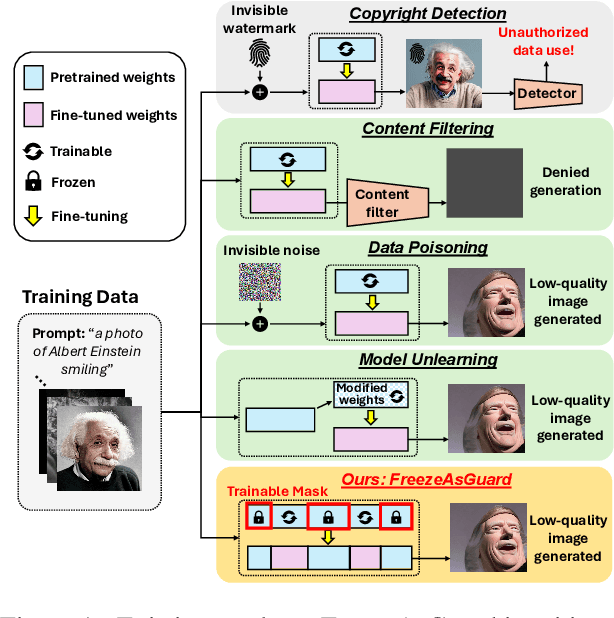
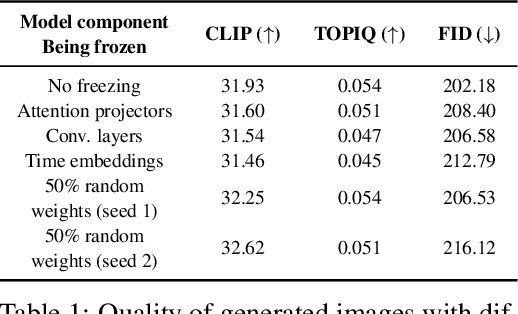

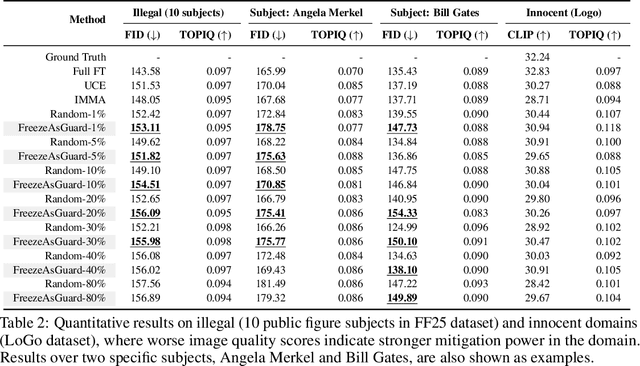
Text-to-image diffusion models can be fine-tuned in custom domains to adapt to specific user preferences, but such unconstrained adaptability has also been utilized for illegal purposes, such as forging public figures' portraits and duplicating copyrighted artworks. Most existing work focuses on detecting the illegally generated contents, but cannot prevent or mitigate illegal adaptations of diffusion models. Other schemes of model unlearning and reinitialization, similarly, cannot prevent users from relearning the knowledge of illegal model adaptation with custom data. In this paper, we present FreezeAsGuard, a new technique that addresses these limitations and enables irreversible mitigation of illegal adaptations of diffusion models. The basic approach is that the model publisher selectively freezes tensors in pre-trained diffusion models that are critical to illegal model adaptations, to mitigate the fine-tuned model's representation power in illegal domains but minimize the impact on legal model adaptations in other domains. Such tensor freezing can be enforced via APIs provided by the model publisher for fine-tuning, can motivate users' adoption due to its computational savings. Experiment results with datasets in multiple domains show that FreezeAsGuard provides stronger power in mitigating illegal model adaptations of generating fake public figures' portraits, while having the minimum impact on model adaptation in other legal domains. The source code is available at: https://github.com/pittisl/FreezeAsGuard/
FFAM: Feature Factorization Activation Map for Explanation of 3D Detectors
May 21, 2024LiDAR-based 3D object detection has made impressive progress recently, yet most existing models are black-box, lacking interpretability. Previous explanation approaches primarily focus on analyzing image-based models and are not readily applicable to LiDAR-based 3D detectors. In this paper, we propose a feature factorization activation map (FFAM) to generate high-quality visual explanations for 3D detectors. FFAM employs non-negative matrix factorization to generate concept activation maps and subsequently aggregates these maps to obtain a global visual explanation. To achieve object-specific visual explanations, we refine the global visual explanation using the feature gradient of a target object. Additionally, we introduce a voxel upsampling strategy to align the scale between the activation map and input point cloud. We qualitatively and quantitatively analyze FFAM with multiple detectors on several datasets. Experimental results validate the high-quality visual explanations produced by FFAM. The Code will be available at \url{https://github.com/Say2L/FFAM.git}.
HR Human: Modeling Human Avatars with Triangular Mesh and High-Resolution Textures from Videos
May 18, 2024Recently, implicit neural representation has been widely used to generate animatable human avatars. However, the materials and geometry of those representations are coupled in the neural network and hard to edit, which hinders their application in traditional graphics engines. We present a framework for acquiring human avatars that are attached with high-resolution physically-based material textures and triangular mesh from monocular video. Our method introduces a novel information fusion strategy to combine the information from the monocular video and synthesize virtual multi-view images to tackle the sparsity of the input view. We reconstruct humans as deformable neural implicit surfaces and extract triangle mesh in a well-behaved pose as the initial mesh of the next stage. In addition, we introduce an approach to correct the bias for the boundary and size of the coarse mesh extracted. Finally, we adapt prior knowledge of the latent diffusion model at super-resolution in multi-view to distill the decomposed texture. Experiments show that our approach outperforms previous representations in terms of high fidelity, and this explicit result supports deployment on common renderers.
Bilateral Event Mining and Complementary for Event Stream Super-Resolution
May 16, 2024


Event Stream Super-Resolution (ESR) aims to address the challenge of insufficient spatial resolution in event streams, which holds great significance for the application of event cameras in complex scenarios. Previous works for ESR often process positive and negative events in a mixed paradigm. This paradigm limits their ability to effectively model the unique characteristics of each event and mutually refine each other by considering their correlations. In this paper, we propose a bilateral event mining and complementary network (BMCNet) to fully leverage the potential of each event and capture the shared information to complement each other simultaneously. Specifically, we resort to a two-stream network to accomplish comprehensive mining of each type of events individually. To facilitate the exchange of information between two streams, we propose a bilateral information exchange (BIE) module. This module is layer-wisely embedded between two streams, enabling the effective propagation of hierarchical global information while alleviating the impact of invalid information brought by inherent characteristics of events. The experimental results demonstrate that our approach outperforms the previous state-of-the-art methods in ESR, achieving performance improvements of over 11\% on both real and synthetic datasets. Moreover, our method significantly enhances the performance of event-based downstream tasks such as object recognition and video reconstruction. Our code is available at https://github.com/Lqm26/BMCNet-ESR.
LOG-LIO2: A LiDAR-Inertial Odometry with Efficient Uncertainty Analysis
May 02, 2024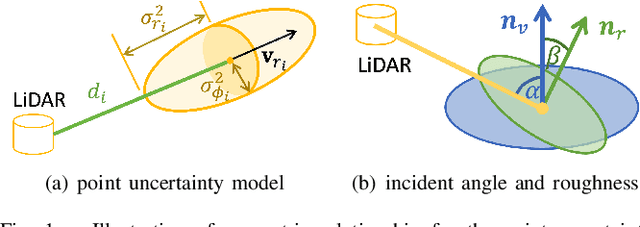
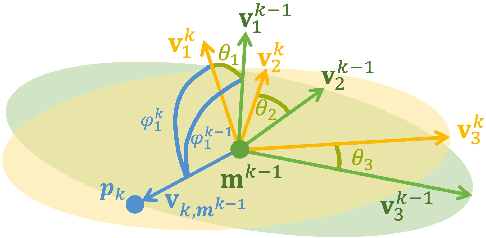
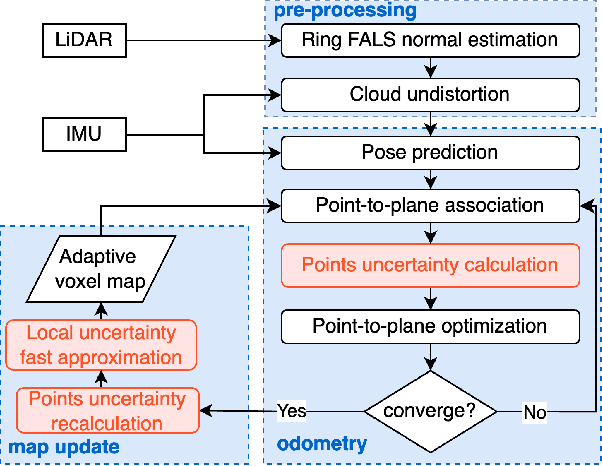
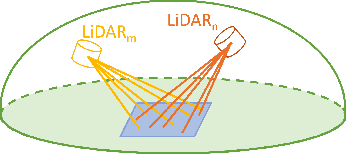
Uncertainty in LiDAR measurements, stemming from factors such as range sensing, is crucial for LIO (LiDAR-Inertial Odometry) systems as it affects the accurate weighting in the loss function. While recent LIO systems address uncertainty related to range sensing, the impact of incident angle on uncertainty is often overlooked by the community. Moreover, the existing uncertainty propagation methods suffer from computational inefficiency. This paper proposes a comprehensive point uncertainty model that accounts for both the uncertainties from LiDAR measurements and surface characteristics, along with an efficient local uncertainty analytical method for LiDAR-based state estimation problem. We employ a projection operator that separates the uncertainty into the ray direction and its orthogonal plane. Then, we derive incremental Jacobian matrices of eigenvalues and eigenvectors w.r.t. points, which enables a fast approximation of uncertainty propagation. This approach eliminates the requirement for redundant traversal of points, significantly reducing the time complexity of uncertainty propagation from $\mathcal{O} (n)$ to $\mathcal{O} (1)$ when a new point is added. Simulations and experiments on public datasets are conducted to validate the accuracy and efficiency of our formulations. The proposed methods have been integrated into a LIO system, which is available at https://github.com/tiev-tongji/LOG-LIO2.
Medical Visual Prompting (MVP): A Unified Framework for Versatile and High-Quality Medical Image Segmentation
Apr 01, 2024
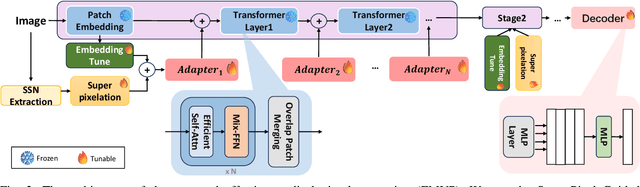
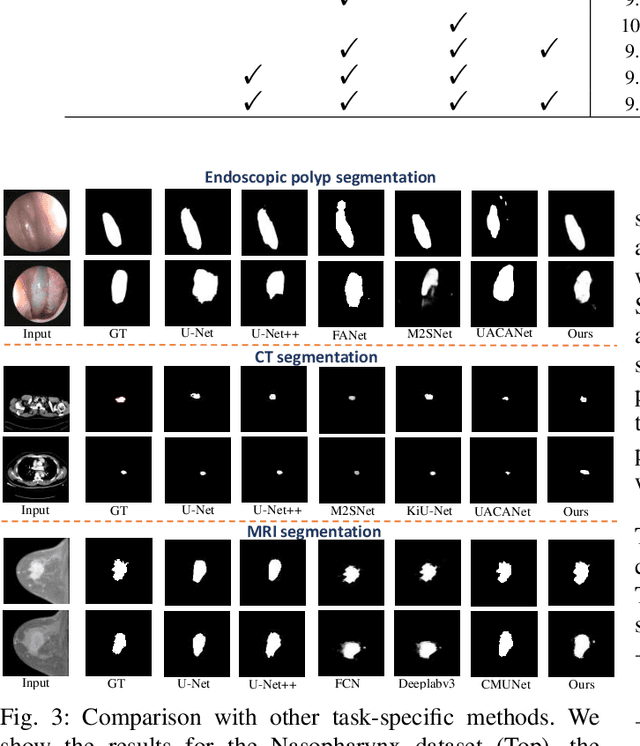

Accurate segmentation of lesion regions is crucial for clinical diagnosis and treatment across various diseases. While deep convolutional networks have achieved satisfactory results in medical image segmentation, they face challenges such as loss of lesion shape information due to continuous convolution and downsampling, as well as the high cost of manually labeling lesions with varying shapes and sizes. To address these issues, we propose a novel medical visual prompting (MVP) framework that leverages pre-training and prompting concepts from natural language processing (NLP). The framework utilizes three key components: Super-Pixel Guided Prompting (SPGP) for superpixelating the input image, Image Embedding Guided Prompting (IEGP) for freezing patch embedding and merging with superpixels to provide visual prompts, and Adaptive Attention Mechanism Guided Prompting (AAGP) for pinpointing prompt content and efficiently adapting all layers. By integrating SPGP, IEGP, and AAGP, the MVP enables the segmentation network to better learn shape prompting information and facilitates mutual learning across different tasks. Extensive experiments conducted on five datasets demonstrate superior performance of this method in various challenging medical image tasks, while simplifying single-task medical segmentation models. This novel framework offers improved performance with fewer parameters and holds significant potential for accurate segmentation of lesion regions in various medical tasks, making it clinically valuable.
Locomotion Generation for a Rat Robot based on Environmental Changes via Reinforcement Learning
Mar 19, 2024
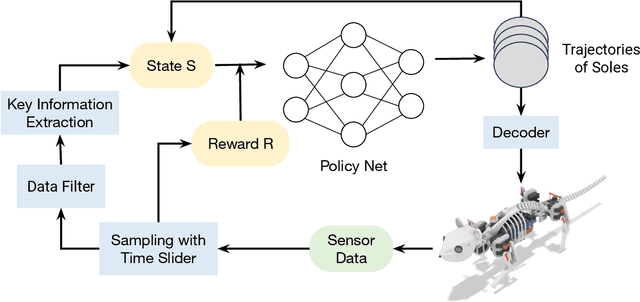
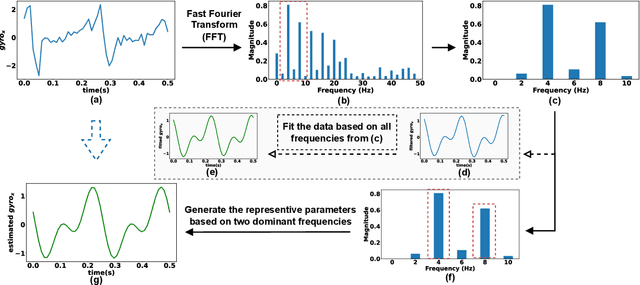
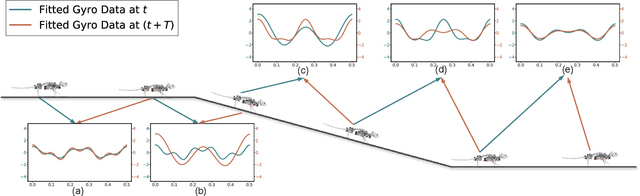
This research focuses on developing reinforcement learning approaches for the locomotion generation of small-size quadruped robots. The rat robot NeRmo is employed as the experimental platform. Due to the constrained volume, small-size quadruped robots typically possess fewer and weaker sensors, resulting in difficulty in accurately perceiving and responding to environmental changes. In this context, insufficient and imprecise feedback data from sensors makes it difficult to generate adaptive locomotion based on reinforcement learning. To overcome these challenges, this paper proposes a novel reinforcement learning approach that focuses on extracting effective perceptual information to enhance the environmental adaptability of small-size quadruped robots. According to the frequency of a robot's gait stride, key information of sensor data is analyzed utilizing sinusoidal functions derived from Fourier transform results. Additionally, a multifunctional reward mechanism is proposed to generate adaptive locomotion in different tasks. Extensive simulations are conducted to assess the effectiveness of the proposed reinforcement learning approach in generating rat robot locomotion in various environments. The experiment results illustrate the capability of the proposed approach to maintain stable locomotion of a rat robot across different terrains, including ramps, stairs, and spiral stairs.
Financial Default Prediction via Motif-preserving Graph Neural Network with Curriculum Learning
Mar 11, 2024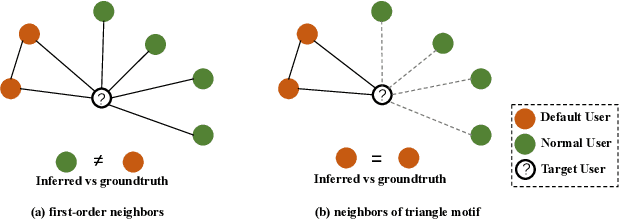
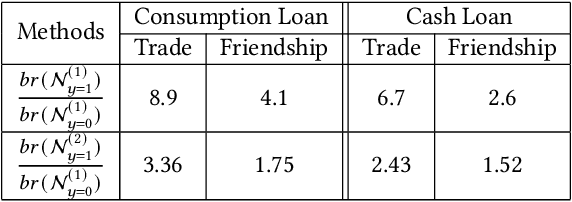
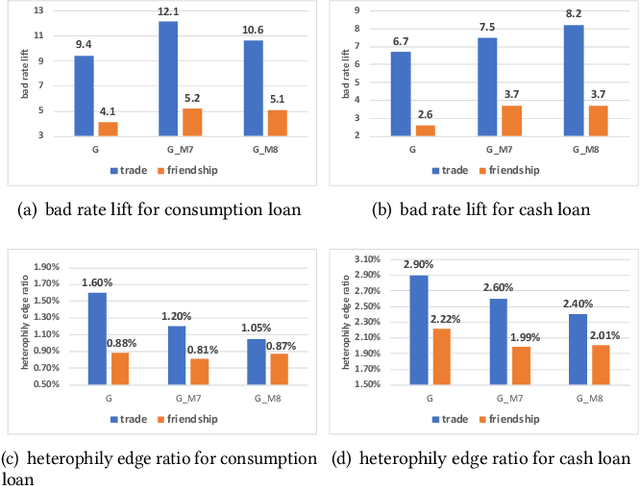
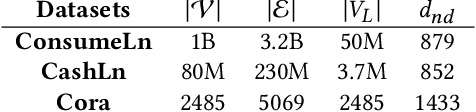
User financial default prediction plays a critical role in credit risk forecasting and management. It aims at predicting the probability that the user will fail to make the repayments in the future. Previous methods mainly extract a set of user individual features regarding his own profiles and behaviors and build a binary-classification model to make default predictions. However, these methods cannot get satisfied results, especially for users with limited information. Although recent efforts suggest that default prediction can be improved by social relations, they fail to capture the higher-order topology structure at the level of small subgraph patterns. In this paper, we fill in this gap by proposing a motif-preserving Graph Neural Network with curriculum learning (MotifGNN) to jointly learn the lower-order structures from the original graph and higherorder structures from multi-view motif-based graphs for financial default prediction. Specifically, to solve the problem of weak connectivity in motif-based graphs, we design the motif-based gating mechanism. It utilizes the information learned from the original graph with good connectivity to strengthen the learning of the higher-order structure. And considering that the motif patterns of different samples are highly unbalanced, we propose a curriculum learning mechanism on the whole learning process to more focus on the samples with uncommon motif distributions. Extensive experiments on one public dataset and two industrial datasets all demonstrate the effectiveness of our proposed method.
Optimizing Dynamic Balance in a Rat Robot via the Lateral Flexion of a Soft Actuated Spine
Mar 01, 2024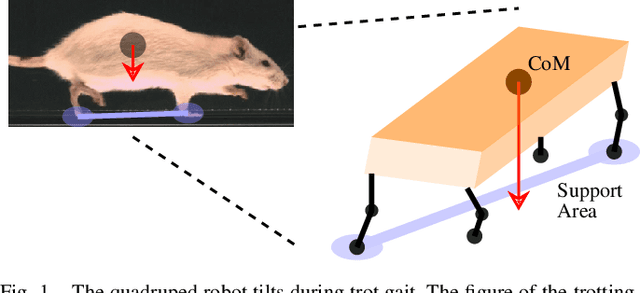
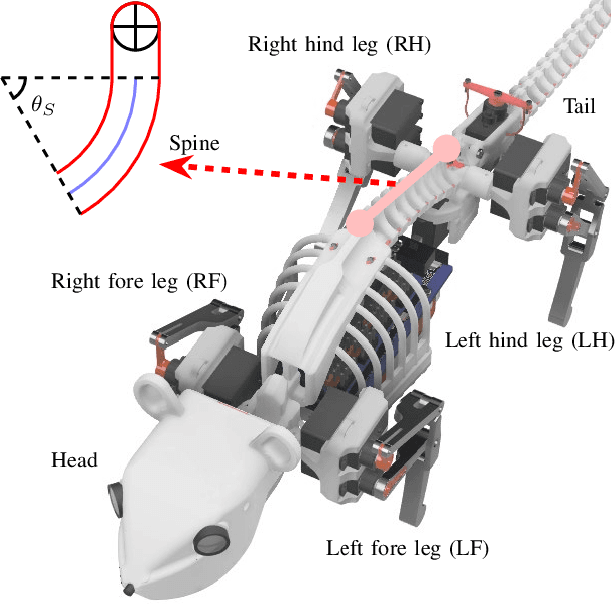
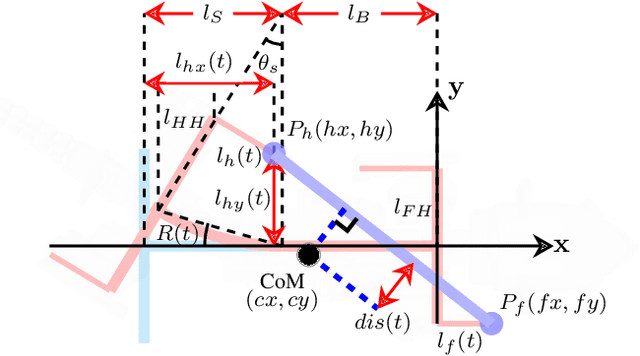
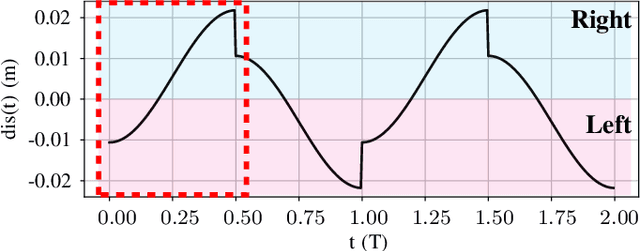
Balancing oneself using the spine is a physiological alignment of the body posture in the most efficient manner by the muscular forces for mammals. For this reason, we can see many disabled quadruped animals can still stand or walk even with three limbs. This paper investigates the optimization of dynamic balance during trot gait based on the spatial relationship between the center of mass (CoM) and support area influenced by spinal flexion. During trotting, the robot balance is significantly influenced by the distance of the CoM to the support area formed by diagonal footholds. In this context, lateral spinal flexion, which is able to modify the position of footholds, holds promise for optimizing balance during trotting. This paper explores this phenomenon using a rat robot equipped with a soft actuated spine. Based on the lateral flexion of the spine, we establish a kinematic model to quantify the impact of spinal flexion on robot balance during trot gait. Subsequently, we develop an optimized controller for spinal flexion, designed to enhance balance without altering the leg locomotion. The effectiveness of our proposed controller is evaluated through extensive simulations and physical experiments conducted on a rat robot. Compared to both a non-spine based trot gait controller and a trot gait controller with lateral spinal flexion, our proposed optimized controller effectively improves the dynamic balance of the robot and retains the desired locomotion during trotting.