 Add to Chrome
 Add to Firefox
 Add to Edge
DSPrompt: Dynamic Soft Prompt Defense Against M-RAG Corruption
Aug 17, 2026
Multimodal Retrieval Augmented Generation (M-RAG) is increasingly vulnerable to adversarial attacks where malicious data are crafted to produce embeddings that align with benign entries in the vector space, deceiving retrieval and inducing harmful outputs. Existing defenses primarily operate at query time, relying on auxiliary detectors, similarity re-ranking, or feature-consistency checks. However, these approaches suffer from non-trivial inference overhead, generalize poorly to unseen attack strategies, and often assume specific attack distributions. To address this, we propose DSPrompt, a Dynamic Soft Prompt defense framework that directly reshapes the retriever's embedding semantics, without modifying the retrieval pipeline. It inserts few learnable soft prompts into each layer of the visual and textual encoders of a frozen retriever, utilizing a shallow-to-deep length schedule that is adaptive to the capacity in the model layers. These prompts are trained under a dynamic min-max scheme: an online multimodal attacker continually crafts hard adversarial documents against the current retriever, while the defender is updated to push such documents out of the top-k while preserving the ranking and diversity of benign evidence. Because the defended encoder can be pre-computed and indexed exactly as in standard dense retrieval, DSPrompt incurs no additional per-query optimization and introduces fewer than 1% additional parameters. Extensive experiments across four benchmarks and three representative poisoning attacks show that DSPrompt substantially reduces the attack success rate and poison retrieval rate while maintaining near-lossless retrieval utility and generation fidelity, consistently outperforming existing defense baselines at a fraction of their computational cost.

A Unified DINOv2-Based Framework for LVEF Estimation, GLS Dysfunction Classification, and Early Cardiotoxicity Prediction
Aug 14, 2026Left ventricular ejection fraction (LVEF) estimation (Task 1), global longitu-dinal strain (GLS)-based dysfunction classification (Task 2), and early cardi-otoxicity prediction (Task 3) provide complementary information for cardio-oncology assessment. LVEF reflects macroscopic ventricular volume chang-es as the clinical standard, whereas GLS captures subtle myocardial defor-mation, indicating subclinical cardiotoxicity before overt LVEF decline. Fur-thermore, predicting cardiotoxicity from baseline echocardiography prior to treatment enables preventive interventions at an early stage. To address these three tasks, we employ a DINOv2-based framework with task-specific adap-tation and prediction heads. Built upon a frozen foundation encoder, the framework incorporates parameter-efficient Low-Rank Adaptation (LoRA) and temporal aggregation to learn task-specialized representations, ensuring robust generalization. Crucially, during inference, it operates in a fully cycle-detection-free and phase-free manner, requiring neither cardiac cycle seg-mentation nor explicit End-Diastolic/End-Systolic (ED/ES) annotations. Ad-ditionally, we introduce an ED/ES-guided 2D/3D hybrid multi-view regres-sion model specifically to optimize Task 1. On a patient-level split containing 1,203 training videos from 237 patients and 300 validation videos from 59 independent patients, the DINOv2-based framework achieved a mean abso-lute error (MAE) of 5.03% for Task 1, an AUC-ROC of 76.48% for Task 2, and an AUC-ROC of 70.26% for Task 3. For Task 1, the specialized ED/ES-guided model further improves performance, achieving an MAE of 4.64%. This framework demonstrates the effectiveness of foundation model repre-sentations across diverse cardio-oncology tasks and the additional benefit of physiology-guided modeling for accurate LVEF estimation.
SAE Interventions are Unreliable: Post-Intervention Recovery of Suppressed Behavior
Jun 16, 2026Sparse Autoencoders (SAEs) decompose residual-stream activations into interpretable features. Recent latent-space defenses increasingly rely on these decompositions, assuming that identified "unsafe" SAE features serve as actionable handles for monitoring and intervention. In this paradigm, clamping a specific harmful feature is expected to reliably prevent model misbehavior. However, we show that this success may hide a recoverable failure mode: the clamp may block one visible route to a behavior without eliminating the behavior itself. We formulate this vulnerability as post-intervention recovery, a constrained residual-space optimization problem. Starting from the post-intervention residual state, we optimize residual perturbations to recover the pre-intervention behavior while preserving the post-intervention values of the targeted SAE features. Even under a strong threat model where the intervention remains active throughout optimization and generation, recovery remains possible. To rule out that recovery simply undoes the intervention, we use encoder-orthogonal updates for single-layer interventions and the corresponding feature-map Jacobian in the cross-layer setting. Across TPP, unlearning, IOI, and refusal steering experiments, this stress test reveals recoverable behavior despite successful feature-level intervention. Especially in the safety-critical refusal-steering setting, we achieve a 95.8% recovery rate on valid samples while keeping defended-feature relative drift to 0.131, substantially below suffix-based baselines. A recovery-path attribution analysis further localizes this recovery to the SAE reconstruction residual, the component left unexplained by the SAE. These results expose a gap between feature-level control and behavioral completeness: SAE features can support causal intervention, but controlling them does not guarantee control over the underlying behavior.
BadWorld: Adversarial Attacks on World Models
Jun 15, 2026Visual world models (VWMs) synthesize interactive, action-conditioned rollouts from a single context image. However, it remains an open question how robust these models are to adversarial perturbations. Standard adversarial attacks fail to assess this vulnerability because attackers lack ground-truth future videos and cannot predict subsequent user controls. We introduce BadWorld, a label-free adversarial framework tailored for autoregressive VWMs that systematically overcomes both constraints. First, to bypass the need for future supervision, we propose a self-supervised velocity attack that directly disrupts the early denoising dynamics of the model. Second, to ensure the attack generalizes across unpredictable user actions, we formulate a trajectory-adaptive bi-level optimization that actively mines hard control sequences to forge control-agnostic perturbations. Evaluated on representative VWMs with continuous and discrete controls, BadWorld exposes severe structural fragility. Visually indistinguishable adversarial images reliably trigger catastrophic degradation in future rollouts, leading to incomplete denoising, structural collapse, and control inconsistency. These findings reveal critical risks for deploying VWMs in safety-critical systems while highlighting a practical mechanism for privacy protection.
DeContext as Defense: Safe Image Editing in Diffusion Transformers
Dec 19, 2025In-context diffusion models allow users to modify images with remarkable ease and realism. However, the same power raises serious privacy concerns: personal images can be easily manipulated for identity impersonation, misinformation, or other malicious uses, all without the owner's consent. While prior work has explored input perturbations to protect against misuse in personalized text-to-image generation, the robustness of modern, large-scale in-context DiT-based models remains largely unexamined. In this paper, we propose DeContext, a new method to safeguard input images from unauthorized in-context editing. Our key insight is that contextual information from the source image propagates to the output primarily through multimodal attention layers. By injecting small, targeted perturbations that weaken these cross-attention pathways, DeContext breaks this flow, effectively decouples the link between input and output. This simple defense is both efficient and robust. We further show that early denoising steps and specific transformer blocks dominate context propagation, which allows us to concentrate perturbations where they matter most. Experiments on Flux Kontext and Step1X-Edit show that DeContext consistently blocks unwanted image edits while preserving visual quality. These results highlight the effectiveness of attention-based perturbations as a powerful defense against image manipulation. Code is available at https://github.com/LinghuiiShen/DeContext.
4D-CAT: Synthesis of 4D Coronary Artery Trees from Systole and Diastole
Sep 03, 2024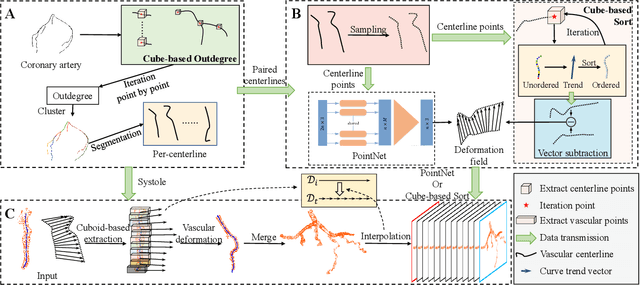
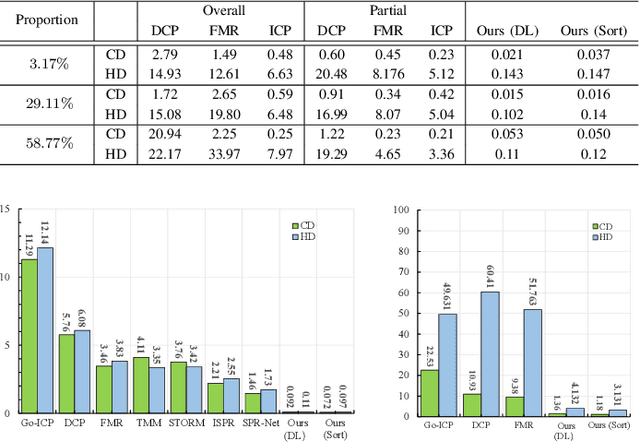
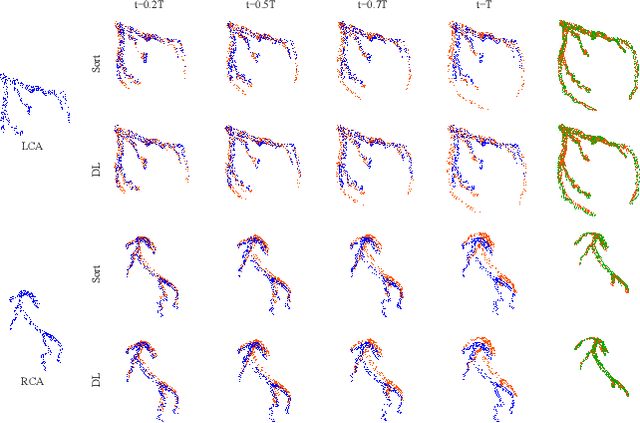
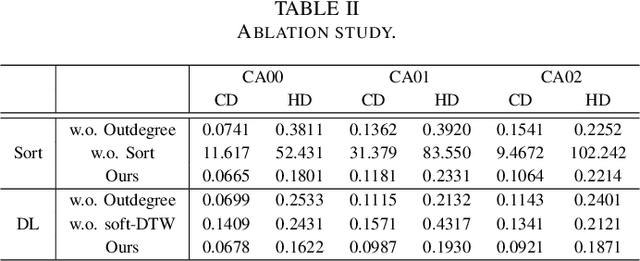
The three-dimensional vascular model reconstructed from CT images is widely used in medical diagnosis. At different phases, the beating of the heart can cause deformation of vessels, resulting in different vascular imaging states and false positive diagnostic results. The 4D model can simulate a complete cardiac cycle. Due to the dose limitation of contrast agent injection in patients, it is valuable to synthesize a 4D coronary artery trees through finite phases imaging. In this paper, we propose a method for generating a 4D coronary artery trees, which maps the systole to the diastole through deformation field prediction, interpolates on the timeline, and the motion trajectory of points are obtained. Specifically, the centerline is used to represent vessels and to infer deformation fields using cube-based sorting and neural networks. Adjacent vessel points are aggregated and interpolated based on the deformation field of the centerline point to obtain displacement vectors of different phases. Finally, the proposed method is validated through experiments to achieve the registration of non-rigid vascular points and the generation of 4D coronary trees.
FFAM: Feature Factorization Activation Map for Explanation of 3D Detectors
May 21, 2024LiDAR-based 3D object detection has made impressive progress recently, yet most existing models are black-box, lacking interpretability. Previous explanation approaches primarily focus on analyzing image-based models and are not readily applicable to LiDAR-based 3D detectors. In this paper, we propose a feature factorization activation map (FFAM) to generate high-quality visual explanations for 3D detectors. FFAM employs non-negative matrix factorization to generate concept activation maps and subsequently aggregates these maps to obtain a global visual explanation. To achieve object-specific visual explanations, we refine the global visual explanation using the feature gradient of a target object. Additionally, we introduce a voxel upsampling strategy to align the scale between the activation map and input point cloud. We qualitatively and quantitatively analyze FFAM with multiple detectors on several datasets. Experimental results validate the high-quality visual explanations produced by FFAM. The Code will be available at \url{https://github.com/Say2L/FFAM.git}.