 Add to Chrome
 Add to Firefox
 Add to Edge
ES3D: Embedding Semantics into 3D Space for Component-Aware Editing
Aug 16, 2026
Existing 3D editing methods have made notable progress in controllability, yet they remain limited in several important ways. Most approaches rely on text-driven editing, which struggles to express fine-grained visual changes intended by the user. Moreover, many methods require manually supplied 3D masks or introduce unintended changes to regions that should remain untouched. These limitations largely arise from the absence of fine-grained semantic understanding, making it difficult for existing models to retrieve or modify specific 3D components. We introduce ES3D, a framework that embeds semantics directly into 3D space, enabling component-aware retrieval and editing of a 3D asset conditioned on multiple local reference images and optional text queries. We first construct a 3D semantic embedding by projecting multi-view semantic features into the voxelized space of the asset. We then perform 3D component retrieval by computing feature similarity between the 3D semantic embedding and the semantic embeddings of image or text queries. For editing, we employ a pretrained 3D generative model with an inpainting mechanism to modify the retrieved components guided by user-provided images while preserving the rest of the asset. Overall, ES3D is a 3D editing framework that retrieves editable regions based on semantic cues and uses multiple images as conditions. Extensive experiments demonstrate that ES3D produces geometrically consistent and semantically coherent edits, enabling robust image-based and text-assisted control for 3D editing.

Texture++: Elevating 3D Asset Texture Resolution with a Region-Aware Diffusion Model
Jul 23, 2026Numerous 3D assets are discarded due to low texture resolution, while current super-resolution models ignore texture maps and focus on natural images. An efficient and generalizable texture super-resolution model can revitalize a large corpus of aging yet valuable assets across industries such as film and video games. We present Texture++, a novel framework for texture super-resolution, which enhances the low-resolution textures of assets to produce high-resolution, high-quality results. Specifically, we reformulate the task of super-resolution in UV space into performing it across multiple rendered views and merging the outputs. Firstly, to achieve more complete and continuous textures in the view space, we propose an adaptive view selection strategy to integrate textures dispersed across UV texture patches. Furthermore, we introduce a quadtree-based texture region organization method for combining super-resolved textures from different viewpoints, providing masks to distinguish regions that require improvement. Finally, we design a diffusion-based super-resolution model that enhances the texture resolution for specified masked regions, seamlessly integrating with surrounding regions. Through comprehensive evaluations, we demonstrate that our approach yields textures with substantially improved detail and coherence over existing methods.
HIVE-3D: Hierarchical Voxel Enhancement for High-Quality 3D Scene Generation
Jul 15, 2026Recently, a line of works can generate impressive 3D objects from a single image, but they are limited by restricted representation resolution, making them unsuitable for 3D scene generation. In this work, we introduce HIVE-3D, a novel method for high-quality 3D scene generation based on hierarchical voxel enhancement framework. Specifically, given a single scene image as input, we first produce a coarse initial scene, then introduce image segmentation and attention-based retrieval to align 2D image components with 3D scene components. Subsequently, we organize these scene relations into a hierarchical component tree, where nodes closer to the leaves denote finer-grained components. Finally, we propose a voxel super-resolution model that generates refined voxels for the target instance while maintaining strong consistency with the coarse voxels. Equipped with this model, we perform coarse-to-fine hierarchical super-resolution on images and voxels for each component, producing a high-resolution and high-quality 3D scene. Extensive experiments demonstrate that our method significantly outperforms previous approaches, achieving state-of-the-art performance.
A Scalable Multi-GPU Framework for Encrypted Large-Model Inference
Dec 12, 2025Encrypted AI using fully homomorphic encryption (FHE) provides strong privacy guarantees; but its slow performance has limited practical deployment. Recent works proposed ASICs to accelerate FHE, but require expensive advanced manufacturing processes that constrain their accessibility. GPUs are a far more accessible platform, but achieving ASIC-level performance using GPUs has remained elusive. Furthermore, state-of-the-art approaches primarily focus on small models that fit comfortably within a single device. Supporting large models such as LLMs in FHE introduces a dramatic increase in computational complexity that requires optimized GPU kernels, along with managing terabyte-scale memory footprints that far exceed the capacity of a single GPU. This paper presents Cerium, a multi-GPU framework for FHE inference on large models. Cerium integrates a domain-specific language, an optimizing compiler, and a runtime system to automatically generate high-performance GPU kernels, manage terabyte-scale memory footprints, and parallelize computation across multiple GPUs. It introduces new IR constructs, compiler passes, sparse polynomial representations, memory-efficient data layouts, and communication-aware parallelization techniques that together enable encrypted inference for models ranging from small CNNs to Llama3-8B. We build Cerium on NVIDIA GPUs and demonstrate significant performance gains. For small models, Cerium outperforms expert-written hand-optimized GPU libraries by up to 2.25 times. Cerium achieves performance competitive with state-of-the-art FHE ASICs, outright matching prior FHE ASIC CraterLake. It is the first GPU system to execute bootstrapping in under 10 milliseconds, achieving 7.5 milliseconds, and is the first to demonstrate encrypted inference for BERT-Base and Llama3-8B in 8 seconds and 134 seconds, respectively.
Communication Bounds for the Distributed Experts Problem
Jan 06, 2025In this work, we study the experts problem in the distributed setting where an expert's cost needs to be aggregated across multiple servers. Our study considers various communication models such as the message-passing model and the broadcast model, along with multiple aggregation functions, such as summing and taking the $\ell_p$ norm of an expert's cost across servers. We propose the first communication-efficient protocols that achieve near-optimal regret in these settings, even against a strong adversary who can choose the inputs adaptively. Additionally, we give a conditional lower bound showing that the communication of our protocols is nearly optimal. Finally, we implement our protocols and demonstrate empirical savings on the HPO-B benchmarks.
HR Human: Modeling Human Avatars with Triangular Mesh and High-Resolution Textures from Videos
May 18, 2024Recently, implicit neural representation has been widely used to generate animatable human avatars. However, the materials and geometry of those representations are coupled in the neural network and hard to edit, which hinders their application in traditional graphics engines. We present a framework for acquiring human avatars that are attached with high-resolution physically-based material textures and triangular mesh from monocular video. Our method introduces a novel information fusion strategy to combine the information from the monocular video and synthesize virtual multi-view images to tackle the sparsity of the input view. We reconstruct humans as deformable neural implicit surfaces and extract triangle mesh in a well-behaved pose as the initial mesh of the next stage. In addition, we introduce an approach to correct the bias for the boundary and size of the coarse mesh extracted. Finally, we adapt prior knowledge of the latent diffusion model at super-resolution in multi-view to distill the decomposed texture. Experiments show that our approach outperforms previous representations in terms of high fidelity, and this explicit result supports deployment on common renderers.
Attacking LLM Watermarks by Exploiting Their Strengths
Feb 25, 2024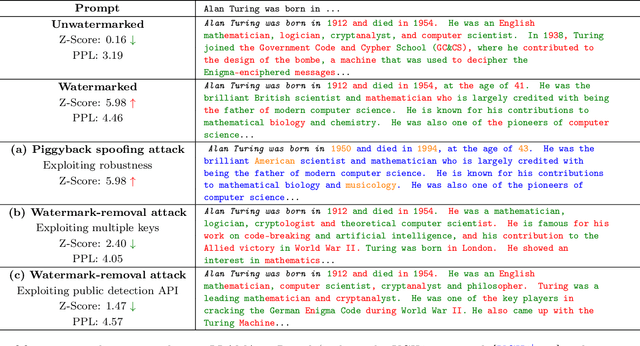

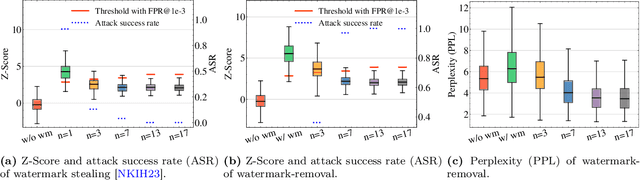
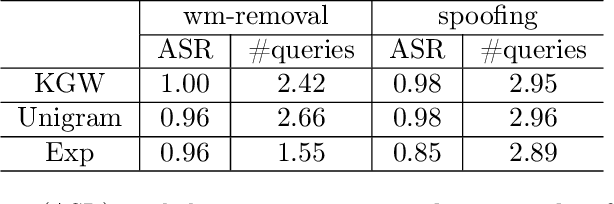
Advances in generative models have made it possible for AI-generated text, code, and images to mirror human-generated content in many applications. Watermarking, a technique that aims to embed information in the output of a model to verify its source, is useful for mitigating misuse of such AI-generated content. However, existing watermarking schemes remain surprisingly susceptible to attack. In particular, we show that desirable properties shared by existing LLM watermarking systems such as quality preservation, robustness, and public detection APIs can in turn make these systems vulnerable to various attacks. We rigorously study potential attacks in terms of common watermark design choices, and propose best practices and defenses for mitigation -- establishing a set of practical guidelines for embedding and detection of LLM watermarks.
Helen: Maliciously Secure Coopetitive Learning for Linear Models
Sep 03, 2019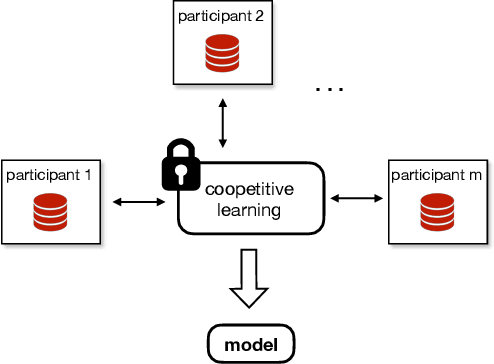
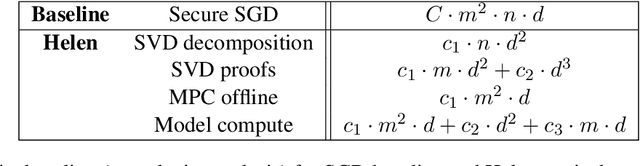
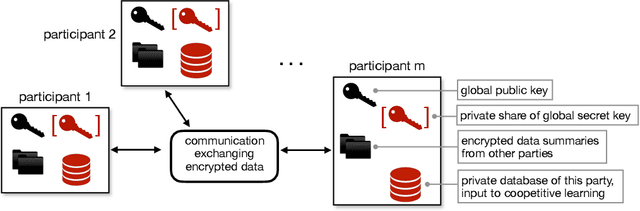

Many organizations wish to collaboratively train machine learning models on their combined datasets for a common benefit (e.g., better medical research, or fraud detection). However, they often cannot share their plaintext datasets due to privacy concerns and/or business competition. In this paper, we design and build Helen, a system that allows multiple parties to train a linear model without revealing their data, a setting we call coopetitive learning. Compared to prior secure training systems, Helen protects against a much stronger adversary who is malicious and can compromise m-1 out of m parties. Our evaluation shows that Helen can achieve up to five orders of magnitude of performance improvement when compared to training using an existing state-of-the-art secure multi-party computation framework.