 Add to Chrome
 Add to Firefox
 Add to Edge
Measuring the Wrong Thing: Internal Harmfulness Scores Anti-Rank Successful Jailbreaks
Aug 10, 2026
Internal safety scores judge a prompt before any text is generated, and they are validated by how well they separate harmful prompts from benign ones. That separation is then read as evidence that the score will also catch the attacks that succeed. Harmful intent is a property of the prompt. Jailbreak success is an outcome produced later by a particular target model, decoding policy, and judge. A filter tuned on a score that measures the wrong quantity spends its false positive budget on attacks that would have failed anyway. In this paper we audit that inference. Attention based measurements are usually read from prompt dependent locations, so a wrapper changes both the content being judged and the place the signal is taken from. We therefore introduce Active Attention Probing, which supplies a fixed content independent measurement coordinate. We pair every base goal with a plain and a wrapped version and generate real completions from the target models. On Llama, wrapping raises harmful generation from 0.05 to 0.27 while harmful intent AUROC falls from 0.936 to 0.803, so the attacks grow more dangerous while the prompts look safer to the score. Among wrapped harmful prompts the outcome AUROC is 0.220, which places the attacks that succeeded below the attacks that failed. Rare token, passive, and detector derived channels reproduce the reversal on the same matched design, and the reversal itself persists across three target models, seven attack families, and two independent judges. Distribution shift then degrades calibration and threshold transfer before it degrades ranking.

PS4: Proxy-Supervised Joint Training for Real Target Speaker Extraction
Jul 09, 2026Training target speaker extraction (TSE) models for real conversational mixtures remains challenging because large-scale training corpora and clean target speech for supervision are unavailable. We present PS4, a proxy-supervised training framework for TSE in real conversational mixtures, with two main contributions. First, we construct a large-scale corpus of 71,771 training samples derived from four public datasets, covering both Chinese and English scenarios. Each sample contains an overlapping speech mixture, per-speaker enrollment audio, a ground-truth transcript, and frame-level voice activity labels. Second, we propose a proxy-supervised joint training strategy that fine-tunes a BSRNN-based TSE model using four complementary differentiable objectives: ASR cross-entropy, speaker similarity, frame-level voice activity detection, and perceptual audio quality. Starting from a publicly available pre-trained checkpoint, only the BSRNN separator is updated during fine-tuning. On the REAL-T challenge leaderboard, PS4 ranks 2nd overall, achieving the best speaker similarity and timing F1 among all submitted systems.
SearchEyes: Towards Frontier Multimodal Deep Search Intelligence via Search World Simulation
Jul 07, 2026Training multimodal search agents to perform multi-hop reasoning remains challenging due to a fundamental structural disconnect: existing pipelines construct training data, search environments, and reward signals independently, causing synthesized structural metadata to be discarded, environments to rely on irreproducible external engines, and RL rewards to remain sparse at the trajectory level. We present \textbf{SearchEyes}, which uses a typed knowledge graph as the backbone of a \emph{simulated search world} that unifies all three components. We propose \textbf{Perception-Knowledge Chains (PKC)} to sample constrained multi-hop paths over the visual-knowledge intersection of Wikidata5M, retaining hop-level entity metadata that simultaneously defines a self-contained search world and step-level reward anchors. We further propose \textbf{Hop-Anchored Policy Optimization (HaPO)}, which reuses these anchors for step-level credit assignment without a separately trained process reward model. Experiments on six multimodal knowledge-intensive benchmarks show that SearchEyes achieves state-of-the-art performance among open-source multimodal search agents, with SearchEyes-27B improving over the strongest open-source baseline by 6.2 points on average.%
Depression Detection on Social Media with Large Language Models
Mar 16, 2024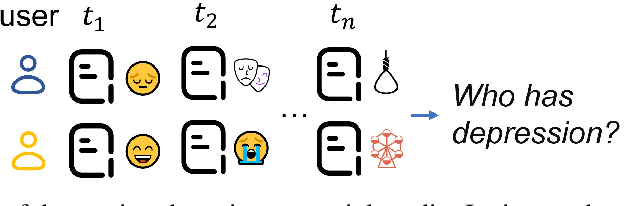
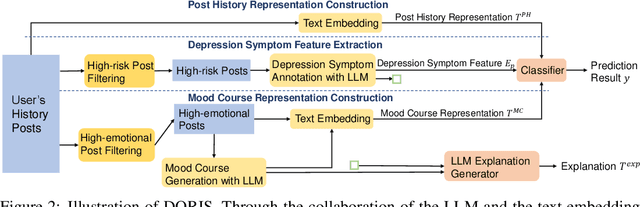
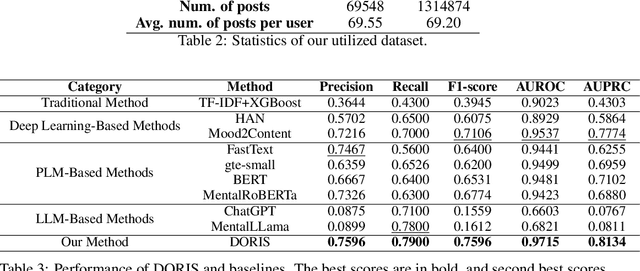
Depression harms. However, due to a lack of mental health awareness and fear of stigma, many patients do not actively seek diagnosis and treatment, leading to detrimental outcomes. Depression detection aims to determine whether an individual suffers from depression by analyzing their history of posts on social media, which can significantly aid in early detection and intervention. It mainly faces two key challenges: 1) it requires professional medical knowledge, and 2) it necessitates both high accuracy and explainability. To address it, we propose a novel depression detection system called DORIS, combining medical knowledge and the recent advances in large language models (LLMs). Specifically, to tackle the first challenge, we proposed an LLM-based solution to first annotate whether high-risk texts meet medical diagnostic criteria. Further, we retrieve texts with high emotional intensity and summarize critical information from the historical mood records of users, so-called mood courses. To tackle the second challenge, we combine LLM and traditional classifiers to integrate medical knowledge-guided features, for which the model can also explain its prediction results, achieving both high accuracy and explainability. Extensive experimental results on benchmarking datasets show that, compared to the current best baseline, our approach improves by 0.036 in AUPRC, which can be considered significant, demonstrating the effectiveness of our approach and its high value as an NLP application.