 Add to Chrome
 Add to Firefox
 Add to Edge
Draft Less, Retrieve More: Hybrid Tree Construction for Speculative Decoding
May 19, 2026
Speculative decoding (SD) accelerates large language model inference by leveraging a draft-then-verify paradigm. To maximize the acceptance rate, recent methods construct expansive draft trees, which unfortunately incur severe VRAM bandwidth and computational overheads that bottleneck end-to-end speedups. While dynamic-depth pruning can reduce this latency by removing marginal branches, it also discards potentially valid candidates, preventing the acceptance rate from reaching the upper bound of dense trees. In this paper, we identify a critical opportunity in resource allocation: the transition from dense to pruned drafting frees up significant computational budget. To break this Pareto tradeoff, we introduce Graft, a compensation framework that couples pruning and retrieval as mutually reinforcing operations. Pruning supplies sufficient budget for retrieval, while retrieval compensates for pruning-induced coverage loss and recovers accepted length. By employing a sequential `prune-then-graft' mechanism, Graft attaches highly predictive retrieved tokens into positions opened by pruning, filling the topological gaps with near-zero overhead. Graft is entirely training-free and lossless. Comprehensive evaluations show that Graft establishes a new Pareto frontier across practical deployment settings, including short-context generation, long-context generation, and large-scale models. On short-context benchmarks, it achieves up to 5.41$\times$ speedup and improves average speedup over EAGLE-3 by up to 21.8% on the large-scale Qwen3-235B. We also provide a preliminary exploration of applying Graft to the DFlash-style block drafting paradigm, offering initial evidence and insights for extending grafting beyond autoregressive draft trees.

NASH: Neural Architecture Search for Hardware-Optimized Machine Learning Models
Mar 10, 2024
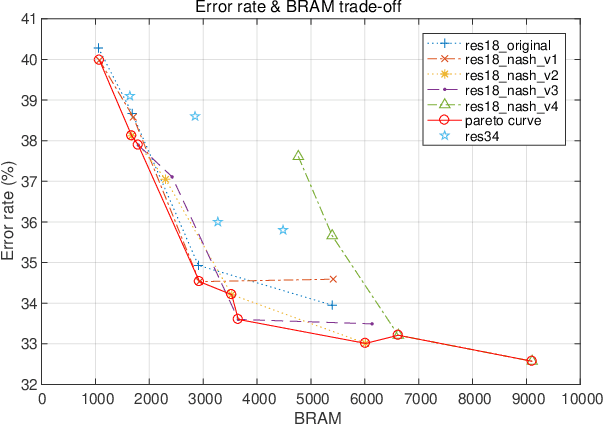
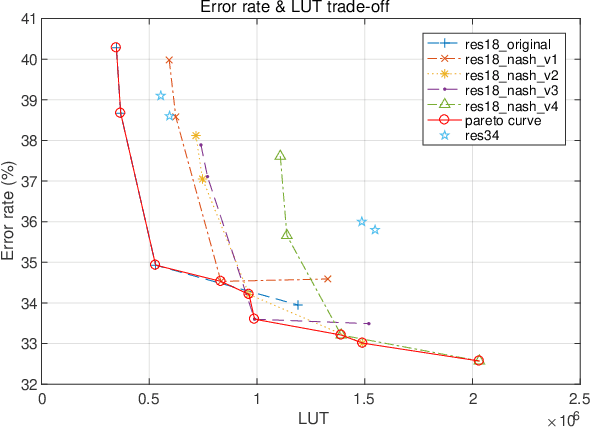
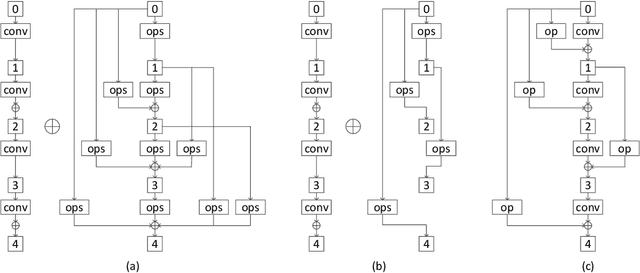
As machine learning (ML) algorithms get deployed in an ever-increasing number of applications, these algorithms need to achieve better trade-offs between high accuracy, high throughput and low latency. This paper introduces NASH, a novel approach that applies neural architecture search to machine learning hardware. Using NASH, hardware designs can achieve not only high throughput and low latency but also superior accuracy performance. We present four versions of the NASH strategy in this paper, all of which show higher accuracy than the original models. The strategy can be applied to various convolutional neural networks, selecting specific model operations among many to guide the training process toward higher accuracy. Experimental results show that applying NASH on ResNet18 or ResNet34 achieves a top 1 accuracy increase of up to 3.1% and a top 5 accuracy increase of up to 2.2% compared to the non-NASH version when tested on the ImageNet data set. We also integrated this approach into the FINN hardware model synthesis tool to automate the application of our approach and the generation of the hardware model. Results show that using FINN can achieve a maximum throughput of 324.5 fps. In addition, NASH models can also result in a better trade-off between accuracy and hardware resource utilization. The accuracy-hardware (HW) Pareto curve shows that the models with the four NASH versions represent the best trade-offs achieving the highest accuracy for a given HW utilization. The code for our implementation is open-source and publicly available on GitHub at https://github.com/MFJI/NASH.