 Add to Chrome
 Add to Firefox
 Add to Edge
Measuring the Wrong Thing: Internal Harmfulness Scores Anti-Rank Successful Jailbreaks
Aug 10, 2026
Internal safety scores judge a prompt before any text is generated, and they are validated by how well they separate harmful prompts from benign ones. That separation is then read as evidence that the score will also catch the attacks that succeed. Harmful intent is a property of the prompt. Jailbreak success is an outcome produced later by a particular target model, decoding policy, and judge. A filter tuned on a score that measures the wrong quantity spends its false positive budget on attacks that would have failed anyway. In this paper we audit that inference. Attention based measurements are usually read from prompt dependent locations, so a wrapper changes both the content being judged and the place the signal is taken from. We therefore introduce Active Attention Probing, which supplies a fixed content independent measurement coordinate. We pair every base goal with a plain and a wrapped version and generate real completions from the target models. On Llama, wrapping raises harmful generation from 0.05 to 0.27 while harmful intent AUROC falls from 0.936 to 0.803, so the attacks grow more dangerous while the prompts look safer to the score. Among wrapped harmful prompts the outcome AUROC is 0.220, which places the attacks that succeeded below the attacks that failed. Rare token, passive, and detector derived channels reproduce the reversal on the same matched design, and the reversal itself persists across three target models, seven attack families, and two independent judges. Distribution shift then degrades calibration and threshold transfer before it degrades ranking.

When Agents Go Rogue: Activation-Based Detection of Malicious Behaviors in Multi-Agent Systems
Jul 07, 2026While enabling effective collaboration on complex tasks, LLM-based Multi-Agent Systems (MAS) face critical security challenges due to vulnerabilities at the agent and interaction levels. Most existing MAS security defenses are built upon two core assumptions: semantically-explicit malicious attacks and explicit graph-based modeling of the MAS topology and agent-level interactions. In practice, real-world attacks are becoming more semantically stealthy, while MAS execution is typically asynchronous without the temporal alignment assumed by graph-based propagation models. To address these limitations, we propose AcMAS, an activation-based framework for malicious-behavior detection in MAS. By analyzing internal reasoning states in the activation space of local agents, AcMAS detects even stealthy attacks in a synchronization-robust fashion, without relying on explicit interaction graphs. Moreover, our activation analysis provides critical signals to guide AcMAS in restoring the functionality of compromised agents, rather than the disruptive agent isolation commonly used by the state-of-the-art methods. Comprehensive evaluation demonstrates that AcMAS significantly outperforms graph-based baselines against stealthy attacks, by +0.22 F1 in synchronous settings (0.94 vs. 0.72) and by +0.55 F1 in asynchronous settings (0.93 vs. 0.38), with generalization across diverse open-source LLM backbones, attack intensity, and MAS scale.
Knowledge Database or Poison Base? Detecting RAG Poisoning Attack through LLM Activations
Nov 28, 2024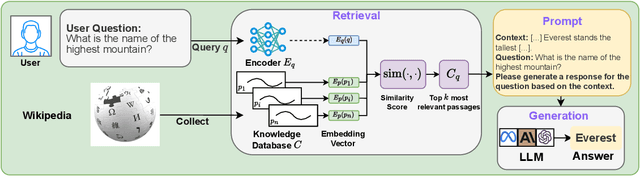
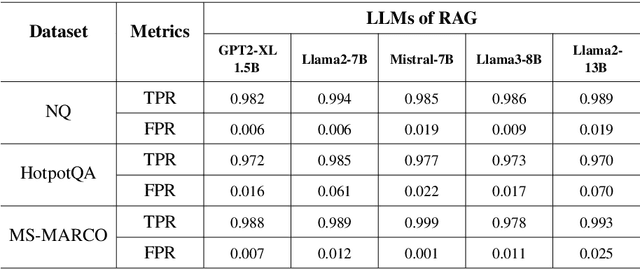
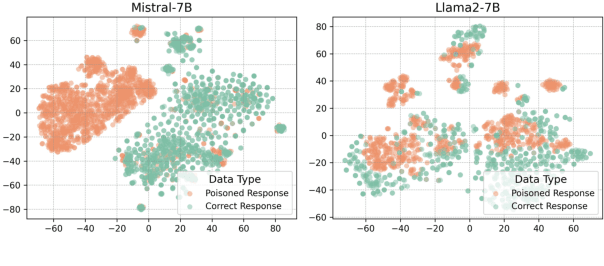

As Large Language Models (LLMs) are progressively deployed across diverse fields and real-world applications, ensuring the security and robustness of LLMs has become ever more critical. Retrieval-Augmented Generation (RAG) is a cutting-edge approach designed to address the limitations of large language models (LLMs). By retrieving information from the relevant knowledge database, RAG enriches the input to LLMs, enabling them to produce responses that are more accurate and contextually appropriate. It is worth noting that the knowledge database, being sourced from publicly available channels such as Wikipedia, inevitably introduces a new attack surface. RAG poisoning involves injecting malicious texts into the knowledge database, ultimately leading to the generation of the attacker's target response (also called poisoned response). However, there are currently limited methods available for detecting such poisoning attacks. We aim to bridge the gap in this work. Particularly, we introduce RevPRAG, a flexible and automated detection pipeline that leverages the activations of LLMs for poisoned response detection. Our investigation uncovers distinct patterns in LLMs' activations when generating correct responses versus poisoned responses. Our results on multiple benchmark datasets and RAG architectures show our approach could achieve 98% true positive rate, while maintaining false positive rates close to 1%. We also evaluate recent backdoor detection methods specifically designed for LLMs and applicable for identifying poisoned responses in RAG. The results demonstrate that our approach significantly surpasses them.