 Add to Chrome
 Add to Firefox
 Add to Edge
The Illusion of Superposition? A Principled Analysis of Latent Thinking in Language Models
Apr 07, 2026
Latent reasoning via continuous chain-of-thoughts (Latent CoT) has emerged as a promising alternative to discrete CoT reasoning. Operating in continuous space increases expressivity and has been hypothesized to enable superposition: the ability to maintain multiple candidate solutions simultaneously within a single representation. Despite theoretical arguments, it remains unclear whether language models actually leverage superposition when reasoning using latent CoTs. We investigate this question across three regimes: a training-free regime that constructs latent thoughts as convex combinations of token embeddings, a fine-tuned regime where a base model is adapted to produce latent thoughts, and a from-scratch regime where a model is trained entirely with latent thoughts to solve a given task. Using Logit Lens and entity-level probing to analyze internal representations, we find that only models trained from scratch exhibit signs of using superposition. In the training-free and fine-tuned regimes, we find that the superposition either collapses or is not used at all, with models discovering shortcut solutions instead. We argue that this is due to two complementary phenomena: i) pretraining on natural language data biases models to commit to a token in the last layers ii) capacity has a huge effect on which solutions a model favors. Together, our results offer a unified explanation for when and why superposition arises in continuous chain-of-thought reasoning, and identify the conditions under which it collapses.

On the Role of Depth in the Expressivity of RNNs
Apr 02, 2026The benefits of depth in feedforward neural networks are well known: composing multiple layers of linear transformations with nonlinear activations enables complex computations. While similar effects are expected in recurrent neural networks (RNNs), it remains unclear how depth interacts with recurrence to shape expressive power. Here, we formally show that depth increases RNNs' memory capacity efficiently with respect to the number of parameters, thus enhancing expressivity both by enabling more complex input transformations and improving the retention of past information. We broaden our analysis to 2RNNs, a generalization of RNNs with multiplicative interactions between inputs and hidden states. Unlike RNNs, which remain linear without nonlinear activations, 2RNNs perform polynomial transformations whose maximal degree grows with depth. We further show that multiplicative interactions cannot, in general, be replaced by layerwise nonlinearities. Finally, we validate these insights empirically on synthetic and real-world tasks.
FlowQ-Net: A Generative Framework for Automated Quantum Circuit Design
Oct 30, 2025Designing efficient quantum circuits is a central bottleneck to exploring the potential of quantum computing, particularly for noisy intermediate-scale quantum (NISQ) devices, where circuit efficiency and resilience to errors are paramount. The search space of gate sequences grows combinatorially, and handcrafted templates often waste scarce qubit and depth budgets. We introduce \textsc{FlowQ-Net} (Flow-based Quantum design Network), a generative framework for automated quantum circuit synthesis based on Generative Flow Networks (GFlowNets). This framework learns a stochastic policy to construct circuits sequentially, sampling them in proportion to a flexible, user-defined reward function that can encode multiple design objectives such as performance, depth, and gate count. This approach uniquely enables the generation of a diverse ensemble of high-quality circuits, moving beyond single-solution optimization. We demonstrate the efficacy of \textsc{FlowQ-Net} through an extensive set of simulations. We apply our method to Variational Quantum Algorithm (VQA) ansatz design for molecular ground state estimation, Max-Cut, and image classification, key challenges in near-term quantum computing. Circuits designed by \textsc{FlowQ-Net} achieve significant improvements, yielding circuits that are 10$\times$-30$\times$ more compact in terms of parameters, gates, and depth compared to commonly used unitary baselines, without compromising accuracy. This trend holds even when subjected to error profiles from real-world quantum devices. Our results underline the potential of generative models as a general-purpose methodology for automated quantum circuit design, offering a promising path towards more efficient quantum algorithms and accelerating scientific discovery in the quantum domain.
A Tensor Decomposition Perspective on Second-order RNNs
Jun 07, 2024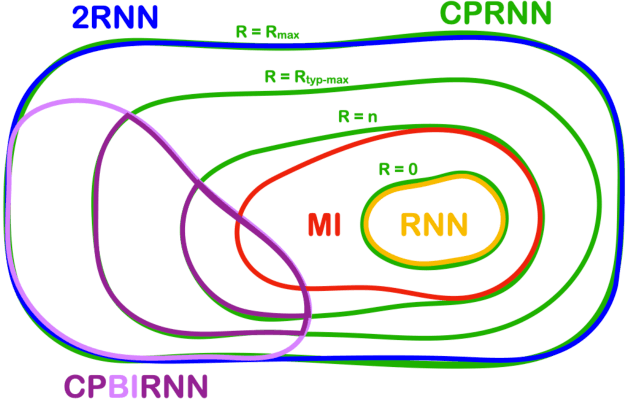
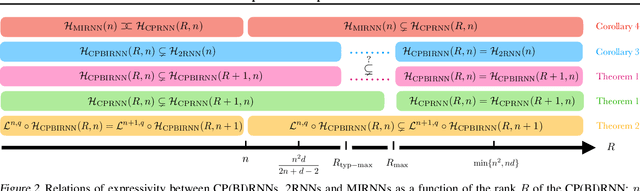
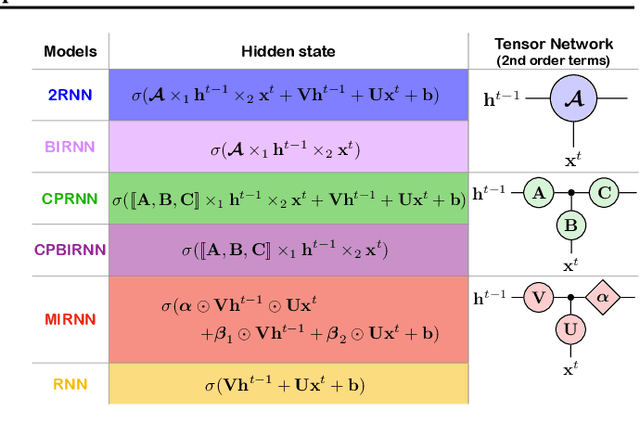
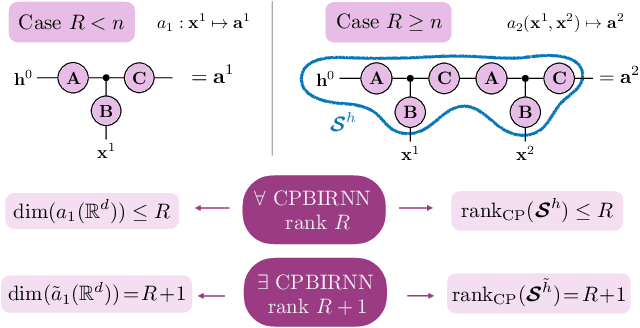
Second-order Recurrent Neural Networks (2RNNs) extend RNNs by leveraging second-order interactions for sequence modelling. These models are provably more expressive than their first-order counterparts and have connections to well-studied models from formal language theory. However, their large parameter tensor makes computations intractable. To circumvent this issue, one approach known as MIRNN consists in limiting the type of interactions used by the model. Another is to leverage tensor decomposition to diminish the parameter count. In this work, we study the model resulting from parameterizing 2RNNs using the CP decomposition, which we call CPRNN. Intuitively, the rank of the decomposition should reduce expressivity. We analyze how rank and hidden size affect model capacity and show the relationships between RNNs, 2RNNs, MIRNNs, and CPRNNs based on these parameters. We support these results empirically with experiments on the Penn Treebank dataset which demonstrate that, with a fixed parameter budget, CPRNNs outperforms RNNs, 2RNNs, and MIRNNs with the right choice of rank and hidden size.