 Add to Chrome
 Add to Firefox
 Add to Edge
Learning Neuro-Symbolic Skills for Bilevel Planning
Jun 21, 2022
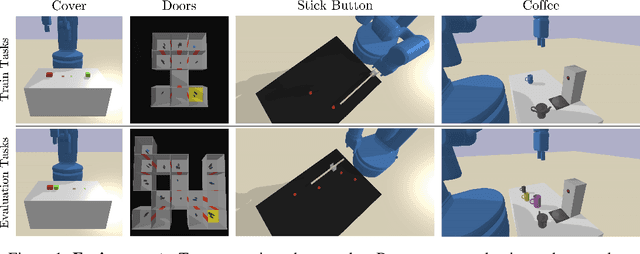

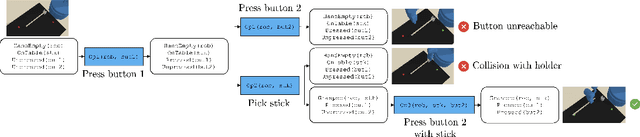
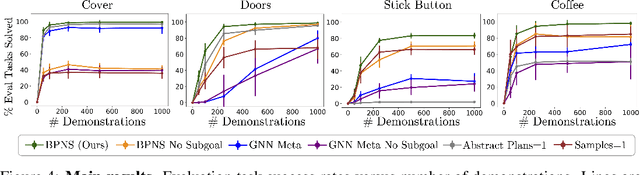
Decision-making is challenging in robotics environments with continuous object-centric states, continuous actions, long horizons, and sparse feedback. Hierarchical approaches, such as task and motion planning (TAMP), address these challenges by decomposing decision-making into two or more levels of abstraction. In a setting where demonstrations and symbolic predicates are given, prior work has shown how to learn symbolic operators and neural samplers for TAMP with manually designed parameterized policies. Our main contribution is a method for learning parameterized polices in combination with operators and samplers. These components are packaged into modular neuro-symbolic skills and sequenced together with search-then-sample TAMP to solve new tasks. In experiments in four robotics domains, we show that our approach -- bilevel planning with neuro-symbolic skills -- can solve a wide range of tasks with varying initial states, goals, and objects, outperforming six baselines and ablations. Video: https://youtu.be/PbFZP8rPuGg Code: https://tinyurl.com/skill-learning

Beyond the Imitation Game: Quantifying and extrapolating the capabilities of language models
Jun 10, 2022Language models demonstrate both quantitative improvement and new qualitative capabilities with increasing scale. Despite their potentially transformative impact, these new capabilities are as yet poorly characterized. In order to inform future research, prepare for disruptive new model capabilities, and ameliorate socially harmful effects, it is vital that we understand the present and near-future capabilities and limitations of language models. To address this challenge, we introduce the Beyond the Imitation Game benchmark (BIG-bench). BIG-bench currently consists of 204 tasks, contributed by 442 authors across 132 institutions. Task topics are diverse, drawing problems from linguistics, childhood development, math, common-sense reasoning, biology, physics, social bias, software development, and beyond. BIG-bench focuses on tasks that are believed to be beyond the capabilities of current language models. We evaluate the behavior of OpenAI's GPT models, Google-internal dense transformer architectures, and Switch-style sparse transformers on BIG-bench, across model sizes spanning millions to hundreds of billions of parameters. In addition, a team of human expert raters performed all tasks in order to provide a strong baseline. Findings include: model performance and calibration both improve with scale, but are poor in absolute terms (and when compared with rater performance); performance is remarkably similar across model classes, though with benefits from sparsity; tasks that improve gradually and predictably commonly involve a large knowledge or memorization component, whereas tasks that exhibit "breakthrough" behavior at a critical scale often involve multiple steps or components, or brittle metrics; social bias typically increases with scale in settings with ambiguous context, but this can be improved with prompting.
Compositional Visual Generation with Composable Diffusion Models
Jun 08, 2022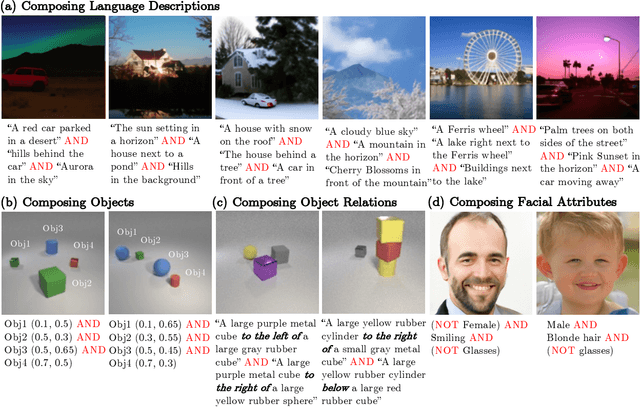
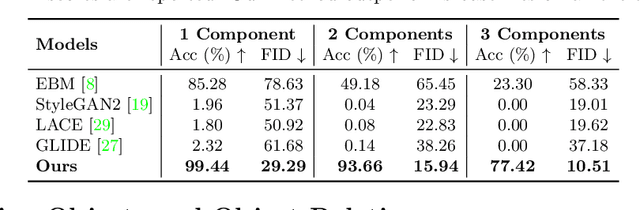

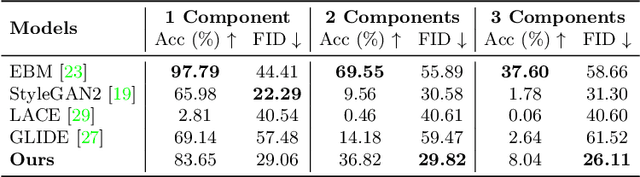
Large text-guided diffusion models, such as DALLE-2, are able to generate stunning photorealistic images given natural language descriptions. While such models are highly flexible, they struggle to understand the composition of certain concepts, such as confusing the attributes of different objects or relations between objects. In this paper, we propose an alternative structured approach for compositional generation using diffusion models. An image is generated by composing a set of diffusion models, with each of them modeling a certain component of the image. To do this, we interpret diffusion models as energy-based models in which the data distributions defined by the energy functions may be explicitly combined. The proposed method can generate scenes at test time that are substantially more complex than those seen in training, composing sentence descriptions, object relations, human facial attributes, and even generalizing to new combinations that are rarely seen in the real world. We further illustrate how our approach may be used to compose pre-trained text-guided diffusion models and generate photorealistic images containing all the details described in the input descriptions, including the binding of certain object attributes that have been shown difficult for DALLE-2. These results point to the effectiveness of the proposed method in promoting structured generalization for visual generation. Project page: https://energy-based-model.github.io/Compositional-Visual-Generation-with-Composable-Diffusion-Models/
Drawing out of Distribution with Neuro-Symbolic Generative Models
Jun 03, 2022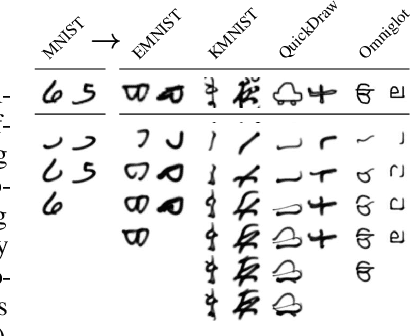
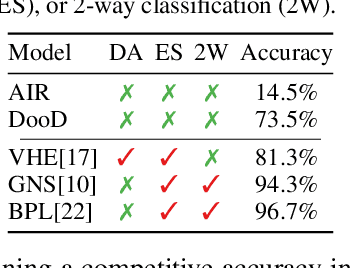
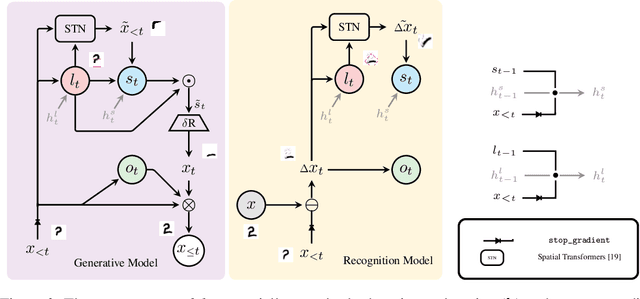
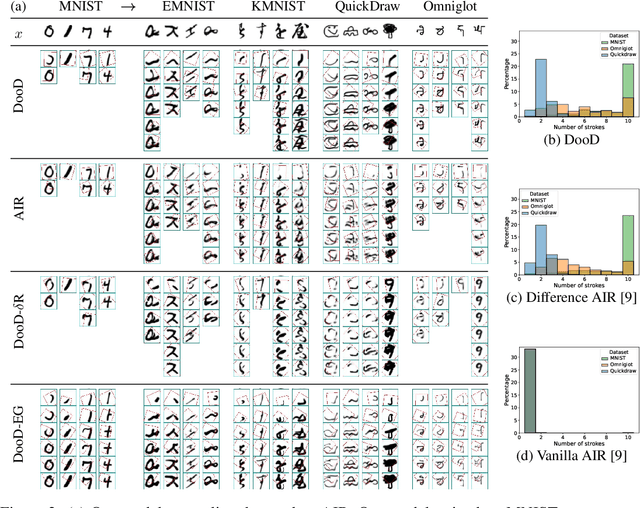
Learning general-purpose representations from perceptual inputs is a hallmark of human intelligence. For example, people can write out numbers or characters, or even draw doodles, by characterizing these tasks as different instantiations of the same generic underlying process -- compositional arrangements of different forms of pen strokes. Crucially, learning to do one task, say writing, implies reasonable competence at another, say drawing, on account of this shared process. We present Drawing out of Distribution (DooD), a neuro-symbolic generative model of stroke-based drawing that can learn such general-purpose representations. In contrast to prior work, DooD operates directly on images, requires no supervision or expensive test-time inference, and performs unsupervised amortised inference with a symbolic stroke model that better enables both interpretability and generalization. We evaluate DooD on its ability to generalise across both data and tasks. We first perform zero-shot transfer from one dataset (e.g. MNIST) to another (e.g. Quickdraw), across five different datasets, and show that DooD clearly outperforms different baselines. An analysis of the learnt representations further highlights the benefits of adopting a symbolic stroke model. We then adopt a subset of the Omniglot challenge tasks, and evaluate its ability to generate new exemplars (both unconditionally and conditionally), and perform one-shot classification, showing that DooD matches the state of the art. Taken together, we demonstrate that DooD does indeed capture general-purpose representations across both data and task, and takes a further step towards building general and robust concept-learning systems.
Planning with Diffusion for Flexible Behavior Synthesis
May 20, 2022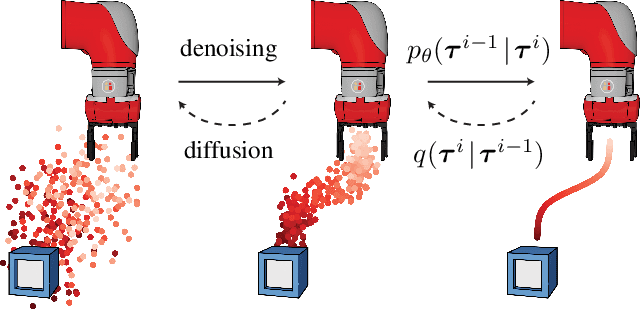
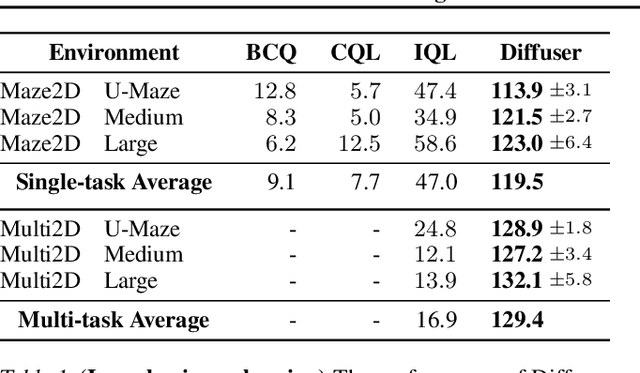
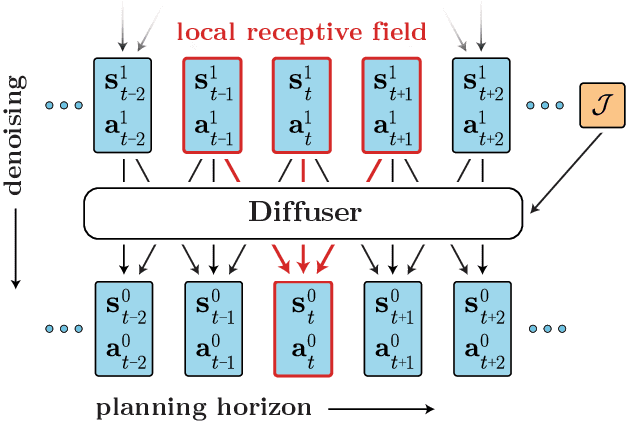
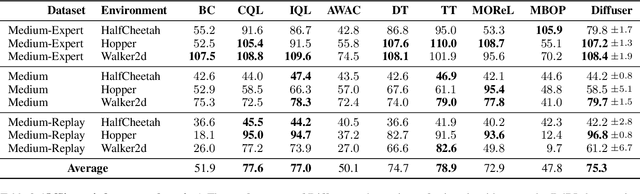
Model-based reinforcement learning methods often use learning only for the purpose of estimating an approximate dynamics model, offloading the rest of the decision-making work to classical trajectory optimizers. While conceptually simple, this combination has a number of empirical shortcomings, suggesting that learned models may not be well-suited to standard trajectory optimization. In this paper, we consider what it would look like to fold as much of the trajectory optimization pipeline as possible into the modeling problem, such that sampling from the model and planning with it become nearly identical. The core of our technical approach lies in a diffusion probabilistic model that plans by iteratively denoising trajectories. We show how classifier-guided sampling and image inpainting can be reinterpreted as coherent planning strategies, explore the unusual and useful properties of diffusion-based planning methods, and demonstrate the effectiveness of our framework in control settings that emphasize long-horizon decision-making and test-time flexibility.
Unsupervised Segmentation in Real-World Images via Spelke Object Inference
May 17, 2022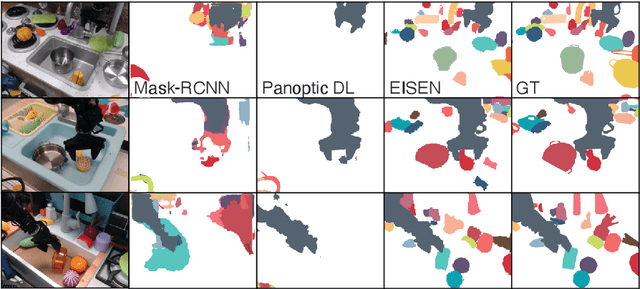
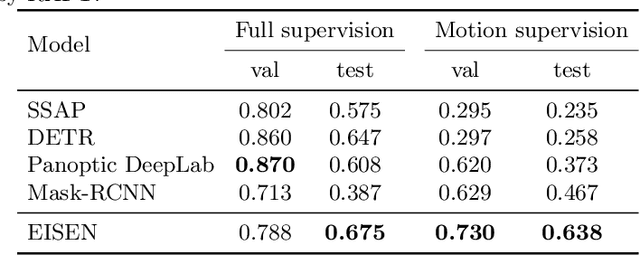
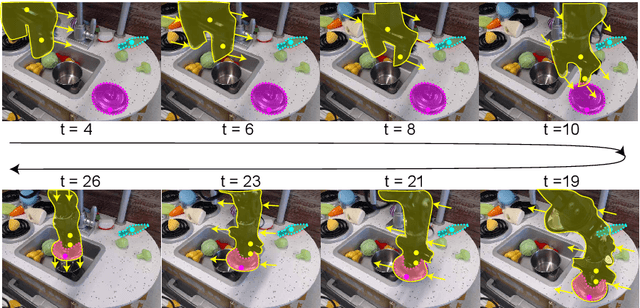

Self-supervised category-agnostic segmentation of real-world images into objects is a challenging open problem in computer vision. Here, we show how to learn static grouping priors from motion self-supervision, building on the cognitive science notion of Spelke Objects: groupings of stuff that move together. We introduce Excitatory-Inhibitory Segment Extraction Network (EISEN), which learns from optical flow estimates to extract pairwise affinity graphs for static scenes. EISEN then produces segments from affinities using a novel graph propagation and competition mechanism. Correlations between independent sources of motion (e.g. robot arms) and objects they move are resolved into separate segments through a bootstrapping training process. We show that EISEN achieves a substantial improvement in the state of the art for self-supervised segmentation on challenging synthetic and real-world robotic image datasets. We also present an ablation analysis illustrating the importance of each element of the EISEN architecture.
Structured, flexible, and robust: benchmarking and improving large language models towards more human-like behavior in out-of-distribution reasoning tasks
May 11, 2022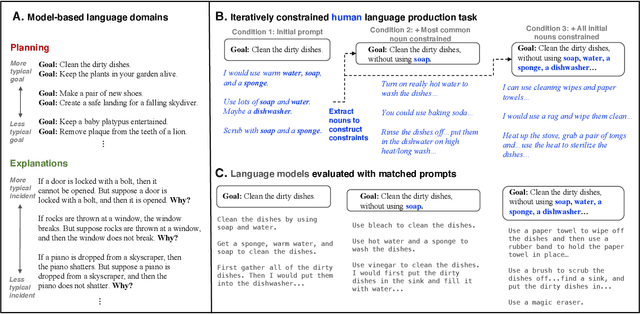
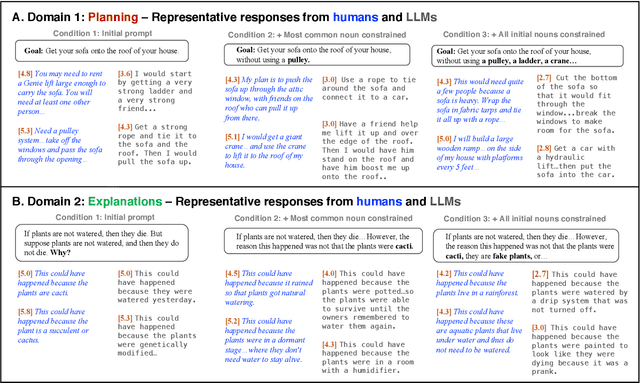
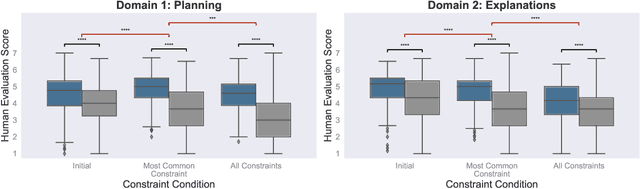
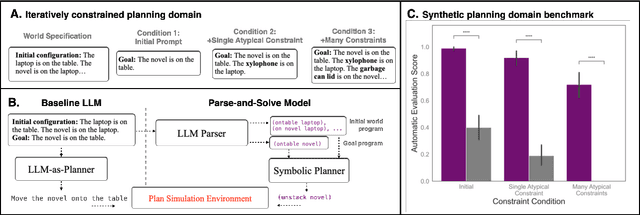
Human language offers a powerful window into our thoughts -- we tell stories, give explanations, and express our beliefs and goals through words. Abundant evidence also suggests that language plays a developmental role in structuring our learning. Here, we ask: how much of human-like thinking can be captured by learning statistical patterns in language alone? We first contribute a new challenge benchmark for comparing humans and distributional large language models (LLMs). Our benchmark contains two problem-solving domains (planning and explanation generation) and is designed to require generalization to new, out-of-distribution problems expressed in language. We find that humans are far more robust than LLMs on this benchmark. Next, we propose a hybrid Parse-and-Solve model, which augments distributional LLMs with a structured symbolic reasoning module. We find that this model shows more robust adaptation to out-of-distribution planning problems, demonstrating the promise of hybrid AI models for more human-like reasoning.
RISP: Rendering-Invariant State Predictor with Differentiable Simulation and Rendering for Cross-Domain Parameter Estimation
May 11, 2022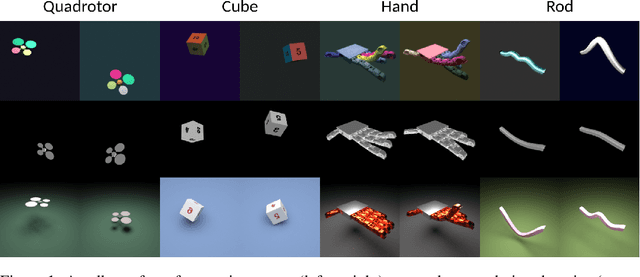
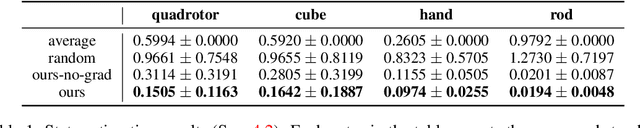
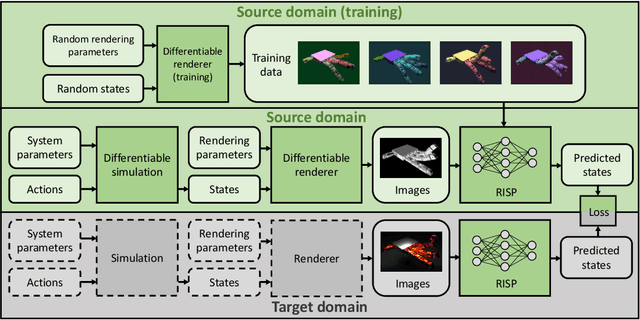
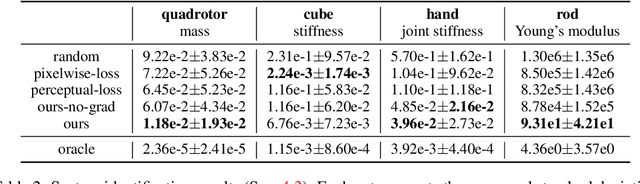
This work considers identifying parameters characterizing a physical system's dynamic motion directly from a video whose rendering configurations are inaccessible. Existing solutions require massive training data or lack generalizability to unknown rendering configurations. We propose a novel approach that marries domain randomization and differentiable rendering gradients to address this problem. Our core idea is to train a rendering-invariant state-prediction (RISP) network that transforms image differences into state differences independent of rendering configurations, e.g., lighting, shadows, or material reflectance. To train this predictor, we formulate a new loss on rendering variances using gradients from differentiable rendering. Moreover, we present an efficient, second-order method to compute the gradients of this loss, allowing it to be integrated seamlessly into modern deep learning frameworks. We evaluate our method in rigid-body and deformable-body simulation environments using four tasks: state estimation, system identification, imitation learning, and visuomotor control. We further demonstrate the efficacy of our approach on a real-world example: inferring the state and action sequences of a quadrotor from a video of its motion sequences. Compared with existing methods, our approach achieves significantly lower reconstruction errors and has better generalizability among unknown rendering configurations.
Identifying concept libraries from language about object structure
May 11, 2022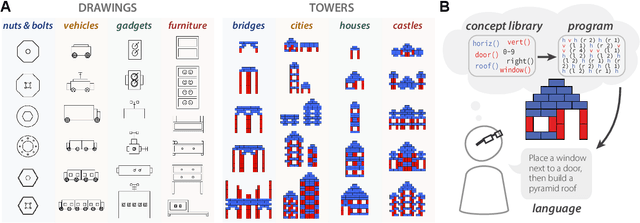
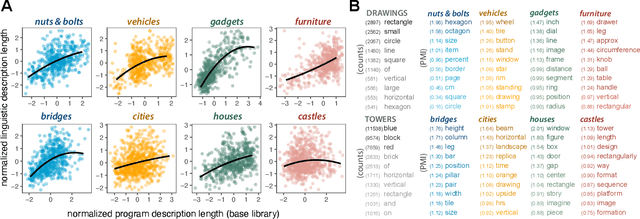
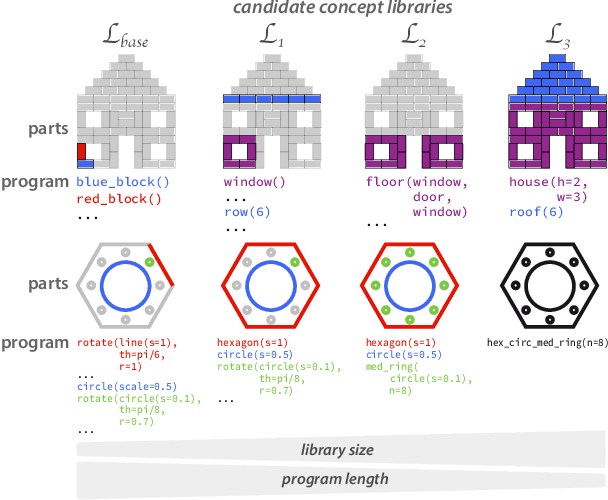
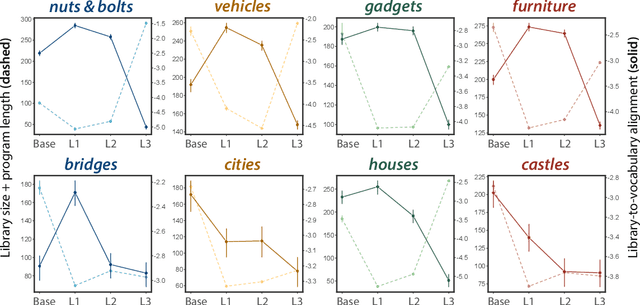
Our understanding of the visual world goes beyond naming objects, encompassing our ability to parse objects into meaningful parts, attributes, and relations. In this work, we leverage natural language descriptions for a diverse set of 2K procedurally generated objects to identify the parts people use and the principles leading these parts to be favored over others. We formalize our problem as search over a space of program libraries that contain different part concepts, using tools from machine translation to evaluate how well programs expressed in each library align to human language. By combining naturalistic language at scale with structured program representations, we discover a fundamental information-theoretic tradeoff governing the part concepts people name: people favor a lexicon that allows concise descriptions of each object, while also minimizing the size of the lexicon itself.
Unsupervised Discovery and Composition of Object Light Fields
May 08, 2022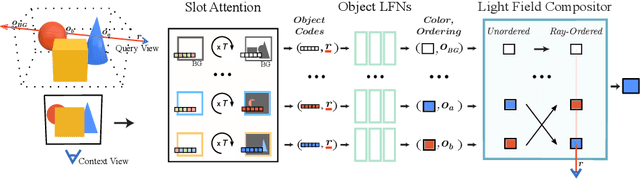

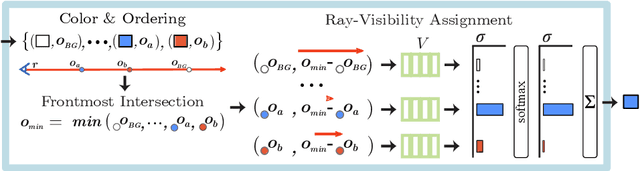

Neural scene representations, both continuous and discrete, have recently emerged as a powerful new paradigm for 3D scene understanding. Recent efforts have tackled unsupervised discovery of object-centric neural scene representations. However, the high cost of ray-marching, exacerbated by the fact that each object representation has to be ray-marched separately, leads to insufficiently sampled radiance fields and thus, noisy renderings, poor framerates, and high memory and time complexity during training and rendering. Here, we propose to represent objects in an object-centric, compositional scene representation as light fields. We propose a novel light field compositor module that enables reconstructing the global light field from a set of object-centric light fields. Dubbed Compositional Object Light Fields (COLF), our method enables unsupervised learning of object-centric neural scene representations, state-of-the-art reconstruction and novel view synthesis performance on standard datasets, and rendering and training speeds at orders of magnitude faster than existing 3D approaches.