 Add to Chrome
 Add to Firefox
 Add to Edge
Identifying Informative Environments for Cognition Parameter Inference via Bayesian Experimental Design
Aug 03, 2026
Computational cognitive modeling seeks to infer latent cognitive mechanisms underlying observed behavior. Bayesian inverse planning provides a principled framework for such inference, but its success depends critically on the experimental environment. Existing approaches typically treat environments as fixed, leaving open the question of which cognitive experiments are most informative for cognition parameter inference. We formulate the design of cognitive planning experiments as a Bayesian Experimental Design (BED) problem, treating the experimental environment as the design variable. We establish an exact Monte Carlo BED benchmark and introduce an amortized Bayesian experimental design framework for efficient posterior inference and design evaluation. Experiments on the Mouselab-MDP process-tracing paradigm show that amortized BED closely matches the environment rankings of exact Monte Carlo BED while substantially reducing computational cost. We further show that no single environment is uniformly optimal across cognitive inference objectives, revealing trade-offs between expected information gain, posterior recoverability, and information efficiency. These results provide a principled framework for designing informative cognitive experiments for Bayesian parameter inference.

Implicit Data Synthesis for Contrastive Unsupervised Data Augmentation
Jun 05, 2026Scientific observations generate large quantities of unlabeled data which is laborious to hand-label, making unsupervised learning techniques valuable for processing datasets. Among these approaches, contrastive learning provides a convenient mechanism for extracting structural representations from unannotated datasets. For natural imagery, the general approach is to use a variety of data-space augmentation methods in order to generate synthetic samples; however, for scientific observations data-space perturbations can fundamentally alter the underlying data. Our proposed method is to generate contrastive samples by perturbing the network weights rather than the underlying data, thus more closely preserving the structure of the data. We demonstrate this technique using a SimCLR-based pipeline applied over radar observations of meteors, and show performance gains under matched protocols.
AIMing for Standardised Explainability Evaluation in GNNs: A Framework and Case Study on Graph Kernel Networks
May 14, 2026Graph Neural Networks (GNNs) have advanced significantly in handling graph-structured data, but a comprehensive framework for evaluating explainability remains lacking. Existing evaluation frameworks primarily involve post-hoc explanations, and operate in the setting where multiple methods generate a suite of explanations for a single model. This makes comparison of explanations across models difficult. Evaluation of inherently interpretable models often targets a specific aspect of interpretability relevant to the model, but remains underdeveloped in terms of generating insight across a suite of measures. We introduce AIM, a comprehensive framework that addresses these limitations by measuring Accuracy, Instance-level explanations, and Model-level explanations. AIM is formulated with minimal constraints to enhance flexibility and facilitate broad applicability. Here, we use AIM in a pipeline, extracting explanations from inherently interpretable GNNs such as graph kernel networks (GKNs) and prototype networks (PNs), evaluating these explanations with AIM, identifying their limitations and obtaining insights to their characteristics. Taking GKNs as a case study, we show how the insights obtained from AIM can be used to develop an updated model, xGKN, that maintains high accuracy while demonstrating improved explainability. Our approach aims to advance the field of Explainable AI (XAI) for GNNs, providing more robust and practical solutions for understanding and improving complex models.
* 19 pages,4 figures, 8 tables
Understanding Human Actions through the Lens of Executable Models
Apr 20, 2026Human-centred systems require an understanding of human actions in the physical world. Temporally extended sequences of actions are intentional and structured, yet existing methods for recognising what actions are performed often do not attempt to capture their structure, particularly how the actions are executed. This, however, is crucial for assessing the quality of the action's execution and its differences from other actions. To capture the internal mechanics of actions, we introduce a domain-specific language EXACT that represents human motions as underspecified motion programs, interpreted as reward-generating functions for zero-shot policy inference using forward-backwards representations. By leveraging the compositional nature of EXACT motion programs, we combine individual policies into an executable neuro-symbolic model that uses program structure for compositional modelling. We evaluate the utility of the proposed pipeline for creating executable action models by analysing motion-capture data to understand human actions, for the tasks of human action segmentation and action anomaly detection. Our results show that the use of executable action models improves data efficiency and captures intuitive relationships between actions compared with monolithic, task-specific approaches.
Banyan: Improved Representation Learning with Explicit Structure
Jul 25, 2024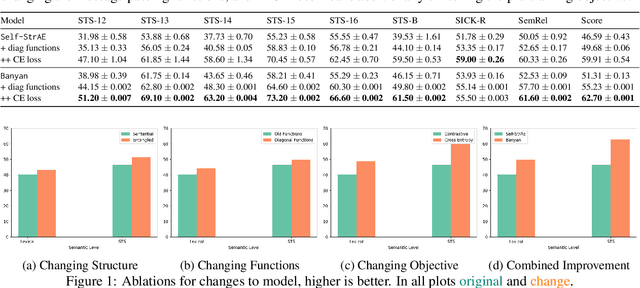
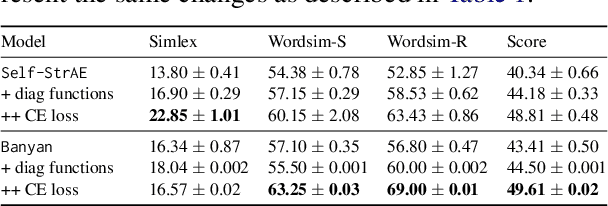
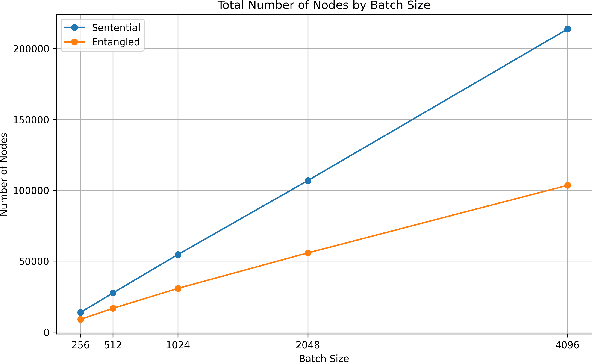

We present Banyan, an improved model to learn semantic representations by inducing explicit structure over data. In contrast to prior approaches using structure spanning single sentences, Banyan learns by resolving multiple constituent structures into a shared one explicitly incorporating global context. Combined with an improved message-passing scheme inspired by Griffin, Banyan learns significantly better representations, avoids spurious false negatives with contrastive learning, and drastically improves memory efficiency in such explicit-structured models. Using the Self-StrAE framework, we show that Banyan (a) outperforms baselines using sentential structure across various settings (b) matches or outperforms unstructured baselines like GloVe (+augmentations) and a RoBERTa medium (+simcse) pre-trained on 100M tokens, despite having just a handful of (non-embedding) parameters, and (c) also learns effective representations across several low resource (Asian and African) languages as measured on SemRel tasks.
Multi-Label Classification for Implicit Discourse Relation Recognition
Jun 06, 2024Discourse relations play a pivotal role in establishing coherence within textual content, uniting sentences and clauses into a cohesive narrative. The Penn Discourse Treebank (PDTB) stands as one of the most extensively utilized datasets in this domain. In PDTB-3, the annotators can assign multiple labels to an example, when they believe that multiple relations are present. Prior research in discourse relation recognition has treated these instances as separate examples during training, and only one example needs to have its label predicted correctly for the instance to be judged as correct. However, this approach is inadequate, as it fails to account for the interdependence of labels in real-world contexts and to distinguish between cases where only one sense relation holds and cases where multiple relations hold simultaneously. In our work, we address this challenge by exploring various multi-label classification frameworks to handle implicit discourse relation recognition. We show that multi-label classification methods don't depress performance for single-label prediction. Additionally, we give comprehensive analysis of results and data. Our work contributes to advancing the understanding and application of discourse relations and provide a foundation for the future study
Self-StrAE at SemEval-2024 Task 1: Making Self-Structuring AutoEncoders Learn More With Less
Apr 02, 2024This paper presents two simple improvements to the Self-Structuring AutoEncoder (Self-StrAE). Firstly, we show that including reconstruction to the vocabulary as an auxiliary objective improves representation quality. Secondly, we demonstrate that increasing the number of independent channels leads to significant improvements in embedding quality, while simultaneously reducing the number of parameters. Surprisingly, we demonstrate that this trend can be followed to the extreme, even to point of reducing the total number of non-embedding parameters to seven. Our system can be pre-trained from scratch with as little as 10M tokens of input data, and proves effective across English, Spanish and Afrikaans.
On the effect of curriculum learning with developmental data for grammar acquisition
Nov 03, 2023This work explores the degree to which grammar acquisition is driven by language `simplicity' and the source modality (speech vs. text) of data. Using BabyBERTa as a probe, we find that grammar acquisition is largely driven by exposure to speech data, and in particular through exposure to two of the BabyLM training corpora: AO-Childes and Open Subtitles. We arrive at this finding by examining various ways of presenting input data to our model. First, we assess the impact of various sequence-level complexity based curricula. We then examine the impact of learning over `blocks' -- covering spans of text that are balanced for the number of tokens in each of the source corpora (rather than number of lines). Finally, we explore curricula that vary the degree to which the model is exposed to different corpora. In all cases, we find that over-exposure to AO-Childes and Open Subtitles significantly drives performance. We verify these findings through a comparable control dataset in which exposure to these corpora, and speech more generally, is limited by design. Our findings indicate that it is not the proportion of tokens occupied by high-utility data that aids acquisition, but rather the proportion of training steps assigned to such data. We hope this encourages future research into the use of more developmentally plausible linguistic data (which tends to be more scarce) to augment general purpose pre-training regimes.
DreamDecompiler: Improved Bayesian Program Learning by Decompiling Amortised Knowledge
Jun 13, 2023Solving program induction problems requires searching through an enormous space of possibilities. DreamCoder is an inductive program synthesis system that, whilst solving problems, learns to simplify search in an iterative wake-sleep procedure. The cost of search is amortised by training a neural search policy, reducing search breadth and effectively "compiling" useful information to compose program solutions across tasks. Additionally, a library of program components is learnt to express discovered solutions in fewer components, reducing search depth. In DreamCoder, the neural search policy has only an indirect effect on the library learnt through the program solutions it helps discover. We present an approach for library learning that directly leverages the neural search policy, effectively "decompiling" its amortised knowledge to extract relevant program components. This provides stronger amortised inference: the amortised knowledge learnt to reduce search breadth is now also used to reduce search depth. We integrate our approach with DreamCoder and demonstrate faster domain proficiency with improved generalisation on a range of domains, particularly when fewer example solutions are available.
Autoencoding Conditional Neural Processes for Representation Learning
May 29, 2023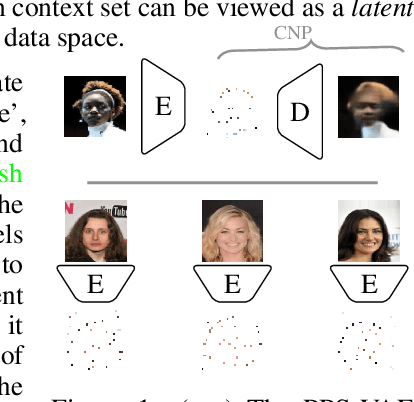
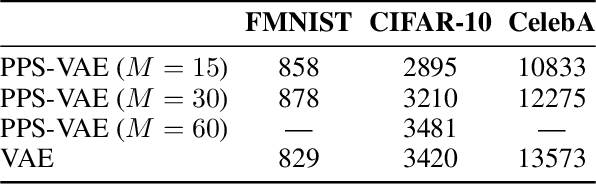
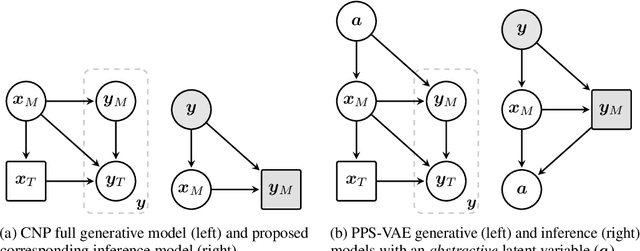
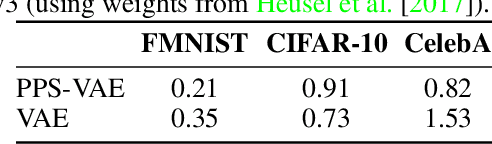
Conditional neural processes (CNPs) are a flexible and efficient family of models that learn to learn a stochastic process from observations. In the visual domain, they have seen particular application in contextual image completion - observing pixel values at some locations to predict a distribution over values at other unobserved locations. However, the choice of pixels in learning such a CNP is typically either random or derived from a simple statistical measure (e.g. pixel variance). Here, we turn the problem on its head and ask: which pixels would a CNP like to observe? That is, which pixels allow fitting CNP, and do such pixels tell us something about the underlying image? Viewing the context provided to the CNP as fixed-size latent representations, we construct an amortised variational framework, Partial Pixel Space Variational Autoencoder (PPS-VAE), for predicting this context simultaneously with learning a CNP. We evaluate PPS-VAE on a set of vision datasets, and find that not only is it possible to learn context points while also fitting CNPs, but that their spatial arrangement and values provides strong signal for the information contained in the image - evaluated through the lens of classification. We believe the PPS-VAE provides a promising avenue to explore learning interpretable and effective visual representations.