 Add to Chrome
 Add to Firefox
 Add to Edge
MRBench: A Comprehensive Benchmark for Human Motion-Text Retrieval
Aug 08, 2026
Human motion-text retrieval provides a rigorous means of assessing cross-modal alignment. Prevailing benchmarks are dominated by homogeneous indoor motions, imbalanced motion distributions, and oversimplified, repetitive texts, which hinder the reliable measurement of cross-domain and cross-granularity alignment. We thus introduce MRBench, a comprehensive motion-text retrieval benchmark featuring heterogeneous motions, broad and balanced category coverage, and reliable, discriminative, multi-granular descriptions. MRBench is constructed through a meticulously designed multi-stage data curation pipeline, which filters and balances candidates, verifies unambiguous semantic alignment, and generates motion-grounded descriptions at multiple granularities. The resulting benchmark contains 3,390 motions drawn from motion capture, in-the-wild videos, synthetic videos, and motion generative models, covering 118 fine-grained categories. Each motion is paired with concise, standard, and fine-grained descriptions, yielding 10,170 captions. Extensive evaluations of representative retrieval baselines on MRBench reveal a substantial cross-dataset generalization gap and pronounced sensitivity to query granularity. We propose a lightweight granularity-aware model anchored at a frozen standard-caption-aligned retrieval model. LLM-based concise and fine-grained captions provide pseudo-supervision for extra-branch granularity-specific motion extractors and text adapters. For inference, granularity-aware score fusion integrates global and adapted similarities while strictly maintaining score comparability across all description levels. The resulting model improves mixed-granularity retrieval without compromising standard-caption performance. We believe that our MRBench provides a comprehensive testbed for advancing motion-language alignment evaluation.

Enfold: Folding World Model Imagination into Predictive Representations for Ultra-Efficient Embodied Control
Aug 03, 2026World generative models are typically used through what they produce: a rendered future, a video-conditioned action, or latent context computed by a costly generative branch. We argue that their more reusable asset is the computation that constructs a future. As a generator transforms a corrupted future into a coherent trajectory, its intermediate states organize appearance, spatial layout, and interaction across levels of abstraction. Can this future-generative computation be internalized in a representation inferred from the present alone? We present Enfold, which transfers this computation into a representation predicted from the current visual context and language instruction. During training, multi-level states exposed as the generator processes the observed future supervise a current-only encoder. The learned representation is fed back to condition future generation and is read by task heads without allowing task gradients to reshape the encoder. At deployment, action prediction no longer executes the generator. Across LIBERO, RoboTwin2.0, and real-robot tasks, Enfold supports strong control while reducing action latency by $3.7\times$ relative to Fast--WAM, Enfold-Flash reaches $10.1\times$. Representation analyses show that it suppresses nuisance variation and preferentially captures changes that emerge over longer horizons. When the current scene is altered by human intervention, both the generated continuation and the executed actions adapt, which is inconsistent with fixed trajectory replay. These results recast a world generator as a source of predictive control representations: its future need not be materialized at every step if its internal structure can be enfolded into the present.
Enfold: Folding World-Generator Computation into Predictive Representations for Efficient Embodied Control
Jul 29, 2026World generative models are typically used through what they produce: a rendered future, a video-conditioned action, or latent context computed by a costly generative branch. We argue that their more reusable asset is the computation that constructs a future. As a generator transforms a corrupted future into a coherent trajectory, its intermediate states organize appearance, spatial layout, and interaction across levels of abstraction. Can this future-generative computation be internalized in a representation inferred from the present alone? We present Enfold, which transfers this computation into a representation predicted from the current visual context and language instruction. During training, multi-level states exposed as the generator processes the observed future supervise a current-only encoder. The learned representation is fed back to condition future generation and is read by task heads without allowing task gradients to reshape the encoder. At deployment, action prediction no longer executes the generator. Across LIBERO, RoboTwin2.0, and real-robot tasks, Enfold supports strong control while reducing action latency by $3.7\times$ relative to Fast--WAM, Enfold-Flash reaches $10.1\times$. Representation analyses show that it suppresses nuisance variation and preferentially captures changes that emerge over longer horizons. When the current scene is altered by human intervention, both the generated continuation and the executed actions adapt, which is inconsistent with fixed trajectory replay. These results recast a world generator as a source of predictive control representations: its future need not be materialized at every step if its internal structure can be enfolded into the present.
POLAR: A Portrait OLAT Dataset and Generative Framework for Illumination-Aware Face Modeling
Dec 16, 2025Face relighting aims to synthesize realistic portraits under novel illumination while preserving identity and geometry. However, progress remains constrained by the limited availability of large-scale, physically consistent illumination data. To address this, we introduce POLAR, a large-scale and physically calibrated One-Light-at-a-Time (OLAT) dataset containing over 200 subjects captured under 156 lighting directions, multiple views, and diverse expressions. Building upon POLAR, we develop a flow-based generative model POLARNet that predicts per-light OLAT responses from a single portrait, capturing fine-grained and direction-aware illumination effects while preserving facial identity. Unlike diffusion or background-conditioned methods that rely on statistical or contextual cues, our formulation models illumination as a continuous, physically interpretable transformation between lighting states, enabling scalable and controllable relighting. Together, POLAR and POLARNet form a unified illumination learning framework that links real data, generative synthesis, and physically grounded relighting, establishing a self-sustaining "chicken-and-egg" cycle for scalable and reproducible portrait illumination. Our project page: https://rex0191.github.io/POLAR/.
Perceiving and Acting in First-Person: A Dataset and Benchmark for Egocentric Human-Object-Human Interactions
Aug 06, 2025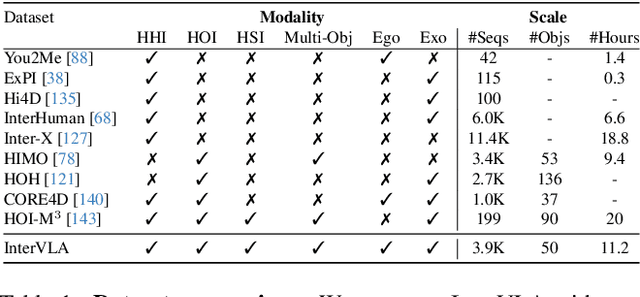
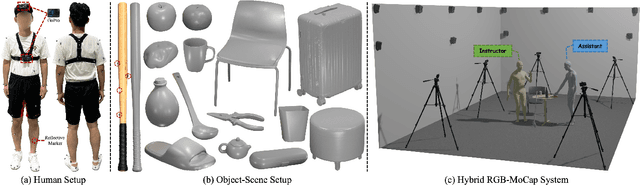
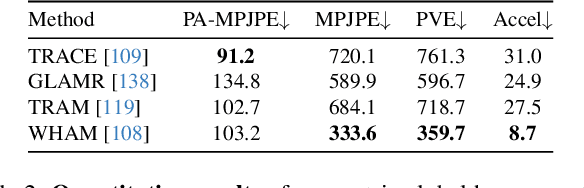
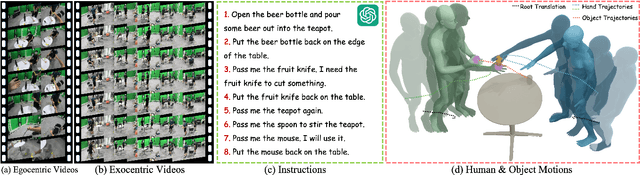
Learning action models from real-world human-centric interaction datasets is important towards building general-purpose intelligent assistants with efficiency. However, most existing datasets only offer specialist interaction category and ignore that AI assistants perceive and act based on first-person acquisition. We urge that both the generalist interaction knowledge and egocentric modality are indispensable. In this paper, we embed the manual-assisted task into a vision-language-action framework, where the assistant provides services to the instructor following egocentric vision and commands. With our hybrid RGB-MoCap system, pairs of assistants and instructors engage with multiple objects and the scene following GPT-generated scripts. Under this setting, we accomplish InterVLA, the first large-scale human-object-human interaction dataset with 11.4 hours and 1.2M frames of multimodal data, spanning 2 egocentric and 5 exocentric videos, accurate human/object motions and verbal commands. Furthermore, we establish novel benchmarks on egocentric human motion estimation, interaction synthesis, and interaction prediction with comprehensive analysis. We believe that our InterVLA testbed and the benchmarks will foster future works on building AI agents in the physical world.