 Add to Chrome
 Add to Firefox
 Add to Edge
AHA-WAM:Asynchronous Horizon-Adaptive World-Action Modeling with Observation-Guided Context Routing
Jun 08, 2026
World-action models have emerged as a promising paradigm for robot manipulation, jointly modeling visual scene dynamics and actions to inject physical priors into policy learning. However, existing world-action models couple world prediction and action execution at the same temporal resolution, forcing the world branch to model near-term frame variations that are redundant and weakly informative. We posit that strictly binding world prediction and action execution to the same temporal rhythm may underutilize the potential of the video branch for embodied control. Therefore, we propose AHA-WAM, an Asynchronous Horizon-Adaptive World-Action Model built on a dual Diffusion Transformer (DiT) architecture that reorganizes world-action modeling around this temporal asymmetry. AHA-WAM instantiates the video DiT as a low-frequency world planner that maintains rolling key-value memory over past observations and exposes reusable layerwise latent context encoding long-horizon scene evolution, while a high-frequency action DiT executes short action chunks in closed loop by querying this context through layerwise joint attention. To support asynchronous execution, we introduce horizon-adaptive offset training and Observation-Guided Video-Context Routing (OVCR), which together let the action expert exploit long-horizon world context while remaining responsive to real-time execution state without rerunning the video DiT. Experiments on RoboTwin and real-world manipulation tasks show that AHA-WAM achieves state-of-the-art performance without any robot-data pretraining, attaining 92.80% average success on RoboTwin and 78.3% success across 4 real-world tasks, while reaching 24.17 Hz closed-loop control with a 4.59x speedup over Fast-WAM.

EmotiCrafter: Text-to-Emotional-Image Generation based on Valence-Arousal Model
Jan 10, 2025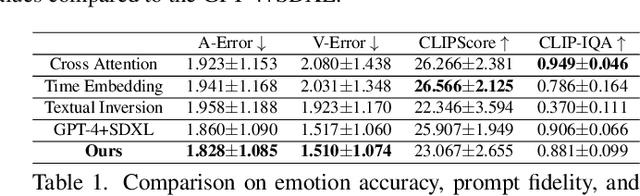
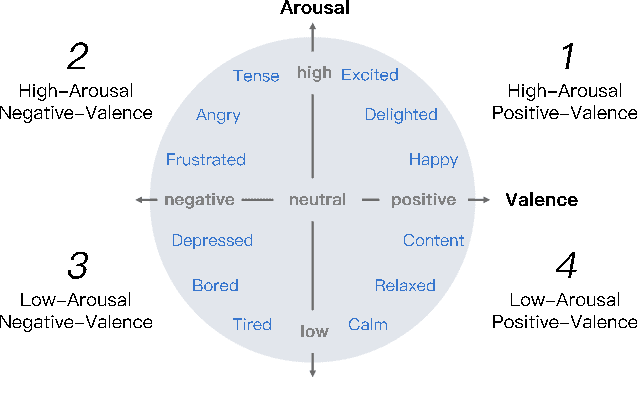
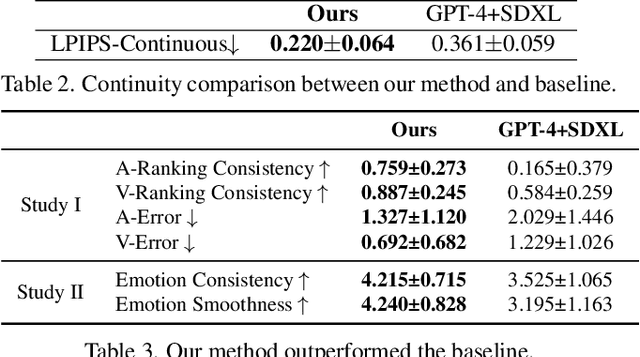
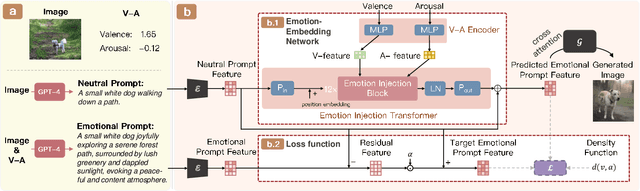
Recent research shows that emotions can enhance users' cognition and influence information communication. While research on visual emotion analysis is extensive, limited work has been done on helping users generate emotionally rich image content. Existing work on emotional image generation relies on discrete emotion categories, making it challenging to capture complex and subtle emotional nuances accurately. Additionally, these methods struggle to control the specific content of generated images based on text prompts. In this work, we introduce the new task of continuous emotional image content generation (C-EICG) and present EmotiCrafter, an emotional image generation model that generates images based on text prompts and Valence-Arousal values. Specifically, we propose a novel emotion-embedding mapping network that embeds Valence-Arousal values into textual features, enabling the capture of specific emotions in alignment with intended input prompts. Additionally, we introduce a loss function to enhance emotion expression. The experimental results show that our method effectively generates images representing specific emotions with the desired content and outperforms existing techniques.