 Add to Chrome
 Add to Firefox
 Add to Edge
Enfold: Folding World Model Imagination into Predictive Representations for Ultra-Efficient Embodied Control
Aug 03, 2026
World generative models are typically used through what they produce: a rendered future, a video-conditioned action, or latent context computed by a costly generative branch. We argue that their more reusable asset is the computation that constructs a future. As a generator transforms a corrupted future into a coherent trajectory, its intermediate states organize appearance, spatial layout, and interaction across levels of abstraction. Can this future-generative computation be internalized in a representation inferred from the present alone? We present Enfold, which transfers this computation into a representation predicted from the current visual context and language instruction. During training, multi-level states exposed as the generator processes the observed future supervise a current-only encoder. The learned representation is fed back to condition future generation and is read by task heads without allowing task gradients to reshape the encoder. At deployment, action prediction no longer executes the generator. Across LIBERO, RoboTwin2.0, and real-robot tasks, Enfold supports strong control while reducing action latency by $3.7\times$ relative to Fast--WAM, Enfold-Flash reaches $10.1\times$. Representation analyses show that it suppresses nuisance variation and preferentially captures changes that emerge over longer horizons. When the current scene is altered by human intervention, both the generated continuation and the executed actions adapt, which is inconsistent with fixed trajectory replay. These results recast a world generator as a source of predictive control representations: its future need not be materialized at every step if its internal structure can be enfolded into the present.

Enfold: Folding World-Generator Computation into Predictive Representations for Efficient Embodied Control
Jul 29, 2026World generative models are typically used through what they produce: a rendered future, a video-conditioned action, or latent context computed by a costly generative branch. We argue that their more reusable asset is the computation that constructs a future. As a generator transforms a corrupted future into a coherent trajectory, its intermediate states organize appearance, spatial layout, and interaction across levels of abstraction. Can this future-generative computation be internalized in a representation inferred from the present alone? We present Enfold, which transfers this computation into a representation predicted from the current visual context and language instruction. During training, multi-level states exposed as the generator processes the observed future supervise a current-only encoder. The learned representation is fed back to condition future generation and is read by task heads without allowing task gradients to reshape the encoder. At deployment, action prediction no longer executes the generator. Across LIBERO, RoboTwin2.0, and real-robot tasks, Enfold supports strong control while reducing action latency by $3.7\times$ relative to Fast--WAM, Enfold-Flash reaches $10.1\times$. Representation analyses show that it suppresses nuisance variation and preferentially captures changes that emerge over longer horizons. When the current scene is altered by human intervention, both the generated continuation and the executed actions adapt, which is inconsistent with fixed trajectory replay. These results recast a world generator as a source of predictive control representations: its future need not be materialized at every step if its internal structure can be enfolded into the present.
Scalable LLM Agent Tool Access in the Cloud
Jul 17, 2026LLM agents increasingly rely on tool calling to act on external systems, and the Model Context Protocol (MCP) has quickly become its de facto interface. Operating MCP at cloud scale, however, becomes difficult. On the tool provider side, legacy services are not directly callable through MCP; the rapid protocol development also creates ongoing compatibility cost. On the agent side, the number of accessible tool is limited by the LLM context window and inference overhead; mounting a large tool set increases token usage and inference latency and can reduce task success rate. Moreover, for stateful MCP backends with multiple replicas, preserving session affinity increases client-side complexity. We present a cloud-scale gateway system for MCP service. It breaks the direct-connect model on the data plane and offloads legacy service integration, consolidating incompatible MCP variants, access control, tool recommendation, and session-aware routing to the gateway. Hybrid retrieval sustains 98% Top-15 recall; it scales agent tool access to 3,000+ with high tool selection accuracy, and reduces tool selection time by $8.9\times$ and token usage by $23.8\times$, with low per-call overhead, stable under scale-out. Finally, we share the lessons learned from deploying the gateway system in production.
COMFYCLAW: Self-Evolving Skill Harnesses for Image Generation Workflows
Jul 02, 2026Agents are increasingly used to construct workflows and assist humans in completing recurring tasks more efficiently. As these workflows become repeated and domain-specific, agent memory and reusable skills become increasingly important: agents should be able to recall workflow patterns, execution constraints, and user preferences from previous runs. We study this problem in workflow-based image generation and introduce COMFYCLAW, an agentic skill evolution harness for controlling ComfyUI workflows. COMFYCLAW formulates workflow construction as typed graph editing, exposes tools organized by construction stage, automatically reverts invalid edits, and uses a region-level vision-language model (VLM) verifier to translate visual failures into actionable repair suggestions. The framework further evolves a progressively disclosed skill library, where trajectories, execution errors, and verifier feedback from previous runs are distilled into reusable Agent Skills. Across four benchmark splits, three agent models, and two image backbones, COMFYCLAW achieves the best average image-generation evaluation score across all six agent configurations, outperforming a verifier-only baseline without skill evolution. Human annotations further show that annotators prefer COMFYCLAW over variants without skill evolution. Our results suggest that skill evolution is an effective mechanism for improving agent reliability and performance in recurring visual workflow construction.
MM-Zero: Self-Evolving Multi-Model Vision Language Models From Zero Data
Mar 10, 2026Self-evolving has emerged as a key paradigm for improving foundational models such as Large Language Models (LLMs) and Vision Language Models (VLMs) with minimal human intervention. While recent approaches have demonstrated that LLM agents can self-evolve from scratch with little to no data, VLMs introduce an additional visual modality that typically requires at least some seed data, such as images, to bootstrap the self-evolution process. In this work, we present Multi-model Multimodal Zero (MM-Zero), the first RL-based framework to achieve zero-data self-evolution for VLM reasoning. Moving beyond prior dual-role (Proposer and Solver) setups, MM-Zero introduces a multi-role self-evolving training framework comprising three specialized roles: a Proposer that generates abstract visual concepts and formulates questions; a Coder that translates these concepts into executable code (e.g., Python, SVG) to render visual images; and a Solver that performs multimodal reasoning over the generated visual content. All three roles are initialized from the same base model and trained using Group Relative Policy Optimization (GRPO), with carefully designed reward mechanisms that integrate execution feedback, visual verification, and difficulty balancing. Our experiments show that MM-Zero improves VLM reasoning performance across a wide range of multimodal benchmarks. MM-Zero establishes a scalable path toward self-evolving multi-model systems for multimodal models, extending the frontier of self-improvement beyond the conventional two-model paradigm.
PathInsight: Instruction Tuning of Multimodal Datasets and Models for Intelligence Assisted Diagnosis in Histopathology
Aug 13, 2024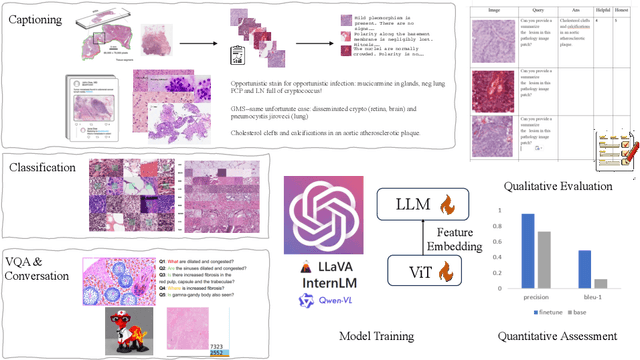
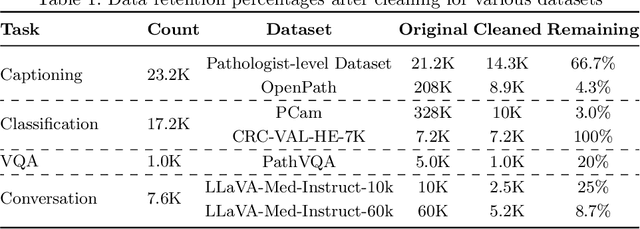

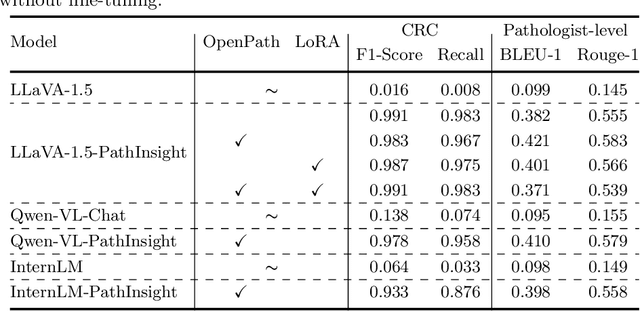
Pathological diagnosis remains the definitive standard for identifying tumors. The rise of multimodal large models has simplified the process of integrating image analysis with textual descriptions. Despite this advancement, the substantial costs associated with training and deploying these complex multimodal models, together with a scarcity of high-quality training datasets, create a significant divide between cutting-edge technology and its application in the clinical setting. We had meticulously compiled a dataset of approximately 45,000 cases, covering over 6 different tasks, including the classification of organ tissues, generating pathology report descriptions, and addressing pathology-related questions and answers. We have fine-tuned multimodal large models, specifically LLaVA, Qwen-VL, InternLM, with this dataset to enhance instruction-based performance. We conducted a qualitative assessment of the capabilities of the base model and the fine-tuned model in performing image captioning and classification tasks on the specific dataset. The evaluation results demonstrate that the fine-tuned model exhibits proficiency in addressing typical pathological questions. We hope that by making both our models and datasets publicly available, they can be valuable to the medical and research communities.
What a Whole Slide Image Can Tell? Subtype-guided Masked Transformer for Pathological Image Captioning
Oct 31, 2023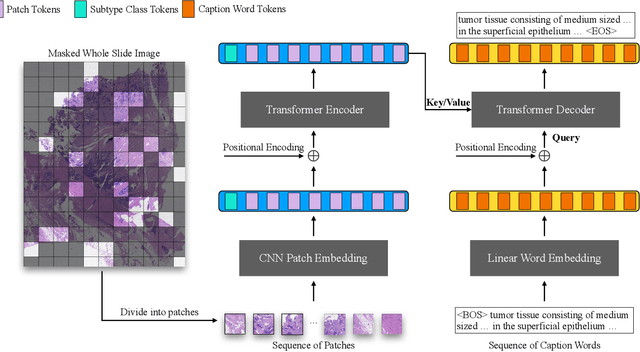
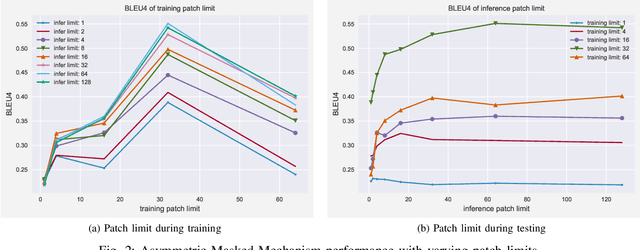
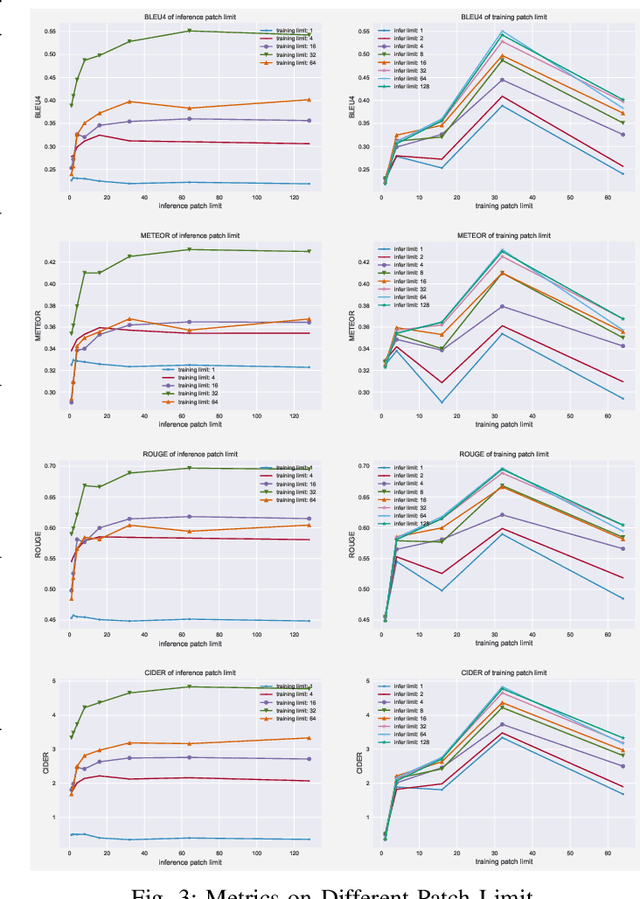

Pathological captioning of Whole Slide Images (WSIs), though is essential in computer-aided pathological diagnosis, has rarely been studied due to the limitations in datasets and model training efficacy. In this paper, we propose a new paradigm Subtype-guided Masked Transformer (SGMT) for pathological captioning based on Transformers, which treats a WSI as a sequence of sparse patches and generates an overall caption sentence from the sequence. An accompanying subtype prediction is introduced into SGMT to guide the training process and enhance the captioning accuracy. We also present an Asymmetric Masked Mechansim approach to tackle the large size constraint of pathological image captioning, where the numbers of sequencing patches in SGMT are sampled differently in the training and inferring phases, respectively. Experiments on the PatchGastricADC22 dataset demonstrate that our approach effectively adapts to the task with a transformer-based model and achieves superior performance than traditional RNN-based methods. Our codes are to be made available for further research and development.
HTEC: Human Transcription Error Correction
Sep 18, 2023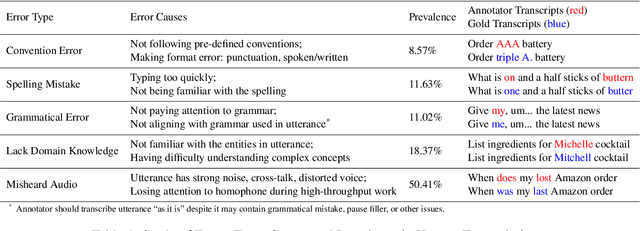
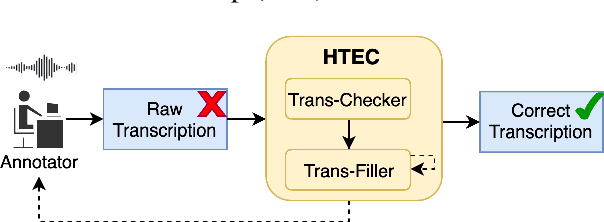


High-quality human transcription is essential for training and improving Automatic Speech Recognition (ASR) models. Recent study~\cite{libricrowd} has found that every 1% worse transcription Word Error Rate (WER) increases approximately 2% ASR WER by using the transcriptions to train ASR models. Transcription errors are inevitable for even highly-trained annotators. However, few studies have explored human transcription correction. Error correction methods for other problems, such as ASR error correction and grammatical error correction, do not perform sufficiently for this problem. Therefore, we propose HTEC for Human Transcription Error Correction. HTEC consists of two stages: Trans-Checker, an error detection model that predicts and masks erroneous words, and Trans-Filler, a sequence-to-sequence generative model that fills masked positions. We propose a holistic list of correction operations, including four novel operations handling deletion errors. We further propose a variant of embeddings that incorporates phoneme information into the input of the transformer. HTEC outperforms other methods by a large margin and surpasses human annotators by 2.2% to 4.5% in WER. Finally, we deployed HTEC to assist human annotators and showed HTEC is particularly effective as a co-pilot, which improves transcription quality by 15.1% without sacrificing transcription velocity.