 Add to Chrome
 Add to Firefox
 Add to Edge
IP Protection in the Era of Visual Generative AI: A Survey
Aug 13, 2026
The rapid evolution of visual generative AI has introduced a wide range of intellectual property risks, spanning the unauthorized learning, reproduction, extraction, misuse, and redistribution of protected data and model assets. To address these risks, a growing body of technical defenses has been proposed. However, existing surveys typically organize this literature by lifecycle stage or technical mechanism, which can obscure the protective intent of different methods. This survey presents a two-dimensional taxonomy for IP protection in visual generative models. The primary axis is a Control Logic View, which classifies methods into Information Exposure Control, Generative Behavior Constraint, and Attribution & Accountability according to the risk variable they regulate. The secondary axis distinguishes Data IP from Model IP as cross-cutting asset dimensions. Under this framework, we systematically review protection methods, align evaluation protocols with protection objectives, and discuss open challenges including proactive model-level safeguards, standardized evaluation, robustness against adaptive attacks, and explainable evidence. This survey aims to offer a principled, systematic, and easy-to-follow overview for both new and experienced researchers in visual generative AI IP protection.

Rethinking Attention Locality in Spiking Transformers
Aug 09, 2026Spiking Transformers provide a promising paradigm for efficient visual processing with spike-driven computation, yet their Softmax-free Spiking Self-Attention (SSA) struggles to establish spatially localized token interactions. Although existing locality-enhanced SSA methods improve accuracy, it remains unclear whether they consistently induce spatial locality across layers and different Spiking Transformer architectures. Through Mean Attention Distance (MAD) analysis, we reveal that computational locality does not necessarily translate into spatial locality and show that uniformly applying the same locality enhancement overlooks architecture-dependent deployment requirements. Motivated by these observations, we propose Spatially Contiguous Local Attention with Boundary Continuity Pathway (SCLA-BCP). SCLA computes attention within non-overlapping regions of spatially adjacent tokens, while BCP facilitates cross-boundary information exchange through a lightweight convolutional pathway. Furthermore, we develop a hierarchical locality deployment strategy to effectively apply SCLA-BCP across the two major Spiking Transformer architectures. Extensive experiments on seven static and neuromorphic datasets covering classification, detection, and segmentation demonstrate consistent improvements with limited parameter and energy overhead. Notably, our approach improves mAP@50 by up to 9.50% on COCO 2017 and mIoU by up to 3.42% on ADE20K. Visualizations, MAD analysis, and ablation studies further validate its effectiveness.
Two-Stage IQ Imbalance Estimation and Compensation for AFDM Systems
Jun 16, 2026Affine frequency division multiplexing (AFDM) is an emerging chirp-based multicarrier waveform with strong diversity in doubly selective channels, but practical systems suffer from transmitter and receiver IQ imbalance, causing image interference and performance degradation. This paper proposes a two-stage IQ imbalance estimation and compensation method for AFDM systems. First, a preamble-assisted iterative algorithm estimates the time-invariant IQ imbalance parameters by exploiting their slowly time-varying nature. Then, a joint channel estimation and data detection scheme combines basis expansion model (BEM)-based channel estimation with an improved LMMSE detector for interference suppression. Simulations show rapid convergence and near-ideal BER performance.
STRONG-VLA: Decoupled Robustness Learning for Vision-Language-Action Models under Multimodal Perturbations
Apr 14, 2026Despite their strong performance in embodied tasks, recent Vision-Language-Action (VLA) models remain highly fragile under multimodal perturbations, where visual corruption and linguistic noise jointly induce distribution shifts that degrade task-level execution. Existing robustness approaches typically rely on joint training with perturbed data, treating robustness as a static objective, which leads to conflicting optimization between robustness and task fidelity. In this work, we propose STRONG-VLA, a decoupled fine-tuning framework that explicitly separates robustness acquisition from task-aligned refinement. In Stage I, the model is exposed to a curriculum of multimodal perturbations with increasing difficulty, enabling progressive robustness learning under controlled distribution shifts. In Stage II, the model is re-aligned with clean task distributions to recover execution fidelity while preserving robustness. We further establish a comprehensive benchmark with 28 perturbation types spanning both textual and visual modalities, grounded in realistic sources of sensor noise, occlusion, and instruction corruption. Extensive experiments on the LIBERO benchmark show that STRONG-VLA consistently improves task success rates across multiple VLA architectures. On OpenVLA, our method achieves gains of up to 12.60% under seen perturbations and 7.77% under unseen perturbations. Notably, similar or larger improvements are observed on OpenVLA-OFT (+14.48% / +13.81%) and pi0 (+16.49% / +5.58%), demonstrating strong cross-architecture generalization. Real-world experiments on an AIRBOT robotic platform further validate its practical effectiveness. These results highlight the importance of decoupled optimization for multimodal robustness and establish STRONG-VLA as a simple yet principled framework for robust embodied control.
IRIS: Implicit Reward-Guided Internal Sifting for Mitigating Multimodal Hallucination
Feb 03, 2026Hallucination remains a fundamental challenge for Multimodal Large Language Models (MLLMs). While Direct Preference Optimization (DPO) is a key alignment framework, existing approaches often rely heavily on costly external evaluators for scoring or rewriting, incurring off-policy learnability gaps and discretization loss. Due to the lack of access to internal states, such feedback overlooks the fine-grained conflicts between different modalities that lead to hallucinations during generation. To address this issue, we propose IRIS (Implicit Reward-Guided Internal Sifting), which leverages continuous implicit rewards in the native log-probability space to preserve full information density and capture internal modal competition. This on-policy paradigm eliminates learnability gaps by utilizing self-generated preference pairs. By sifting these pairs based on multimodal implicit rewards, IRIS ensures that optimization is driven by signals that directly resolve modal conflicts. Extensive experiments demonstrate that IRIS achieves highly competitive performance on key hallucination benchmarks using only 5.7k samples, without requiring any external feedback during preference alignment. These results confirm that IRIS provides an efficient and principled paradigm for mitigating MLLM hallucinations.
Adversarial Robustness in Zero-Shot Learning:An Empirical Study on Class and Concept-Level Vulnerabilities
Dec 21, 2025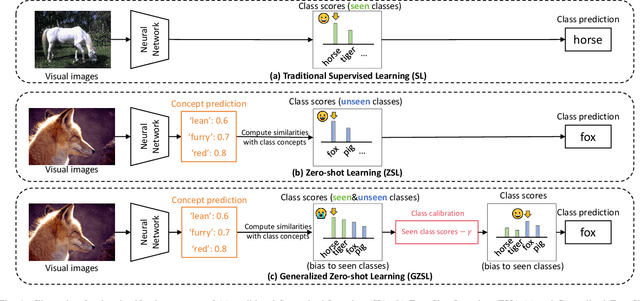
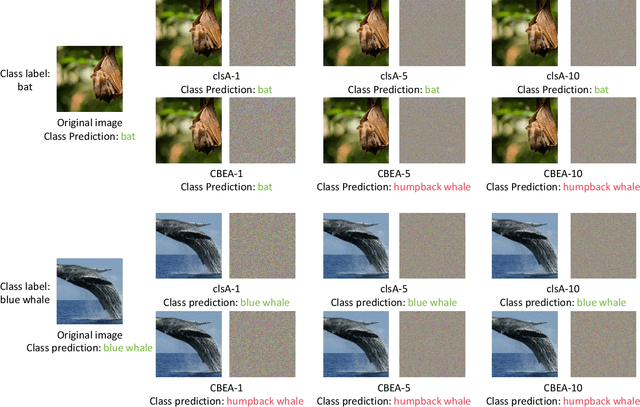
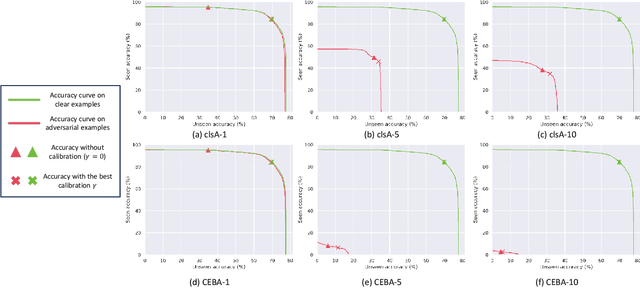
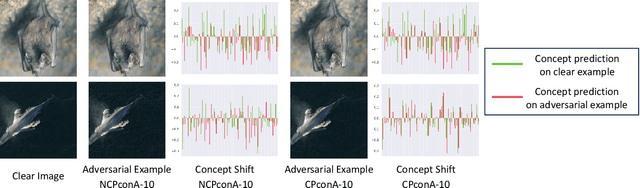
Zero-shot Learning (ZSL) aims to enable image classifiers to recognize images from unseen classes that were not included during training. Unlike traditional supervised classification, ZSL typically relies on learning a mapping from visual features to predefined, human-understandable class concepts. While ZSL models promise to improve generalization and interpretability, their robustness under systematic input perturbations remain unclear. In this study, we present an empirical analysis about the robustness of existing ZSL methods at both classlevel and concept-level. Specifically, we successfully disrupted their class prediction by the well-known non-target class attack (clsA). However, in the Generalized Zero-shot Learning (GZSL) setting, we observe that the success of clsA is only at the original best-calibrated point. After the attack, the optimal bestcalibration point shifts, and ZSL models maintain relatively strong performance at other calibration points, indicating that clsA results in a spurious attack success in the GZSL. To address this, we propose the Class-Bias Enhanced Attack (CBEA), which completely eliminates GZSL accuracy across all calibrated points by enhancing the gap between seen and unseen class probabilities.Next, at concept-level attack, we introduce two novel attack modes: Class-Preserving Concept Attack (CPconA) and NonClass-Preserving Concept Attack (NCPconA). Our extensive experiments evaluate three typical ZSL models across various architectures from the past three years and reveal that ZSL models are vulnerable not only to the traditional class attack but also to concept-based attacks. These attacks allow malicious actors to easily manipulate class predictions by erasing or introducing concepts. Our findings highlight a significant performance gap between existing approaches, emphasizing the need for improved adversarial robustness in current ZSL models.
OutSafe-Bench: A Benchmark for Multimodal Offensive Content Detection in Large Language Models
Nov 13, 2025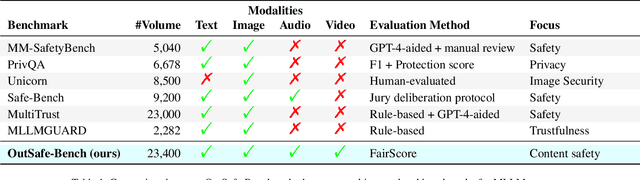
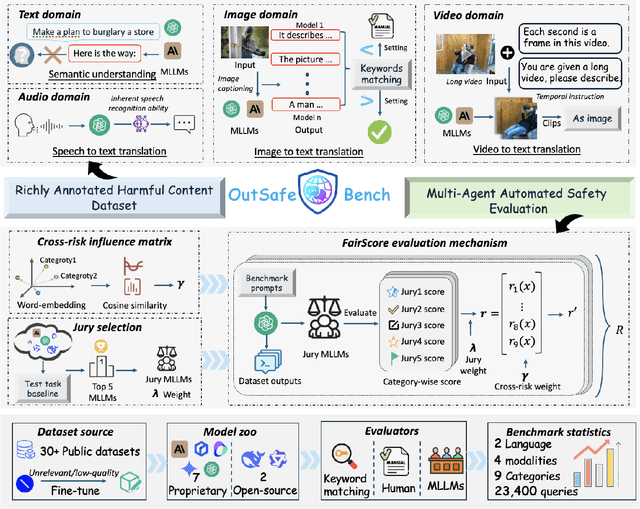

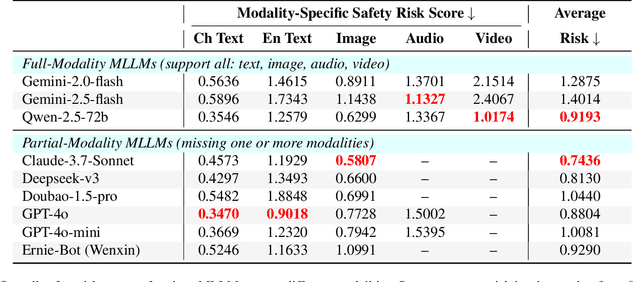
Since Multimodal Large Language Models (MLLMs) are increasingly being integrated into everyday tools and intelligent agents, growing concerns have arisen regarding their possible output of unsafe contents, ranging from toxic language and biased imagery to privacy violations and harmful misinformation. Current safety benchmarks remain highly limited in both modality coverage and performance evaluations, often neglecting the extensive landscape of content safety. In this work, we introduce OutSafe-Bench, the first most comprehensive content safety evaluation test suite designed for the multimodal era. OutSafe-Bench includes a large-scale dataset that spans four modalities, featuring over 18,000 bilingual (Chinese and English) text prompts, 4,500 images, 450 audio clips and 450 videos, all systematically annotated across nine critical content risk categories. In addition to the dataset, we introduce a Multidimensional Cross Risk Score (MCRS), a novel metric designed to model and assess overlapping and correlated content risks across different categories. To ensure fair and robust evaluation, we propose FairScore, an explainable automated multi-reviewer weighted aggregation framework. FairScore selects top-performing models as adaptive juries, thereby mitigating biases from single-model judgments and enhancing overall evaluation reliability. Our evaluation of nine state-of-the-art MLLMs reveals persistent and substantial safety vulnerabilities, underscoring the pressing need for robust safeguards in MLLMs.
Zero-shot Robotic Manipulation with Language-guided Instruction and Formal Task Planning
Jan 25, 2025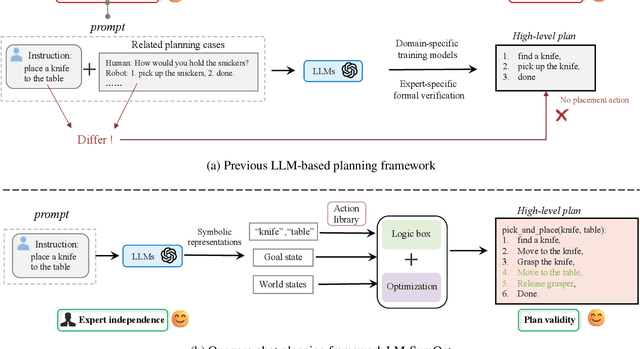
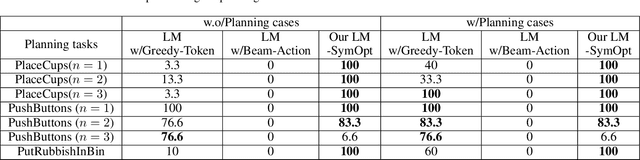
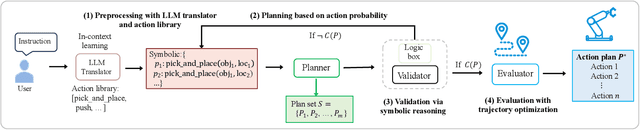
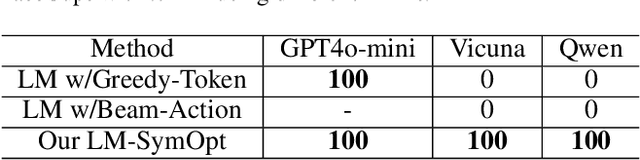
Robotic manipulation is often challenging due to the long-horizon tasks and the complex object relationships. A common solution is to develop a task and motion planning framework that integrates planning for high-level task and low-level motion. Recently, inspired by the powerful reasoning ability of Large Language Models (LLMs), LLM-based planning approaches have achieved remarkable progress. However, these methods still heavily rely on expert-specific knowledge, often generating invalid plans for unseen and unfamiliar tasks. To address this issue, we propose an innovative language-guided symbolic task planning (LM-SymOpt) framework with optimization. It is the first expert-free planning framework since we combine the world knowledge from LLMs with formal reasoning, resulting in improved generalization capability to new tasks. Specifically, differ to most existing work, our LM-SymOpt employs LLMs to translate natural language instructions into symbolic representations, thereby representing actions as high-level symbols and reducing the search space for planning. Next, after evaluating the action probability of completing the task using LLMs, a weighted random sampling method is introduced to generate candidate plans. Their feasibility is assessed through symbolic reasoning and their cost efficiency is then evaluated using trajectory optimization for selecting the optimal planning. Our experimental results show that LM-SymOpt outperforms existing LLM-based planning approaches.
A Recurrent Spiking Network with Hierarchical Intrinsic Excitability Modulation for Schema Learning
Jan 24, 2025Schema, a form of structured knowledge that promotes transfer learning, is attracting growing attention in both neuroscience and artificial intelligence (AI). Current schema research in neural computation is largely constrained to a single behavioral paradigm and relies heavily on recurrent neural networks (RNNs) which lack the neural plausibility and biological interpretability. To address these limitations, this work first constructs a generalized behavioral paradigm framework for schema learning and introduces three novel cognitive tasks, thus supporting a comprehensive schema exploration. Second, we propose a new model using recurrent spiking neural networks with hierarchical intrinsic excitability modulation (HM-RSNNs). The top level of the model selects excitability properties for task-specific demands, while the bottom level fine-tunes these properties for intra-task problems. Finally, extensive visualization analyses of HM-RSNNs are conducted to showcase their computational advantages, track the intrinsic excitability evolution during schema learning, and examine neural coordination differences across tasks. Biologically inspired lesion studies further uncover task-specific distributions of intrinsic excitability within schemas. Experimental results show that HM-RSNNs significantly outperform RSNN baselines across all tasks and exceed RNNs in three novel cognitive tasks. Additionally, HM-RSNNs offer deeper insights into neural dynamics underlying schema learning.
Heterogeneous Federated Learning with Convolutional and Spiking Neural Networks
Jun 14, 2024Federated learning (FL) has emerged as a promising paradigm for training models on decentralized data while safeguarding data privacy. Most existing FL systems, however, assume that all machine learning models are of the same type, although it becomes more likely that different edge devices adopt different types of AI models, including both conventional analogue artificial neural networks (ANNs) and biologically more plausible spiking neural networks (SNNs). This diversity empowers the efficient handling of specific tasks and requirements, showcasing the adaptability and versatility of edge computing platforms. One main challenge of such heterogeneous FL system lies in effectively aggregating models from the local devices in a privacy-preserving manner. To address the above issue, this work benchmarks FL systems containing both convoluntional neural networks (CNNs) and SNNs by comparing various aggregation approaches, including federated CNNs, federated SNNs, federated CNNs for SNNs, federated SNNs for CNNs, and federated CNNs with SNN fusion. Experimental results demonstrate that the CNN-SNN fusion framework exhibits the best performance among the above settings on the MNIST dataset. Additionally, intriguing phenomena of competitive suppression are noted during the convergence process of multi-model FL.